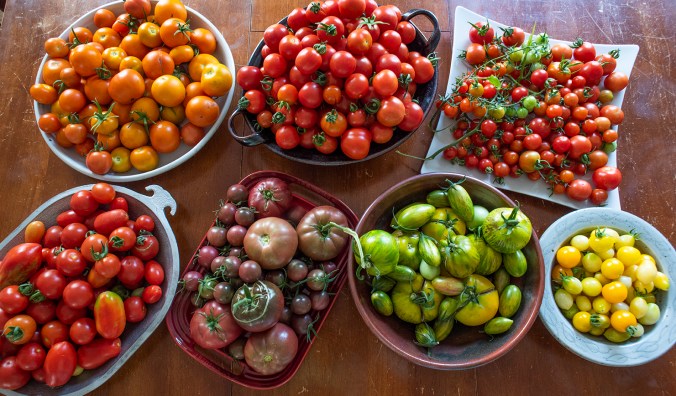
When it comes to home gardens, there is no contest – tomatoes are far and away the most popular vegetable (botanically a fruit) to plant. And it’s no surprise; while we can purchase tomatoes year-round, they’re uniformly cold, flavorless, mealy orbs only vaguely reminiscent of “tomato.” But a homegrown tomato in late summer, sliced thickly and drizzled with good olive oil, flaky salt and cracked pepper? There is simply nothing better, and the grocery store versions do not hold a candle. Home growers and small farmers know this.
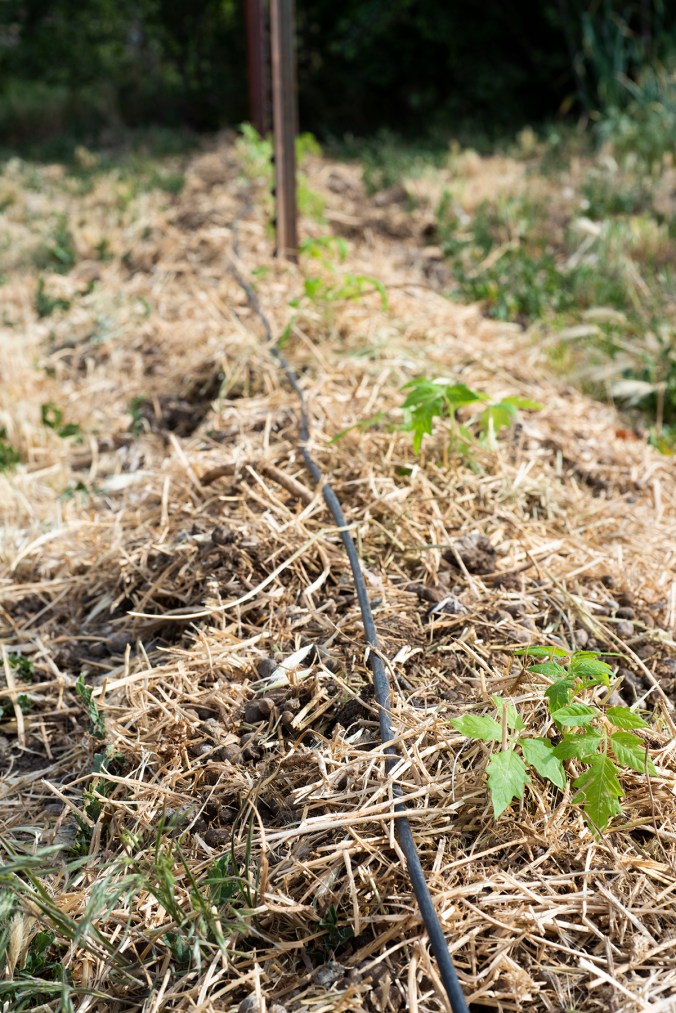
We heavily mulch our tomatoes with spent straw, to preserve what little moisture that might exist.
Depending on where you are in the northern hemisphere, it might well be time to plant your tomatoes! Or maybe you’ve already planted? Planting dates for warm-weather crops vary depending on many factors; our farm is in Zone 5b with estimated last/first frost dates of about May 11 and October 4. It is absolutely essential that you know your growing zone and your estimated first and last frost dates if you want to plant anything! Also know, though, that these are only estimates, that intensifying climate change has made predictions wildly difficult, and that a huge number of factors can affect these dates – particularly if you’re in a built-up urban or suburban area (heat sink) or a more open rural area, where microclimates and windbreaks will be a factor. That May 11 last frost date for our unique microclimate is way too early, in my opinion; we’ve had overnight lows in the mid-30s well into the latter third of May, and tomatoes do not like cold temperatures. This year, however, we went from cool and dry to hot and dry in the blink of an eye, and so our tomatoes (and peppers, and cucumbers) went out on May 26, earlier than ever. Let’s hope I made the right decision! And let’s hope this means an earlier harvest!
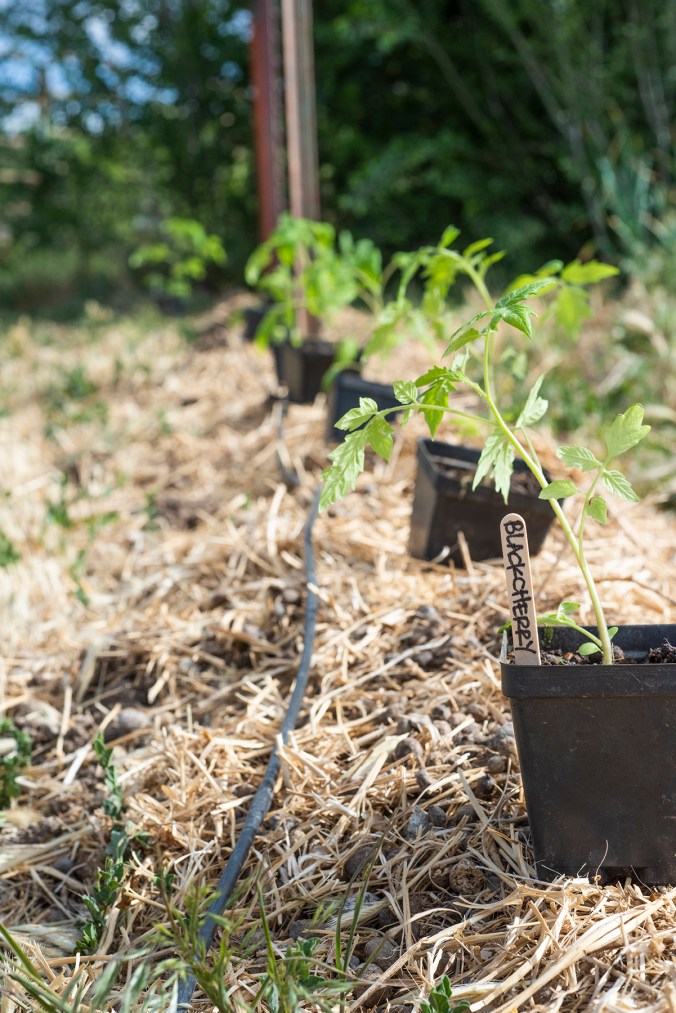
Starts set along the planting line to maintain good spacing.
If you’ve started your own plants indoors from seed, make sure to ‘harden off’ the plants by gradually acclimating them to ever-harsher outdoor sun and wind conditions, over a span of five to seven days, before you abandon their tender stems to the vagaries of the brutal outdoors. If you buy tomato starts at a greenhouse or big-box store, like most gardeners do, the plants should have been hardened off and will be ready to plant.

Bigger plants aren’t better – bury two-thirds of your start in a trench to encourage strong roots.
Plant deep! If your plant is particularly leggy (as happens in warm spring greenhouses), plant it in a trench on its side. You can bury two-thirds of the plant, with only the top one-third showing aboveground; this helps create a strong root system and protects the delicate stem from wind damage (a major issue here). If your plant already has flowers or fruit, gently pinch these off. The tomato needs to devote its immediate energy to establishing its roots and isn’t yet ready to produce fruit. Plants will need to be watered in especially well to avoid transplant shock, particularly if it’s hot, dry and/or windy. Try to transplant in cooler morning or evening temperatures rather than under a blazing afternoon sun if at all possible.
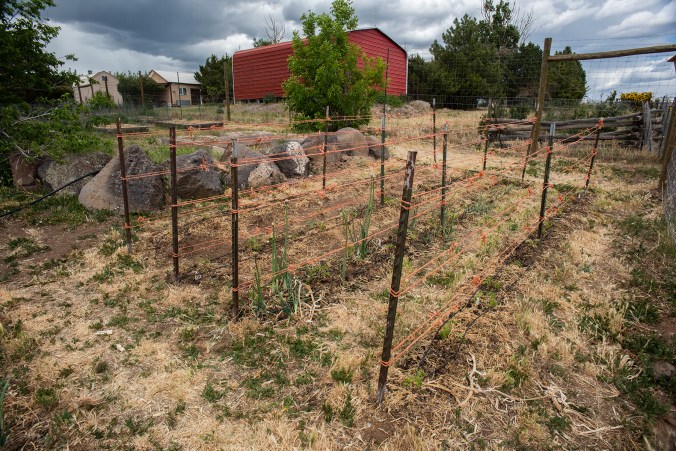
Our tomatoes are supported by strong T-posts and braided baling twine. We rotate our tomato plot every year.
Tomatoes come in two basic types, determinate and indeterminate. A determinate plant tends to be smaller and usually produces all its fruit in a short span, which is helpful for canning and preserving as the harvest arrives in a limited timeframe. An indeterminate tomato can become a massive, snaking vine, producing fruit for weeks or months, depending on conditions. Most heirlooms are naturally indeterminate; paste/canning and smaller-scale container-type tomatoes are usually hybrid and often determinate. There is a lot of variation within these guidelines, however.
Tomato plants really benefit from three things: excellent air circulation (to minimize disease pressure), staking or trellising (especially necessary for larger beefsteaks), and regular pruning (to encourage fruit production). Standard cheap galvanized tomato cages are frequently not strong enough to contain a full-grown heirloom plant; sturdier supports (concrete wire mesh or T-posts) are better than weaker, because if the plant collapses under its own weight, the central stem may snap and the plant is done. Always keep tomato plants off the ground as much as possible; fruit sitting on the ground will rot, attract insects, or present an easy target for squirrels, and the vines will twist and compact themselves into a huge, unharvestable mess. Excess moisture is virtually never an issue in our high-plains desert, but in wetter climates tomatoes, especially larger cultivars, are often subject to cracking if it’s endlessly rainy or they’re watered too often. The plant tag or a quick search will help you learn what conditions your particular tomato plants want – but all tomatoes want lots of sun, at least six to eight hours a day.

If you’re still shopping and you want to grow your plants in pots or containers, make sure you choose appropriate varieties for this. Not all cultivars grow well in pots, and no matter which tomato you choose, you’ll need a really big pot and you’ll likely need to water far more frequently than if the plants are in the ground. Pots dry out surprisingly fast, especially on sunny decks with southern exposure. And if you’re in an even-colder mountain climate than we are, look for some of the short-season cultivars bred to do well in higher-elevation conditions. Most of these come out of Russia and some can produce in as few as 60 days. Not all tomatoes are suited for all environments, and it pays to do a little research to get the best variety for your household (do you use tomatoes more in salads or do you want to can/dry them?) and growing conditions.
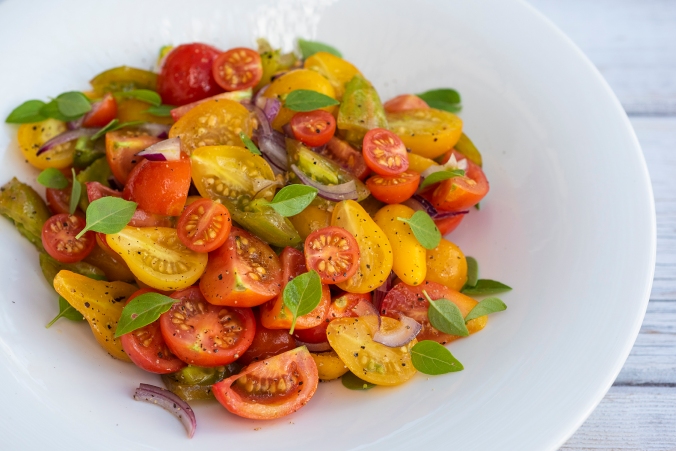
This will be an everyday meal come August and September.
We grow an assortment of tomatoes, including small cherry/grape style, medium ‘salad’ tomatoes and larger slicers (beefsteaks), plus paste for canning and drying. Our tomatoes are mostly heirloom so I can save seeds, but include a couple of hybrids because they perform so well (Super Sweet 100) or have unmatched flavor (Sungold). This year, I’ve planted about 80 plants of thirty-two different tomato cultivars. Some are well-tested classics that I know perform well here, like Cherokee Purple, Oxheart, Black Cherry and Julia Child. Others are new cultivars that I’m keen to trial – this year, I’m testing Black Prince, Yellow Brandywine, Valencia, Prairie Fire and Mountain Girl. After heirloom beans, tomatoes are my absolute favorite crop to grow. They’re challenging, especially in our climate, but well worth the effort – and I can’t wait for the first harvest in (hopefully) late August!
Are you growing tomatoes in your home garden this year? If so, what varieties do you usually choose?
 Finding Quiet Farm
Oh, sadly, the garden is not in production this year; so there are no tomatoes. Otherwise, I prefer the simple and common sort that I find at the hardware store. Weirdly, some of the uncommon sorts have become more common than the common sorts. We sometimes have difficulty finding ‘Roma’.
LikeLike
Tony! You’ve been here long enough that you know full well I’m going to tell you to save seeds and grow your own favorites, so you can always find exactly what you want. 🙂 Warmest wishes to you for an excellent season, even with your garden in fallow. Thanks for being here.
LikeLiked by 1 person
We have our tomatoes in, all 45! From cherry varieties, to beefsteaks, early girls and various yellow, orange and black tomatoes.
Peas are flowering, harvesting lettuces and assorted greens. The peppers have settled in and are taking off. We tried Merlot bells and lilac bells to see how they do! And poblanos too.
The cucumbers are up but are hanging out in the green house for a little longer.
It has been a good spring season for us!
LikeLike
Nancy, love hearing about your garden! Looking forward to your review of any new tomato/pepper varieties you’re trialing this year. Sending you and yours so much love.
LikeLike