Hello friends, and how are things with you? We are quickly entering our busiest season on the farm, jumping between planting, irrigation and weeding, and are working hard on keeping ourselves physically and mentally healthy while still accomplishing our tasks. Here are a few recent images from the farm, if you’d like to see.

Plant ID is not tricky with this one.
The lilacs have nearly finished for the year, but the blooms and their scent were spectacular this season. We have primarily the classic pale purple flowers with a few white ones thrown in for good measure. While we have planted lots of things during our time at Quiet Farm, we cannot take any credit for the lilacs as all were planted before we found this place. They are such a welcome addition to our spring and we love their unmistakable scent as we go about our farm tasks. Do you have a favorite spring flower?
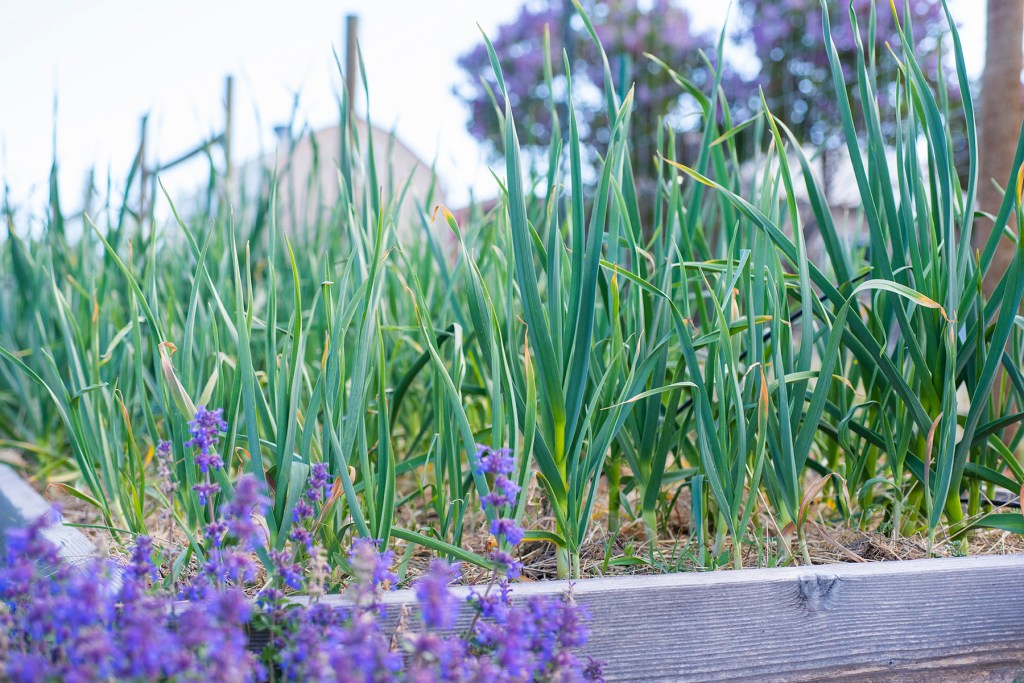
One of our garlic beds with catmint in bloom on the lower left.
In our climate, garlic is typically planted just before first frost (usually mid-October), then harvested the following July. Last fall, I planted three full beds of garlic – one hardneck and two softneck. This is the most I’ve ever planted, but we plan to offer it for sale this summer both for eating and as seedstock. While garlic is technically sold as specific varieties, it quickly adapts itself to its particular microclimate; after five years of growing garlic here, I can confidently say this is “Quiet Farm garlic,” and that it will grow well in our difficult climate. Hardneck garlic produces scapes, which are a tender central stalk that is harvested to focus the plant’s energy on the bulb belowground; we’ll see scapes in a week or ten days and will use them in stir-fries and pesto. (Softneck garlic doesn’t produce scapes.) The fifty pounds of garlic we harvested last summer went into cold storage over the winter and kept us well-supplied; we’re excited to have even more this year. If you’re local and want to grow your own garlic, let us know and we’ll get you set up!
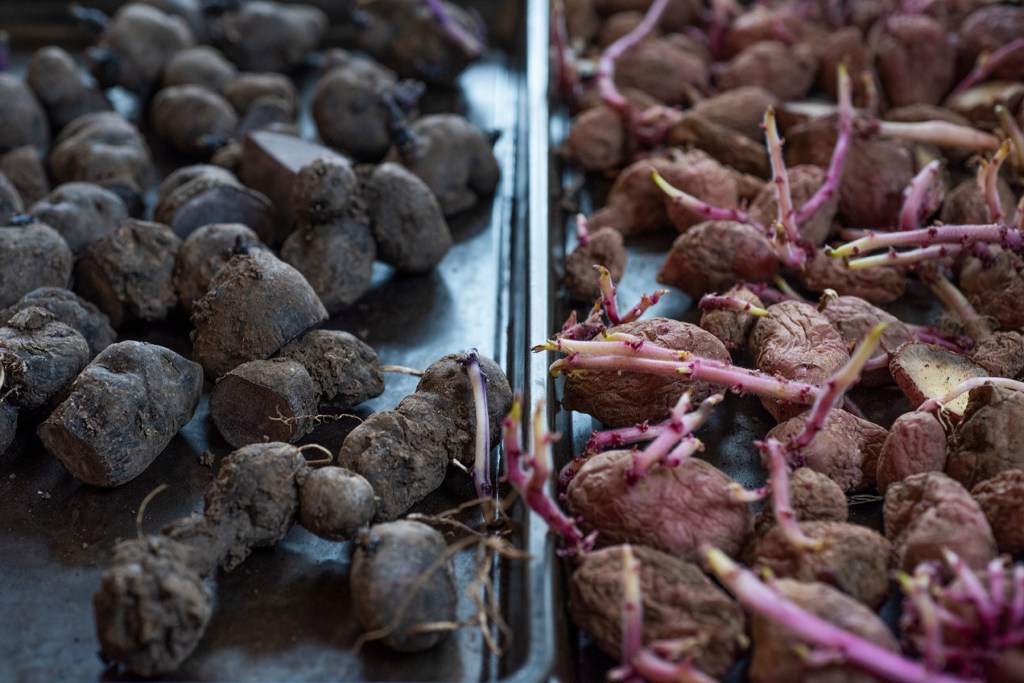
Sprouted seed potatoes ready for planting.
Did you know there are over 4,000 edible potato varieties? Of course, we only see a tiny handful of these in our supermarket. While we love potatoes, our farm isn’t ideal for growing them – they like loose, sandy soil, which we definitely do not have – but we still plant some every year. The rule of thumb in our area has been to plant potatoes when the dandelions bloom, so that’s the guideline we typically follow. This year we planted our saved reds from last year, as well as purple Peruvians from a friend’s farm. Every year I shift locations and planting methods, so we’ll see how our harvest fares this season!
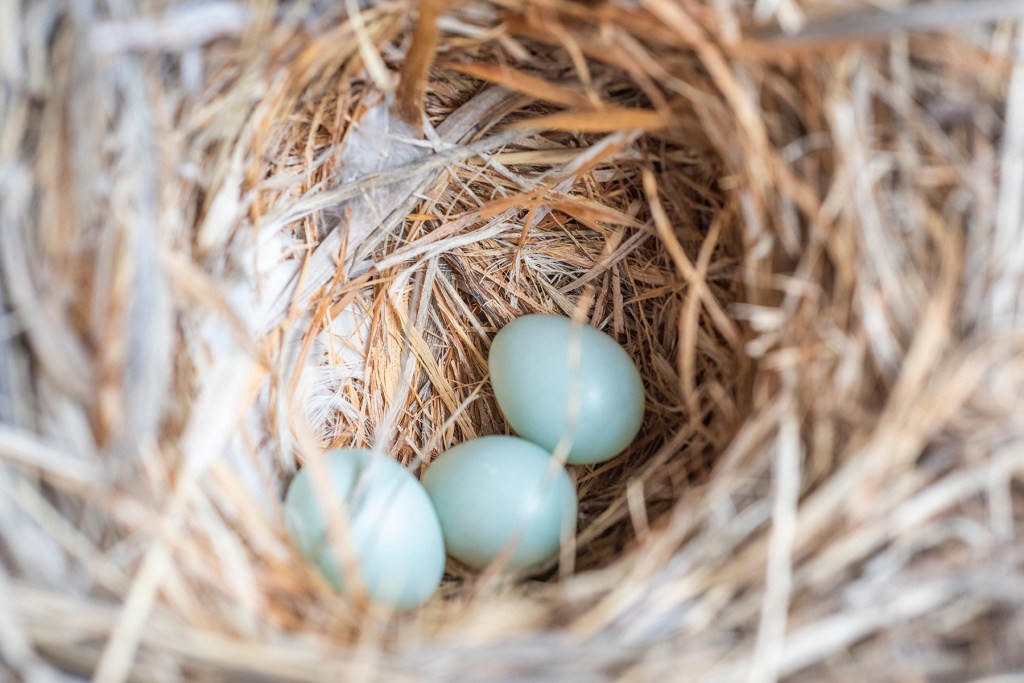
Unviable but gorgeous to see, nevertheless.
When we break down our irrigation in the fall, we store our raised bed tubing in lengths of broken gated pipe in our tractor shed to keep it neat and tangle-free. When N went to get it out a few weeks ago, he realized that mountain bluebirds had made a nest in the pipe. Sadly, the eggs had been abandoned by the adults (likely due to us unintentionally disturbing the area with our activity) but we did carefully extract the nest and the unbroken eggs. We have impressive numbers of migratory and year-round bird populations here, and it’s a wonder to see what they create with a few twigs.

My in-progress quilt on my beloved vintage Singer, a treasured thrift store find.
One of our favorite events of the year is coming up soon – our local arts center’s upcycled art festival, where participants take any piece of “trash” and turn it into “treasure.” This is our arts center’s biggest annual fundraiser and we’ve participated every single year; it’s honestly one of the coolest events in our little community. The artistic creations are incredible! This year I am making a quilt entirely crafted from thrifted clothes and sheets, as well as a refinished dresser and an unusual plant display. N has made rustic Colorado flag wall plaques from reclaimed wood. We are very much looking forward to seeing other contributors’ art this weekend!
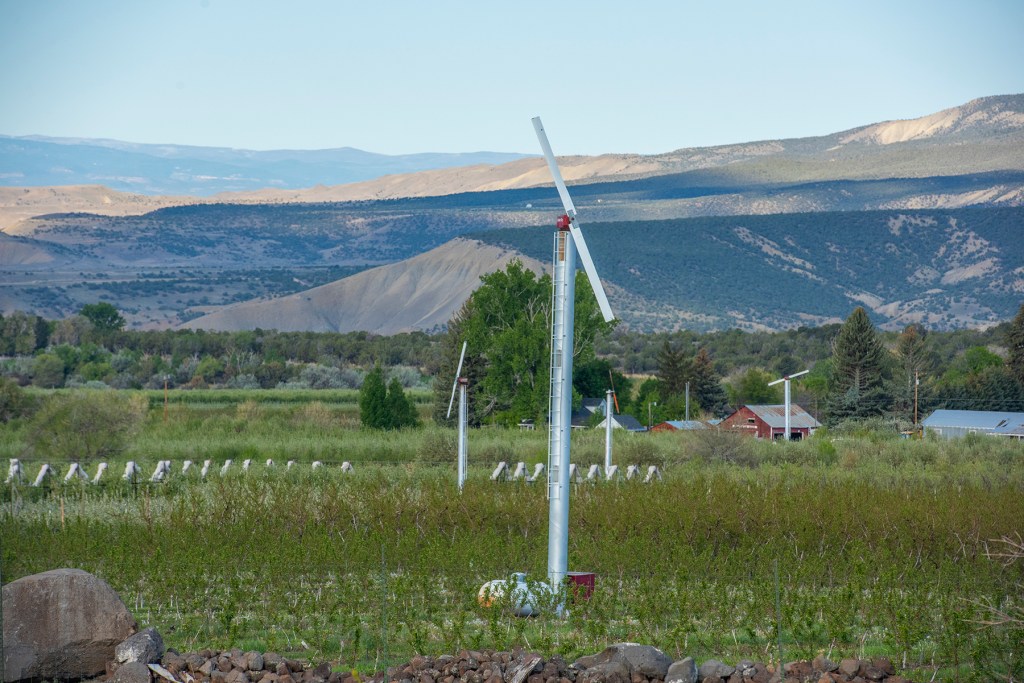
The fans could mean the difference between the success and failure of an entire year.
And finally, as we move into the height of the growing season along with our orchardist and farmer friends and neighbors, we want to take a moment to reflect on what it means to grow food. We’ve had a cool and erratic spring, and some nights ago we were awakened about 2:30AM by the unmistakable sound of the orchard fans switching on, in a desperate attempt to keep cold air from settling over the fruit trees already in full bloom. This is the latest in the year we’ve ever heard the fans, and it is yet another indication that our historical weather patterns can no longer be trusted or relied upon. When we are lying awake, listening to the helicopter whir of the massive fans, our thoughts are with the orchard crews pulling a stressful all-nighter to keep the fans fueled with propane and the burn boxes at the end of each row stocked with last year’s prunings, and the very real knowledge that the entire year’s crop – and possibly the trees themselves – might be lost if the temperatures get too low. In the grocery store or even the farmers’ market we as customers might just see a peach, or a tomato, or an apple, but these crops were labored over and sweated over and agonized over and maybe cried over. Where our food comes from, and how it’s grown, matters. Respecting that hard work matters.
A local farmer colleague shared the same sentiment in her recent newsletter: “At some point, for us, you just cross your fingers and hope for the best. But, this is to say that one, it is nice to feel and sense this solidarity and connection with other growers in our agricultural community – that regardless of size and scope of farm, we all fight the same fight with the elements at times and we all celebrate this SENSE OF PLACE, this land, geography, and environment that shapes our identity and how we do what we do, and, two, it is a reminder of the love, effort, and, ultimately, humility that goes into growing good food for the community. You can taste it in every bite.”
We are proud to be here, and we are proud to farm in this community, and we are proud to be part of a place that takes growing food seriously. And we know just how hard it is to grow good food, and we do not take this for granted.
We’re off to set gated pipe. Wishing you a lovely spring, dear friends.
 Finding Quiet Farm
Enjoyed reading the updates. So where do you put the nest? And the mother bird does not return? Thank you and to all the farmers who grow food. It is easy for us to forget the labor that goes into the food we have so thank you for the reminder.
LikeLike
Often if a nest is abandoned, other birds will either use it for their own or a predator will eat the eggs. In this case, the nest was too well-concealed for either new residents or predators. Now, the nest is carefully contained in a little box in our sunroom. It will become part of our “nature museum”! Thanks for reading!
LikeLike
Just wanted you to know I love to get these emails. Miss seeing you guys around. Alisha
LikeLike
Hi Alisha! Great to hear from you and hope you and your family are happy, healthy and well! Thanks for reading!
LikeLike
Pingback: Farm update: July 8 | Finding Quiet Farm