Adventures in RVing, vol. 2

Oh, hello there! We’re not really lost in the wilds somewhere; we’re just spending the summer traveling back and forth between the Western Slope and the Front Range. This is only a 300-mile commute but it’s so much more adventurous than it sounds!

Monarch Pass 01 sml

If you drive between the Western Slope and the Front Range you must cross the Continental Divide (whether you want to or not). On this trip, we chose Monarch Pass.

Cattle Drive 01 sml

Sometimes you get caught in a cattle drive. Livestock always have right-of-way.

Shady Creek 01 sml

Our house (on the left) is tiny compared to some of the big rigs we’ve seen!

Flair 02 sml

Learning to back N into tight spots is one of my newly acquired skills.

Hot Seat 01 sml

N can drive the RV and take photos. Don’t try this at home, kids.

IMG_20180609_074639898[1]

Apparently I can drive and take photos, too. Isn’t Colorado pretty?

njb_5245.jpg

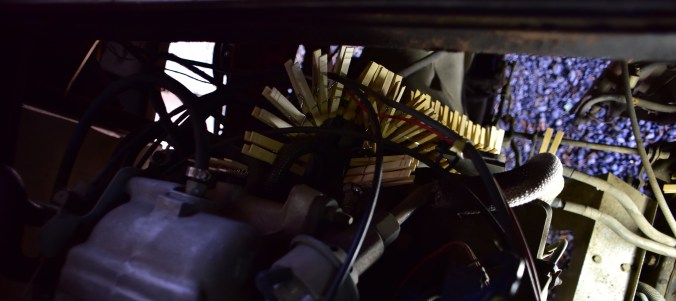
In case you’re wondering, wooden clothespins do not solve vapor lock. We’re hoping a new fuel pump will.


Downsizing

An announcement: we’re on the road again. Four weeks ago, we sold our house. Three weeks ago, we bought a vintage (“vintage” is an official rebranding of just plain “old”) Class A motorhome. Two weeks ago, we moved out of our house into our RV, and now we’re full-timers.

68th-01-sml.jpg

Above: our first home. Below: our second home. 

Flair 03 sml.jpg

Please forward our mail to this address. Thank you.

Selling our first house wasn’t easy, by any stretch. People do this all the time, yet for us it seemed a monumental task. We disliked every part of the process, from working with real estate agents to staging the home (goodbye, cherished family photos!) to disappearing on command during showings and open houses to negotiating complicated repair and inspection requests. Signing the papers at closing was painfully bittersweet. Ultimately, though, both the worst and the best part of the entire tedious process turned out to be the sorting, the culling, and the discarding.

Continue reading

Sowing the seeds

As recently as three or four generations ago, the vast majority of seeds planted in home gardens were saved from year to year. Gardeners learned what plants thrived in their unique microcosm, and they might have saved seeds from the earliest beans, or the largest cucumber, or the most delicious tomato. Season after season, these saved seeds protected plant diversity, acted as a hedge against famine and in many cases were so treasured that they were sewn into hems of immigrants’ clothes when they traveled – voluntarily or not – to new lands.

Seeds 02 sml

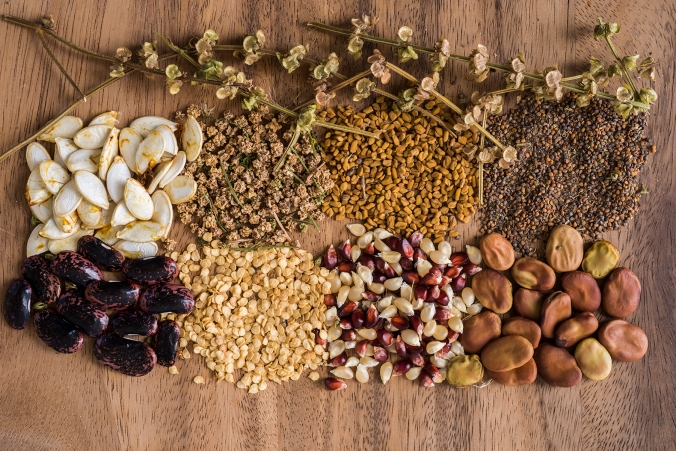
A few samples from the Quiet Farm seed bank.

Now, we think nothing of buying seed packets every growing season. Wintertime brings glossy seed catalogs to the mailbox, filled with mouth-watering descriptions of intensely flavorful tomatoes, trendy kalettes, or spicier peppers. We page through these during the dark, cold days, eagerly anticipating the chance to get our hands in the soil once again, and often we order much more than we need. Most home gardeners have a wealth of seeds left over from previous years, and even this abundance doesn’t stop us from buying just a few more. They’re just tiny packets, we reason. A few more couldn’t hurt.

Continue reading

Scouting trip

For a site called Finding Quiet Farm, we don’t actually write that much about finding Quiet Farm. This isn’t because we’re not looking, but because we haven’t found much worth sharing. Farmland in the U.S. is bulldozed and paved over for housing developments and shopping malls at a staggering rate of forty acres per hour, and the land that is available tends to be just a touch out of our price rangeWe spent a month in Oregon this fall, volunteering on farms and looking for our own place, but ultimately decided that Oregon wasn’t our home. We drove back to Denver through Colorado’s Western Slope, and decided to give that part of the state – previously ignored – a closer look in the new year.

Colorado sign sml

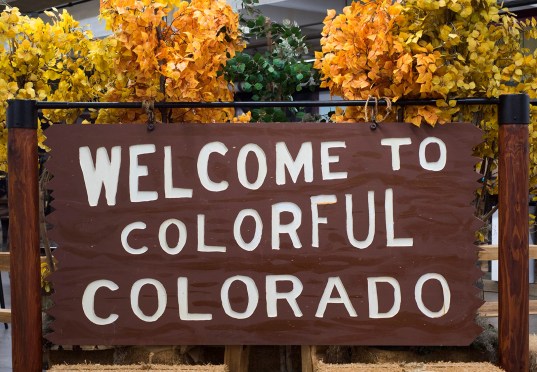
The first week of 2018 saw us westbound from Denver crossing the high mountain passes, which was easy instead of treacherous because winter in Colorado was canceled this year. We visited Grand Junction, Delta, Montrose, Olathe, Hotchkiss and Paonia, areas famous for peaches and sweet corn and cherries and the center of Colorado’s nascent wine industry, too.

Car sml

Our trusty road trip car. (Just kidding.)

Over the course of three long, intense days, we saw maybe a dozen properties. Most, of course, were discarded immediately: rickety house in need of extensive, costly renovation, sketchy neighbors, too much infrastructure devoted to horses, odd adobe construction, property too close to busy roads. But there were two in particular that caught our attention: one forty-acre parcel just outside of Grand Junction, a reasonably major population center, and one in a tiny apple-growing area just up the Grand Mesa, the largest flat-topped mountain in the world.

Orchards

Apple trees with protective winter coverings ready for use…if winter ever appears.

Continue reading

Enough

Back in the Ye Olden Days, N and I worked on boats. One of these boats – the one we met on – was a scuba diving liveaboard that plied the waters between St. Maarten and St. Kitts, in the Netherlands Antilles. Much of our history together, along with thousands of other people, was erased earlier this year with the landfall of Hurricane Irma. The island we knew so well doesn’t exist any longer.

Thanksgiving magazines

Every year, they promise the PERFECT Thanksgiving. And every year, we buy it.

On this particular dive boat, there were as many as eighteen guests and eight crew. I cooked, and N guided dives. And because provisioning in the Caribbean is never easy, the weekly menu was set by the home office, and it was the same, week in and week out. We had Taco Night, and a barbecue, and because most of our guests were American, every Thursday was a full Thanksgiving spread. Because – trust me – there is nothing you want to eat more in the middle of a humid Caribbean July than the heaviest meal known to man. Every. Single. Thursday.

Thanksgiving turkey ad

We’re so rich in this country that we will give you a free turkey!

I’ve cooked well more than fifty full Thanksgiving meals in my time on this planet thus far, and I’d like to state here and now that I am done. Unsurprisingly, N cannot stand the meal either. I’ve talked about this before in my classes – how much I really, really loathe this season – but this year, it’s worse than ever. I simply cannot embrace the excess. The waste. The sheer, utter, obscene overconsumption just for the sake of pointless tradition.

Stone Barns-11.jpg

Over two hundred million pounds of food will be thrown away on or shortly after Thanksgiving. The USDA conservatively estimates that over one-third of all turkeys raised for this one day will be thrown out, uneaten. These animals lived a horrible life and died for nothing. This is the season both for abundance and for waste, when we’re both begged to donate to hundreds of needy charities yet told at every turn that we need to buy more, eat more, consume more. I can no longer support America’s most gluttonous holiday: we’re the only country in the world that celebrates Thanksgiving, and we do so with such little regard for the shocking overconsumption that we promote to the rest of the world. And then there’s the day after Thanksgiving.

NJB_1413

Because nothing says “giving thanks” like buying a bolt-action rifle on Black Friday.

A holiday devoted to proudly eating oneself into a “turkey coma,” followed by camping out so we can buy ever-larger televisions or the latest iPhone? Or a new gun? What is there to celebrate, honestly? While this holiday may have actually originated as a rightful celebration of having enough, now it’s about having more. More of everything. More food, specifically the dishes we just “have to have at the table.” You know, Aunt Mildred’s casserole that everyone secretly hates but it’s tradition. And so it sits there, congealing, and is quietly thrown out at the end of the evening because no one, no one wants to take it home. Or the two meat main courses, because everyone really needs both ham and turkey. And everyone really needs eight different side dishes. And everyone really needs three desserts. And everyone really needs to throw all this excess food away on the Sunday evening after Thanksgiving because, quite frankly, everyone is f*ing tired of looking at it.

Turkey.jpg

How about this year, we declare it enough. We have enough. Enough food. Enough electronics. Enough guns. Enough unused things in our house collecting dust. How about this year we agree to eat less, to buy less, to not feel sick at ten o’clock at night while we’re camping out at Bed Bath & Beyond. How about this year, we don’t worry about what do with all those leftovers because we just cooked enough. How about this year, we just decide that what we have is enough. And how about we leave it at that.

Let’s learn about the farm bill!

Since about – oh, let’s just say November 9, 2016, not to be too precise – many Americans have found themselves much more interested in politics than in times past. And while that’s a good thing, it’s an understatement to say American politics can be rather confusing. As in, we don’t really get what’s going on, but it doesn’t seem to have that much impact on our relatively comfortable day-to-day lives, so we just go along, merrily forwarding cat videos, virtual-signing critical online petitions that have absolutely no real-world impact and binge-watching the new season of Stranger Things.
NJB_0905.JPG

Finding Quiet Farm tries hard to both educate and entertain, so today we’re going to talk about the farm bill. Oh, I can hear you rolling your eyes right now all the way across the Interwebs, but bear with me. The farm bill, which as Michael Pollan says “should actually be called the food bill,” really does affect every single American, every single day. Multiple times a day, to be honest, because each bite of food you eat in this country is directly tied to the farm bill. And if you have kids, and if they eat any food at all in a school environment, then you’re affected even more. Without further ado, then, a brief, (hopefully) simple introduction to the farm bill, and why you should care about it.
NJB_0763.JPG

Let’s start with the basics. What is the farm bill?

The farm bill is a “multibillion dollar tangle of agricultural subsidies, welfare programs and environmental patronage,” or, more simply, it’s legislation that connects the food on our plates, the farmers and ranchers who produce that food, and the natural resources – our soil, air and water – that making growing food possible. It costs just under $500 billion – that’s half a trillion U.S. taxpayer dollars!

It’s a multiyear omnibus (meaning it covers many different programs) law revamped about every five years and the current farm bill will expire in 2018. That means it’s time for our beloved politicians to start crafting a new farm bill.
njb_0202.jpg

What does the farm bill do?

The National Sustainable Agriculture Coalition puts it best:

“In the simplest terms, the farm bill has a tremendous impact on farming livelihoods, how food is grown, and what kinds of foods are grown.  This in turn affects the environment, local economies, and public health.  These are some pretty good reasons to become involved in advocating for a farm bill that supports health and sustainability!

Through programs covering everything from crop insurance for farmers to healthy food access for low-income families, from beginning farmer training to support for sustainable farming practices, this powerful package of laws sets the course of our food and farming system – in good ways and bad. It’s our job to make sure the farm bill reflects what our country’s farmers and eaters need for a sustainable future.

Every five years, the farm bill expires and is updated: proposed, debated, and passed by Congress and then signed into law by the President. (The current farm bill, The Agricultural Act of 2014, was signed into law on February 7, 2014.)

The farm bill got its start in 1933 as part of President Franklin Delano Roosevelt’s New Deal legislation. Its three original goals –  to keep food prices fair for farmers and consumers, ensure an adequate food supply, and protect and sustain the country’s vital natural resources – responded to the economic and environmental crises of the Great Depression and the Dust Bowl. Although the farm bill has changed in the last 70 years, its primary purposes are the same.”

Basically, the farm bill does many things, but its most significant elements are the federal food stamp program (officially called the Supplemental Nutrition Assistance Program), crop insurance and crop subsidies. There are other, smaller aspects, but these are by far the most important (and costly).

Stone Barns 031.jpg

How does this affect me, or more literally, why should I care?

You should care if you either 1. eat food in the U.S. and/or 2. pay taxes, because you’re funding this monster. And if you’re concerned about our rapidly escalating health care costs, or that for the first time in modern industrial history the current generation has a lower life expectancy than their parents, or even if you only care about just your own household food budget, then the farm bill (and food policy in general) should matter to you.
NJB_0269.JPG

What’s wrong with the farm bill?

Where to begin? It was implemented in the 1930s, and modern agriculture is vastly different now than it was during the Great Depression and the ensuing years. After World War II, we got really, really good at growing vast quantities of corn, wheat and soy with the help of leftover nitrogen, which was made into powerful fertilizer. And in the 1970s farmers were encouraged to “get big or get out,” so the small, diversified family farm started to disappear, and farmers were paid to constantly increase their production of cereal grains, again primarily corn and soy – now used as inexpensive animal feed and as the primary ingredients in processed foods and drinks.

Now, fewer than two million Americans live on farms, while crop yields – and pesticide, herbicide and insecticide usage – continues to increase. Huge monoculture farms cover most of the Midwest, reducing natural diversity and vastly increasing the chances of another devastating Dust Bowl. Large monocrop farmers are millionaires many times over, and small farms are going under. We produce far more cheap, high-calorie, nutritionally-devoid food than we need in this country, and the result of that overproduction includes massive dead zones in the Gulf of Mexico, sick animals raised in their own waste, and a population ridden with heart disease, obesity, diabetes and other lifestyle-related ailments. Plus, many low-income Americans cannot afford fresh fruit and vegetables and other whole foods.

Without question, the farm bill needs revision so it can better impact our current crises, including our food-insecure population and the serious health and environmental burdens our country is facing. But Big Ag has a lot of money and a lot of influence, and the 2018 version is unlikely to offer any significant improvements.

Stone Barns 098.jpg
What can I do to help implement changes in future farm bills?

Well, I’d love to end this on a super-positive, grassroots movement note and tell you to write your elected representative! Call your elected representative! Stand outside the office of your elected representative! But let’s be truthful here: all of our elected representatives are on someone’s payroll, and lobbying is a lucrative career. So the best you can do, to be perfectly honest, is vote with your dollars, because that’s the only vote that really matters. And you vote every single time you spend money.

If you value small farms, find your local farms, know your farmer, and buy directly from them. Skip the middleman. Search out local CSAs, and patronize them. If you believe more federal dollars should support organic farms, buy organic. Read labels, and ask questions. If you want to eat animals that have lived a good life and had a humane death, stop buying cheap commodity feedlot meat and battery eggs. Buy from companies who honor the same values you honor. Do some research. Don’t buy heavily processed foods and drinks made from soy and corn derivatives. Grow your own food, if possible. Anything helps, even a few windowboxes of herbs. And above all else, refuse to believe that something is in your best interest just because someone tells you so. Stand up for yourself, your family, your health and your values – because everyone is out to sell you something, and it’s your responsibility to figure out whether you really should buy it.
NJB_0992


32,831 miles later

About eight months ago, we decided to put our regular lives on hold for a brief period and venture out to see the world again. We were heartsick and weary and in desperate need of a break from pretty much everything except each other. So we gave away our chickens, threw a few clothes in a backpack and locked up our house. And thus it happened that on a chilly January day, we left Colorado for Japan.

Garden Snow 01

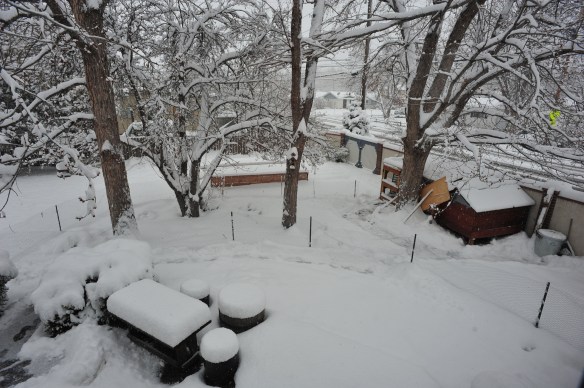
Colorado

Tokyo Fuji sunset 01 sml

Japan

In Japan, we visited monkeys in hot tubs and worked on farms. We ate ramen and tempura and so many other delicious things. We walked Tokyo and Kyoto and fell deeply, completely in love with a country so strange and different and welcoming and lovely that we cannot wait to return.

New Zealand 01 sml

New Zealand

From Japan, we flew to New Zealand. We rented a ragged campervan and drove the length and breadth of the country. We stumbled on an old sheep station and did some stunning walks and learned how macadamia nuts grow. And we discovered that we are perfectly content to live in a campervan…and we plan to do that again soon, too.

Cambodia 01 sml

Cambodia

After New Zealand, we were off to southeast Asia. We started in Cambodia with Angkor Wat and we also saw interesting things being made, like incense and rice noodles and tofu. Oh, and it was hot. (At least we thought so until we got to India, where we learned what heat really is.)

Da Nang 03 sml

Vietnam

We traveled overland to Vietnam, where we jumped on trains, dodged motorbikes, devoured street food and struggled to learn more about a conflicted country with a conflicted history.

Chiang Mai sml

Thailand

Then it was time for a brief rest in Thailand; we went to more markets and bicycled through rice paddies and learned how to make handmade paper. We didn’t ride any elephants but we loved our time on the Banana Pancake Trail.

Flower Market 01 sml

India

No matter what, we weren’t ready for the heat and noise and crush and total sensory assault that is India. We’ve never traveled anywhere that we loved and hated in equal measure – sometimes in the exact same moment – and this complicated country has for certain gotten under our skin. We’ll be back here, too, and much better prepared this time.

Madrid palace 01

Spain

We flew from India to England, with a brief jaunt to gorgeous Madrid. This is one hell of a city…we miss drinking canas and eating jamón y queso at 2AM with hundreds of other people in the city’s beautiful plazas.

Bushby 01 sml

England

We finished with some restorative time in the Midlands’ lush, rolling hills, where the innumerable shades of intense green defy belief. Hours of walking with only cows and sheep for company and then perhaps a brief stop at the local pub for a pint of Tiger. It’s not the worst way to spend a day.

Denver Moon

Colorado

And that brings us to now. We’ve been home for about three weeks and we’re struggling to adjust. This is not the country we left; it has been immensely challenging to reconcile the joy and freedom and lovely people of our travels with the rage and divisiveness and fear currently smothering all of us like a dense fog. But we’re back on our bikes, we’re volunteering on a goat farm and we’ve planted our garden. And this fall, we’ll be out on the road again to search for our farm property in earnest. Thanks for joining us on our travels over these past months and please stay tuned, friends, as our journey has just begun. We’re off to find Quiet Farm.

Opting out

Stone Barns-01.jpg

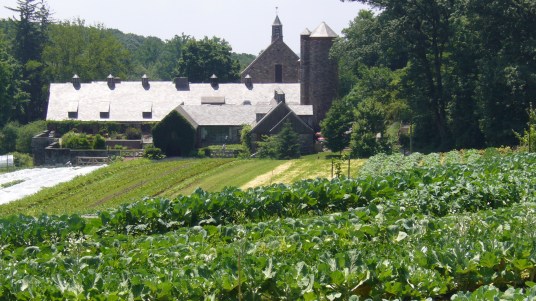
The entrance to Stone Barns, Pocantico Hills, New York.

N and I live in a modest home in a modest suburban neighborhood where most of the houses date from the early to mid-1960s. (Photo above: not our house.) It’s our first house together, the first place we’ve really had space, since we spent the early years of our relationship living on dive boats and private yachts and in cheap short-term yachtie housing all over the world.

I love our house. I am more attached to our house than one should be, but it represents so much of who we are, individually and as a partnership. I love its built-in bookshelves and the odd thrift-store art and the wood stove that N hates that I use so much because he’s convinced I’m going to set the entire house on fire.

Unfortunately, our house that I love so much is surrounded by other houses. And in the other houses live people. People with dogs.

Stone Barns 011.jpg

Every house around us has at least one dog; our neighbor to the east has five (five? really?) Chihuahuas. And these dogs bark. All the time. Day in and day out. And at night, too. The neighbors are at work, or at home with the TV on, or somewhere else, and it doesn’t matter to them that the dogs are barking. They don’t hear it, or they do and they don’t care. Either way, the dogs in our neighborhood have made living here hard, especially because of how much we love our house. Animal Control has no teeth and we’ve had the police called on us for harassing our neighbors when we rang their doorbell at 1AM because their dogs were out and wouldn’t stop barking.

And so we are opting out. We are opting out of a constant aural assault where listening to other people’s pets and music and television in public (and private) places is becoming commonplace. We are opting out of a society that expects us to buy cheaply-made things with built-in obsolescence to be happy. We are opting out of a “consume rather than produce” mentality.  We are opting out of a desperately compromised food and health-care system designed to keep us all just a little bit sick, because there is no money to be made off healthy people and certainly no money to be made off dead people.

Some years ago, while listening to the dogs’ unending cacophony, N said that all he wanted was to live someplace quiet. And so was the name Quiet Farm born, and the title of this blog, too. (N’s suggestion for the blog title was Buckingham Shrugged. Go here if that allusion requires explanation.) We are on a quest to find our own piece of land where we can live peacefully and quietly, raising, growing and processing our own food and hopefully teaching others to do the same.

Stone Barns 067.jpg

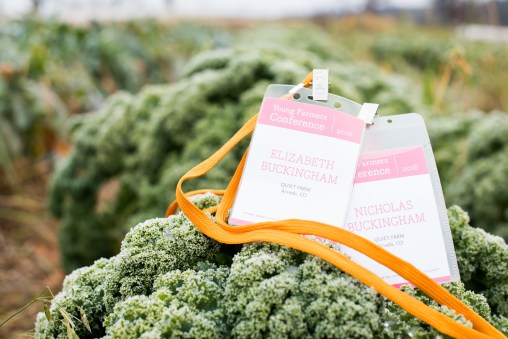
We spent last week here, at the country’s pre-eminent sustainable farming conference. The average age of farmers in the U.S. is nearly 60, and many of those farmers have no succession plan in place. Current estimates suggest that we lose nearly 40 acres of farmland an hour (AN HOUR!), most to urban development and sprawl. This conference, which is only open by lottery and which we’ve waited for three years to attend, is designed for people like us – those who are opting out.

Stone Barns-09.jpg

This event is like a college semester packed into three days. We attended classes on beekeeping and poultry processing and biodynamic farming and liability insurance and finding farmland and animal necropsy. We listened to inspiring talks from Dan Barber and Mark Bittman, and we ate amazing food. Oh, and I got to cook in the kitchen of the best restaurant in the U.S. so that wasn’t a big deal for me at all.

And while we definitely skewed older than the average attendee (damn you, Millennials – you’re drowning in debt so where are you getting the money to farm?) we also reinforced our bone-deep knowledge that this is where we’re supposed to be. This is our tribe, this is our religion. Finding Quiet Farm is the most significant journey we’ve embarked on yet. Thanks for joining us.

Stone Barns-13.jpg


Things to do

So. Here we are, six weeks out from our round-the-world departure, and I’m starting to feel more than a little overwhelmed about the list of things to do. We’ve both traveled pretty extensively but it seems to me that traveling in my twenties was substantially easier than this time round. Is it because I have a house? A partner? Plants and a freezer and chickens and bees and a garden? Yes, yes, and yes to all that. Plus a business that requires a great deal of my focus and energy, even while I prepare to let it go dormant for a time. And I’m older, and wearier, for certain. And yet…every time I find myself in a state of absolute panic, I start thinking about that open road ahead of us in January. I think about getting on the plane in Denver – carrying, of course, a copy of the Sunday New York Times because I’m only allowed that special luxurious pleasure when I travel – and I think about all of the adventures we’re about to have that I don’t even know about yet. And that makes my list of immunizations, shopping, visas, storage, bank accounts, arranging and rearranging worth it. It will absolutely be worth it.

PTP#1

It all starts here

IMG_20170218_192138881_HDR.jpg

On January 8, 2017, we depart Denver for a five-month round-the-world sabbatical. By then we will have quit our jobs, put our businesses on pause, given away our chickens, mulched the gardens and closed down our house. We start in Japan, move south to New Zealand, come back up to southeast Asia, head to India for a five-week train trip, then finish with a month in England. The decision to take this trip was somewhat impulsive. There is so much to be done, and we’re in the thick of it right now.