Flatten the curve

Waffles Pommegranate 01 sml

I read a story this past week – possibly apocryphal, but right now, who cares? – about shoppers in a Trader Joe’s who got into a fistfight over the last package of frozen waffles. My first thought: isn’t an indefinite home quarantine a great time to learn how to make your own waffles? My second thought: Americans display Black Friday tendencies even in the face of an unprecedented global crisis.

Our county is sparsely populated, especially compared to much of the rest of the state, but we have an extraordinarily high percentage of elderly residents. We’re following the “flatten the curve” guidance and will be on self-isolation for at least the next two weeks. I’ll be entirely honest: this doesn’t really change our normal lives at all; we’ve regularly gone two or more weeks without leaving the farm and without encountering other people. So it’s business as usual for us here, with the added incentive to get lots of seeds started and spring planting done; thankfully, the weather ahead looks perfect for outdoor work.

Some ideas if you, too, are staying home to protect your community: plan your garden! Make soup! Start seeds! Bake bread! Cook a pot of beans! Go on a long walk! Grow some microgreens! Make yogurt! Dust off your sewing machine or your knitting needles and do something creative and relaxing! (I’m super-excited to see that “visible mending” is now a legitimate trend – and I have a big pile of socks to repair!) Start a compost pile! Read some great books! Make waffles so other people can fight over the frozen packets! Make the most of this difficult situation and learn something new. Enjoy unexpected time with loved ones and limit your news access, too. (Again, easier said than done.)

Be calm, be kind and be gentle – with yourself, and with others. I hope we get through this and come out better and stronger on the other side. Andrà tutto bene, friends.


Farm update: March 9

How are you doing? It’s probably been a whipsaw week where you live, too. Here we are trying our best to stay busy and avoid the headlines (easier said than done). A few things we’ve been up to, if you’d like to see:

Bees Coffee Filter 01 sml

The bees love coffee as much as we do!

One sure sign of warming weather (which is coming far too early, in our opinion) is enhanced bee activity. On warm, sunny days we’re seeing lots of bees buzzing in the compost pile (they particularly love our spent coffee filters) and also near one of our big trees that’s in early bud. The apple trees in the surrounding orchards haven’t bloomed yet, but it’s always nice to know that our resident bee population survived another winter.

Continue reading

Starting seeds

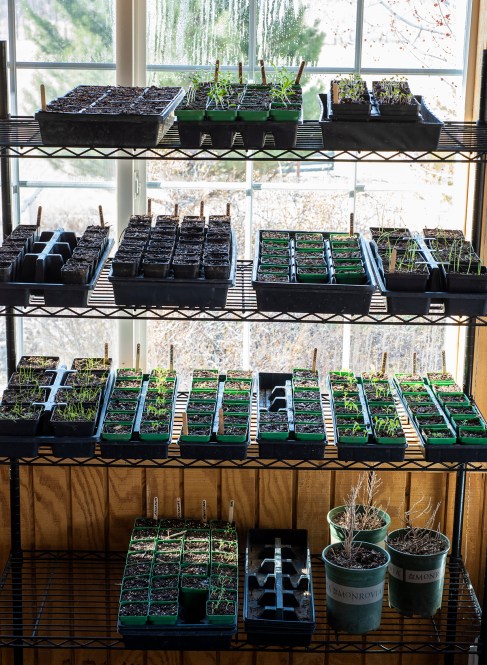
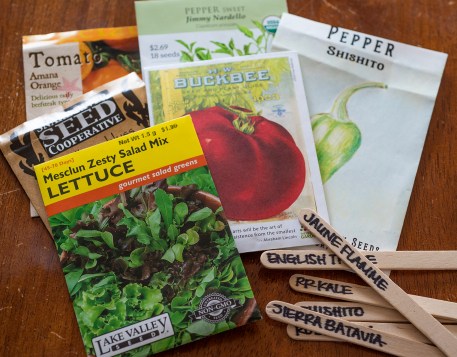
Welcome to March! Our spring is shaping up to be a bit too premature and a bit too warm and a bit too dry for our liking; we’d like to see quite a lot more moisture. This time last year, we still had at least four inches of snowpack on the ground; this year, zilch. Also last year, we were adorable, eager, optimistic, first-year farmers, and we started our seeds way too early. This year, we’re hardened, grizzled veterans, so we know better. And next year? Watch out.

Compost 08 sml

If you’re going to grow anything outside, the single most important piece of information you need is your average first and last frost date. This statistic is pretty much exactly what it sounds like; weather stations all over the country send data to the USDA, which in turn calculates average first and last frost dates. These dates are essential because most (but not all) annual food crops will not tolerate freezing temperatures.

Here at Quiet Farm, our average last frost is May 13, and our average first frost is October 4 for a 143-day growing season; this means we’re almost assured not to have frost between these dates. Keep in mind, however, that this is an average, not a guarantee – you’re safer assuming that frost is possible one to two weeks on either side of these dates. (The location of weather stations varies widely and can sometimes be inaccurate, so check where your closest weather station is located to ensure you’re getting the best information. Plus, the climate emergency is totally destroying the consistency and reliability of these dates. It’s all pretty much guesswork from here on out.)

Continue reading

Farm update: February 24

Greetings! We are currently stuck in that awkward phase between winter and spring. Some days it’s all teasing warmth and perfect blue skies, and some days it’s bleak and grey with icy, biting winds. Most of our snow is gone, though we expect (and hope for) one or two more storms, at least. It’s a changeable season, but spring is definitely in the air and we’re starting to hear more songbirds and see new growth everywhere we look. Here are a few things we’ve been up to recently.

Prairie Falcon 01 sml

A prairie falcon (Falco mexicanus) in one of our towering cottonwoods.

We still haven’t captured a photo of our shy Northern harrier, seen regularly hunting mice in our pasture on sunny afternoons, but N did snap this lovely photo of a prairie falcon. The prairie falcon is about the size of a peregrine falcon, but with a much different hunting style (low swooping over the ground, rather than rapid dives). Unfortunately for the songbirds we’ve been hearing, much of the prairie falcon’s winter diet is the Western meadowlark, but we hope this one will focus more on our ground squirrel population. As with all falcons, the female is substantially larger than the male. Continue reading

The best books about food

Apparently this country is electing a president this year and probably electing some other people too, though over here at Quiet Farm we’re doing our damnedest to ignore the entire circus. One thing that still surprises (and infuriates!) me immensely in every single election cycle is that we never, ever discuss national food policy. Neither side even mentions it in passing, unless a hotdish fundraiser happens. We talk about defense, and education, and occasionally the climate crisis, and of course health care, and yet we never discuss the single issue that unites every one of us, regardless of party affiliation. We never talk about the fact that if we changed our food system, we’d naturally change our health care system for the better. And that changing our food system would be a huge step towards repairing our devastated planet. Changing our food system would also mean more military readiness, since we’re now too fat to fight. And our children would gain a better education if they had access to better nutrition for growing brains and bodies. We always ignore the food, when it’s the one issue we should talk about more than any other.

Continue reading

Winter on the farm

In nautical terminology, “the doldrums” refer to an actual place – waters near the Equator where sailing ships were often stuck for days or weeks in windless seas. In common parlance, however, the doldrums mean “a state or period of stagnation, inactivity or depression.” And so here we are in deepest winter.

Raised Beds 02 sml

Our dormant raised beds, slumbering under snow.

Continue reading

How to make hummus

Hummus 07 sml

It’s no secret that we here at Quiet Farm are big fans of the humble bean. We’ve discussed this before, of course; beans are high in protein and fiber, both of which help keep you full longer and keep your digestive tract functioning properly. If you’re looking to eat less meat, beans make a terrific whole-food alternative (unlike many of the processed soy patties now masquerading as meat). They’re cheap, easily available, store forever in the pantry, simple to cook and often local; it’s no wonder I make a pot of beans every three or four days.

Today, though, let’s talk hummus. There are a few foods that I firmly believe will always be better when you make them yourself – for me, that’s granola, yogurt and hummus. Of course you can easily buy all of these things at the grocery store, but hummus is surprisingly expensive for what it contains, and it will take you all of ten minutes to make a batch. You might find yourself making a batch once a week. And it’s so simple that hopefully you’ll read this entire post before realizing that I managed to avoid giving you a recipe…because hummus is more of a concept than a true recipe.

Continue reading

Floor plan

Who remembers way, way back in April when we purchased beetle-kill planks for the master bedroom and closet? Not us. And who remembers back when building and installing custom bookshelves was the trickiest project we had taken on? Apparently we forgot about that, too. Let us say frankly that laying this pine flooring is by far the most infuriating, the most frustrating, the most demoralizing task we’ve ever tackled here at Quiet Farm. Oh, I know I say this about every project but I am not joking here.

Master Floor 05 sml

The planks are “curing.” (They’ve been abandoned in favor of other projects.)

The best thing about this flooring project is 1. it’s finished (mostly) and 2. we learned so, so much about flooring and our own tolerance for suffering. It’s such an honorable, martyr-ish, humble-brag thing to talk about how you renovated your entire antique farmhouse yourself, but this project was truly the closest we’ve come to calling in a professional to bail us out of the mess we’d created. But since you’re already here, friends – who doesn’t like to read about other people’s DIY trauma? – let’s share what we’ve learned.

Continue reading

Best diet hack ever!

Fruit Platter 01 sml

It’s January, and in America at least, that means New Year’s resolutions. Gyms are packed. Whole Foods is packed. Juice bars are packed. “Revolutionary” diet books and “foolproof” programs and “guaranteed” supplements and exorbitantly expensive electronic bikes are winging their way to doorsteps across the country even as we speak. And for what, dear friends? Although “get healthy” and “lose weight” are by far the most common resolutions, numerous studies have shown that over 80% of all resolutions are abandoned somewhere in February, if not sooner. The problem isn’t the resolution itself – it’s the way most of us go about it.

Squash Soup 01 sml

In this country, we are nothing if not dietary extremists. We go vegan or Paleo or gluten-free on impulse, or because we think everyone else is doing it. We blindly subscribe to the latest social media-fueled/celebrity-endorsed “health” trend. (Looking at you, celery juice.) We ignore moderation as a lifestyle entirely, and instead fixate on the newest, shiniest trick that promises to make us better, healthier and twenty pounds lighter. But why haven’t the fifty previous sparkly tricks worked? Because all of those glittering promises are built on quick fixes and short-term solutions, not on building a lifetime of habits. Let’s be honest – anyone can stick to pretty much anything for a week or two, maybe even a month or six weeks. Eat more salads? No problem. Cut back on alcohol? Easy. Go full-on keto? Tougher, but still manageable.

Continue reading

Farm update: January 6

Hello there, and a very happy new year to you and yours. If you’re here for the first time, welcome! If you’re returning after our hiatus, thanks for coming back! We look forward to sharing a new year of food and farm adventures with you.

ATV Plow 01 sml

Our updated Snow Management Plan in action!

Last winter – our first winter at Quiet Farm – our area received an unprecedented amount of snow. Our inaugural Snow Management Plan was…ineffective, shall we say; we had no tractor and no plow and no way of getting out of our quarter-mile driveway with a foot of snow on the ground. At one point, we resorted to begging a friend with a truck to flatten the snow by driving up and down our lane so we could at least leave the farm (thanks, Joe!). Needless to say, that was not a sustainable long-term solution.

This winter we haven’t had nearly as much snow, but we do have a plan – a detachable plow for our ATV. And so far, the ATV plow has worked like a champion. We’re even thinking of purchasing other implements for the ATV, so that we can use it like a mini-tractor, since we’ve been unsuccessful in finding a reasonably-priced midsize tractor to manage our pasture. Stay tuned.

Continue reading