The zucchini chronicles

Zucchinis 01 sml

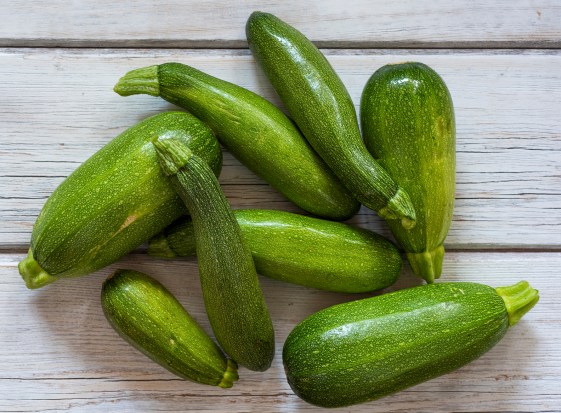
This is only one day’s harvest!

(…or the courgette chronicles, for our English audience.) By now we’re likely all familiar with the time-honored adage about how rural residents only lock their cars in July and August, because that’s when a fiendish neighbor is most likely to deposit a bag of overgrown and unwanted zucchini on the passenger seat. It’s an apt joke, however; anyone who has grown summer squash knows that it absolutely has a mind of its own. One day, there are tiny flowers on the plant; not even twenty-four hours later, it seems, zucchini the size of baseball bats have taken over the garden. If not carefully monitored, these plants can become unmanageable very quickly.

Squash 01 sml

Please, someone, tell me what’s wrong with this zucchini plant?

I always think of zucchini (like my beloved kale) as a self-esteem boost for the gardener. It grows well in just about any conditions, needs little care and produces voluminously and reliably. Interestingly, this is the first season I’ve struggled with zucchini – of seven plants, four look like the photo above: small and stunted with initially green leaves that turn crisp and brown without growing larger. The plant keeps putting on new leaves, which promptly die; no blossoms or fruit appear. All of the seven plants are from the same seed and in the same bed and none are planted where squash grew last year; I’ve never seen anything like this. Are they diseased? Attacked by a mysterious pest? Why are three plants growing perfectly? If any experienced gardeners want to weigh in on this unexpected quandary, I’d love to hear your thoughts.

Continue reading

Farm update: July 20

“Still, I cook. We need to cook, after all, to nourish ourselves and those around us. We need to cook to feel better, to make others feel better, to get along. I may begin the process in weariness, but as often as not I end it in surprise and triumph, happy at least to have made something delicious, to have shared it with those with whom I shelter.”

-Sam Sifton, The New York Times

Quiche 01 sml

No longer trendy but still delicious.

One of the cruel ironies of being a farmer is that when the vegetables really start rolling in, it’s way too hot to cook. Plus, after twelve hours working in the blazing sun all we want is chilled watermelon and ice-cold beer – not exactly a balanced diet. Enter the quiche! Long a mainstay of stuffy, boring women’s luncheons, quiche is hopelessly out of fashion but so well-suited for hot summer months, especially when fresh eggs, vegetables and herbs are in abundance. I always bake first thing in the morning (the house doesn’t need any help heating up later in the day), and quiche is perfect warm, cold or at room temperature. It has a reputation for being terribly unhealthy, but loaded with broccoli, spinach, peppers and herbs, with just a little egg and sharp, savory cheese to bind it all together, it’s an ideal summer staple. Let’s bring quiche back!

Continue reading

Farm update: May 11

It’s hot, dry and windy out here, and feels more like late July than early May. We seem to have skipped straight from a parched winter into an equally arid summer, missing the soft green lushness of spring entirely; the peas and radishes survived frost damage only to turn bitter and pithy from sun scald. Last year we had rain almost every single day in May, and this year it’s unlikely we’ll see any. Early reports indicate that the mountain snowpack is melting far too quickly, thanks to this premature summer, and our primary focus these days is on keeping all of our plants irrigated. Here are a few more things we’ve been up to recently.

Irrigation 02 sml

Our gated irrigation pipe at work. 

All of our irrigation water comes from snow on the Grand Mesa. When the snow thaws each spring, the snowmelt makes its way down the mountain through an intricate series of ditches, headgates, creeks and pipes. We’re focused this year on regenerating our pasture, so have started flood-irrigating our land to see what grows. Later this season we’ll remark our pasture (cut channels that direct the water) and hopefully seed it with perennial grasses, too. Eventually we’ll use the land for rotational grazing, likely a grass-fed steer or two. Flood irrigation requires a lot of work – the water has to be “moved” by opening and closing valves and gates along the pipes – but it’s the system we have, so we’re learning how to use it to the land’s advantage.

Continue reading

The sourdough bandwagon

Here’s what N and I have learned in the five-odd weeks since this madness really kicked off: the things we’ve been doing for years – growing food, baking bread, keeping chickens, buying only secondhand, cutting our own hair – are exactly what all of America seems to want to do right now. Listen up, everyone: we’re cool and we’re on-trend and we are probably influencers too. We’re going to call ourselves influencers, anyway. We’d like to influence you to bake sourdough, mostly because no one can find any yeast yet people still really, really like fresh bread.

Sourdough 05 sml

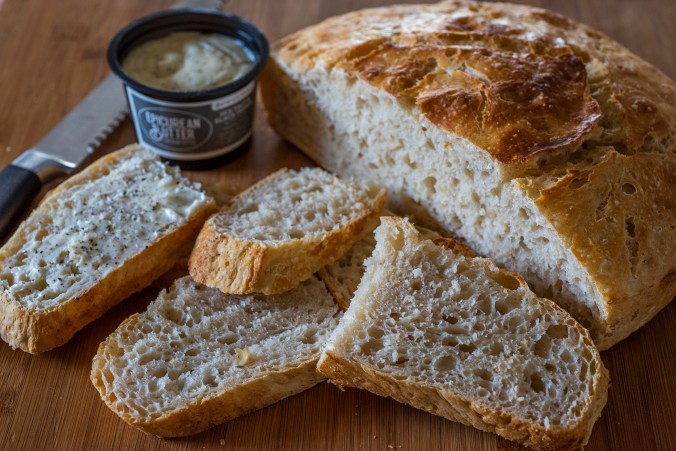
Really, what’s better than fresh bread and good butter?

I’m not at all surprised by the gardening and the bread baking, truly. People have extra time on their hands and want to do something both purposeful and satisfying, plus spring has arrived in most places and it’s a pleasure to be outside. But the sourdough thing? That did take me by surprise, as sourdough has a reputation for being so tricky and difficult and obsessive and a little weird because people name their sourdough starters and refer to them as pets. But then of course all of the country’s commercial yeast disappeared somewhere so it’s only natural that everyone would turn to sourdough, and people also need new pets in this time of isolation, kind of like Wilson in Castaway, so it all sort of makes sense.

Continue reading

Kitchen substitutions

A lifetime ago, N and I worked and lived on boats. We worked on fancy boats and not-so-fancy boats and were often at sea for days or even weeks at a time, traveling from southern Florida to the Caribbean, or across the Atlantic to make quick landfall in the Azores before an intense Mediterranean charter season. Being at sea meant no quick runs to the store, no online grocery delivery, and so I grew adept at using the ingredients I had on hand and figuring out what substitutions I could make.

It turns out that this skill comes in handy in our new world, too. Americans are cooking and baking more than ever – which is fantastic! – and more often than not, we’re doing so with a limited selection of ingredients, thanks to supply-chain bottlenecks and unnecessary hoarding and other factors. So it might be useful to learn some simple kitchen substitutions, which will make you a better cook and a better baker both during quarantine and once things return to “normal,” whatever that might mean.

Continue reading

Farm update: February 24

Greetings! We are currently stuck in that awkward phase between winter and spring. Some days it’s all teasing warmth and perfect blue skies, and some days it’s bleak and grey with icy, biting winds. Most of our snow is gone, though we expect (and hope for) one or two more storms, at least. It’s a changeable season, but spring is definitely in the air and we’re starting to hear more songbirds and see new growth everywhere we look. Here are a few things we’ve been up to recently.

Prairie Falcon 01 sml

A prairie falcon (Falco mexicanus) in one of our towering cottonwoods.

We still haven’t captured a photo of our shy Northern harrier, seen regularly hunting mice in our pasture on sunny afternoons, but N did snap this lovely photo of a prairie falcon. The prairie falcon is about the size of a peregrine falcon, but with a much different hunting style (low swooping over the ground, rather than rapid dives). Unfortunately for the songbirds we’ve been hearing, much of the prairie falcon’s winter diet is the Western meadowlark, but we hope this one will focus more on our ground squirrel population. As with all falcons, the female is substantially larger than the male. Continue reading

How to make hummus

Hummus 07 sml

It’s no secret that we here at Quiet Farm are big fans of the humble bean. We’ve discussed this before, of course; beans are high in protein and fiber, both of which help keep you full longer and keep your digestive tract functioning properly. If you’re looking to eat less meat, beans make a terrific whole-food alternative (unlike many of the processed soy patties now masquerading as meat). They’re cheap, easily available, store forever in the pantry, simple to cook and often local; it’s no wonder I make a pot of beans every three or four days.

Today, though, let’s talk hummus. There are a few foods that I firmly believe will always be better when you make them yourself – for me, that’s granola, yogurt and hummus. Of course you can easily buy all of these things at the grocery store, but hummus is surprisingly expensive for what it contains, and it will take you all of ten minutes to make a batch. You might find yourself making a batch once a week. And it’s so simple that hopefully you’ll read this entire post before realizing that I managed to avoid giving you a recipe…because hummus is more of a concept than a true recipe.

Continue reading

You can pickle that

Are you swimming in zucchini and other summer squashes right now? We are, and grateful for it; if not for squash and kale and basil, I wouldn’t have grown much of anything this season. But what to do with all that zucchini, once you’ve grilled it in thick slices and tossed it with pasta and made overly-sweet not-at-all-healthy zucchini bread and so on? Those plants keep producing, even the surprise volunteers that showed up in the potato towers and the compost pile. Well, you could pickle that.

Canning 02 sml

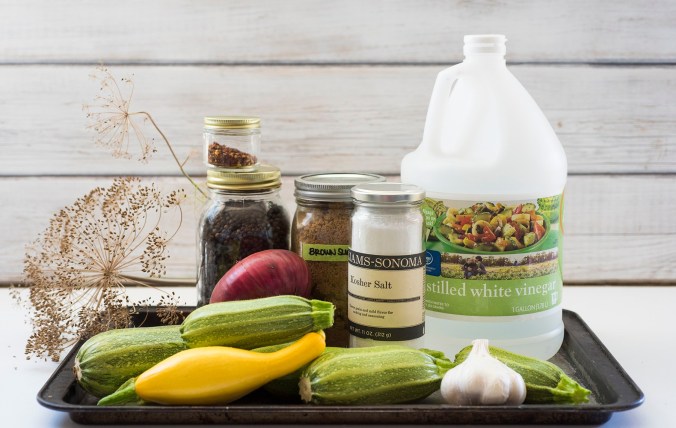
What to do when the zucchini are threatening to take over.

The Quiet Farm household isn’t a huge fan of traditional cucumber dill pickles. I’ve tried them all the ways over the years – even traditional barrel fermentation, which meant that I once dumped five gallons of moldy, slimy cucumbers and their brine into our overwhelmed compost pile back at our old house in Denver – and it’s never been something that we’ve loved. (One of my sacrosanct rules of preserving: only make what you’ll actually eat.) Our altitude means that canned vegetables have to be processed much longer in a boiling water bath so pickles are almost always soggy; limp, overcooked cucumbers aren’t my thing. Also, even though I adore sharp, acidic flavors, standard vinegar pickles are sometimes just…too much.

Continue reading

An ode to kale

Kale had a moment a few years back; it was suddenly – without warning – on every restaurant menu and in every recipe. It was as though kale had just been invented. Now, of course, it’s been supplanted as the trendy vegetable du jour – first by Brussels sprouts, and now by cauliflower. (I sincerely wish I’d invented “cauliflower rice;” the mark-up on those plastic packages – just for throwing it in a food processor! – is shocking.)

Kale 01 sml

There are lots more varieties of kale than just what you see in the supermarket.

Like most Americans, I first encountered kale when I worked in the catering industry. Curly kale is so often a garnish on salad bars and buffets that we think of it more as decoration than vegetable. But its very hardiness – its ability to sit out on a buffet table for hours on end no matter the temperature, without wilting, is precisely what makes it so valuable both in the garden and in the kitchen.

Continue reading