Gardening for beginners

The aftermath of both September 11 and the 2008 economic collapse brought a renewed interest in home gardening, and our current catastrophe looks to be no different. Garden centers have started operating online, seed companies are back-ordered for the foreseeable future and lots of people are reviewing their HOA regulations and eyeing available space in their suburban backyards. While it might not be practical to expect a backyard garden to provide all necessary food for a standard American family (how do you grow dinosaur-shaped chicken nuggets, anyway?), gardening offers an active yet meditative experience, an immense sense of satisfaction and self-sufficiency, and a deeper appreciation for how much work it takes to grow food. With that in mind, we offer a few basic tips for people looking to start their own garden.
Seedling 02 sml

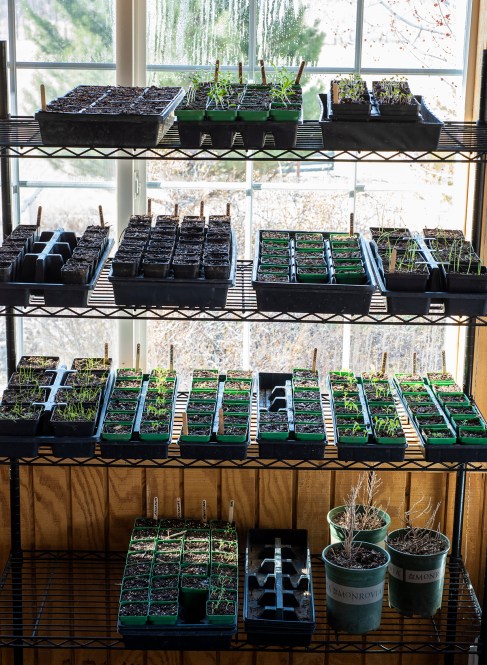
The current seed-starting set-up in our sunroom, expanding by the day.

Start small, and plant what you’ll actually eat. In moments of stress or panic (or when we suddenly have an unexpected amount of free time on our hands) we might be tempted to dig up our entire backyard and start an urban farm. This is great in theory, but if you’ve never grown a single basil plant before, we highly recommend that you start small – maybe just a couple of herb pots or a tidy little container garden on a sunny patio. It’s easy to think big and abundant, but when things return (somewhat) to normal, whenever that may be, you may not have the necessary time to devote to your garden. You can always expand if it turns out you love growing food.

Also in the interest of keeping things manageable, plant what you’ll actually eat. I’ve decided this year that I’m no longer going to devote precious garden space to eggplant, because although we don’t hate it, we don’t love it, either. And our vegetable real estate is exceedingly valuable – more so every year – and I want to plant things we adore, like tomatoes and peppers and interesting culinary herbs. When you’re choosing what you’ll grow, make sure you have a selection of vegetables and herbs that are relevant to your household, and if possible, try one new variety that you’ve never eaten before.
Continue reading

Farm update: March 9

How are you doing? It’s probably been a whipsaw week where you live, too. Here we are trying our best to stay busy and avoid the headlines (easier said than done). A few things we’ve been up to, if you’d like to see:

Bees Coffee Filter 01 sml

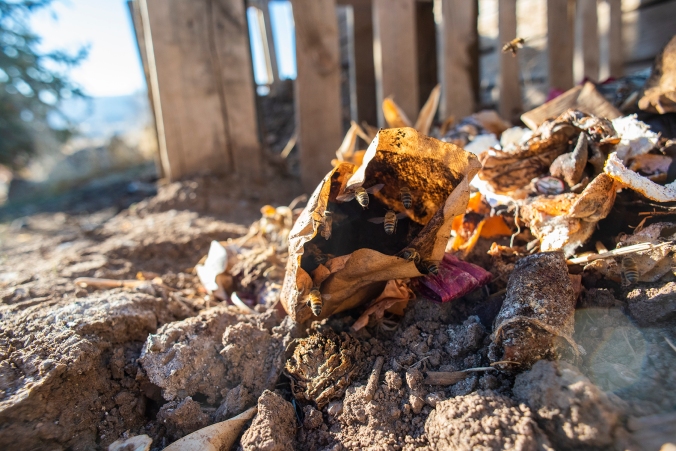
The bees love coffee as much as we do!

One sure sign of warming weather (which is coming far too early, in our opinion) is enhanced bee activity. On warm, sunny days we’re seeing lots of bees buzzing in the compost pile (they particularly love our spent coffee filters) and also near one of our big trees that’s in early bud. The apple trees in the surrounding orchards haven’t bloomed yet, but it’s always nice to know that our resident bee population survived another winter.

Continue reading

The best books about food

Apparently this country is electing a president this year and probably electing some other people too, though over here at Quiet Farm we’re doing our damnedest to ignore the entire circus. One thing that still surprises (and infuriates!) me immensely in every single election cycle is that we never, ever discuss national food policy. Neither side even mentions it in passing, unless a hotdish fundraiser happens. We talk about defense, and education, and occasionally the climate crisis, and of course health care, and yet we never discuss the single issue that unites every one of us, regardless of party affiliation. We never talk about the fact that if we changed our food system, we’d naturally change our health care system for the better. And that changing our food system would be a huge step towards repairing our devastated planet. Changing our food system would also mean more military readiness, since we’re now too fat to fight. And our children would gain a better education if they had access to better nutrition for growing brains and bodies. We always ignore the food, when it’s the one issue we should talk about more than any other.

Continue reading

How to make hummus

Hummus 07 sml

It’s no secret that we here at Quiet Farm are big fans of the humble bean. We’ve discussed this before, of course; beans are high in protein and fiber, both of which help keep you full longer and keep your digestive tract functioning properly. If you’re looking to eat less meat, beans make a terrific whole-food alternative (unlike many of the processed soy patties now masquerading as meat). They’re cheap, easily available, store forever in the pantry, simple to cook and often local; it’s no wonder I make a pot of beans every three or four days.

Today, though, let’s talk hummus. There are a few foods that I firmly believe will always be better when you make them yourself – for me, that’s granola, yogurt and hummus. Of course you can easily buy all of these things at the grocery store, but hummus is surprisingly expensive for what it contains, and it will take you all of ten minutes to make a batch. You might find yourself making a batch once a week. And it’s so simple that hopefully you’ll read this entire post before realizing that I managed to avoid giving you a recipe…because hummus is more of a concept than a true recipe.

Continue reading

Best diet hack ever!

Fruit Platter 01 sml

It’s January, and in America at least, that means New Year’s resolutions. Gyms are packed. Whole Foods is packed. Juice bars are packed. “Revolutionary” diet books and “foolproof” programs and “guaranteed” supplements and exorbitantly expensive electronic bikes are winging their way to doorsteps across the country even as we speak. And for what, dear friends? Although “get healthy” and “lose weight” are by far the most common resolutions, numerous studies have shown that over 80% of all resolutions are abandoned somewhere in February, if not sooner. The problem isn’t the resolution itself – it’s the way most of us go about it.

Squash Soup 01 sml

In this country, we are nothing if not dietary extremists. We go vegan or Paleo or gluten-free on impulse, or because we think everyone else is doing it. We blindly subscribe to the latest social media-fueled/celebrity-endorsed “health” trend. (Looking at you, celery juice.) We ignore moderation as a lifestyle entirely, and instead fixate on the newest, shiniest trick that promises to make us better, healthier and twenty pounds lighter. But why haven’t the fifty previous sparkly tricks worked? Because all of those glittering promises are built on quick fixes and short-term solutions, not on building a lifetime of habits. Let’s be honest – anyone can stick to pretty much anything for a week or two, maybe even a month or six weeks. Eat more salads? No problem. Cut back on alcohol? Easy. Go full-on keto? Tougher, but still manageable.

Continue reading

Farm update: October 21

Buck 01 sml

The south lawn of our house makes a peaceful resting spot.

Is it autumn where you live? Is it crisp and cool with bright scarlet and gold leaves everywhere? Is it dark when you wake up in the morning? It is here, and we’re settling into this brief transition season before winter extends its icy grip. Much of our work these days involves cleaning, tidying, preserving, covering and generally setting things in place for the colder months. We try to take advantage of these bluebird fall days for as long as we can; once the snows come, we won’t be working outside much.

Garlic Slate 01 sml

Growing garlic takes forever, but it’s worth the wait.

Ninety of this season’s largest garlic cloves have been planted in a bed newly prepared with lots of rich compost. Last year’s garlic went into an existing cinderblock bed that was here when we moved in; a few weeks ago we broke that bed down and dispersed the soil into new trenches for garlic and asparagus. The cloves will slumber quietly here over the winter, and in the spring we’ll hopefully see green garlic peeking up through mulch and snow. Every year we’ll plant more and more garlic; we eat a lot of it, of course, but since garlic adapts to its unique environment, we want a generous quantity to save for planting.

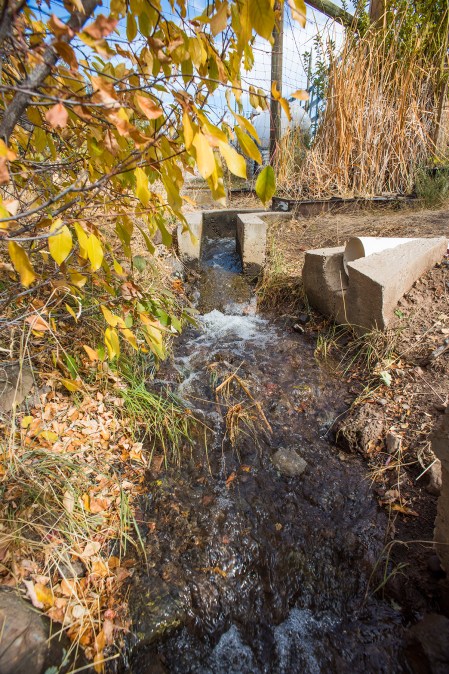
Irrigation Water 01 sml

The water runs through a culvert underneath our driveway and out into our pasture. You can see our flume in the upper right.

We ran our irrigation water for the first time this season, and it went surprisingly well. Our pasture isn’t planted right now so the irrigation run was more of an experiment to see how the water would move through our gated pipe system. We own shares in a local creek that pulls water from reservoirs on the Grand Mesa; when we want to run water we order a certain amount for a certain period and that water is deducted from our account. This run was for two days (forty-eight hours straight!) and it requires a lot of hands-on management, mainly opening and closing gates manually in the big pipes. When we’re more comfortable with our irrigation we won’t need to babysit it as much, but we’re unleashing hundreds of thousands of gallons of water mere feet from our house, and we definitely want to pay close attention to where it’s going.

Tomatoes Ripening 01 sml

Our tomato crop redeemed itself after a rocky start.

We harvested all of our vegetables prior to our recent hard freeze and brought in just over one hundred pounds of green, unripe tomatoes. In the past I’ve never had good luck ripening tomatoes indoors, but for whatever reason these are ripening quite well. They’re no longer good to eat fresh – the overnight temperatures dropped too low, so the tomatoes taste as though they’ve been refrigerated – but they’re perfect for sauces, soups and purees. A pantry stocked with canned homegrown tomatoes is a winter gift indeed.

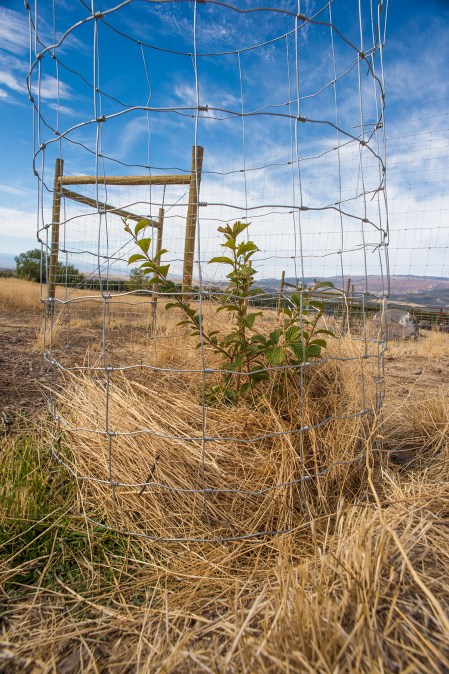
Tree Mulch 01 sml

One of our little saplings, hopefully protected from winter weather (and deer). 

We’ve hustled recently to layer all of our fruit tree saplings with warm winter mulch. Some of our little trees look healthy and others are…struggling. We’re hopeful that the mulch blanket will keep the trees protected from our harsh winter weather, since their root systems are likely to still be quite delicate. One of our priority spring projects next year will be to put a drip irrigation system in the orchard so we can stop watering the trees by hand.

We’re back to work, friends. We wish you a good week.


Save our seeds

Seeds 01 sml

Our first hard frost is forecast this week, so there is much to be done. In addition to lots of canning and preserving, autumn on a small homestead means saving seeds. We’ve talked about the importance of seed saving previously, and each season we’re working on expanding our seed bank. Never before has it been so important to save our own seeds and thereby take responsibility for our own food supply; as seed companies are again and again snapped up by massive agrochemical conglomerates, our control of our own seeds – our fundamental birthright, and the source of our food supply – becomes ever more tenuous.

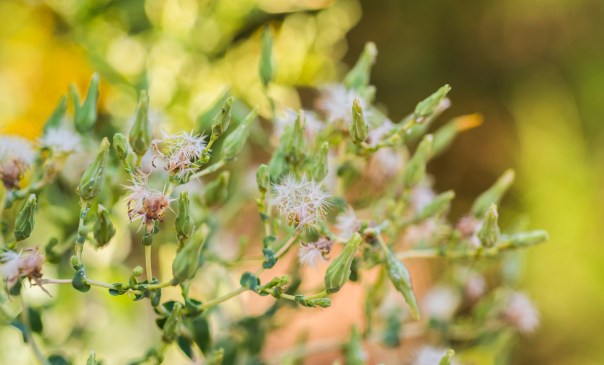
Lettuce Seed 01 sml

Most lettuces and other salad greens encase their seeds in little windblown puffballs.

As I wrote in our previous seed post, “Today, nearly three-quarters of all seeds planted in the U.S. – both unmodified and genetically engineered varieties – are privately owned and controlled by three large agrichemical corporations. Growing food is a basic human right, and we are quickly moving towards a future in which we will no longer own the source of our food. Lack of food leads to hunger, which leads to unrest, which leads to revolution, which leads to profitable wars benefitting those same corporations. Building our own seed banks, even if technically illegal, means we still have some say in our food supply. Seed saving is a small but powerful act of resistance.”

Continue reading

You can pickle that

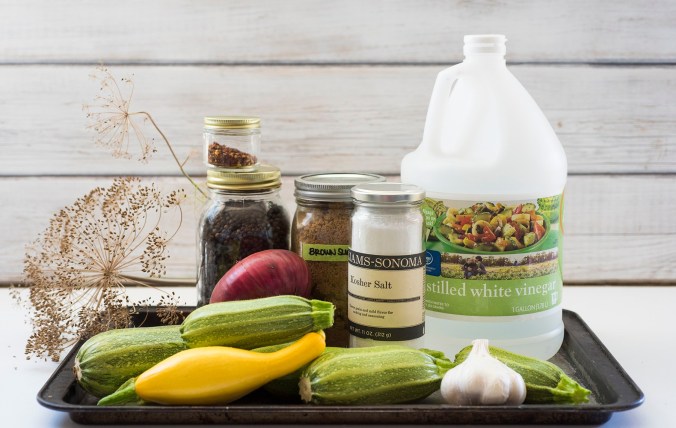
Are you swimming in zucchini and other summer squashes right now? We are, and grateful for it; if not for squash and kale and basil, I wouldn’t have grown much of anything this season. But what to do with all that zucchini, once you’ve grilled it in thick slices and tossed it with pasta and made overly-sweet not-at-all-healthy zucchini bread and so on? Those plants keep producing, even the surprise volunteers that showed up in the potato towers and the compost pile. Well, you could pickle that.

Canning 02 sml

What to do when the zucchini are threatening to take over.

The Quiet Farm household isn’t a huge fan of traditional cucumber dill pickles. I’ve tried them all the ways over the years – even traditional barrel fermentation, which meant that I once dumped five gallons of moldy, slimy cucumbers and their brine into our overwhelmed compost pile back at our old house in Denver – and it’s never been something that we’ve loved. (One of my sacrosanct rules of preserving: only make what you’ll actually eat.) Our altitude means that canned vegetables have to be processed much longer in a boiling water bath so pickles are almost always soggy; limp, overcooked cucumbers aren’t my thing. Also, even though I adore sharp, acidic flavors, standard vinegar pickles are sometimes just…too much.

Continue reading

The FAQ Series: Tomatoes

People think of tomatoes as a summer crop – as in June and July summer. And perhaps you live in a Magical Land of Elves and Unicorns (hello, Florida and southern California!) where field-grown tomatoes are available virtually year-round. Here in western Colorado, however, field-grown tomatoes don’t come on strong until August and September – but of course all the food blogs and magazines are telling us that it’s now time for apple cider and winter squash and pumpkin spice everything. It’s a confusing period, this shoulder season.

heirloom-tomatoes-05-sml.jpg

Seed packets offer plenty of information – and if it’s an heirloom, they’ll be sure to mention it.

There is no debate that tomatoes are the star of the garden. They’re by far the most popular crop for home gardeners as well as the biggest seller at farmers’ markets, and more tomatoes are grown each year than any other fruit in the world – including apples and bananas. There are more than twenty thousand known varieties of tomatoes, and new cultivars are developed every year.

Like the word organic, the word heirloom gets thrown around a lot in reference to tomatoes. But what is an heirloom tomato, exactly? And why do they cost five dollars a pound?

Continue reading