The Farm Series: Rebel Farm

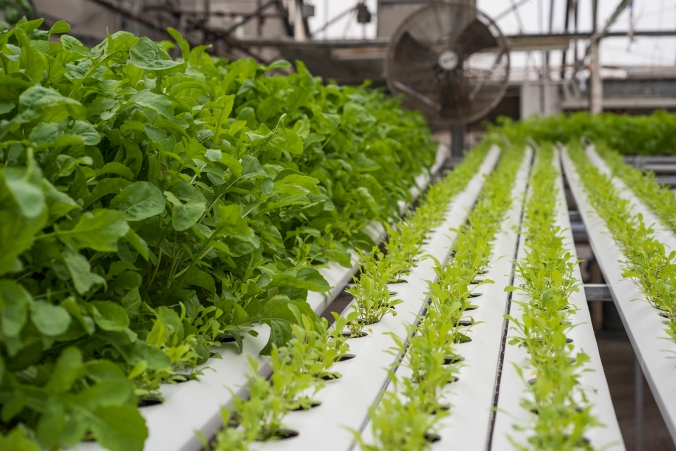
Friends, we don’t want you to think that all we do is trek around wintry European countries, eating schnitzel and drinking wine. No, sometimes we also visit delightful urban hydroponic farms and we eat handfuls of just-harvested fresh greens. Balance. It’s all about balance.rebel-farm-01-sml.jpg

Rebel Farm 05 sml

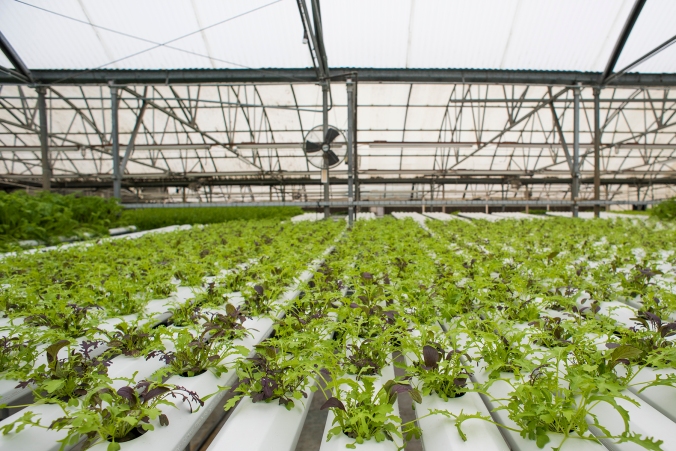
Rebel Farm, run by Jake and Lauren, is a 15,000 square-foot hydroponic greenhouse on the border of Denver and Lakewood. For those readers who live in Colorado, you may well wonder how these fine folks can afford to grow lettuce, rather than weed, considering that just about every greenhouse in the state has been snatched up by the marijuana industry. In the case of Rebel Farm, however, the greenhouse is perfectly situated between two schools – which means it cannot be a grow operation, and instead it can grow food. Brilliant.

Rebel Farm 19 sml

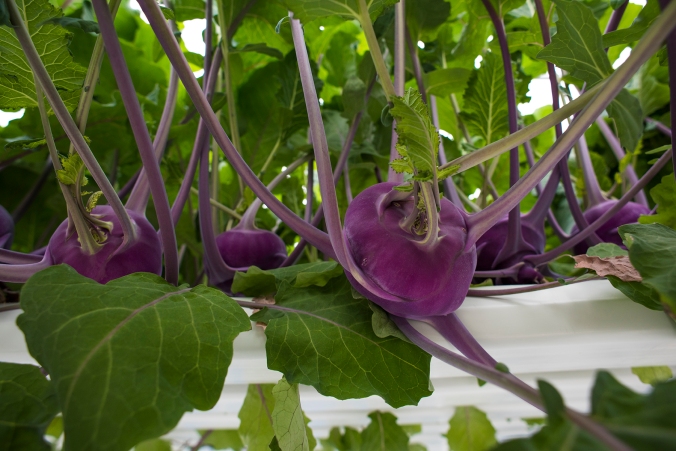
Purple kohlrabi, sadly underappreciated by CSA members everywhere.

Rebel Farm 08 sml

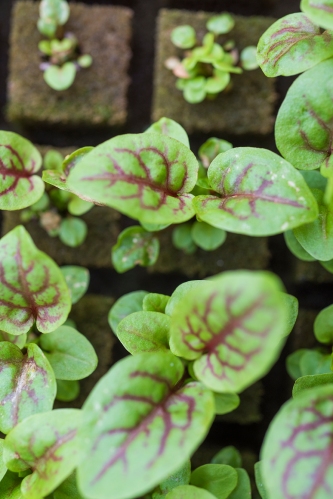
Tangy, citrusy red sorrel.

Rebel Farm 04 sml

If you’re not familiar with hydroponics, don’t feel alone. In its simplest form, hydroponics is a method of growing plants without soil. The plants can be planted in gravel, sand or other inert materials, or their roots can be suspended in a nutrient-rich water mixture. There are lots of different ways to grow hydroponically; Rebel Farm uses the NFT, or nutrient film technique, method.

Continue reading

The FAQ Series: Box Meal Kits

Well, hello there! How is 2018 treating you thus far? We over here at FQF are currently swanning our way through France and Germany, and we’ll be sending you some delightful travel missives in the not-too-distant future. But until then, we’d like to talk about box meal kits, because they’ve been a popular topic of conversation lately on both our professional and personal circuits.

What are box meal kits, you might ask? They’re basically recipes and ingredients shipped to you on a regular or on-demand basis, from which you craft (hopefully) delicious, quick(ish) meals. You don’t need to shop or plan; all you need to do is decide which meals you want and how often you want them. And there are many, many companies from which to choose. HelloFresh is probably the most well-known, but there is also Blue Apron, Green Chef, Purple Carrot, Plated, Sun Basket and many others. Plus, Amazon recently bought Whole Foods, so they’re expected to enter the ring any day now, and Wal-Mart is jumping in, too.

Food Box 01 sml

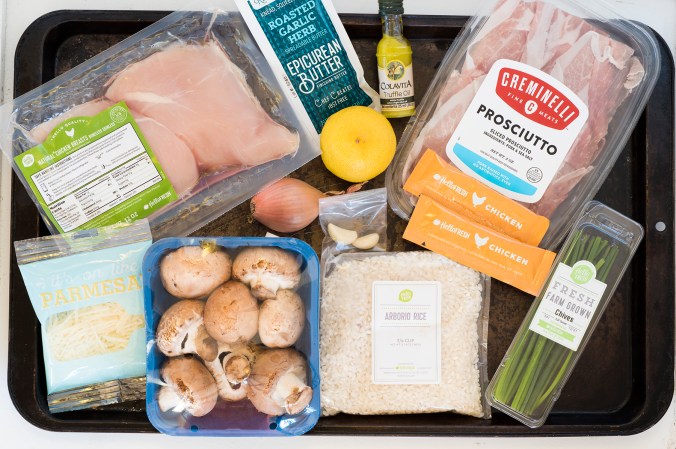
Thanks to our good friends over at Epicurean Butter, we received two HelloFresh meals to test: Prosciutto-Wrapped Chicken with Mushroom Risotto and Kale Grilled Cheese Sandwiches with Tomato Soup. Although HelloFresh offers a number of different plans to choose from, these two meals were each designed to serve two people and they cost about $20 each, or $10 per serving.

Each meal arrives much as you see above: a shopping bag contains the ingredients, plus a photo recipe card and nutritional info; the shopping bags are then all tucked into an insulated box with packing material and ice packs. Typically, you receive three different meals in a box, but again, this varies according to your plan and the company. Cooking oils, salt and pepper are not included, but everything else you need should be.

Food Box 02 sml

Despite the fact that I find following recipes very similar to being put in a choke collar, I wanted to honor the spirit of this experiment and pretend that I was a standard HelloFresh customer, rather than a professional chef. So I laid out all of my ingredients, checked them carefully against the recipe card, and followed the directions to the letter. N even read out the instructions to me while I was at the stove; this resulted in much hilarity as my natural instinct was to do everything my way – he had to correct me frequently, and of course I argued. My goal, obviously, was to see how close I could get to the presentation in the photo as well as the preparation time indicated.

Continue reading

A winter cake

It seems winter in Colorado has been canceled this year, considering that it was nearly seventy degrees (21C for our international audience) when we took these photos. In December. And on one hand, this is delightful, because driving in the snow is truly one of my least favorite activities, despite being a born-and-bred Colorado native. And on the other hand, these disconcerting weather patterns freak me out in a serious fashion. But I’m working on my anxiety, and my ability to “accept the things I cannot change.” So let’s make a cake.

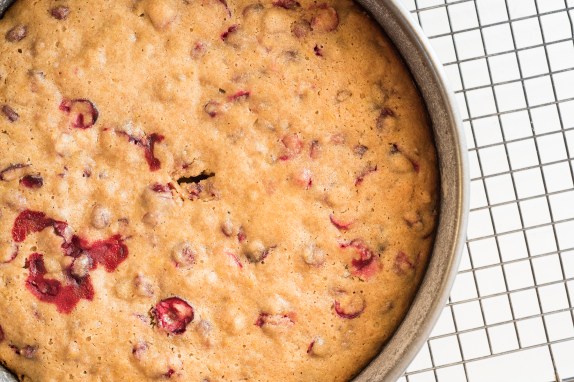
Pom Ginger Cran Cake 01 sml

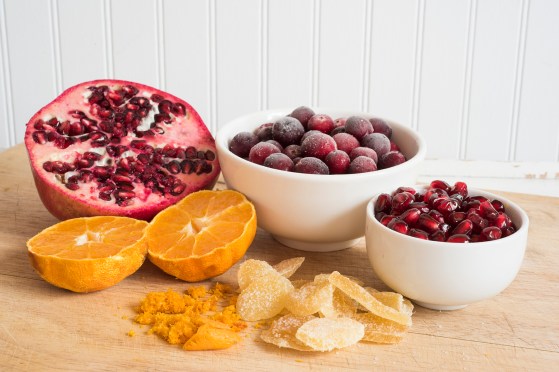
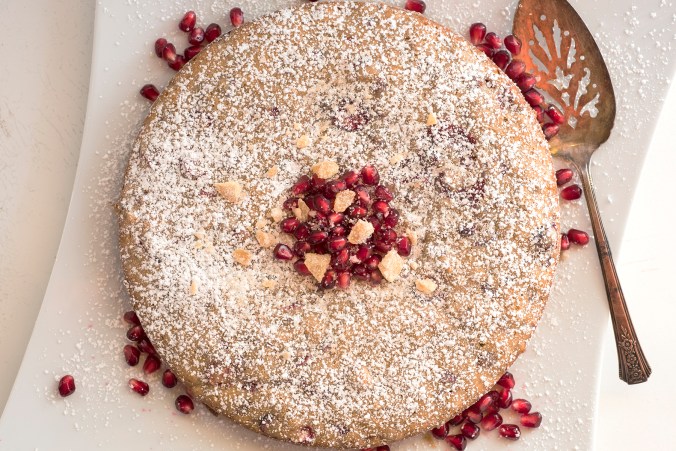
This lovely cake has all the flavors of winter: tangy, bright cranberries and citrus, plus sharp, spiky ginger. And pomegranates. Oh, pomegranates. Is there any fruit I adore more? I think not. When these babies are in season, as they are now, I often eat one a day. Somehow their tart sparkle seems to apologize for the misery of endless winter – or whatever season it is we’re currently having. The cake isn’t excessively sweet, either, which pleases me; if you had a strong, dark honey on hand, I imagine that might be compelling here.

Pom Ginger Cran Cake 03 sml

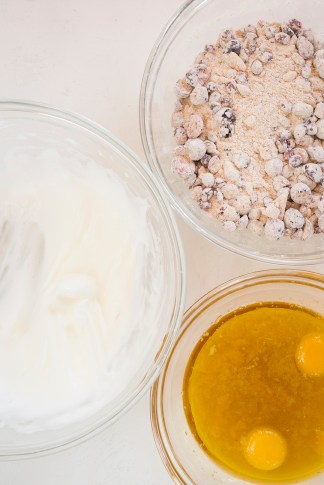
Any time you’re making a light, delicate cake, friends, please be careful not to overmix the batter – it’s a sure way to achieve dense, tough gumminess. This is even more key when baking at altitude, as we are here. Assemble all of your ingredients in advance, then place your liquids in one bowl, your dry ingredients and the fruit in another, and whip the egg whites at the very last minute, when everything else is ready. Never pre-whip your egg whites then go back to put together the other components – their ethereal fluffiness is exactly what you need. (Tossing dried, fresh or frozen fruit with flour helps keep it from sinking to the bottom of the cake, and from bleeding its juices, though that effect can actually be quite pretty. If you’re using frozen fruit, never let it thaw first but just throw it in frozen. And move quickly.)

Pom Ginger Cran Cake 04 sml

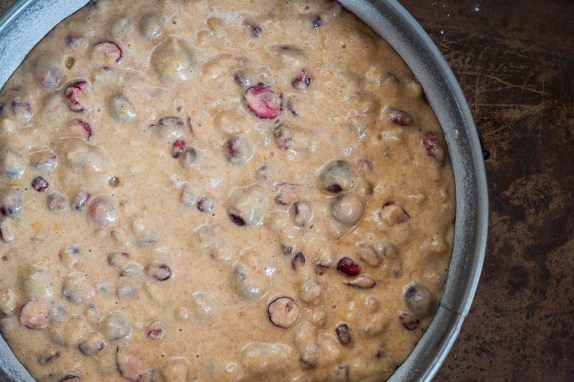
As before, make sure your pan is prepped and your oven is preheated. Once the batter is together, it needs to go straight into a hot oven. This is not the time to dilly-dally.

Pom Ginger Cran Cake 05 sml

This recipe as written makes for quite a moist cake, which is lovely here in Colorado as it stays fresher for longer in our dry climate. I reduced the leavening by 1/4 tsp. and added 1/4 cup extra flour, as is often done when adjusting baking recipes for altitude. If you’re at sea level, you may need to use a total of 3/4 tsp. baking powder. You can probably reduce the whole wheat pastry flour by 1/4 cup at sea level, too. Make sure to check carefully for doneness with this cake; I found that I needed a bit more baking time than the recipe indicates. Ovens vary; adjust accordingly.

Pom Ginger Cran Cake 06 sml


Pomegranate, Cranberry and Ginger Cake (written for 5,300 ft. elevation)

For The Cake

  • 1/2 cup honey
  • 1/4 cup mild olive oil
  • 2 large eggs, at room temperature, separated
  • 2 tbsp. freshly grated orange zest
  • 1/3 cup fresh orange juice
  • 5 tbsp. crystallized ginger, chopped
  • 1 1/4 cup whole wheat pastry flour
  • 2/3 cup all-purpose flour
  • 1/2 tsp. baking powder
  • 1/2 tsp. salt
  • 1/2 cup fresh or dried cranberries
  • 1/2 cup pomegranate seeds, plus more for garnish
  • 2 tsp. confectioner’s sugar for dusting
  

Directions

Preheat oven to 350 degrees. Butter and flour an 8-inch round cake pan; line with parchment paper and butter and flour the parchment.

In a small bowl, stir together honey, olive oil, egg yolks, zest, juice and 3 tbsp. crystallized ginger. In a large bowl, sift together both flours, baking powder and salt. Gently fold cranberries and pomegranate seeds into dry ingredients. In another bowl, beat egg whites and a pinch of salt with an electric mixer until soft peaks form, about 1-2 minutes. Using a rubber spatula, gently fold honey mixture into flour mixture, then fold in egg whites until combined. Do not overmix.

Pour and scrape batter into prepared pan and bake until toothpick inserted in center comes out clean, about 35 minutes. Allow cake to cool on a wire rack for at least 10 minutes; run a knife around sides of pan to loosen cake and turn it our onto rack. Remove paper and allow to cool completely.

To serve, sift confectioner’s sugar over cake and garnish with remaining crystallized ginger and additional pomegranate seeds.

Things that are great!

Friends, let’s start this week with an optimistic post (for once). How about a quick round-up of things that are great right now?


NJB_3308

A small family farm in Hoi An, Vietnam.

The Washington Post reports that a growing number of young Americans are leaving desk jobs to farm:

“For only the second time in the last century, the number of farmers under 35 years old is increasing, according to the U.S. Department of Agriculture’s latest Census of Agriculture. Sixty-nine percent of the surveyed young farmers had college degrees — significantly higher than the general population.

This new generation can’t hope to replace the numbers that farming is losing to age. But it is already contributing to the growth of the local-food movement and could help preserve the place of midsize farms in the rural landscape.”

Granted, the movement is small, but it is in fact a movement. And it’s moving in the right direction. There are numerous barriers, to be certain, but this is progress.

MFGD-46.jpg

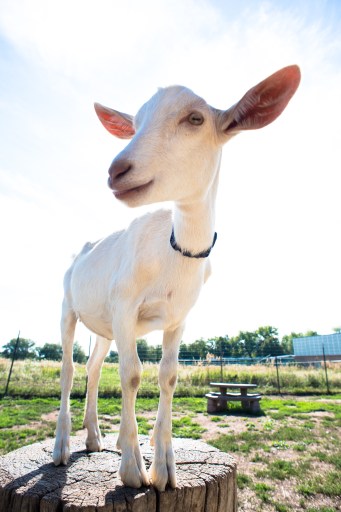
How can you not love this munchkin?

Not only are young people going back to the land, but more women are making more incredible cheese than ever. Led by such trailblazing pioneers as Allison Hooper of Vermont Creamery and Mary Keehn from Cypress Grove, handcrafted cheese in this country – primarily made from goat milk, but sheep and cow, too – is truly enjoying its second wave:

“A commonly cited fantasy Plan B among urban paper-pushing professionals, the artisanal-cheese business has surged in recent years, with more than 900 specialty cheese makers in the United States, according to the American Cheese Society, a nonprofit trade organization in Denver. The A.C.S. does not keep data on gender, said its executive director, Nora Weiser, but compared with the bro-centric field of craft beer, where female brewers have struggled to get respect and recognition despite significant contributions, cheese making is a relative haven.”

While “American cheese” has long been a joke in the rest of the world, it is definitely no longer a joke – it’s remarkable. And delicious. Go buy some.

NJB_0197.JPG

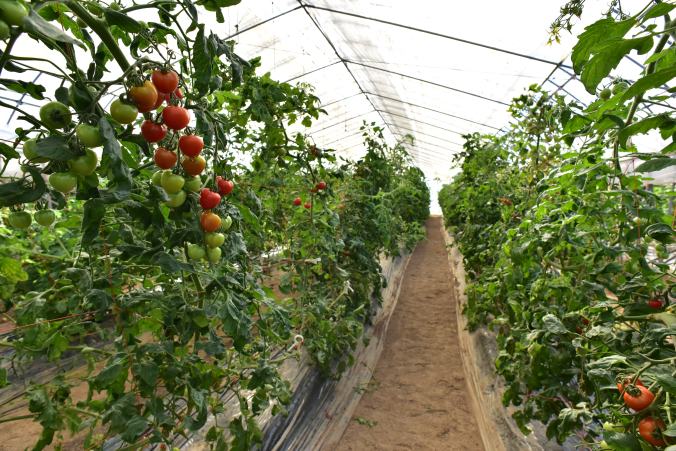
Greenhouse tomatoes in Japan.

In other positive news, vertical farming is finally coming into its own, pushed by high-dollar investments from people like Jeff Bezos, who clearly know a thing or two about running a business. Vertical farming is exactly what it sounds like: growing food in towers, with carefully controlled irrigation, lighting and temperature systems. While farmland continues to be gobbled up at staggering rates, vertical farming, which has been trialed successfully in repurposed shipping containers and other unusual places, might provide a local food alternative, especially in densely populated urban areas. There is still a lot of work to be done, but innovative, forward-thinking entrepreneurs are constantly revamping traditional farming rules. And we will need this sort of innovation, as both global temperature and global population climbs ever higher.

DSC_2678

I’m not putting a picture of soda on this blog. Drink water. (This is Victoria Falls, on the border of Zimbabwe and Zambia.)

And for our final Great Thing today, how about this: soda consumption in the United States has dropped again, for the twelfth consecutive year. This statistic is proof that anti-sugar publicity campaigns and soda taxes are working, at least in some areas. While we’re still drinking about forty gallons per person, per year on average (!!!), those numbers are trending down. And that is definitely a Great Thing.


Thanks, but no thanks

Dear Oregon:

It is with regret that we inform you that you are no longer a candidate for the location of Quiet Farm. Although we visited you with highest hopes, we found that our expectations did not coincide with reality.

NJB_1223

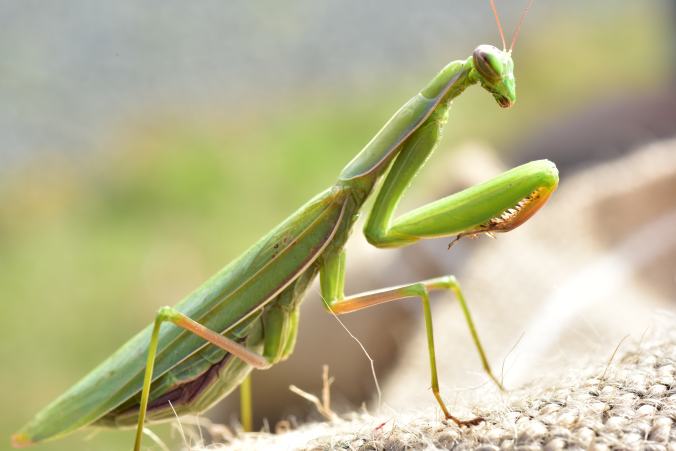
Praying Mantis

NJB_1196

Fly Agaric Mushroom (poisonous!)

It goes without saying, Oregon, that your flora and fauna are simply exceptional. Just look at these photos! Coming from our dry, stark, high-plains desert, we were stunned by the sheer life found everywhere in this damp climate: on fallen logs, under chestnut leaves, buried in cranberry bogs.

NJB_1278

Pacific Tree Frog

NJB_1199

Still Life with Mushrooms

And the water! All the free water, everywhere! Just falling from the sky! Oh look, it’s still raining! Truly, it’s a miracle, and it means you can grow pretty much anything here. But we also found that farming in the pouring rain wasn’t as much fun as we’d hoped. Slogging through inches of sloppy mud while trying to dig out a stuck tractor or get feed to hungry animals sounds adventurous, but we’re afraid it would just become rather tedious.

NJB_1260

Rough-Skinned Newt (its underside is bright orange!)

NJB_1044

Cascades Frog

(While we’re on the topic of growing things, Oregon, we’d like to talk about “medicinal substances,” if you get our meaning. As a state, it seemed to us that you’ve embraced the recreational drug lifestyle just a touch too enthusiastically for our comfort, and that’s saying something, considering we hail from Colorado.)

NJB_1049

Woolly Bear Caterpillar

NJB_1268

Angel Mushroom (unconfirmed ID)

This is a tough letter for us to write, Oregon, because we were pretty much ready to set up shop and get Quiet Farm up and running. But outside of Portland or possibly Eugene, we don’t feel confident that the community can support the type of business we want to start. And unfortunately, we can’t afford any property near Portland or Eugene. Apparently it’s all being snatched up by escaping Californians.

NJB_1206

Red-Veined Meadowhawk

Please know, Oregon, that you’re more than welcome to reapply as a potential Quiet Farm location at any time. We’ll just need to see a dramatic reduction in your extortionate property prices as well as a corresponding reduction in your precipitation rates. Oh, and lay off the weed for a bit, please. There’s work to be done.

With regards,

The Quiet Farm Scouting Team


Going nuts, vol. 2

We started the year learning about macadamias in New Zealand, so it’s only fitting that we should close it out harvesting chestnuts in Oregon. Prior to marrying an Englishman, I had never eaten a fresh chestnut – only candied, at culinary school in France – but they’ve become part of our fall traditions, as they were for him in childhood. And now that I’ve harvested them myself, I truly have a newfound appreciation for their exorbitant price. These things are little monsters.

NJB_1272

The trees in the grove we harvested are between fifteen and twenty years old.

Chestnut trees are grown across much of the world; chestnuts themselves are important food crops in Asia and Europe. Chestnuts were also hugely valuable to native Americans and early settlers; the fruit is primarily carbohydrates, has more starch by weight than potatoes and contains enough vitamin C to prevent scurvy. In the early 1900s, however, the Bronx Zoo imported Asian chestnut trees for their botanical collection and inadvertently introduced chestnut blight to North America. Within forty years, the blight wiped out nearly every single one of the forty billion chestnut trees in America, with only a few small isolated stands now remaining across the country.

NJB_1275

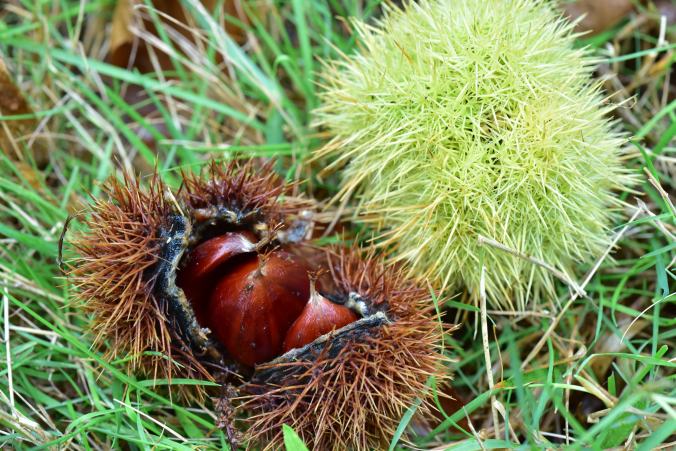
Usually you’ll find three chestnuts in the burr, but it depends on the species.

The actual chestnuts are contained in a burr, or hull, which is exactly like a tiny, angry porcupine. When the chestnuts are ripe, the chocolate-colored burrs fall to the ground; unlike other fruits or nuts, chestnuts are never harvested directly from the tree.

NJB_1279

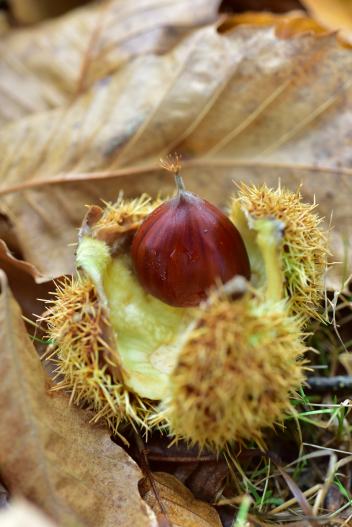
Ripe burrs split open, as on the left.

The burrs split open on their own, further indicating ripeness; this is primarily due to soil humidity, as chestnut trees prefer more humid climates. Sometimes unripe (green) burrs will also fall, and if they haven’t opened they should be left to ripen further.

NJB_1271

Dry leaves and empty burrs after harvesting.

Things to know when harvesting chestnuts: you’ll need gloves. Kevlar gloves, to be precise, and yes, that is the material used for bulletproof vests. These things look relatively harmless but are truly vicious, and good gloves are mandatory. And it will take you ages to harvest these; the little burrs love to hide in the huge piles of dry leaves that have also fallen from the tree. They’re like adorable, spiky landmines, and now I know personally why they’re criminally expensive: the pain level is extraordinarily high. (I’m almost certain they were used as extras in this film.)

NJB_1262

Looks harmless. Isn’t.

These edible chestnuts aren’t to be confused with horse chestnuts, which are mildly toxic to humans, or water chestnuts, which are grown aquatically and used in Asian cuisine. Attempts have been made since the 1930s to hybridize the American and Asian chestnut trees, in order to create a native species resistant to blight, but it hasn’t as yet been hugely successful. (On a related note, we’re about to suffer another major loss of trees, as the emerald ash borer – also imported from Asia, on shipping pallets this time – continues its trail of destruction across America. Colorado alone is projected to lose more than two million trees.)

NJB_1261

It took forever to harvest a three-gallon bucket!

Chestnuts are used in savory and sweet preparations all over France and Italy; as with cranberries, they’re commonly seen in holiday recipes because their harvest time coincides perfectly. And in wintertime in cities like London or New York or Paris, you’ll often find street vendors roasting chestnuts over repurposed fifty-gallon oil drums.

NJB_1284

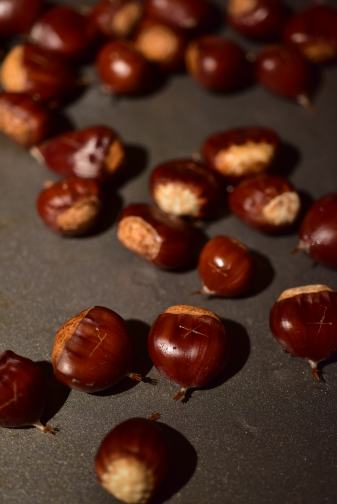
To roast fresh chestnuts at home, carefully cut an ‘X’ into the flat side of each nut. Use sturdy kitchen shears to do this and be very, very careful; the nuts are slippery and unwieldy. Place on a baking sheet and broil until you hear the first explosion, about ten minutes depending on the quantity and your broiler temperature; be patient and wait until the second explosion, which indicates that all of them should be cooked through. Open the oven carefully and quickly lay a kitchen towel over the entire tray as more explosions are likely to follow. Let cool until you can safely handle them, then peel and dip each nut into coarse salt and enjoy. (Sorry about your oven; you’ll probably need to clean up the shrapnel once it’s cooled down. And a pro tip: it’s not a great idea to roast chestnuts in someone else’s oven, unless you’re also willing to clean it.)

NJB_1290

Although chestnuts seem to thwart you at every turn, the reward is well worth the potential injury. Roasted chestnuts pair perfectly with a wee snifter of bourbon and are even better if enjoyed in front of a roaring fire. Take pleasure in the simple things, friends, and clean up the oven later.

Let’s learn about the farm bill!

Since about – oh, let’s just say November 9, 2016, not to be too precise – many Americans have found themselves much more interested in politics than in times past. And while that’s a good thing, it’s an understatement to say American politics can be rather confusing. As in, we don’t really get what’s going on, but it doesn’t seem to have that much impact on our relatively comfortable day-to-day lives, so we just go along, merrily forwarding cat videos, virtual-signing critical online petitions that have absolutely no real-world impact and binge-watching the new season of Stranger Things.
NJB_0905.JPG

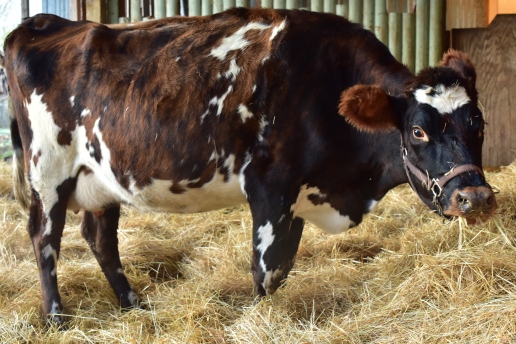
Finding Quiet Farm tries hard to both educate and entertain, so today we’re going to talk about the farm bill. Oh, I can hear you rolling your eyes right now all the way across the Interwebs, but bear with me. The farm bill, which as Michael Pollan says “should actually be called the food bill,” really does affect every single American, every single day. Multiple times a day, to be honest, because each bite of food you eat in this country is directly tied to the farm bill. And if you have kids, and if they eat any food at all in a school environment, then you’re affected even more. Without further ado, then, a brief, (hopefully) simple introduction to the farm bill, and why you should care about it.
NJB_0763.JPG

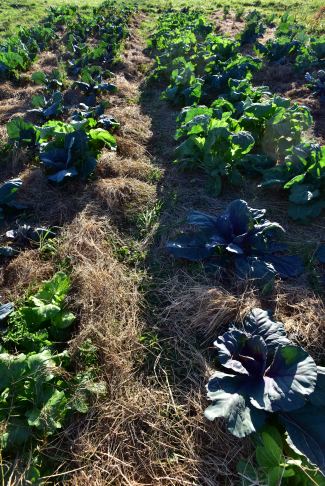
Let’s start with the basics. What is the farm bill?

The farm bill is a “multibillion dollar tangle of agricultural subsidies, welfare programs and environmental patronage,” or, more simply, it’s legislation that connects the food on our plates, the farmers and ranchers who produce that food, and the natural resources – our soil, air and water – that making growing food possible. It costs just under $500 billion – that’s half a trillion U.S. taxpayer dollars!

It’s a multiyear omnibus (meaning it covers many different programs) law revamped about every five years and the current farm bill will expire in 2018. That means it’s time for our beloved politicians to start crafting a new farm bill.
njb_0202.jpg

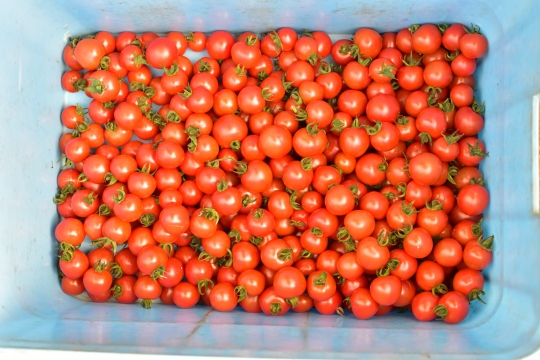
What does the farm bill do?

The National Sustainable Agriculture Coalition puts it best:

“In the simplest terms, the farm bill has a tremendous impact on farming livelihoods, how food is grown, and what kinds of foods are grown.  This in turn affects the environment, local economies, and public health.  These are some pretty good reasons to become involved in advocating for a farm bill that supports health and sustainability!

Through programs covering everything from crop insurance for farmers to healthy food access for low-income families, from beginning farmer training to support for sustainable farming practices, this powerful package of laws sets the course of our food and farming system – in good ways and bad. It’s our job to make sure the farm bill reflects what our country’s farmers and eaters need for a sustainable future.

Every five years, the farm bill expires and is updated: proposed, debated, and passed by Congress and then signed into law by the President. (The current farm bill, The Agricultural Act of 2014, was signed into law on February 7, 2014.)

The farm bill got its start in 1933 as part of President Franklin Delano Roosevelt’s New Deal legislation. Its three original goals –  to keep food prices fair for farmers and consumers, ensure an adequate food supply, and protect and sustain the country’s vital natural resources – responded to the economic and environmental crises of the Great Depression and the Dust Bowl. Although the farm bill has changed in the last 70 years, its primary purposes are the same.”

Basically, the farm bill does many things, but its most significant elements are the federal food stamp program (officially called the Supplemental Nutrition Assistance Program), crop insurance and crop subsidies. There are other, smaller aspects, but these are by far the most important (and costly).

Stone Barns 031.jpg

How does this affect me, or more literally, why should I care?

You should care if you either 1. eat food in the U.S. and/or 2. pay taxes, because you’re funding this monster. And if you’re concerned about our rapidly escalating health care costs, or that for the first time in modern industrial history the current generation has a lower life expectancy than their parents, or even if you only care about just your own household food budget, then the farm bill (and food policy in general) should matter to you.
NJB_0269.JPG

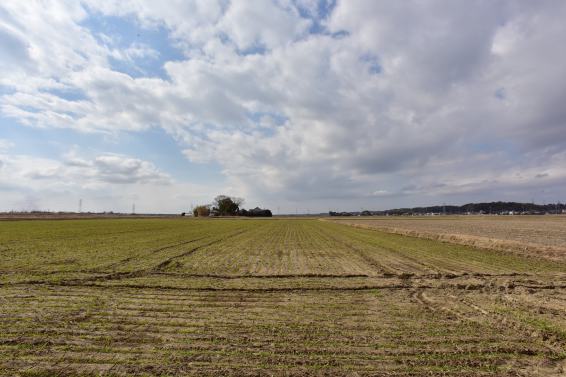
What’s wrong with the farm bill?

Where to begin? It was implemented in the 1930s, and modern agriculture is vastly different now than it was during the Great Depression and the ensuing years. After World War II, we got really, really good at growing vast quantities of corn, wheat and soy with the help of leftover nitrogen, which was made into powerful fertilizer. And in the 1970s farmers were encouraged to “get big or get out,” so the small, diversified family farm started to disappear, and farmers were paid to constantly increase their production of cereal grains, again primarily corn and soy – now used as inexpensive animal feed and as the primary ingredients in processed foods and drinks.

Now, fewer than two million Americans live on farms, while crop yields – and pesticide, herbicide and insecticide usage – continues to increase. Huge monoculture farms cover most of the Midwest, reducing natural diversity and vastly increasing the chances of another devastating Dust Bowl. Large monocrop farmers are millionaires many times over, and small farms are going under. We produce far more cheap, high-calorie, nutritionally-devoid food than we need in this country, and the result of that overproduction includes massive dead zones in the Gulf of Mexico, sick animals raised in their own waste, and a population ridden with heart disease, obesity, diabetes and other lifestyle-related ailments. Plus, many low-income Americans cannot afford fresh fruit and vegetables and other whole foods.

Without question, the farm bill needs revision so it can better impact our current crises, including our food-insecure population and the serious health and environmental burdens our country is facing. But Big Ag has a lot of money and a lot of influence, and the 2018 version is unlikely to offer any significant improvements.

Stone Barns 098.jpg
What can I do to help implement changes in future farm bills?

Well, I’d love to end this on a super-positive, grassroots movement note and tell you to write your elected representative! Call your elected representative! Stand outside the office of your elected representative! But let’s be truthful here: all of our elected representatives are on someone’s payroll, and lobbying is a lucrative career. So the best you can do, to be perfectly honest, is vote with your dollars, because that’s the only vote that really matters. And you vote every single time you spend money.

If you value small farms, find your local farms, know your farmer, and buy directly from them. Skip the middleman. Search out local CSAs, and patronize them. If you believe more federal dollars should support organic farms, buy organic. Read labels, and ask questions. If you want to eat animals that have lived a good life and had a humane death, stop buying cheap commodity feedlot meat and battery eggs. Buy from companies who honor the same values you honor. Do some research. Don’t buy heavily processed foods and drinks made from soy and corn derivatives. Grow your own food, if possible. Anything helps, even a few windowboxes of herbs. And above all else, refuse to believe that something is in your best interest just because someone tells you so. Stand up for yourself, your family, your health and your values – because everyone is out to sell you something, and it’s your responsibility to figure out whether you really should buy it.
NJB_0992


Hive inspection

Back in late July, we showed some photos of our beehive. A few weeks later, we opened the hive again for a summer inspection and wanted to share those pictures here too. As we’ve said before, we’re new to beekeeping, but we’re learning more every day.

Equipment.jpg

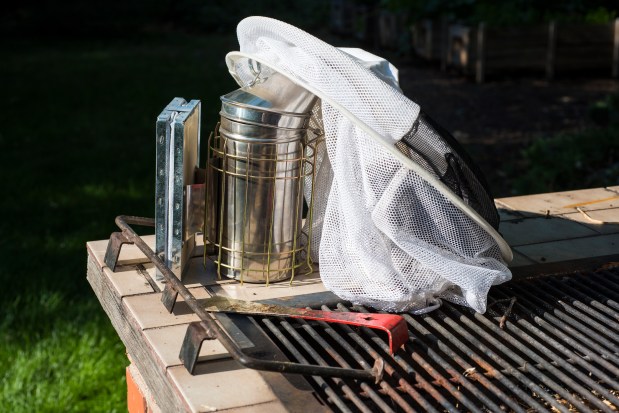
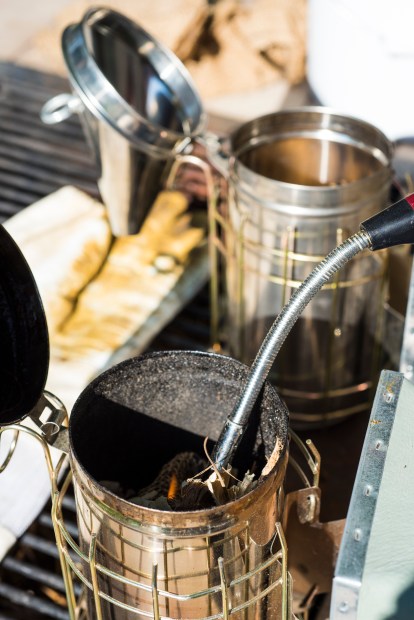
Necessary equipment: veil, smoker, pry bar and support frame.

Smoker Ignition.jpg

Lighting the smoker.

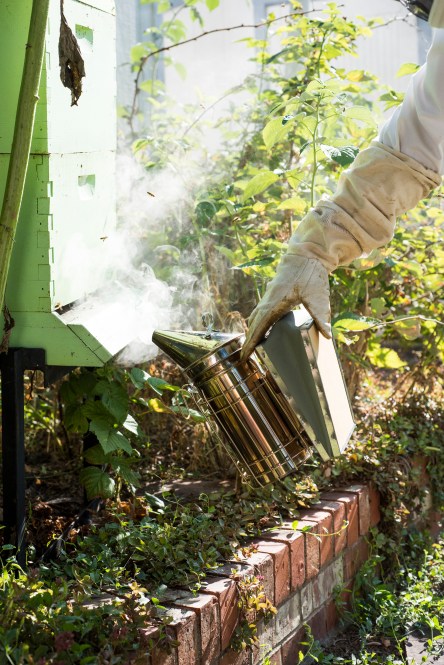
Smokers are commonly used by beekeepers when opening and inspecting hives. The smoke is thought to dampen the guard bees’ pheromone response, allowing the beekeeper to open the hive without a defensive reaction. This does not mean, however, that beekeepers don’t get stung – but the goal is to minimize the stings, because those are harmful not only to the beekeeper but obviously to the hive, too, as the bees die once they’ve stung. Good beekeepers want to reduce unnecessary bee death whenever possible.

Smoker Entrance

Smoking the hive in preparation for opening.

Hive Opening.jpg

Carefully opening the hive. (I am very helpfully holding an enormous sunflower stalk out of the way.)

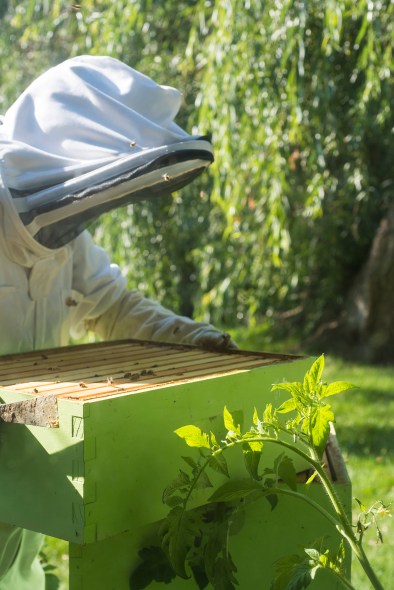
Beekeepers traditionally wear white because large predators of hives – bears, raccoons, skunks – are overall dark in color. It is thought that the bees will be less stressed, and therefore less likely to attack, if the beekeepers are clothed in white. In South America, however, beekeepers most often wear red.

Honey Super.jpg

The inner workings of our Langstroth hive.

Frame Opening.jpg

Removing the frames one by one.

Frames 02.jpg

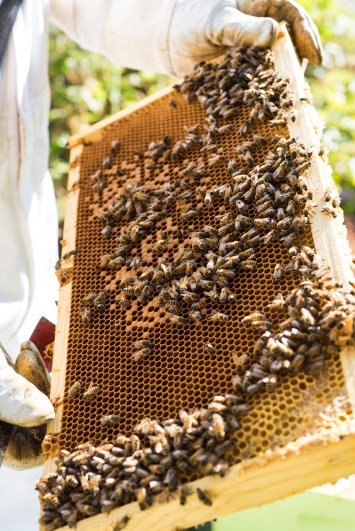
It is such a thrill to see so many healthy, thriving bees!

Frame Inspection 05.jpg

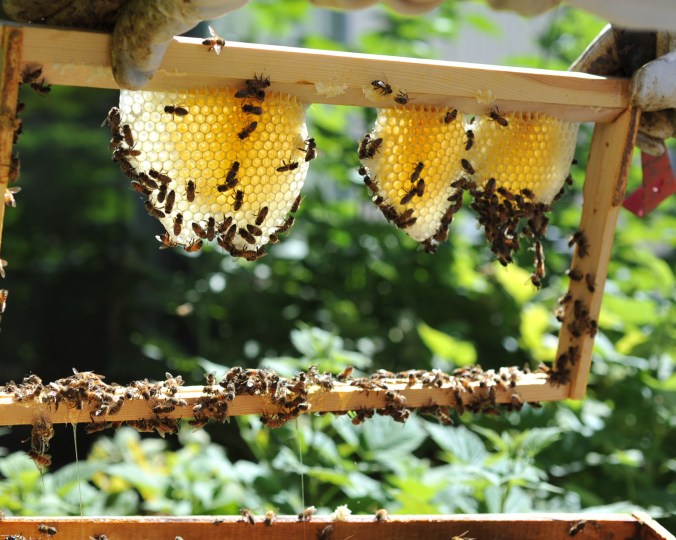
Frame Honeycomb.jpg

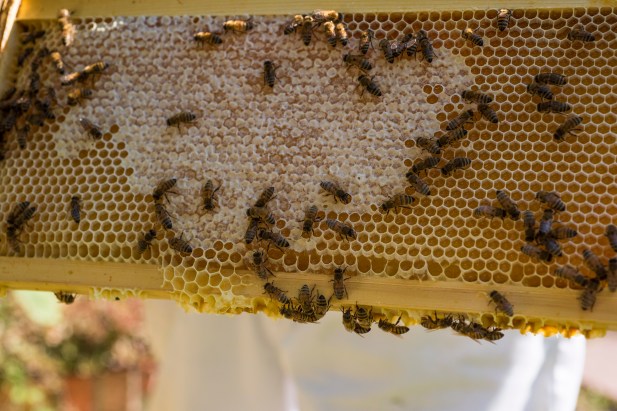
Honeycomb! We’ll leave some for the bees’ winter food supply, and hopefully there will be enough for us, too.

Frame Inspection 06.jpg

Can you spot the queen? I couldn’t.

Hive Open.jpg

Our hive without its top box and cover.

Hive Closing Up 02.jpg

Closing up the hive.

We’re hoping we’ll be able to harvest some of that gorgeous honey you saw above in a few weeks, before the weather turns. Stay tuned!

P.S. Jim, you’re the best. We couldn’t do this without you. Thanks!


Saving the bees

On a cool spring day four years ago, our friend Jim came to pick us up in his truck. We drove to a local feed store where we waited forever with dozens of other eager apiarists to pick up our new beehive. The sellers had driven down from Wyoming, where their hives and queens were specifically raised in extreme environments (mainly intense winter winds), meaning they’d likely survive their move to the Front Range.

Bee 01.jpg

That first hive didn’t make it. We lost it two years ago, and to this day we still don’t know why it didn’t overwinter successfully. Because our neighbors’ lawn care company uses ten thousand different poisonous chemicals? Because we didn’t maintain the winter sugar water supply properly? Because of colony collapse disorder? We don’t know, and we won’t ever know. That total lack of knowledge is one of the most challenging aspects of keeping honeybees.
Bumble Bee 01.jpg

Such remarkably strong and beautiful creatures.

We are very new to beekeeping. We’re on our second hive, and though it seems to be exceptionally strong at the moment, there are a lot of different pressures on pollinators right now. We try to do our very best by our bees; we read and we talk to friends who keep bees and we monitor the hive carefully, but ultimately we’re not entirely in control of the situation.

Bee 02.jpg

Planting flowers that bees love is one of the best things you can do to help them.

In June, the U.S. officially withdrew from the Paris climate accord. This decision sent yet another exceptionally strong message to the rest of the world that Americans are basically a bunch of nutjob flat-earthers who believe climate change is a global conspiracy cooked up by the Chinese. In challenging times like these, it’s easy to believe that nothing we do makes any difference and that we’re all doomed. Keeping bees, however, is one of our small commitments to creating the kind of world we want to live in.

Hive

Our basic hive set-up, strapped down to keep out hungry raccoons.

It’s no great secret that honeybees and other pollinators are under a huge amount of stress. Whether from loss of habitat, monocropping, neonicotinoids, or other factors, pollinators are disappearing at critical rates. One-third of our total food supply requires pollinators to thrive, and it’s only in recent years that farmers, home gardeners and scientists have started addressing this issue. Colony collapse disorder has gotten a lot of attention, but it’s still not widely understood, and the disappearance of pollinators most likely can’t be exclusively blamed on CCD. It’s a complicated story.

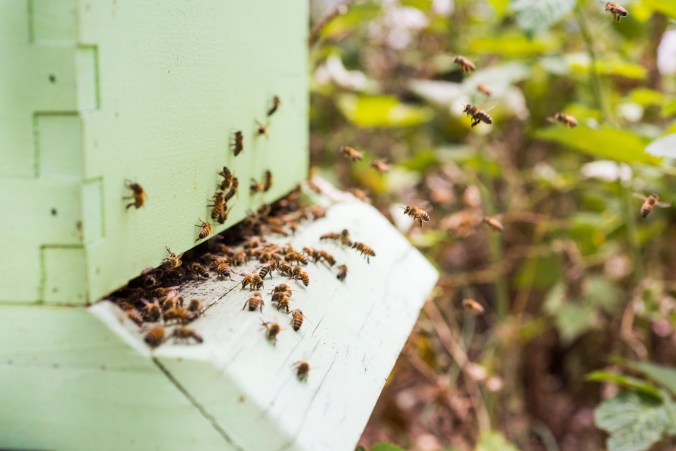
Bee entrance.jpg

Watching the bees at the hive entrance is one of the great joys of beekeeping.

The term pollinator doesn’t refer to just bees; pollinators can also include birds, bats, butterflies, beetles and other small mammals. All of these creatures are responsible for helping to propagate certain plants, but honeybees give humans the greatest return for their investment. Honey is the only food produced by insects that humans eat, although protein derived from insects is about to become the next big trend in sustainable eating. (You heard it here first, friends.)

Hive 02

Our hive is a Langstroth; the other most common style is called a top-bar hive.

We started keeping bees to help pollinators and to help our garden, and because we know we’ll have hives on our farm. The honey is no small bonus either, especially since eating it regularly has seemed to really help N with the seasonal allergies he’s struggled with here in Colorado. Beekeeping isn’t necessarily difficult, but it does require a certain investment in time, money and equipment; we’re always trying to learn more about how we can become better beekeepers.

Honeycomb

Examining built-up comb on a frame.

Beehives are unbelievably complex and elaborate communities; a typical honeybee hive usually contains about 50,000 bees. There is a basic three-tier caste system: one queen, plus workers, who are female, and drones, who are male. Drones only exist to mate with the queen and are incapable of feeding themselves or foraging, plus they die immediately after mating. Workers, on the other hand, might be nurses, attendants, cleaners, foragers, guards or undertakers. Healthy queens live for an average of two to three years but have been known to live as long as five years; workers and drones live between two to four months, depending on their role in the hive.

NJB_0213.JPG

Greenhouses often have to bring in pollinators to mimic conditions outdoors.

A single bee colony can produce between sixty and one hundred pounds of honey in a year. For every pound of honey produced, the bees have visited two million flowers and flown over 55,000 miles. And each individual honeybee only produces about 1/12th of a teaspoon of honey in its lifetime, so the next time you’re grousing over the price of local honey, consider how much work went into creating it. Bees fly up to about five miles from their home hive to forage; for obvious reasons it’s tough to find true organic honey – how often can you guarantee that every single plant bees might visit within a five-mile radius is completely organic? Our honey definitely isn’t (see neighbor reference above).
Bumble Bee 02.jpg

Bumblebees are easily recognizable by their plump, furry bodies.

People are scared of bees. We’re always careful to warn guests and workmen about our hive and to inquire about allergies. We’ve both been stung numerous times, some occasions definitively our fault and some entirely unprovoked. I’ve been lucky enough to actually see the bees swarm – when the hive becomes too crowded and a group decides to set off for greener pastures – which isn’t ideal for beekeepers but is a remarkable (and slightly spooky) experience. Our hive this year is also strong enough that we’ve been able to take a split, which is essentially a controlled division of the hive before it has a chance to swarm. Splits are better than swarms in most cases, because with a swarm there is always a risk of losing the queen. Unless the hive can produce a new queen, the entire colony will die.

Spider bee.jpg

Spiders have to eat too.

To make the clear, clean honey you most often find at the grocery store, the honey is heated and filtered to remove beeswax, pollen, bee parts and other potential contaminants. Certain beekeepers claim that this heat treatment removes the most beneficial components of the honey, so some honey is labeled “raw.” True raw honey has never been heated beyond naturally occurring hive temperatures, about 95 degrees Fahrenheit, but this labeling term – like so many in the U.S. – isn’t regulated and therefore no one is checking up on manufacturers who use the term illicitly. There have also been numerous instances of honey being adulterated with corn syrup and other sweeteners; when there is money to be made someone will always find a way to do so fraudulently. As with just about every food, buy as close to the source as possible, read the label carefully and ask questions. Local honey is sold almost everywhere in the world; it’s worth seeking some out where you live.

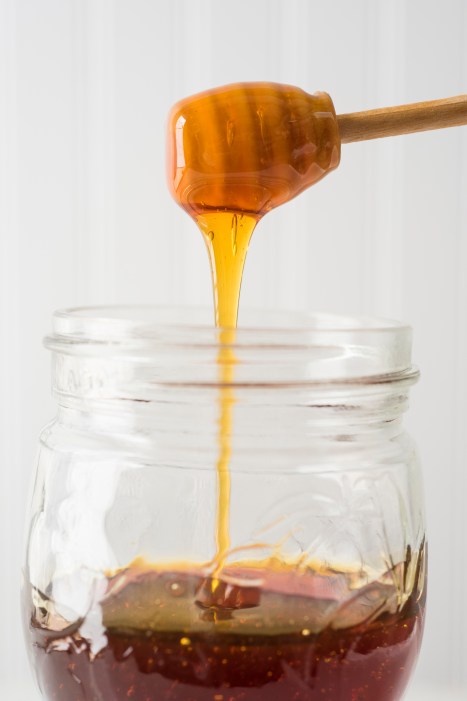
Honey Flow

Is it any wonder this stuff is referred to as liquid gold?

In the Western world, it’s common for new mothers to be told not to feed honey to infants under one year of age. This came about in the late 1970s because it is theoretically possible for honey to contain Clostridium botulinum bacterium, which could (again theoretically) cause infant botulism. It’s extremely rare, however, and after twelve months the intestinal system has matured so that the toxin will no longer pose a risk. Considering that the bacterium is commonly found in dirt and dust everywhere, and that we regularly advocate feeding infants formula containing monocropped GMO soybeans and yogurt laced with food dye and high-fructose corn syrup, this warning against one of nature’s true pure foods seems a little panicky. As we’ve discussed, however, we love to identify a single villain rather than target the entire compromised system. Invariably we ignore all sensible advice to the contrary.

Honey Jars.jpg

Notice the different colors; darker honey is typically stronger in flavor than lighter.

If you have the space and the inclination, please consider starting your own backyard hive. Like chickens, it’s a lot less work than people think, and the rewards are more than worth the effort. If having your own hive isn’t practical, seek out the best local honey you can find and support your local beekeepers. A farmers’ market is often a great place to find local honey, or you can try this site. If you’re buying honey at the grocery store, read the label carefully: in Colorado, I’ve seen “local honey” on products from California and other states. That might have been local when it was collected and packaged, but it’s also a very easy way to mislead consumers into paying more. Be a conscious consumer.

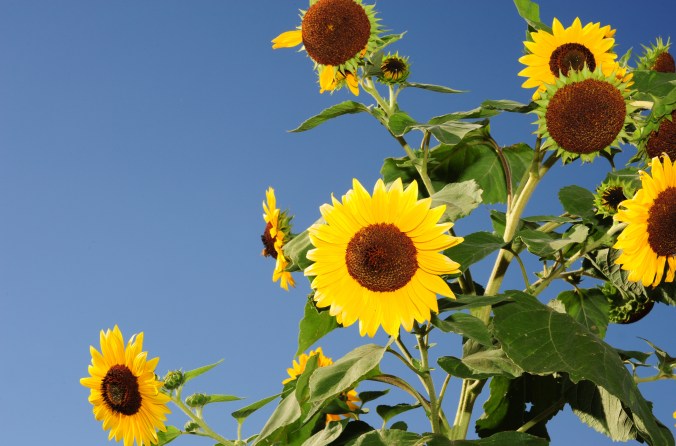
Sunflowers

It’s easy to feel overwhelmed when faced with critical issues of this scale, but this is actually one where small actions can make a difference. Want to learn more about pollinators and how you can help? Go here, here and here.