Food swap

Friends, good day to you! We’ve been in absentia over here at FQF HQ for a few weeks now, as we’re in the trenches of selling our current miniature urban farm and deciding where we’re headed next. These sorts of grown-up activities are simply not for the faint of heart. This is our first home and therefore our first home sale, and the entire process has been much more challenging and elaborate and tricky and bittersweet than we imagined. But enough of all that! Let’s discuss delightful food-focused activities! How about food swaps?

food-swap-14-sml.jpg

Food Swap 13 sml

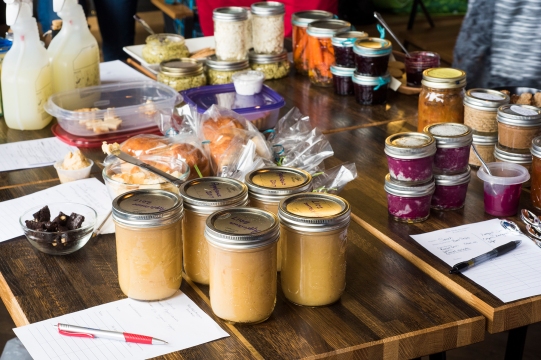
What is a food swap, you might ask? Well, it’s an incredibly fun community event where a bunch of like-minded gardeners, canners, cooks, bakers, hunters and other food-loving people come together to eat, drink and trade homemade treats. The concept is pretty simple: bring five or more of your own homemade goods and go home with the same number of other people’s delicious contributions.

Food Swap 11 sml

Our community table set up for the swap.

Food Swap 05 sml

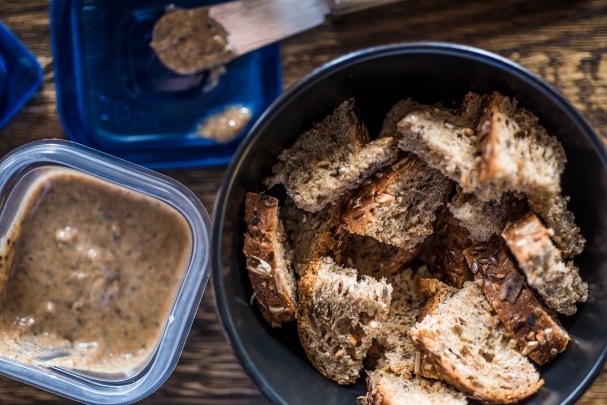
Almond-flax butter ready for sampling.

Continue reading

Sausages and laws

One of the toughest things about deciding that you want to become a farmer (especially when you decide this in your late 30s) is that you can’t really go to Farm School, mostly because it doesn’t exist. Farming used to be a profession passed down from generation to generation; farms stayed in the same family for decades, and sons and daughters learned how to care for animals and grow food and nurture the land from the time they were tiny. This is so much not the case any longer.

Advocacy 01 sml

We named February our Month of Education, and so in our pursuit of self-designed Farm School, we attended just about every single course, seminar, conference, talk or networking event geared towards farmers and ranchers in Colorado. We’ve been to a lot of classes since we started seriously planning Quiet Farm three years ago, but this past month took our education to a new level. We went to a grantwriting course and Alfalfa University and a tax planning class and a potluck farm forum and toured a hydroponic farm and a million other events. And we went to the State Capitol, too.

Advocacy 03 sml

Continue reading

The Farm Series: Rebel Farm

Friends, we don’t want you to think that all we do is trek around wintry European countries, eating schnitzel and drinking wine. No, sometimes we also visit delightful urban hydroponic farms and we eat handfuls of just-harvested fresh greens. Balance. It’s all about balance.rebel-farm-01-sml.jpg

Rebel Farm 05 sml

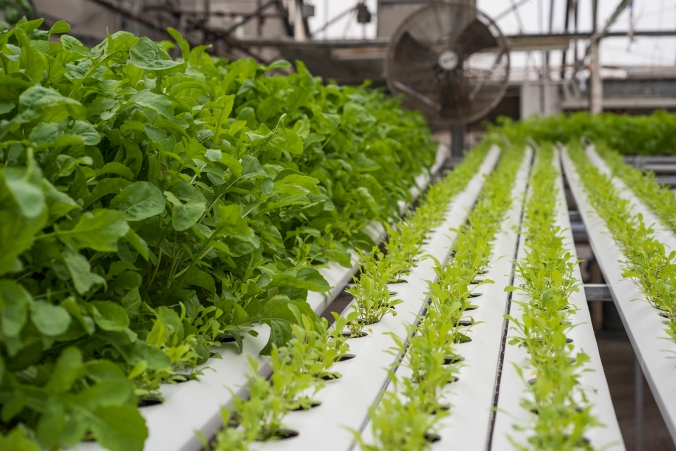
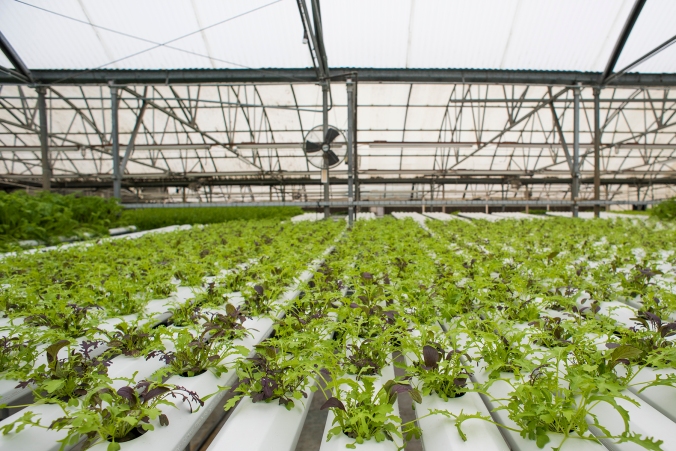
Rebel Farm, run by Jake and Lauren, is a 15,000 square-foot hydroponic greenhouse on the border of Denver and Lakewood. For those readers who live in Colorado, you may well wonder how these fine folks can afford to grow lettuce, rather than weed, considering that just about every greenhouse in the state has been snatched up by the marijuana industry. In the case of Rebel Farm, however, the greenhouse is perfectly situated between two schools – which means it cannot be a grow operation, and instead it can grow food. Brilliant.

Rebel Farm 19 sml

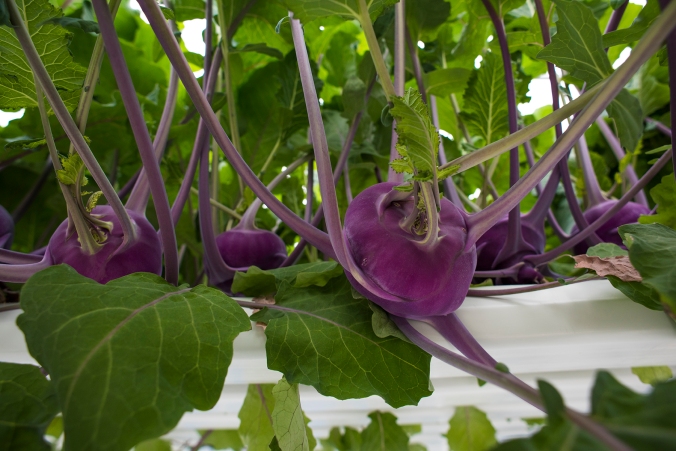
Purple kohlrabi, sadly underappreciated by CSA members everywhere.

Rebel Farm 08 sml

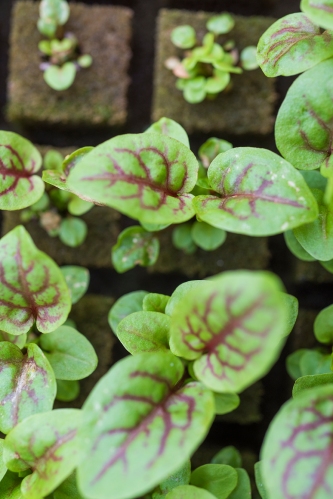
Tangy, citrusy red sorrel.

Rebel Farm 04 sml

If you’re not familiar with hydroponics, don’t feel alone. In its simplest form, hydroponics is a method of growing plants without soil. The plants can be planted in gravel, sand or other inert materials, or their roots can be suspended in a nutrient-rich water mixture. There are lots of different ways to grow hydroponically; Rebel Farm uses the NFT, or nutrient film technique, method.

Continue reading

Scouting trip

For a site called Finding Quiet Farm, we don’t actually write that much about finding Quiet Farm. This isn’t because we’re not looking, but because we haven’t found much worth sharing. Farmland in the U.S. is bulldozed and paved over for housing developments and shopping malls at a staggering rate of forty acres per hour, and the land that is available tends to be just a touch out of our price rangeWe spent a month in Oregon this fall, volunteering on farms and looking for our own place, but ultimately decided that Oregon wasn’t our home. We drove back to Denver through Colorado’s Western Slope, and decided to give that part of the state – previously ignored – a closer look in the new year.

Colorado sign sml

The first week of 2018 saw us westbound from Denver crossing the high mountain passes, which was easy instead of treacherous because winter in Colorado was canceled this year. We visited Grand Junction, Delta, Montrose, Olathe, Hotchkiss and Paonia, areas famous for peaches and sweet corn and cherries and the center of Colorado’s nascent wine industry, too.

Car sml

Our trusty road trip car. (Just kidding.)

Over the course of three long, intense days, we saw maybe a dozen properties. Most, of course, were discarded immediately: rickety house in need of extensive, costly renovation, sketchy neighbors, too much infrastructure devoted to horses, odd adobe construction, property too close to busy roads. But there were two in particular that caught our attention: one forty-acre parcel just outside of Grand Junction, a reasonably major population center, and one in a tiny apple-growing area just up the Grand Mesa, the largest flat-topped mountain in the world.

Orchards

Apple trees with protective winter coverings ready for use…if winter ever appears.

Continue reading

Saddle up

Howdy, pardner! Are you one of the over twelve hundred people who relocated to Colorado last month (just like every month for the past three years or so, which makes us one of the fastest-growing states in the country)? If you’re new here, you might not know that January means only one thing in our town, and that’s the National Western Stock Show. Never been? Get your boots on and let’s go.

Cowgirl Flag sml

“Ladies and gentlemen, please remove your hats and stand for our national anthem.”

Posters sml

For a long time, Denver was embarrassed about its cowtown reputation. We were embarrassed that we weren’t seen as elegant and sophisticated, like New York or Los Angeles. We were embarrassed that we didn’t have fancy restaurants but instead had an abundance of steakhouses, particularly classy joints where they’d cut your necktie off. We were embarrassed that we wore blue jeans (pressed) and boots (clean) to just about every gathering, formal or not.

Continue reading

Food stamp challenge

One of the comments I hear most frequently in my cooking classes and presentations is that “it’s impossible to eat healthy on a budget.” I wholeheartedly disagree with this statement, and to prove my point, I decided N and I would take part in the Food Stamp Challenge. In Colorado, the challenge is organized by Hunger Free Colorado; your state will have different resources available.

While SNAP (Supplemental Nutrition Assistance Program) benefits vary from place to place and family to family, in Colorado food stamps amount to approximately $4.20 per person, per day. That amounts to $1.40 per meal, if you eat three meals a day, or about $29.40 per week; that number encompasses everything you consume, including drinks and snacks. (Legally, you cannot buy alcohol, tobacco, lottery tickets or non-food products with food stamps, but unfortunately you can buy soda, energy drinks, candy, cakes, chips, cookies, ice cream and plenty of other unhealthy items.) This is going to take some planning, and some smart shopping.

Here’s the tricky bit, though: SNAP benefits can’t be used for any sort of takeaway food, and can’t be used for anything consumed within a store. So no prepared deli items, no to-go coffees, no rotisserie chickens. It’s easy to see why smart hunger relief experts advocate cooking classes along with SNAP benefits; to make the most of this program, you really need to know how to cook from scratch.

Since my household comprises two adults, I’ll allot us a total weekly budget of $58.80. And since I want to play in the most honest way possible, I’ll plan for the way we currently eat: we drink black coffee in the mornings but don’t eat an early-morning breakfast; we typically eat around 10AM and 4PM (it works for us). We also eat very little meat, so going mostly vegetarian won’t be much of a struggle; this budget definitely doesn’t allow for a lot of good meat. And we only eat at restaurants when we’re traveling, so planning and cooking all of our meals at home won’t stress us, either.

Food Stamp 05 sml

Scanning for sales is key to eating well on a budget.

A couple of other caveats about our food stamp challenge:

  • A challenge like this is necessarily a snapshot in time. We’re doing our challenge in December, which definitely makes most fresh fruits and vegetables harder to come by in our Rocky Mountain region – and they’re certainly not local, except for onions and greens! Fresh produce would be more abundant and less expensive in late summer.
  • To play fair, I am not using our backyard honey, or my own canned and frozen goods pantry. I have dozens of jars of applesauce, salsa, Western Slope peaches and other homemade canned goods, plus lots of produce in the freezer, but since I can’t truly ascribe a dollar value to these, we’re not eating these during the challenge.
  • I refuse to dramatically change our standard eating style in order to adhere to the budget; I’m not going to add cheap meat or nutritionally devoid, high-sugar cereal to our shopping list just to have something on the table. That isn’t what we eat now, and I believe the point of this challenge is to make fresh, delicious, nutritious food on a limited budget – not to just eat for the sake of eating.
  • As mentioned above, we’re a household of two healthy adults, and we only eat two meals a day. Your own household’s food stamp challenge will look very different, but we would love to hear about it!
Food Stamp 03 sml

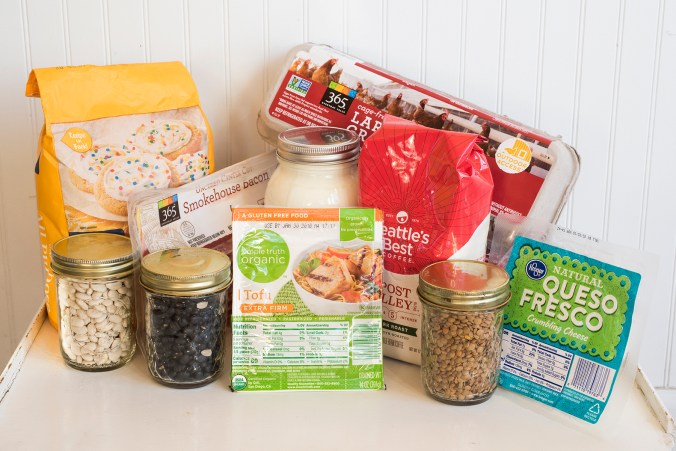
Some of our food stamp challenge ingredients. Embrace the bulk department.

Here’s what I bought for our challenge:

  • 12 oz. whole-bean coffee ($4.99, and it amounts to about $0.12 per cup. Worth every penny.)
  • 12 oz. animal-welfare certified bacon ($4.99)
  • dairy: 1 gal. local whole milk ($2.19), plain yogurt for starter ($0.59), 10 oz. queso fresco cheese ($2.49)
  • two dozen non-GMO cage-free with outdoor access eggs ($5.98)
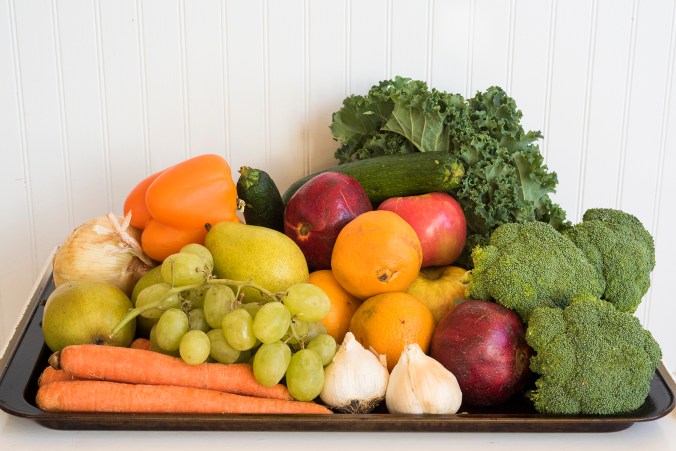
  • fruit: 3 apples ($0.98), 3 grapefruit ($0.99), 1 lb. grapes ($0.97), 6 kiwi ($0.99), 3 pomegranates ($0.99), 3 pears ($0.98), 8 satsuma clementines ($1)
  • grains and legumes: 0.5 lb. dried black beans ($0.85), 0.5 lb. brown rice ($0.35), 0.5 lb. dried chickpeas ($0.75), 0.5 lb. green lentils ($0.59), 0.5 lb. rolled oats ($0.35), 1 lb. linguine ($0.99), 0.5 lb. white beans ($0.99)
  • 1 lb. organic tofu ($1.79)
  • vegetables: 2 lb. broccoli ($1.76), 1 lb. carrots ($0.69), 1 bunch cilantro ($0.33), 12 oz. frozen corn ($1), 2 cucumbers ($1), 3 bell peppers ($0.99), 2 heads garlic ($0.66), 2 bunches kale ($1.98), 1 lb. yellow onions ($1), 12 oz. frozen peas ($1), 5 oz. salad greens ($1.69), 1 bunch scallions ($0.33), 3 zucchini ($0.99)
  • staples: assorted bulk spices ($1), 0.5 lb. roasted almonds ($2.99), corn tortillas ($0.99), 5 lb. flour ($1.79), 0.25 lb. roasted pumpkin seeds ($1.25), 3 packets yeast ($1.19 with coupon), hot sauce ($0.99)

Total spent: $58.41
Food Stamp 04 sml

Thanks to savvy shopping and the discount table, this is less than $10 of healthy, nutrient-dense fruits and vegetables!

And here is our simple seven-day menu plan; again, we start with a pot of black coffee and only eat two meals per day. For snacks, we eat fresh fruit or raw vegetables, plus a handful of almonds and pumpkin seeds.

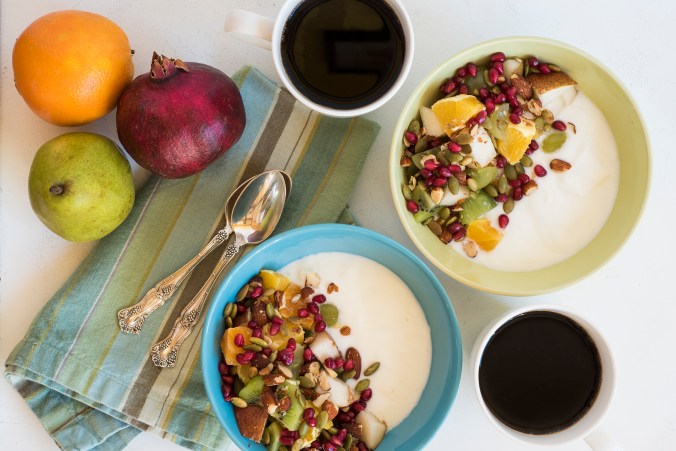
  • Day One: yogurt with fruit and almonds; white beans and sautéed kale with fried eggs; fresh bread
  • Day Two: breakfast tacos with eggs, zucchini, peppers, onions and queso fresco; tofu and broccoli stir-fry over brown rice; green salad
  • Day Three: oatmeal with fruit and almonds; pasta with bacon, garlic, zucchini and peppers; green salad; fresh bread
  • Day Four: eggs on toast with sautéed greens; lentil, vegetable and chickpea soup; green salad; fresh bread
  • Day Five: yogurt with fruit and almonds; frittata with vegetables, greens and queso fresco
  • Day Six: oatmeal with fruit and almonds; spicy black bean and corn soup; kale salad
  • Day Seven: huevos rancheros with leftover beans and rice; “favorites” (i.e. everything remaining from the week)
Cast Iron 05 sml

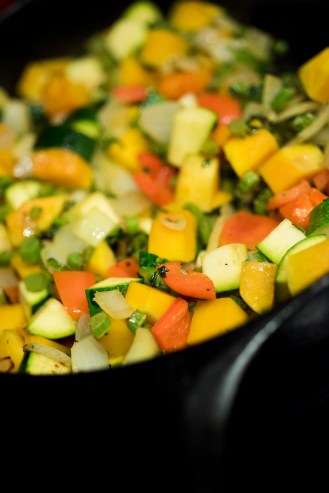
Remind me again why vegetables are boring?

My comments on the week:

  • Our menu wasn’t really that different from what we eat on a regular basis. Each day included at least four servings of various fruits and vegetables and usually more, plus grains and legumes. Virtually everything we ate was healthy, flavorful and made from scratch. We didn’t feel hungry or deprived, but I can easily see how someone accustomed to eating at restaurants and/or eating a lot of meat might find this challenge…well, challenging.
  • I chose bacon as our only meat for the week because it offers so much flavor in even tiny quantities. In addition to adding it to pasta and soups, I also used the rendered fat for sautéing vegetables and greens for extra savory punch. Skipping the bacon entirely would obviously leave about ten percent of the weekly budget for other items, but that’s a sacrifice I’m willing to make. I’d rather eat a small amount of good, flavorful meat than a lot of cheap meat.
  • I made four quarts of my own yogurt from one gallon of whole milk; the starter culture only has to be purchased once since you use a bit of your own yogurt as the starter for future batches. Plain full-fat yogurt made from good milk is a great source of quality protein, fat and calories, and dramatically cheaper than buying it premade.
Food Stamp 07 sml

Does it still count as breakfast if we eat at eleven o’clock?

  • I also baked my own fresh bread as I do now, both for health and economic reasons. Although one could claim that whole wheat flour would be a better choice for homemade bread, I would argue that any homemade bread is far better than what you can buy, and far cheaper. Plus, stale bread becomes croutons and breadcrumbs, which add extra value and flavor; storebought sandwich bread doesn’t go stale, it just molds. (I buy my yeast in one-pound bags for $2.99 from a local restaurant-supply store; this is far cheaper than three packets for $1.19, even with a coupon. If you bake bread regularly, buy your yeast in bulk.)
  • It’s virtually impossible to eat purely organic on a budget this tight. While I appreciate the virtues of organic, with so little money to spend I’d far rather eat more conventional fruits and vegetables than just a few organic ones. Value for money wins here, although some of the discounted produce was organic.
  • I did miss having access to a well-stocked pantry, specifically various oils, vinegars, cooking fats (including good butter), seasonings and condiments. It’s very easy to make delicious, healthy food by just dressing it up a bit, and citrus, spices and other flavor enhancers really come in handy.
  • I also really missed cheese. We eat a lot of cheese, both on its own and as a garnish for vegetables and grains, and while I love queso fresco, I really enjoy using a variety of specialty cheeses in almost every meal. Plus, good cheese can often be found at a discount at our grocery store, too!

Food Stamp 02 sml

Because we’re obsessed with aesthetic perfection and meaningless sell-by dates, it’s easy to find supermarket bargains.

Tips for success for your own food stamp challenge:

  • Flexibility is absolutely key. I bought what was on sale, rather than what I necessarily wanted. If you’re going to cook well on a budget, pay attention to store advertising circulars, clip coupons and learn to adjust your meal plan based on what’s available at a good price, rather than what you feel like eating.
  • Our local grocery store has recently started selling blemished or undersized produce at a discount. This produce made all the difference in our food stamp challenge; most of our fruits and vegetables came from this table, usually packed at three for $0.99. I also always search for items close to their sell-by date that the store is looking to offload at a discount; I’ve purchased a lot of healthy, cheap and still-good food this way (see photo above). Don’t ignore this option if you’re cooking on a budget.
  • Also, don’t ignore frozen vegetables. They are cheap, healthy and easy to have on hand, plus they were frozen when that vegetable was actually in season. Fresh vegetables aren’t always the best option, especially on a tight budget.
  • Shop the bulk department for grains, legumes and spices; skipping the inflated packaging makes a huge difference in price. Dried beans are far less expensive than canned, and they don’t contain excess salt, either. Soaking beans overnight takes virtually no time and a slow cooker makes preparing healthy food easy.
  • Search out local ethnic markets. I could have spent substantially less on produce and beans if I had gone to any one of our incredible Mexican markets here in Denver. I wouldn’t buy animal products there, but I’d definitely buy pantry staples.
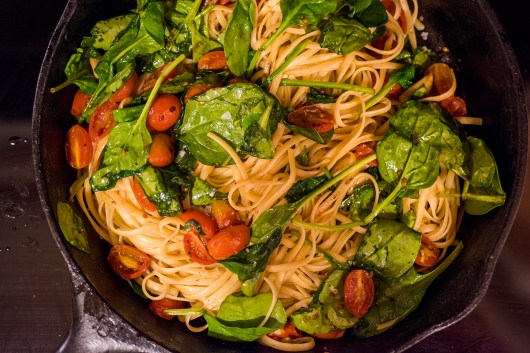
Food Stamp 01 sml

Pasta is oft-maligned, but it is quick, inexpensive, filling, and most importantly easy to pack with lots of vegetables.

  • Get a good knife and a good cutting board and learn how to prep your own fruits and vegetables. Paying for the precut product costs a lot extra and it’s already started to deteriorate, too.
  • Think nutrient-dense and lots of color: discounted spinach, sturdy kale or purple cabbage rather than cheap but nutritionally vacant iceberg; black beans over pinto beans. Whenever possible, choose the most intensely colored whole food (that Windex-colored Gatorade does not qualify).
  • And think high flavor, too. I used small amounts of bacon, sharp, salty queso fresco and crunchy nuts and seeds to add a lot of flavor and texture to our dishes. You don’t need much, but they add interest. I spent money on onions, garlic, scallions and cilantro, both because they’re healthy and because they add a ton of flavor and punch without spending a fortune. Growing your own fresh herbs is a great way to enhance your meals.
  • We had quite a bit of food remaining at the end of the week (both prepared and raw ingredients); this is partially why our final day incorporated “favorites.” If you want to eat on a budget, you have to make use of leftovers, too. Throwing away food is exactly the same as throwing away money.

Food Stamp 06 sml

Garlicky white beans and kale with fried eggs: pretty much perfect, in my opinion.

N pointed out that this challenge was easy for me, because I know how to prepare healthy, delicious food and enjoy doing so. While that’s certainly true, I would say yet again that the number-one best thing you can do for both your physical and your financial health is to learn how to cook, and cook often – whether or not you’re on a strict food budget. Take responsibility for your own health, and cook yourself some wholesome, tasty food. You don’t need to break the bank to do that.

If you choose to organize your own food stamp challenge, please share it with us!


A winter cake

It seems winter in Colorado has been canceled this year, considering that it was nearly seventy degrees (21C for our international audience) when we took these photos. In December. And on one hand, this is delightful, because driving in the snow is truly one of my least favorite activities, despite being a born-and-bred Colorado native. And on the other hand, these disconcerting weather patterns freak me out in a serious fashion. But I’m working on my anxiety, and my ability to “accept the things I cannot change.” So let’s make a cake.

Pom Ginger Cran Cake 01 sml

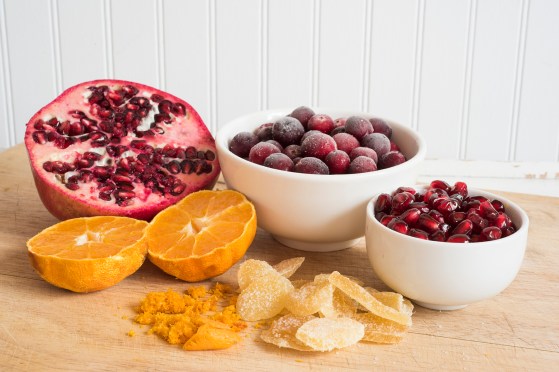
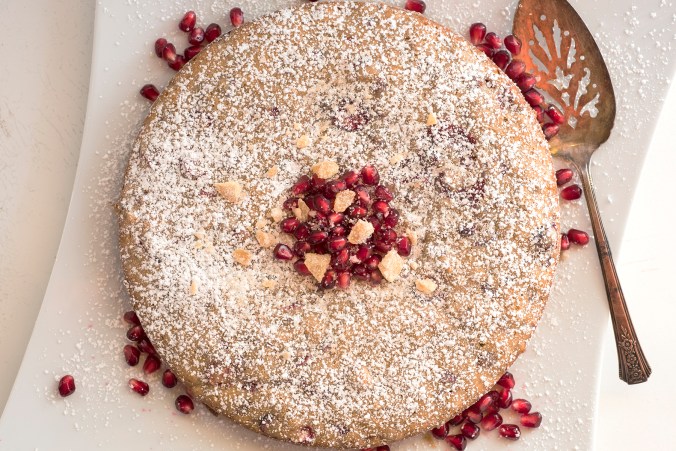
This lovely cake has all the flavors of winter: tangy, bright cranberries and citrus, plus sharp, spiky ginger. And pomegranates. Oh, pomegranates. Is there any fruit I adore more? I think not. When these babies are in season, as they are now, I often eat one a day. Somehow their tart sparkle seems to apologize for the misery of endless winter – or whatever season it is we’re currently having. The cake isn’t excessively sweet, either, which pleases me; if you had a strong, dark honey on hand, I imagine that might be compelling here.

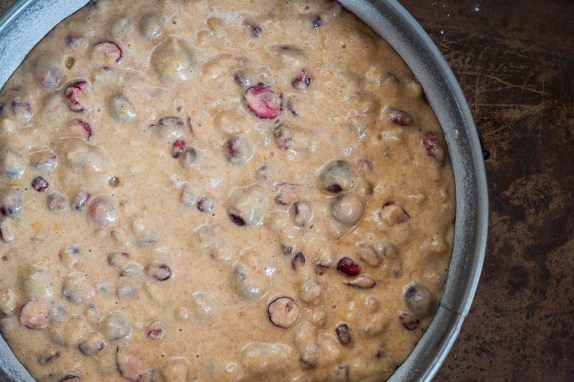
Pom Ginger Cran Cake 03 sml

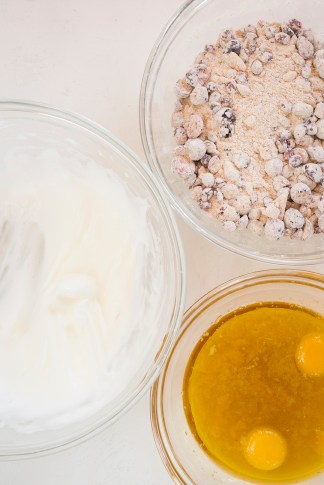
Any time you’re making a light, delicate cake, friends, please be careful not to overmix the batter – it’s a sure way to achieve dense, tough gumminess. This is even more key when baking at altitude, as we are here. Assemble all of your ingredients in advance, then place your liquids in one bowl, your dry ingredients and the fruit in another, and whip the egg whites at the very last minute, when everything else is ready. Never pre-whip your egg whites then go back to put together the other components – their ethereal fluffiness is exactly what you need. (Tossing dried, fresh or frozen fruit with flour helps keep it from sinking to the bottom of the cake, and from bleeding its juices, though that effect can actually be quite pretty. If you’re using frozen fruit, never let it thaw first but just throw it in frozen. And move quickly.)

Pom Ginger Cran Cake 04 sml

As before, make sure your pan is prepped and your oven is preheated. Once the batter is together, it needs to go straight into a hot oven. This is not the time to dilly-dally.

Pom Ginger Cran Cake 05 sml

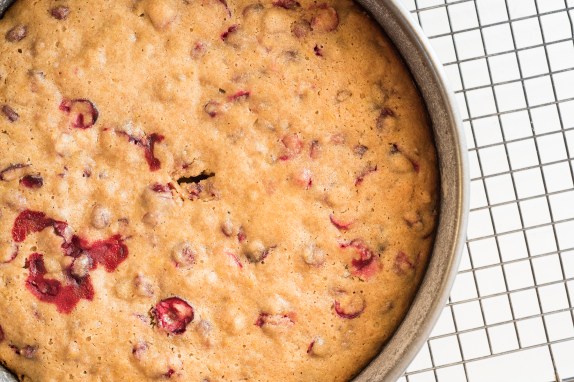
This recipe as written makes for quite a moist cake, which is lovely here in Colorado as it stays fresher for longer in our dry climate. I reduced the leavening by 1/4 tsp. and added 1/4 cup extra flour, as is often done when adjusting baking recipes for altitude. If you’re at sea level, you may need to use a total of 3/4 tsp. baking powder. You can probably reduce the whole wheat pastry flour by 1/4 cup at sea level, too. Make sure to check carefully for doneness with this cake; I found that I needed a bit more baking time than the recipe indicates. Ovens vary; adjust accordingly.

Pom Ginger Cran Cake 06 sml


Pomegranate, Cranberry and Ginger Cake (written for 5,300 ft. elevation)

For The Cake

  • 1/2 cup honey
  • 1/4 cup mild olive oil
  • 2 large eggs, at room temperature, separated
  • 2 tbsp. freshly grated orange zest
  • 1/3 cup fresh orange juice
  • 5 tbsp. crystallized ginger, chopped
  • 1 1/4 cup whole wheat pastry flour
  • 2/3 cup all-purpose flour
  • 1/2 tsp. baking powder
  • 1/2 tsp. salt
  • 1/2 cup fresh or dried cranberries
  • 1/2 cup pomegranate seeds, plus more for garnish
  • 2 tsp. confectioner’s sugar for dusting
  

Directions

Preheat oven to 350 degrees. Butter and flour an 8-inch round cake pan; line with parchment paper and butter and flour the parchment.

In a small bowl, stir together honey, olive oil, egg yolks, zest, juice and 3 tbsp. crystallized ginger. In a large bowl, sift together both flours, baking powder and salt. Gently fold cranberries and pomegranate seeds into dry ingredients. In another bowl, beat egg whites and a pinch of salt with an electric mixer until soft peaks form, about 1-2 minutes. Using a rubber spatula, gently fold honey mixture into flour mixture, then fold in egg whites until combined. Do not overmix.

Pour and scrape batter into prepared pan and bake until toothpick inserted in center comes out clean, about 35 minutes. Allow cake to cool on a wire rack for at least 10 minutes; run a knife around sides of pan to loosen cake and turn it our onto rack. Remove paper and allow to cool completely.

To serve, sift confectioner’s sugar over cake and garnish with remaining crystallized ginger and additional pomegranate seeds.

Eating healthy on the road

Oh, the quintessential American road trip. Our country’s iconic open highways have been immortalized in so many classic movies, like when we thought “the Rocky Mountains would be a whole lot rockier.” Or perhaps you need to bootleg a few Coors Banquets from Texas to Georgia? Maybe two legendary ladies in a ’66 T-Bird is more your style? Whatever your favorite road trip film might be, there is no arguing that eating healthy while driving American highways is no easy feat.

IMG_20171014_101120147

Hello Wyoming, and thanks for inventing cruise control. (Photo may have been taken in 1987 or 2017. With filters, who knows?)

I like to move food. It’s my thing. Whenever we leave our house, it’s a guarantee that there are a few canvas shopping bags and maybe a plastic tub or two stacked by the door. We go to my sister’s for dinner and I bring jars of homemade applesauce, fruit leather for my niece (also known as “repurposed jam”) or gorgeous cheese from these lovely folks. My book club ladies leave with end-of-the-garden produce, dinner leftovers and more cheese. And if we’re off on a trip, whether by car or by plane, I simply will not be held hostage by the American industrial food complex.

IMG_0764

Mmmm…McDonald’s or Cinnabon? Why not both?

The vast majority of food in this country is based on two key ingredients: corn and soy. We are very, very good at growing corn and soy, and even better at turning it into cheap meat, soda and processed food. And these “edible foodlike substances” are most of what’s on offer at your standard convenience store or truck stop. And to add insult to injury, it is absurdly priced! I will not play by those rules.

IMG_20171016_204714

Example A, above. Look! It’s a $2.79 “meal replacement bar!” You know, so we don’t have to eat an actual meal! Can you read the first ingredient? It’s soy protein isolate. The second ingredient is sugar, and the third is soluble corn fiber. If all of your standard meals are composed of soy, sugar and corn, then by all means, please choose this as a meal replacement. But this is just one of many examples of a giant, powerful marketing machine that has convinced the American public that we 1. don’t have time to cook and 2. can eat some junk like this with “PROTEIN” printed in large font and call it a meal. No, no and no.

IMG_0760.JPG

Absolutely no actual food was harmed in the making of these edible foodlike substances.

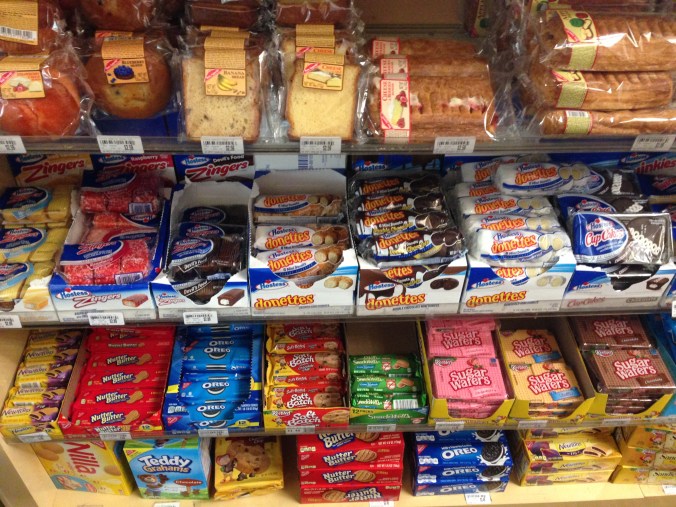
If you’re on a road trip, whenever possible get off the highway and into a town supermarket. Gas stations, convenience stores and truck stops are by their very nature stocked with cheap, non-perishable food, so that’s what you’ll buy. Their staff has neither the time or inclination to stock and then dispose of fresh fruit, vegetables and meat, so instead you’ll encounter a display like the one above. If you can make it away from the interstate and into a small grocery store, you’ll hopefully have access to a much better selection of food.

IMG_20171015_122515762

I genuinely pity the poor animals who died to make these “meat sticks.” (Also, “thungry?” Is this like “hangry?” Notice that it’s trademarked.)

NJB_0687.JPG

Part of our road trip survival kit.

So what’s a person to do in the face of this pretend food trash? Easy answer: plan in advance. Just like cooking healthy food at home, eating well on the road requires a bit of time and planning. But if you’re already doing other pre-road trip tasks like checking your tire pressure and refilling your windshield wiper fluid, why not get some healthy food in order? For me, it’s mostly shelf-stable items, plus a few perishables in a cooler. My basic road trip essentials, most of which are easily found in the bulk section of a good supermarket:

  • stellar cheese and good crackers are mandatory
  • dried fruit, including figs, apricots and homemade fruit leather
  • fresh fruit that can last, such as citrus and apples (no berries or bananas!)
  • homemade granola, to eat on its own or with purchased yogurt
  • jerky, either homemade or from well-raised animals
  • nuts, which for us are typically roasted salted almonds
  • rice cracker mix, pretzels or other reasonably healthy salty snacks
  • homemade granola or energy bars, or packaged bars with clean labels (be able to pronounce and understand every single ingredient, and the first three ingredients shouldn’t be soy, sugar and corn)
  • good-quality dark chocolate, preferably without soy lecithin

And for equipment:

  • without question, a good chef’s knife and paring knife, protected in sheaths, and a small polypropylene cutting board.
  • we bring our own coffeemaker, grinder, beans and mugs. We sleep cheap, and I’m not drinking Motel 6 coffee. Not negotiable.
  • cutlery rolls, which include an inexpensive metal fork, knife, spoon, reusable straw and corkscrew. We don’t use single-use items, with the exception of compostable paper napkins.
  • Mason jars with screw-top lids and a few plastic containers. These can be used for drinks, storing snacks or to eat meals.
  • a wooden spoon, rubber spatula and metal tongs
  • a small electric burner plus a frying pan and mini stockpot. This makes meal prep on the road easy – and more importantly – possible.

In all honesty, at various stops along this trip I did notice small containers of cut fresh fruit, hardboiled eggs and some seemingly fresh sandwiches and wraps, which indicates that demand is shifting. But there is no guarantee that every gas station will have these, and if you pack your own food you’ll have a much better selection and save a ton of money. I saw two packaged hardboiled eggs priced at $1.99; with a cooler and ice packs, a dozen well-sourced hardboiled eggs, flaky salt and hot sauce can easily be brought along for about $4 and a few minutes’ work in advance. There is simply no one thing you can do to improve both your physical and financial health more than planning, cooking and bringing your own food. Enough said.

Friends, please remember that your health is your responsibility, and what you choose to eat makes a huge difference in your health. Take some time prior to your next trip and bring food along, and stand in opposition to a system that insists you have to eat what it offers.


Backyard chickens

We have made no secret here at Finding Quiet Farm of our love for backyard poultry. Honestly, what is there not to love?

Black Star

A Black Star from our most recent flock.

They monitor the rodent population. They keep weeds under control. They are ridiculously entertaining. And most importantly, they turn food waste into incredible eggs.

Pullet Silver Wyandot 01

Our young Silver Wyandotte pullet at about six months.

Pullet Barred Rock 02

Lovely, but these chickens are NOT supposed to be in these raised beds.

Okay, sometimes they (repeatedly) escape the run you’ve so carefully built and they eat your tomatoes. But the eggs are worth it, we swear.

chickens4

A Barred Rock (upper left) and a Silver Wyandotte.

chickens2

A strong, proud Australorp, one of our favorite breeds.

We’ve had two flocks now at our suburban home, and we encourage the entire universe to keep backyard chickens. They’re less work than dogs or cats, with more reward. They need food, clean water and shelter, of course, plus the ability to run around and eat bugs and weeds and kitchen scraps and what-have-you, and they need protection from predators. Where we live, those are unfortunately rampant – hawks, owls, raccoons, foxes, dogs – but thanks to N’s superlative coop-building skills, we never had a single bird taken.

chickens1

The windfall apple clean-up crew.

If you’re thinking of adding chickens to your family homestead, check your local regulations first. We’re allowed five hens and no roosters where we live, but laws vary widely from city to city. Know what you’re buying, too; many a rooster has ended up abandoned at a shelter because it was sold as a hen. It’s not common knowledge, but you don’t need a rooster to get eggs – and they’re illegal in most communities.

Garden Snow 02

Winter is coming. Seriously. And the chickens need to stay warm.

If you live in a particularly cold area, make sure to buy cold-hardy breeds and that your coop protects your birds from winter drafts. It’s actually easier for birds to stay warm than cool (those trusty feathers) but icy winds can be very detrimental to their health. When planning your coop and run, keep in mind that chickens also need adequate shade in hot summer months. Keeping their space clean and dry doesn’t take much time or effort, and you’ll be amply rewarded.

chickens3

Chickens are not vegetarians, no matter what your egg carton says.

Oh, the “vegetarian-fed hens” you see advertised on your egg cartons? They’re only vegetarian because they’re crowded into miniscule cages and don’t have the opportunity to eat what they actually want to eat, which is mice. And bugs. And lettuce. And sandwich crusts. And overly ripe peaches. And leftover sausage bits. And the aforementioned tomatoes. Chickens are omnivores, not vegetarians. Please remember that the next time you buy eggs, and don’t be swayed by meaningless packaging terms – or by bucolic pictures of peaceful, verdant farms. In the U.S., at least, laying hens have by far the worst lives of any production animal.

Chicken eggs

Small pleasures: collecting still-warm eggs from nest boxes.

None of the other labels on your egg carton mean anything either, by the way. Whether “farm-fresh” or “natural” or “pasture-raised,” not one of these is regulated by any governing body. You can pretty much slap whatever you want on an egg carton and call it good, and people will pay more for pretty words that make them feel better. “USDA Organic” is actually regulated – if they can find enough inspectors to do some real inspecting – but it only indicates that the chickens consumed organic feed, not that they had any sort of decent life. Well over 95% of all commercially produced eggs in the U.S. were laid by hens who lived their entire lives in less space than a standard piece of paper. They never went outside, they never hunted or pecked, they never dust-bathed,  they never saw sunlight or grass, they never even flapped their wings because they didn’t have enough room. That’s why eggs are cheap, and also why salmonella outbreaks are rampant. Bottom line: buy your eggs from someone you know.

Eggs Thai pink

Eggs for sale at a Thai market.

Americans are often shocked when eggs in Europe and elsewhere in the world aren’t sold in the refrigerated section. Yet another example of our obsession with “safety” and “hygiene,” in this country we wash all eggs prior to shipping and sale at grocery stores, superstores and warehouses. This removes the protective coating that eggs are laid with, and reduces their shelf life, thereby requiring refrigeration. Eggs in the rest of the world aren’t washed until they’re used, and so can be stored at room temperature.

Eggs Basket

Although brown eggs will cost you more at the grocery store, there is no nutritional difference. The color of the shells is determined by the chicken’s breed, not by what it eats or where it lives. Most supermarket eggs are white because they were laid by Leghorns, the most common breed in the U.S., whereas brown supermarket eggs were probably produced by Rhode Island Reds. Blue and green eggs come from Araucanas and other unique breeds. You’re not getting any extra nutrition by paying for brown eggs.

Eggs Comparison

There really is a difference between eggs laid by battery hens and those laid by true free-range birds. Notice the backyard egg, on the right: the white is thicker, with more color and viscosity, and the yolk is definitely more yellow. This indicates a varied diet, including foraged protein.

Eggs Frying Pan

And when they’re cooked, the backyard egg (again on the right) stays true and tall, but the battery egg sort of melts. Supermarket egg yolks are weirdly chalky and sticky when cooked, while backyard eggs have a buttery creaminess. The taste difference, honestly, is night and day. Good eggs taste the way eggs ought to taste, instead of some insipid manufactured version thereof.

Eggs

According to legend, the one hundred pleats in a chef’s hat represent the number of ways they know how to cook eggs.

Whether or not you keep chickens at home, know that eggs from well-kept hens are one of the best inexpensive protein sources available. Ask at your local feed store or farmers’ market to find eggs raised near you and support backyard poultry, or start your own flock! Go here to learn more.


Cookbook Club: Full Moon Suppers

It will come as precisely no surprise to any of you that I have what some might consider an excessive cookbook collection. I try to keep it pared down – honestly, I do – but then every October the local library has their annual book sale where you get to fill shopping bags for $6 each and I just lose any ability I might once have had to act like a rational adult. It’s true. And no one will ever, ever help us move.

Peach Cake Cook Book.jpg

Not long ago, this cookbook crossed my path, and it is pure and simple and lovely. As a professional chef, I know that most cookbooks are used by home cooks, and therefore I am infuriated (not too strong a word) by gorgeous, glossy, overproduced cookbooks with fabulous photos where the recipes don’t actually work. Home cooks, especially those just starting out, don’t need perfect photos of airbrushed superstars (or blog stars) happily munching on avocado toast. What they need are clear, easy to-understand recipes that have been tested many times, in many kitchens (preferably home kitchens), with variable equipment. And possibly not all of the correct ingredients.

Peaches Garden.jpg

The last of the season’s stone fruit. 

Annemarie Ahearn has been cooking and farming on her family’s property overlooking Penobscot Bay, Maine, since 2009. As she says,

“I had not moved to Maine on a whim. My plan was to open a cooking school for home cooks and teach people how to grow a kitchen garden. The mission of the school aligned with my personal ambition, which was to fundamentally change my daily routine. City life, while rich with professional opportunity, did not feed my soul in the way that I was hoping a more rural life would. And what better place to experience nature than on a farm, nestled between the mountains and the sea? So many skills that my grandmothers and generations prior to theirs possessed I did not know the first thing about. Chopping wood for warmth, putting up preserves for winter, catching a fish for dinner and raising laying hens for eggs were all efforts that I wanted to experience firsthand.”

The book is broken into twelve menus, appropriately themed to the twelve months of the year. Her recipes are simple, seasonal and easy to follow, and every single one pays homage to the land above all else. I can’t get the quality of Maine lobster that she has, nor fresh periwinkles, but there are plenty of recipes here that could easily be made across the country, depending on the season. We haven’t been to Salt Water Farm (yet), but we feel a definite kinship between the cooking and farming life Annemarie has forged for herself on Maine’s rocky, windswept coast and the cooking and farming life we want to build at Quiet Farm, wherever that may be.

Tomatoes Green.jpg

Please ripen before first frost hits…

I’ll be completely honest and say that I’m a little late on this post, but truly that’s only because I was (im)patiently waiting for our tomatoes to ripen so I could make a glorious summer salad. Salt Water Farm has a short growing season too; they treasure their warm-weather peaches, tomatoes and corn just as we do at nearly six thousand feet in the Rocky Mountains. You work with what you have.

Lovage G&T.jpg

Cocktail hour is my favorite hour!

Each of the twelve menus in Full Moon Suppers starts with a paired beverage. N and I really only partake of gin-and-tonics in summer; they seem to suit the weather so well. I’ve seen a couple of recipes this summer encouraging the use of lovage in a simple syrup to add to G&Ts or sparkling water; since I have an abundance of lovage that I leave for the bees every year, I thought I might as well use it. The syrup is truly simple: combine two cups water, two cups sugar and bring to a boil. Add eight cups roughly chopped lovage, remove from heat and allow to cool completely while lovage steeps. Strain into a clean quart jar and store in refrigerator. It’s herby, grassy and deeply refreshing, whether in a cocktail or sparkling water. I’m surprised by how much I like it.

Tomatoes Tray 02.jpg

Tomato Cucumber Salad.jpg

I know that I said previously that once you finally have ripe tomatoes, you should only anoint them with olive oil and salt. But really, you should also find some amazing local sweet corn (I froze all my excess from this event) and some fresh cucumbers and you should make this salad. It has a simple vinaigrette made with lemon and mustard and honey and red wine vinegar, and honestly, it tastes like summer in a bowl. This is not a salad you’d make any other time of the year – only when the ingredients are at their absolute very best. And that window of opportunity is very swiftly closing.

Peach Cake Recipe.jpg

Peaches Tray.jpg

And then there’s the peach cake, although in my world it’s a peach and nectarine cake, plus I added almonds to complement the almond flour and for extra crunch. Oh, and I just served it with mascarpone rather than sweetened whipped cream. (It’s exceedingly difficult for me to follow recipes exactly.) But this one is worth the time and effort, and even though it takes forever to bake, you’ll be rewarded. The butter creates a gorgeous, rich crust, but the interior is as soft as a dream. And this would work beautifully with home-canned peaches, too, should you be so inclined, so you can make it more than two months of the year.

Peach Cake Uncooked.jpg

Peach Cake Cooked.jpg

Peach Cake.jpg

Peach Almond Cake with Mascarpone

Chef’s Notes: As mentioned above, I included 1/2 cup slivered almonds in the batter; incorporate these with the dry ingredients in the first step. I used a combination of ripe peaches and nectarines, and I served the cake with just a dollop of this plus additional sliced fresh peaches and nectarines on the side. No additional alterations are needed to bake this cake in the Denver area, although above 7,000 feet you may wish to make adjustments. This cake counts as breakfast, in case you’re wondering.

For The Cake

  • 1 cup all-purpose flour
  • ½ cup almond flour
  • ½ tsp. sea salt
  • 2 tsp. baking powder
  • 9 tbsp. unsalted butter, softened to room temperature
  • 1 heaping cup sugar
  • 3 extra-large eggs, at room temperature
  • 1 tsp. vanilla extract
  • ¾ cup cream
  • 4 large, pitted peaches, thinly sliced
  • 2 tbsp. melted butter

For The Cream

  • 2 cups heavy cream
  • 1 tbsp. sugar
  • ½ tsp. vanilla extract
  • ½ cup mascarpone
  • confectioner’s sugar for dusting
  

Directions

Preheat the oven to 375°. Line the bottom of an 8-inch springform pan with a round of parchment paper. Butter and flour the sides of the pan.

In a medium bowl, combine the all-purpose flour, almond flour, salt and baking powder. With a stand mixer fitted with the paddle attachment, whip together the butter and sugar. Incorporate the eggs one at a time, whipping well. Whip in the vanilla extract. Mix in a third of the dry ingredients, then a third of the cream. Continue alternating the dry ingredients and cream in thirds, scraping the sides of the bowl in between additions.

Pour the batter into the prepared cake pan. Spread the peach slices on top and press them into the dough. Brush with melted butter. Bake for 1 hour, or until the cake has set and turned golden on top. The cake is done when you insert a toothpick into the center and it comes out clean. Allow to cool on a rack; serve slightly warm or at room temperature.

Using your stand mixer fitted with a whisk, whip the cream with the sugar and vanilla extract until soft peaks form. Fold in mascarpone.

Serve slices of cake on individual plates with a generous spoonful of cream and a dusting of confectioner’s sugar on top.

(All recipes reprinted with permission from Full Moon Suppers at Salt Water Farm by Annemarie Ahearn and published by Roost Books, but the photographs are N’s!)