The FAQ Series: Sugar, Part Three

We promise that this is our last post on sugar (for now). As you’ll remember, in this three-part series we’ve already talked about sugars you have at home and sugars used by the food processing industry. Now, let’s discuss how the sugar industry has worked so hard to convince us all that sugar is not only benign, but actually good for you!

Sugar 16 sml

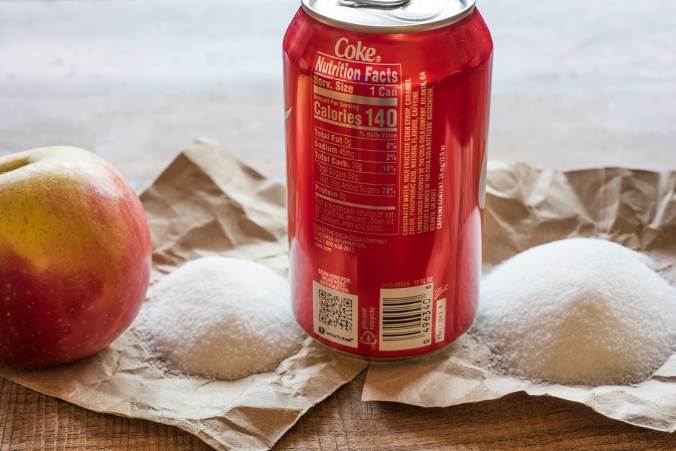
Before we get into the sugar industry, we’d like to clarify exactly what we mean by added sugars. An added sugar is any quantity or type of sugar that doesn’t naturally occur in a specific food. A perfect example of this is applesauce: in its simplest form, applesauce is made by cooking apples until they’re soft, then mashing or puréeing them. Lots of ingredients can be added to applesauce, including spices like cinnamon and acidifiers such as citric acid to preserve color. Fresh apples contain plenty of natural sugar; primarily fructose, but also sucrose and glucose in small proportions.

Most store-bought applesauce, however, includes added sugars, in the form of high-fructose corn syrup, honey or any of the other sweeteners we’ve mentioned. So if that applesauce label were adhering to the now-abandoned revised nutrition labeling laws, it would have to list both the naturally occurring sugar in the apples, plus all of the sugar added by the manufacturer. Hopefully this clarifies the concept of added sugars – it doesn’t occur naturally in the food or drink.
Sugar 09 sml

Both the apple and the soda contain sugar, but all of the apple’s sugar occurs naturally. All of the soda’s sugar is added.

The sugar conspiracy is one of the most significant health-related stories to appear in the news recently. Essentially, the claim is this: fifty years ago, the sugar industry funded studies on the potential correlation between sugar and heart disease. When preliminary studies did appear to confirm this link, the studies were shut down, and research findings were concealed. The Sugar Research Foundation also reportedly paid Harvard scientists to obscure the link between sugar consumption and heart disease, pushing them to blame saturated fats instead.

And that, friends, is one reason why we’ve spent decades being told not to eat bacon, eggs, butter, cheese or burgers – because they cause heart disease. While excessive consumption of the low-quality saturated fats found in most American diets definitely isn’t a healthy choice, the point is that sugar should also shoulder a lot of the blame. And we now consume a lot more sugar than we do saturated fat, and our heart disease rates are still rising.

Sugar 15 sml

All dried fruit contains natural sugar, but processors add a lot, too. Buy unsweetened dried fruit (this means no Craisins!).

Humans instinctively love the taste of sweet things; sweetness implies carbohydrates, which are quickly converted to energy in our bodies. Now, however, our satiety point is ever higher: as food manufacturers use more and more sugar (or artificial sweeteners), we need more and more in order to stay satisfied and for things to taste sweet. In short, we’re hooked. Sugar has repeatedly been shown to have addictive qualities; one controversial study demonstrated that rats preferred sugar to cocaine.

Not only does eating sugar give you a quick hit of dopamine, causing you to crave it more frequently, but it also ages your skin prematurely, causes inflammation that may increase joint pain, builds up in your liver (causing non-alcoholic fatty liver disease) and thickens your artery walls, leading to heart disease, heart attacks and strokes. And obviously, we know it rots our teeth. But because sugar kills so slowly, it’s taken us decades to acknowledge its risks. Sound familiar? Indeed, this is the tale of Big Tobacco, with a different villain. (Fun fact: cigarettes contain a lot of sugar. It dramatically increases their inhalability and therefore their addictiveness. This is true.)

sugar-11-sml1.jpg

Notice the percentages? If it’s only 27% juice, the rest is most likely corn syrup, water, colorings and flavorings. And even if it’s 100% juice, it’s still sugar.

While our entire standard American diet (cheap meat! low-fat dairy! refined starches! hold the vegetables!) is to blame for the astronomical rates of obesity, diabetes and heart disease in the U.S., sugar is a big part of this – and by far, we consume the vast majority of sugar in sweetened beverages. Coca-Cola has spent millions funding studies shifting blame for obesity away from sugary drinks and onto “lifestyle choices,” and we’ve long been told that “fruit juice is part of a healthy diet” – remember every breakfast commercial with its tall, frosty glass of Florida orange juice? But soda and fruit juice are still simply liquid sugar, and we’ve been convinced that drinking our calories doesn’t count. This is proving immeasurably detrimental to our health.

Sugar 07 sml

They all contain sugar. But they also contain fiber.

Drinking juice, or soda, or sweetened coffees or teas, or energy drinks, is basically a great way to mainline sugar, with no health benefits whatsoever. Eating whole fruits and vegetables, on the other hand, offers your body accessible sugar – with the immensely important addition of fiber. Fiber is key, because it acts like those traffic lights allowing timed access to busy highways: it slows the sugar down in your body, giving you more time to absorb it. This is precisely why a soda gives you a sugar rush and then a crash, but a roasted sweet potato allows for sustained energy. The standard American diet is shockingly low in quality fiber, and this deficiency seriously affects our overall health; increasing rates of various GI diseases, including Crohn’s, IBS and colon cancer, prove this. For optimum health, you have to control the way your body absorbs sugar, and the fiber in whole foods does just that.

Sugar 14 sml

Salted peanut butter chocolate chunk cookie, anyone?

Let me be clear: I am in no way advocating a 100% sugar-free diet. First, it’s virtually impossible to achieve, and second, it takes a lot of the joy out of eating, which should be one of our greatest pleasures. I obviously bake frequently, and I use real sugar when I bake. But I want people to know when they’re eating sugar. When you drink your calories, or when you eat yogurt that doesn’t taste that sweet, or when you drown your industrial burger in high-fructose corn syrup, you’re consuming a ton of sugar, but you’re not getting the true enjoyment out of sweets. I want people to eat delicious, satisfying, well-made desserts, but I also want people to appreciate those for what they are: occasional treats. Hidden sugar simply does not need to be part of every single food, beverage, condiment and snack we consume, but our processed food industry has convinced us otherwise.
sugar-08-sml.jpg

So after all this lecturing, how can you reduce sugar in your own diet? It’s actually pretty simple.

  • Eat whole foods, including unlimited fresh fruit and vegetables. Eat whole grains and quality fats, like good butter and olive oil.
  • Work on your own sugar satiety point. If you regularly sweeten your coffee or tea, start by using a little less. Then a little less, then a little less again. Do this gradually. Eventually, you’ll reset your own taste buds.
  • Don’t drink your calories. Despite what the label says, there is no health benefit, and you’ll end up eating more because drinks don’t satisfy the way actual food does. Black coffee, unsweetened green, black or herbal tea or sparkling water with lemon will do just fine; stay away from fancy juice bars. And soda is poison. End of story.
  • Read every single ingredient label. Learn the names of all the industrial sugars. Then avoid them. Even better, save yourself lots of reading time by purchasing foods without ingredient labels, like fresh produce and bulk grains.
  • And above all else, cook or make it yourself. When you prepare food from scratch, you control exactly what’s in it, and you know that you don’t need six teaspoons of sugar in your morning yogurt, or eight teaspoons of sugar in your coffee.

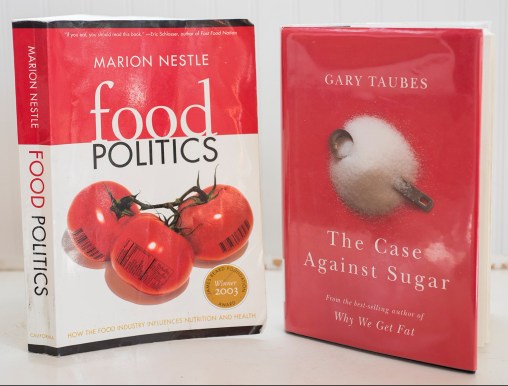
Thanks for following our sugar series! If you’d like to read more about the processed food industry and the sugar conspiracy, I’d highly recommend these two books: Food Politics, by Marion Nestle (or anything else by her) and The Case Against Sugar, by Gary Taubes. And let us know what else you’d like to learn more about, and we’ll get on the case!
The FAQ Series: Sugar, Part Two

In Part One of our series on sugar, we discussed the most common sugars you might have at home and typically use in your own drinks and baked goods. Food processing companies, however, have access to dozens more ingredients that they can use in their products, all of which are sugar – but under different names.

sugar-19-sml-e1518656415874.jpg

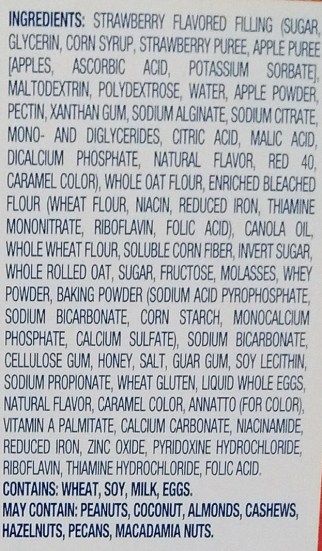
Here’s a fun game: how many different names for sugar can you find on this ingredient label?

Keep in mind that labeling laws in the U.S. require a product’s ingredients to be listed in descending weight order, with the most prevalent ingredient first and so on. Because added sugars are in at least 75% of all processed foods (a conservative estimate), manufacturers are understandably wary of listing sugar as one of the first three ingredients, even if that’s technically true. So the loophole here is to obviously identify sugars individually – that is, maltodextrin separate from high fructose corn syrup which is separate from invert sugar and so on. Did you know that sugar goes by over 60 different names on American food labels, and anything ending in “-ose” is sugar? If you see more than three of these on a product label – especially if they occur within the top three ingredients – put it back on the shelf.

  1. Agave nectar
  2. Barbados sugar
  3. Barley malt
  4. Barley malt syrup
  5. Beet sugar
  6. Brown sugar
  7. Buttered syrup
  8. Cane juice
  9. Cane juice crystals
  10. Cane sugar
  11. Caramel
  12. Carob syrup
  13. Castor sugar
  14. Coconut palm sugar
  15. Coconut sugar
  16. Confectioner’s sugar
  17. Corn sweetener
  18. Corn syrup
  19. Corn syrup solids
  20. Date sugar
  21. Dehydrated cane juice
  22. Demerara sugar
  23. Dextrin
  24. Dextrose
  25. Evaporated cane juice
  26. Free-flowing brown sugars
  27. Fructose
  28. Fruit juice
  29. Fruit juice concentrate
  30. Glucose
  31. Glucose solids
  32. Golden sugar
  33. Golden syrup
  34. Grape sugar
  35. HFCS (high-fructose corn syrup)
  36. Honey
  37. Icing sugar
  38. Invert sugar
  39. Malt syrup
  40. Maltodextrin
  41. Maltol
  42. Maltose
  43. Mannose
  44. Maple syrup
  45. Molasses
  46. Muscovado
  47. Palm sugar
  48. Panocha
  49. Powdered sugar
  50. Raw sugar
  51. Refiner’s syrup
  52. Rice syrup
  53. Saccharose
  54. Sorghum syrup
  55. Sucrose
  56. Sugar (granulated)
  57. Sweet sorghum
  58. Syrup
  59. Treacle
  60. Turbinado sugar
  61. Yellow sugar

Continue reading

Manger et boire à Paris

Of course we went on a food tour while in Paris. How could we not? This is the city where I learned to cook (and drink), and there are far too many delicious choices to navigate on your own. Many thanks to Jennifer from Paris by Mouth, who escorted us through the Saint-Germain neighborhood with grace, hospitality and true passion for food and wine.

PFT-02

PFT-01

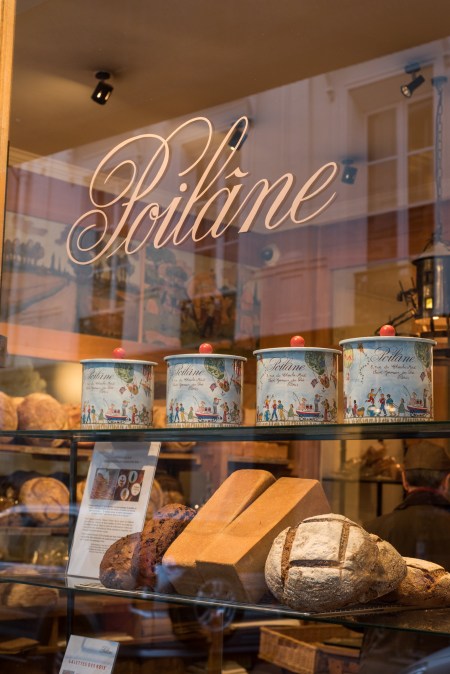
Our first stop: the esteemed Poilâne bakery, the most famous boulanger in the world. Poilâne is operated by Apollonia Poilâne, who took over the company when her parents died in an accident in 2002. She was eighteen, and she ran the company from her dorm room at Harvard until her graduation, four years later. Interviewed during that time, she said, “The one or two hours you spend procrastinating, I spend working. It’s nothing demanding at all.” Words of wisdom, indeed.

Continue reading

Paris, je t’aime

Pariscolor-01

Pariscolor-14

Pariscolor-04

“In every corner of Paris I was reminded: the city is old; it stays the same. People will try to tell you how different it is, how it has evolved: the food scene is different; the construction is killing that neighborhood; the tourists are getting more obnoxious. But for me, those changes barely register. Paris is essentially the same. That’s the whole point of it.”

Continue reading

The FAQ Series: Box Meal Kits

Well, hello there! How is 2018 treating you thus far? We over here at FQF are currently swanning our way through France and Germany, and we’ll be sending you some delightful travel missives in the not-too-distant future. But until then, we’d like to talk about box meal kits, because they’ve been a popular topic of conversation lately on both our professional and personal circuits.

What are box meal kits, you might ask? They’re basically recipes and ingredients shipped to you on a regular or on-demand basis, from which you craft (hopefully) delicious, quick(ish) meals. You don’t need to shop or plan; all you need to do is decide which meals you want and how often you want them. And there are many, many companies from which to choose. HelloFresh is probably the most well-known, but there is also Blue Apron, Green Chef, Purple Carrot, Plated, Sun Basket and many others. Plus, Amazon recently bought Whole Foods, so they’re expected to enter the ring any day now, and Wal-Mart is jumping in, too.

Food Box 01 sml

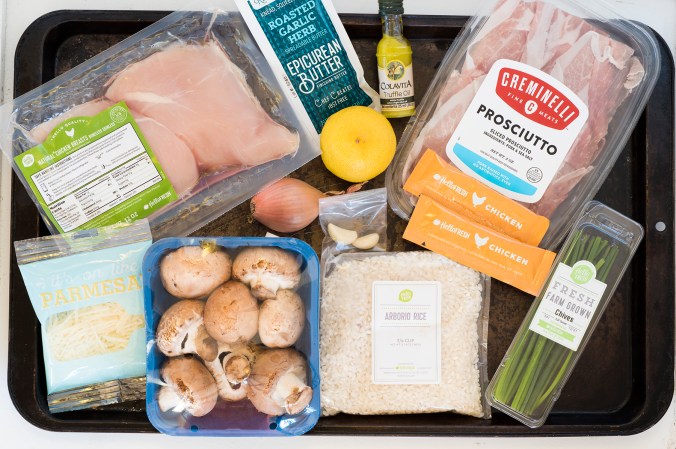
Thanks to our good friends over at Epicurean Butter, we received two HelloFresh meals to test: Prosciutto-Wrapped Chicken with Mushroom Risotto and Kale Grilled Cheese Sandwiches with Tomato Soup. Although HelloFresh offers a number of different plans to choose from, these two meals were each designed to serve two people and they cost about $20 each, or $10 per serving.

Each meal arrives much as you see above: a shopping bag contains the ingredients, plus a photo recipe card and nutritional info; the shopping bags are then all tucked into an insulated box with packing material and ice packs. Typically, you receive three different meals in a box, but again, this varies according to your plan and the company. Cooking oils, salt and pepper are not included, but everything else you need should be.

Food Box 02 sml

Despite the fact that I find following recipes very similar to being put in a choke collar, I wanted to honor the spirit of this experiment and pretend that I was a standard HelloFresh customer, rather than a professional chef. So I laid out all of my ingredients, checked them carefully against the recipe card, and followed the directions to the letter. N even read out the instructions to me while I was at the stove; this resulted in much hilarity as my natural instinct was to do everything my way – he had to correct me frequently, and of course I argued. My goal, obviously, was to see how close I could get to the presentation in the photo as well as the preparation time indicated.

Continue reading

Saddle up

Howdy, pardner! Are you one of the over twelve hundred people who relocated to Colorado last month (just like every month for the past three years or so, which makes us one of the fastest-growing states in the country)? If you’re new here, you might not know that January means only one thing in our town, and that’s the National Western Stock Show. Never been? Get your boots on and let’s go.

Cowgirl Flag sml

“Ladies and gentlemen, please remove your hats and stand for our national anthem.”

Posters sml

For a long time, Denver was embarrassed about its cowtown reputation. We were embarrassed that we weren’t seen as elegant and sophisticated, like New York or Los Angeles. We were embarrassed that we didn’t have fancy restaurants but instead had an abundance of steakhouses, particularly classy joints where they’d cut your necktie off. We were embarrassed that we wore blue jeans (pressed) and boots (clean) to just about every gathering, formal or not.

Continue reading

How to eat healthier

I may not love Thanksgiving, but I do love everything about January. I love the quiet after the holidays, the fresh start, the clean slate. And of course, this is the time of year when so many of us promise to do better. When we promise to eat right, drink less, stop going out to restaurants so often, quit smoking, save our money, exercise more and all the rest.Snowy trees.jpgI don’t subscribe to the negativity often associated with New Year’s resolutions. (By mid-January, over a quarter of all New Year’s resolutions have been discarded, and only a scant 10% are actually followed through to the end of the year. Those are some pretty bleak statistics.) Changing habits is hard enough; I’d much rather start off on a positive note. I make a list of goals, not resolutions.
And with that positivity in mind, how about a quick primer on eating better in 2018? This isn’t designed to be an exhaustive list, nor a restrictive diet plan, merely a few simple tips to get your head in the right place for making healthy changes in your daily eating. Diets don’t work, but changing your mindset does.

Continue reading

Food stamp challenge

One of the comments I hear most frequently in my cooking classes and presentations is that “it’s impossible to eat healthy on a budget.” I wholeheartedly disagree with this statement, and to prove my point, I decided N and I would take part in the Food Stamp Challenge. In Colorado, the challenge is organized by Hunger Free Colorado; your state will have different resources available.

While SNAP (Supplemental Nutrition Assistance Program) benefits vary from place to place and family to family, in Colorado food stamps amount to approximately $4.20 per person, per day. That amounts to $1.40 per meal, if you eat three meals a day, or about $29.40 per week; that number encompasses everything you consume, including drinks and snacks. (Legally, you cannot buy alcohol, tobacco, lottery tickets or non-food products with food stamps, but unfortunately you can buy soda, energy drinks, candy, cakes, chips, cookies, ice cream and plenty of other unhealthy items.) This is going to take some planning, and some smart shopping.

Here’s the tricky bit, though: SNAP benefits can’t be used for any sort of takeaway food, and can’t be used for anything consumed within a store. So no prepared deli items, no to-go coffees, no rotisserie chickens. It’s easy to see why smart hunger relief experts advocate cooking classes along with SNAP benefits; to make the most of this program, you really need to know how to cook from scratch.

Since my household comprises two adults, I’ll allot us a total weekly budget of $58.80. And since I want to play in the most honest way possible, I’ll plan for the way we currently eat: we drink black coffee in the mornings but don’t eat an early-morning breakfast; we typically eat around 10AM and 4PM (it works for us). We also eat very little meat, so going mostly vegetarian won’t be much of a struggle; this budget definitely doesn’t allow for a lot of good meat. And we only eat at restaurants when we’re traveling, so planning and cooking all of our meals at home won’t stress us, either.

Food Stamp 05 sml

Scanning for sales is key to eating well on a budget.

A couple of other caveats about our food stamp challenge:

  • A challenge like this is necessarily a snapshot in time. We’re doing our challenge in December, which definitely makes most fresh fruits and vegetables harder to come by in our Rocky Mountain region – and they’re certainly not local, except for onions and greens! Fresh produce would be more abundant and less expensive in late summer.
  • To play fair, I am not using our backyard honey, or my own canned and frozen goods pantry. I have dozens of jars of applesauce, salsa, Western Slope peaches and other homemade canned goods, plus lots of produce in the freezer, but since I can’t truly ascribe a dollar value to these, we’re not eating these during the challenge.
  • I refuse to dramatically change our standard eating style in order to adhere to the budget; I’m not going to add cheap meat or nutritionally devoid, high-sugar cereal to our shopping list just to have something on the table. That isn’t what we eat now, and I believe the point of this challenge is to make fresh, delicious, nutritious food on a limited budget – not to just eat for the sake of eating.
  • As mentioned above, we’re a household of two healthy adults, and we only eat two meals a day. Your own household’s food stamp challenge will look very different, but we would love to hear about it!

Food Stamp 03 sml

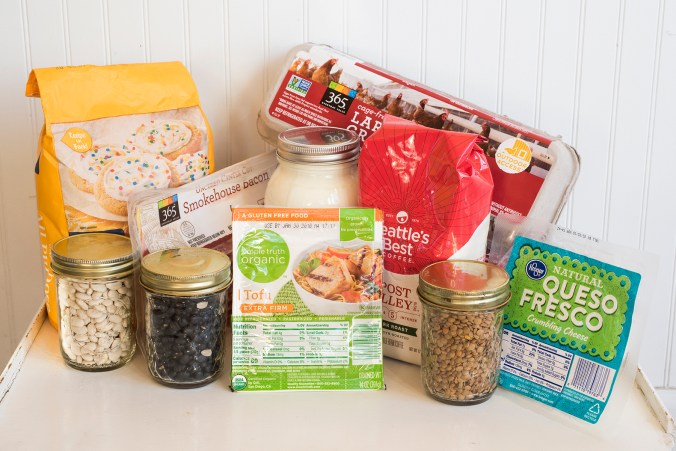
Some of our food stamp challenge ingredients. Embrace the bulk department.

Here’s what I bought for our challenge:

  • 12 oz. whole-bean coffee ($4.99, and it amounts to about $0.12 per cup. Worth every penny.)
  • 12 oz. animal-welfare certified bacon ($4.99)
  • dairy: 1 gal. local whole milk ($2.19), plain yogurt for starter ($0.59), 10 oz. queso fresco cheese ($2.49)
  • two dozen non-GMO cage-free with outdoor access eggs ($5.98)
  • fruit: 3 apples ($0.98), 3 grapefruit ($0.99), 1 lb. grapes ($0.97), 6 kiwi ($0.99), 3 pomegranates ($0.99), 3 pears ($0.98), 8 satsuma clementines ($1)
  • grains and legumes: 0.5 lb. dried black beans ($0.85), 0.5 lb. brown rice ($0.35), 0.5 lb. dried chickpeas ($0.75), 0.5 lb. green lentils ($0.59), 0.5 lb. rolled oats ($0.35), 1 lb. linguine ($0.99), 0.5 lb. white beans ($0.99)
  • 1 lb. organic tofu ($1.79)
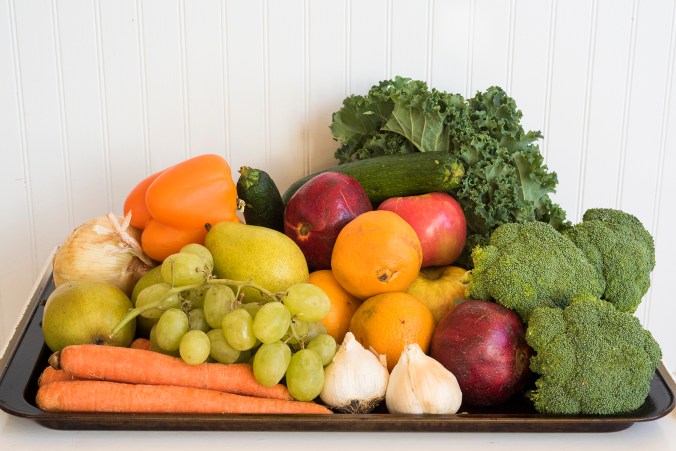
  • vegetables: 2 lb. broccoli ($1.76), 1 lb. carrots ($0.69), 1 bunch cilantro ($0.33), 12 oz. frozen corn ($1), 2 cucumbers ($1), 3 bell peppers ($0.99), 2 heads garlic ($0.66), 2 bunches kale ($1.98), 1 lb. yellow onions ($1), 12 oz. frozen peas ($1), 5 oz. salad greens ($1.69), 1 bunch scallions ($0.33), 3 zucchini ($0.99)
  • staples: assorted bulk spices ($1), 0.5 lb. roasted almonds ($2.99), corn tortillas ($0.99), 5 lb. flour ($1.79), 0.25 lb. roasted pumpkin seeds ($1.25), 3 packets yeast ($1.19 with coupon), hot sauce ($0.99)

Total spent: $58.41

Food Stamp 04 sml

Thanks to savvy shopping and the discount table, this is less than $10 of healthy, nutrient-dense fruits and vegetables!

And here is our simple seven-day menu plan; again, we start with a pot of black coffee and only eat two meals per day. For snacks, we eat fresh fruit or raw vegetables, plus a handful of almonds and pumpkin seeds.

  • Day One: yogurt with fruit and almonds; white beans and sautéed kale with fried eggs; fresh bread
  • Day Two: breakfast tacos with eggs, zucchini, peppers, onions and queso fresco; tofu and broccoli stir-fry over brown rice; green salad
  • Day Three: oatmeal with fruit and almonds; pasta with bacon, garlic, zucchini and peppers; green salad; fresh bread
  • Day Four: eggs on toast with sautéed greens; lentil, vegetable and chickpea soup; green salad; fresh bread
  • Day Five: yogurt with fruit and almonds; frittata with vegetables, greens and queso fresco
  • Day Six: oatmeal with fruit and almonds; spicy black bean and corn soup; kale salad
  • Day Seven: huevos rancheros with leftover beans and rice; “favorites” (i.e. everything remaining from the week)

Cast Iron 05 sml

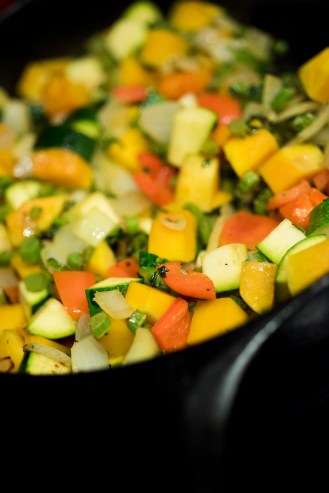
Remind me again why vegetables are boring?

My comments on the week:

  • Our menu wasn’t really that different from what we eat on a regular basis. Each day included at least four servings of various fruits and vegetables and usually more, plus grains and legumes. Virtually everything we ate was healthy, flavorful and made from scratch. We didn’t feel hungry or deprived, but I can easily see how someone accustomed to eating at restaurants and/or eating a lot of meat might find this challenge…well, challenging.
  • I chose bacon as our only meat for the week because it offers so much flavor in even tiny quantities. In addition to adding it to pasta and soups, I also used the rendered fat for sautéing vegetables and greens for extra savory punch. Skipping the bacon entirely would obviously leave about ten percent of the weekly budget for other items, but that’s a sacrifice I’m willing to make. I’d rather eat a small amount of good, flavorful meat than a lot of cheap meat.
  • I made four quarts of my own yogurt from one gallon of whole milk; the starter culture only has to be purchased once since you use a bit of your own yogurt as the starter for future batches. Plain full-fat yogurt made from good milk is a great source of quality protein, fat and calories, and dramatically cheaper than buying it premade.

Food Stamp 07 sml

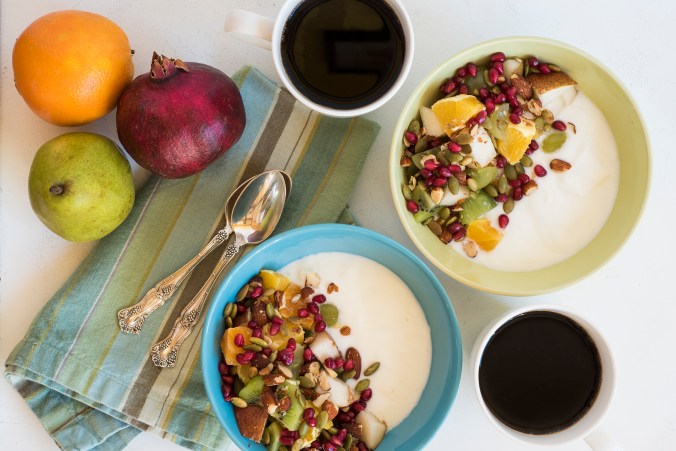
Does it still count as breakfast if we eat at eleven o’clock?

  • I also baked my own fresh bread as I do now, both for health and economic reasons. Although one could claim that whole wheat flour would be a better choice for homemade bread, I would argue that any homemade bread is far better than what you can buy, and far cheaper. Plus, stale bread becomes croutons and breadcrumbs, which add extra value and flavor; storebought sandwich bread doesn’t go stale, it just molds. (I buy my yeast in one-pound bags for $2.99 from a local restaurant-supply store; this is far cheaper than three packets for $1.19, even with a coupon. If you bake bread regularly, buy your yeast in bulk.)
  • It’s virtually impossible to eat purely organic on a budget this tight. While I appreciate the virtues of organic, with so little money to spend I’d far rather eat more conventional fruits and vegetables than just a few organic ones. Value for money wins here, although some of the discounted produce was organic.
  • I did miss having access to a well-stocked pantry, specifically various oils, vinegars, cooking fats (including good butter), seasonings and condiments. It’s very easy to make delicious, healthy food by just dressing it up a bit, and citrus, spices and other flavor enhancers really come in handy.
  • I also really missed cheese. We eat a lot of cheese, both on its own and as a garnish for vegetables and grains, and while I love queso fresco, I really enjoy using a variety of specialty cheeses in almost every meal. Plus, good cheese can often be found at a discount at our grocery store, too!

Food Stamp 02 sml

Because we’re obsessed with aesthetic perfection and meaningless sell-by dates, it’s easy to find supermarket bargains.

Tips for success for your own food stamp challenge:

  • Flexibility is absolutely key. I bought what was on sale, rather than what I necessarily wanted. If you’re going to cook well on a budget, pay attention to store advertising circulars, clip coupons and learn to adjust your meal plan based on what’s available at a good price, rather than what you feel like eating.
  • Our local grocery store has recently started selling blemished or undersized produce at a discount. This produce made all the difference in our food stamp challenge; most of our fruits and vegetables came from this table, usually packed at three for $0.99. I also always search for items close to their sell-by date that the store is looking to offload at a discount; I’ve purchased a lot of healthy, cheap and still-good food this way (see photo above). Don’t ignore this option if you’re cooking on a budget.
  • Also, don’t ignore frozen vegetables. They are cheap, healthy and easy to have on hand, plus they were frozen when that vegetable was actually in season. Fresh vegetables aren’t always the best option, especially on a tight budget.
  • Shop the bulk department for grains, legumes and spices; skipping the inflated packaging makes a huge difference in price. Dried beans are far less expensive than canned, and they don’t contain excess salt, either. Soaking beans overnight takes virtually no time and a slow cooker makes preparing healthy food easy.
  • Search out local ethnic markets. I could have spent substantially less on produce and beans if I had gone to any one of our incredible Mexican markets here in Denver. I wouldn’t buy animal products there, but I’d definitely buy pantry staples.

Food Stamp 01 sml

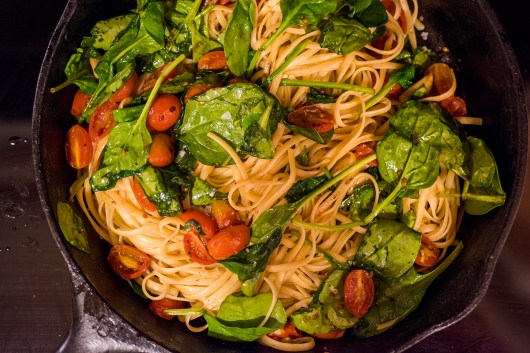
Pasta is oft-maligned, but it is quick, inexpensive, filling, and most importantly easy to pack with lots of vegetables.

  • Get a good knife and a good cutting board and learn how to prep your own fruits and vegetables. Paying for the precut product costs a lot extra and it’s already started to deteriorate, too.
  • Think nutrient-dense and lots of color: discounted spinach, sturdy kale or purple cabbage rather than cheap but nutritionally vacant iceberg; black beans over pinto beans. Whenever possible, choose the most intensely colored whole food (that Windex-colored Gatorade does not qualify).
  • And think high flavor, too. I used small amounts of bacon, sharp, salty queso fresco and crunchy nuts and seeds to add a lot of flavor and texture to our dishes. You don’t need much, but they add interest. I spent money on onions, garlic, scallions and cilantro, both because they’re healthy and because they add a ton of flavor and punch without spending a fortune. Growing your own fresh herbs is a great way to enhance your meals.
  • We had quite a bit of food remaining at the end of the week (both prepared and raw ingredients); this is partially why our final day incorporated “favorites.” If you want to eat on a budget, you have to make use of leftovers, too. Throwing away food is exactly the same as throwing away money.

Food Stamp 06 sml

Garlicky white beans and kale with fried eggs: pretty much perfect, in my opinion.

N pointed out that this challenge was easy for me, because I know how to prepare healthy, delicious food and enjoy doing so. While that’s certainly true, I would say yet again that the number-one best thing you can do for both your physical and your financial health is to learn how to cook, and cook often – whether or not you’re on a strict food budget. Take responsibility for your own health, and cook yourself some wholesome, tasty food. You don’t need to break the bank to do that.

If you choose to organize your own food stamp challenge, please share it with us!


A winter cake

It seems winter in Colorado has been canceled this year, considering that it was nearly seventy degrees (21C for our international audience) when we took these photos. In December. And on one hand, this is delightful, because driving in the snow is truly one of my least favorite activities, despite being a born-and-bred Colorado native. And on the other hand, these disconcerting weather patterns freak me out in a serious fashion. But I’m working on my anxiety, and my ability to “accept the things I cannot change.” So let’s make a cake.

Pom Ginger Cran Cake 01 sml

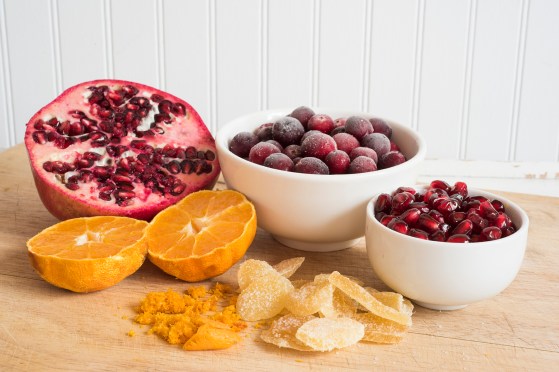
This lovely cake has all the flavors of winter: tangy, bright cranberries and citrus, plus sharp, spiky ginger. And pomegranates. Oh, pomegranates. Is there any fruit I adore more? I think not. When these babies are in season, as they are now, I often eat one a day. Somehow their tart sparkle seems to apologize for the misery of endless winter – or whatever season it is we’re currently having. The cake isn’t excessively sweet, either, which pleases me; if you had a strong, dark honey on hand, I imagine that might be compelling here.

Pom Ginger Cran Cake 03 sml

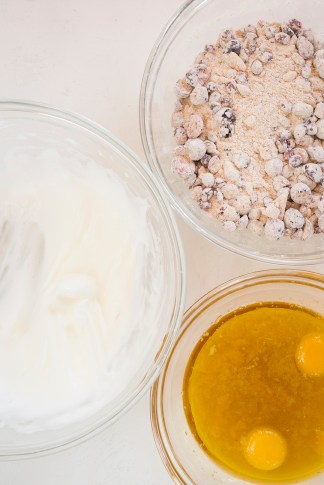
Any time you’re making a light, delicate cake, friends, please be careful not to overmix the batter – it’s a sure way to achieve dense, tough gumminess. This is even more key when baking at altitude, as we are here. Assemble all of your ingredients in advance, then place your liquids in one bowl, your dry ingredients and the fruit in another, and whip the egg whites at the very last minute, when everything else is ready. Never pre-whip your egg whites then go back to put together the other components – their ethereal fluffiness is exactly what you need. (Tossing dried, fresh or frozen fruit with flour helps keep it from sinking to the bottom of the cake, and from bleeding its juices, though that effect can actually be quite pretty. If you’re using frozen fruit, never let it thaw first but just throw it in frozen. And move quickly.)

Pom Ginger Cran Cake 04 sml

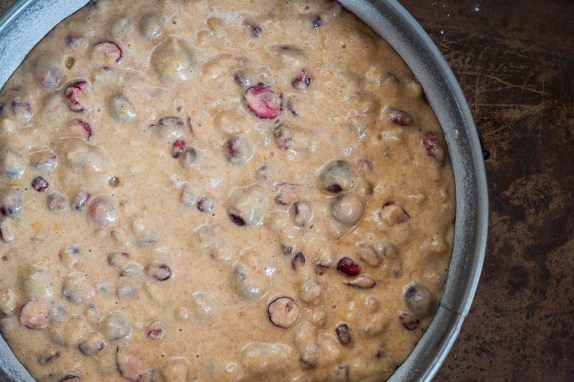
As before, make sure your pan is prepped and your oven is preheated. Once the batter is together, it needs to go straight into a hot oven. This is not the time to dilly-dally.

Pom Ginger Cran Cake 05 sml

This recipe as written makes for quite a moist cake, which is lovely here in Colorado as it stays fresher for longer in our dry climate. I reduced the leavening by 1/4 tsp. and added 1/4 cup extra flour, as is often done when adjusting baking recipes for altitude. If you’re at sea level, you may need to use a total of 3/4 tsp. baking powder. You can probably reduce the whole wheat pastry flour by 1/4 cup at sea level, too. Make sure to check carefully for doneness with this cake; I found that I needed a bit more baking time than the recipe indicates. Ovens vary; adjust accordingly.

Pom Ginger Cran Cake 06 sml


Pomegranate, Cranberry and Ginger Cake (written for 5,300 ft. elevation)

For The Cake

  • 1/2 cup honey
  • 1/4 cup mild olive oil
  • 2 large eggs, at room temperature, separated
  • 2 tbsp. freshly grated orange zest
  • 1/3 cup fresh orange juice
  • 5 tbsp. crystallized ginger, chopped
  • 1 1/4 cup whole wheat pastry flour
  • 2/3 cup all-purpose flour
  • 1/2 tsp. baking powder
  • 1/2 tsp. salt
  • 1/2 cup fresh or dried cranberries
  • 1/2 cup pomegranate seeds, plus more for garnish
  • 2 tsp. confectioner’s sugar for dusting
  

Directions

Preheat oven to 350 degrees. Butter and flour an 8-inch round cake pan; line with parchment paper and butter and flour the parchment.

In a small bowl, stir together honey, olive oil, egg yolks, zest, juice and 3 tbsp. crystallized ginger. In a large bowl, sift together both flours, baking powder and salt. Gently fold cranberries and pomegranate seeds into dry ingredients. In another bowl, beat egg whites and a pinch of salt with an electric mixer until soft peaks form, about 1-2 minutes. Using a rubber spatula, gently fold honey mixture into flour mixture, then fold in egg whites until combined. Do not overmix.

Pour and scrape batter into prepared pan and bake until toothpick inserted in center comes out clean, about 35 minutes. Allow cake to cool on a wire rack for at least 10 minutes; run a knife around sides of pan to loosen cake and turn it our onto rack. Remove paper and allow to cool completely.

To serve, sift confectioner’s sugar over cake and garnish with remaining crystallized ginger and additional pomegranate seeds.

Thanks, but no thanks

Dear Oregon:

It is with regret that we inform you that you are no longer a candidate for the location of Quiet Farm. Although we visited you with highest hopes, we found that our expectations did not coincide with reality.

NJB_1223

Praying Mantis

NJB_1196

Fly Agaric Mushroom (poisonous!)

It goes without saying, Oregon, that your flora and fauna are simply exceptional. Just look at these photos! Coming from our dry, stark, high-plains desert, we were stunned by the sheer life found everywhere in this damp climate: on fallen logs, under chestnut leaves, buried in cranberry bogs.

NJB_1278

Pacific Tree Frog

NJB_1199

Still Life with Mushrooms

And the water! All the free water, everywhere! Just falling from the sky! Oh look, it’s still raining! Truly, it’s a miracle, and it means you can grow pretty much anything here. But we also found that farming in the pouring rain wasn’t as much fun as we’d hoped. Slogging through inches of sloppy mud while trying to dig out a stuck tractor or get feed to hungry animals sounds adventurous, but we’re afraid it would just become rather tedious.

NJB_1260

Rough-Skinned Newt (its underside is bright orange!)

NJB_1044

Cascades Frog

(While we’re on the topic of growing things, Oregon, we’d like to talk about “medicinal substances,” if you get our meaning. As a state, it seemed to us that you’ve embraced the recreational drug lifestyle just a touch too enthusiastically for our comfort, and that’s saying something, considering we hail from Colorado.)

NJB_1049

Woolly Bear Caterpillar

NJB_1268

Angel Mushroom (unconfirmed ID)

This is a tough letter for us to write, Oregon, because we were pretty much ready to set up shop and get Quiet Farm up and running. But outside of Portland or possibly Eugene, we don’t feel confident that the community can support the type of business we want to start. And unfortunately, we can’t afford any property near Portland or Eugene. Apparently it’s all being snatched up by escaping Californians.

NJB_1206

Red-Veined Meadowhawk

Please know, Oregon, that you’re more than welcome to reapply as a potential Quiet Farm location at any time. We’ll just need to see a dramatic reduction in your extortionate property prices as well as a corresponding reduction in your precipitation rates. Oh, and lay off the weed for a bit, please. There’s work to be done.

With regards,

The Quiet Farm Scouting Team