Farm update: July 28

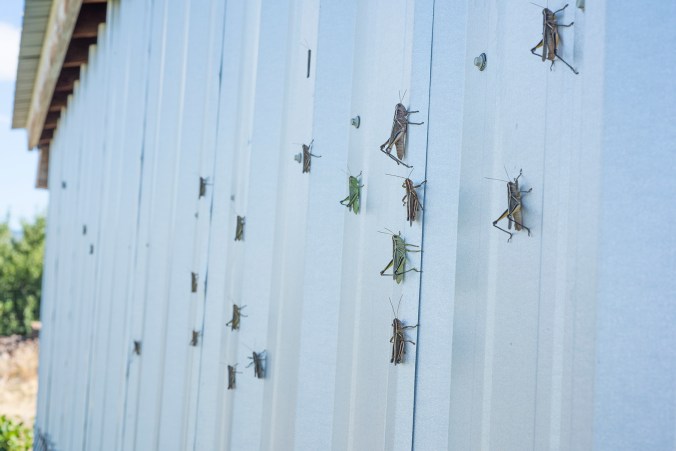
The corral’s warm metal panel is covered with grasshoppers each morning.

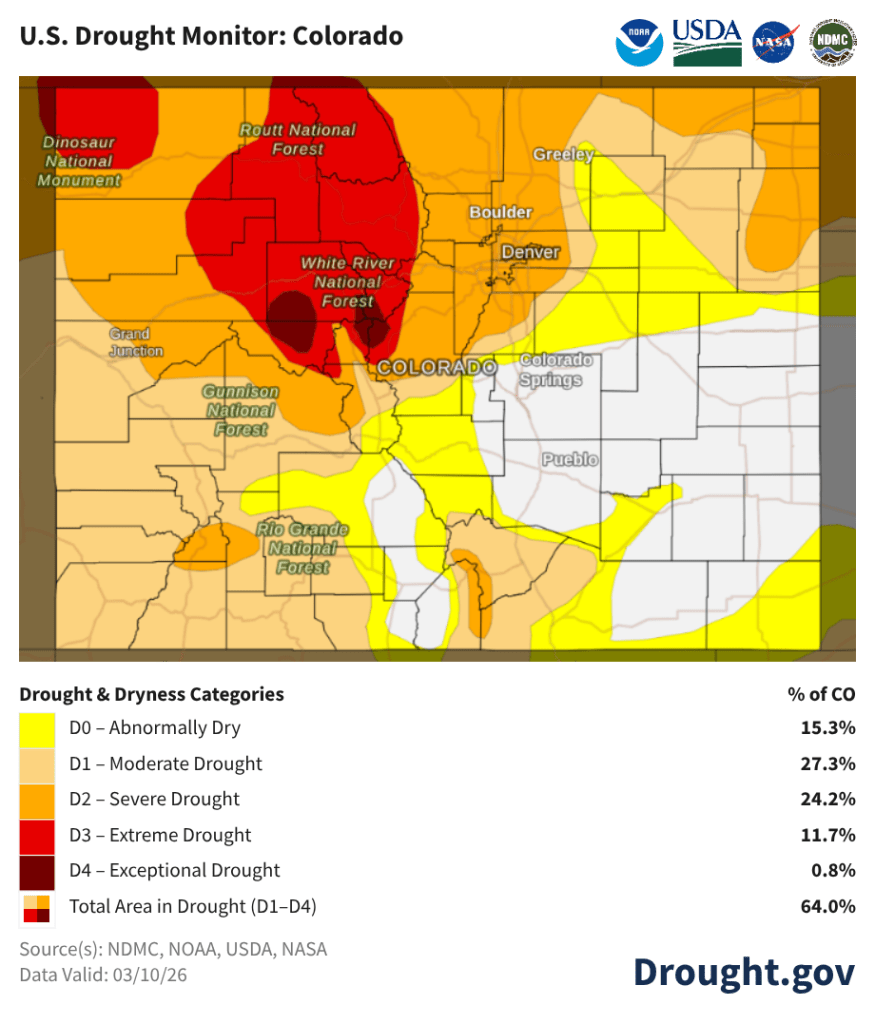
Friends, hello. Muted greetings from high summer in the desert, where it is hot, smoky and dry. Let’s not mince words – the world is full of terrible suffering right now, most of it instigated and/or supported by the current regime. It is hard to know how to phrase things appropriately in the face of an entirely intentional famine. We are experiencing our worst farming season in eight years, yet we have easy access to whatever food we might need or want – but children are being purposefully, deliberately starved, and collectively we are obviously fine with this. We are also fine with concentration camps, a militarized police state and taking benefits from poor kids to enrich billionaires. The active cognitive dissonance required to manage one’s daily existence in 2025 frequently leaves me in despair.

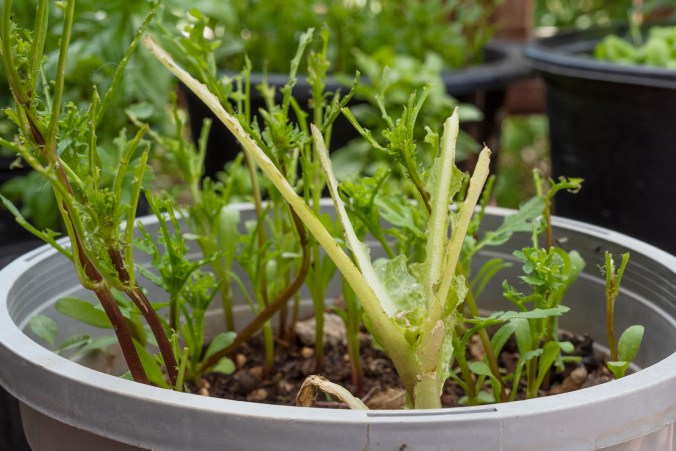
A lettuce plant and marigolds, both stripped to the stalks in a few hours.

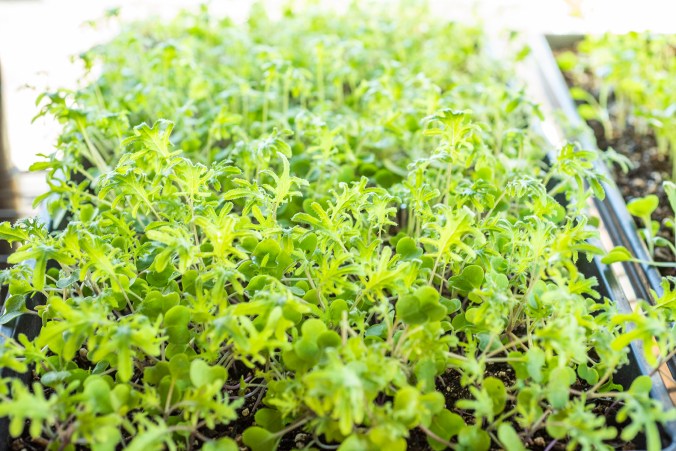
Here’s one thing I do know – along with cruel, vengeful, power-hungry leaders, grasshoppers (and locusts) can also cause famine. The thousand-year drought in the American Southwest has created ideal conditions for these hardy creatures to thrive, and they are most certainly thriving here. Just about every conversation we’ve had with local friends over the past two months has centered on two topics: grasshoppers and drought. We’ve had no appreciable moisture this year, and the grasshoppers have absolutely annihilated many of our crops. Unless you have the experience of walking amongst our raised beds or our pasture and seeing tens of thousands of insects move at once, unless you’ve been hit in the face and arms repeatedly by these sturdy bugs, unless you’ve seen firsthand the scale of the devastation – you cannot possibly appreciate how bad things are here this year.

The kale is not thriving.

The brassicas (kale, cabbages, broccoli, bok choy, and so on) have taken the most damage, by far. Entire beds are destroyed in a few hours or days. I am pulling all the broccoli plants this week as they’re so badly eaten that there is virtually no chance they’ll develop proper heads this season, and it’s just painful to look at them every day. Mint, basil, thyme, tarragon – all the soft herbs are gone entirely.

The bean yield will sadly be far lower than expected this year.

As with all crops, the bean plants are at their most vulnerable when they’ve just put on their first true leaves; the grasshoppers love these tender, nutrient-packed starts. The rows are littered with empty stalks that didn’t survive, but we are seeing some resilience from beans that managed to escape that initial onslaught. We’ll likely get some beans, but certainly not the amount we’d planned on.

Dark-spotted blister beetles, a new arrival for us this year.

An enemy, but also an ally. It’s a delicate balance.

Because Nature never makes mistakes, the grasshopper invasion has been followed by dark-spotted blister beetles, who feast upon grasshopper larvae. We’d never seen these before, but they certainly have plenty to eat this year – although they also took out the beet and chard leaves on their way. They love alfalfa, too, and can be toxic to horses if their poison is heavily concentrated in hay bales.

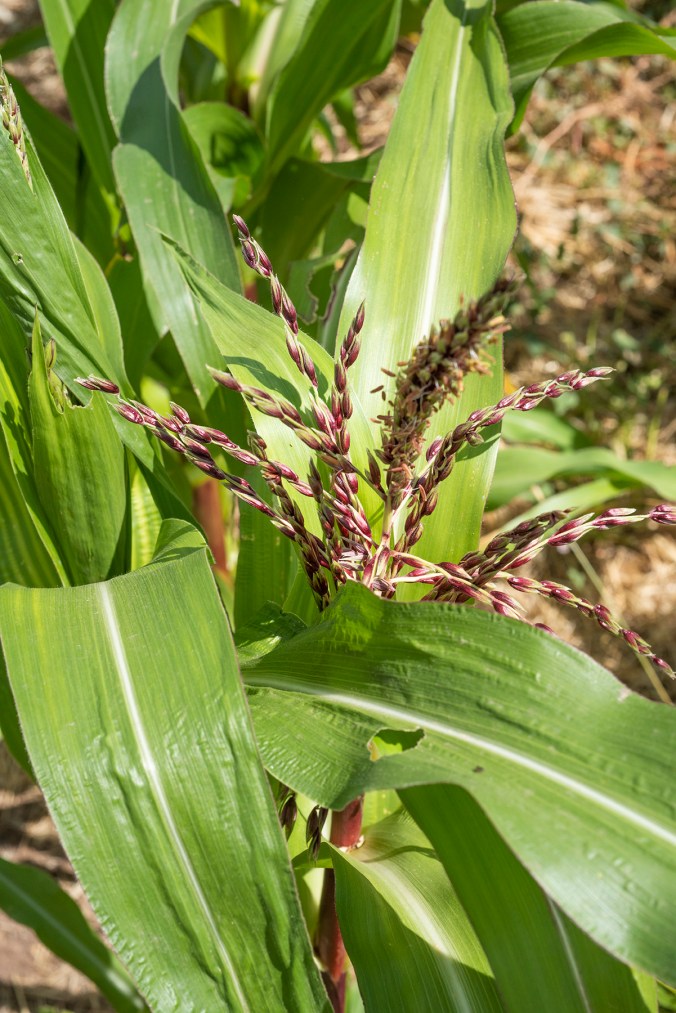
Tassels on Painted Mountain corn; it’s drought-tolerant, cold-tolerant and apparently grasshopper-tolerant.

On the plus side, the grasshoppers have thus far done very little damage to our ‘Painted Mountain’ corn, an heirloom that I am exceptionally proud to grow this year. (You can see a little exploratory leaf-chewing in the photo above, but overall devastation is minimal.) I am so hopeful for this stand of open-pollinated flour corn and will share an update when we harvest.

The tomatoes and peppers have also mostly survived, with the exception of a few replacement transplants that disappeared in hours. I suspect the bitter compounds in well-developed Solanaceae plants aren’t appealing to grasshoppers, though the tiny ones don’t put up much of a fight since they’re likely too little to have developed their defenses. This metaphor is not just relevant in farming, obviously.

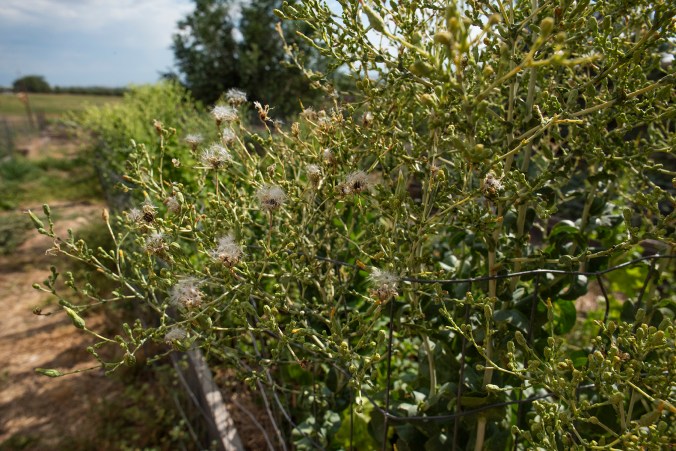
Lettuce plants reproduce by sending out their light seeds on the wind.

And of course the lettuce has gone to seed by now, so it’s time to harvest the little fluffy puffs to collect seeds for future plantings. Saving seeds always reminds me that gardening and farming are ultimately acts of optimism and hope, both of which I am sorely lacking at the moment.

Much as I wish I had a more positive update to share, I am also unwilling to pretend that farming is always easy or fun or rewarding. Sometimes it’s a miserable, exhausting sunbaked slog while watching plants be devoured in a matter of hours. Sometimes it’s replanting precious beans two and three times in the hopes they’ll survive the initial attack. Sometimes it’s bursting into helpless, infuriated tears, because when you’re irrigating, no one can hear you cry. And sometimes it’s taking resigned solace in the famous Zora Neale Hurston quote, “There are years that ask questions and years that answer.” This is a year for questioning, dear friends, and for questioning a lot more than just farming.

Thanks for being here, as ever.

Farm update: May 12

It’s mid-May here on the Western Slope and we’ve had virtually no appreciable moisture for months. Grand Mesa snowpack is critically low. Accordingly, even though water allocations haven’t yet been set, we are planning for an exceptionally limited irrigation season, as are other farmers in our region.

What else is happening on the farm these days?

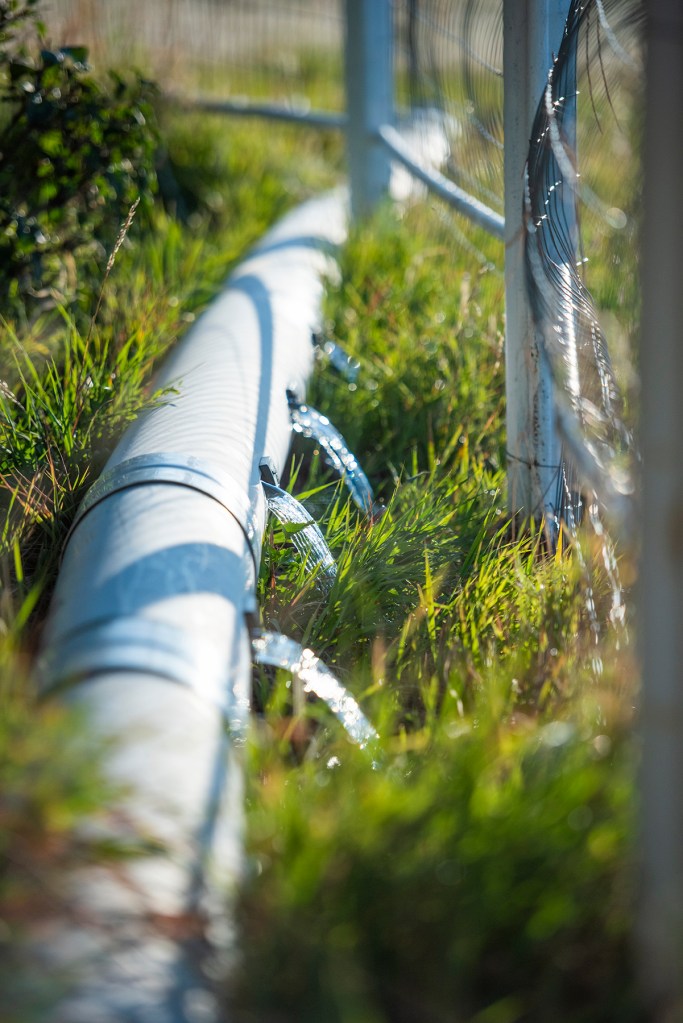
This photo of gated pipe in our pasture is from back in 2018 – our pasture looks nothing like this now.

Our gated pipe is always broken down and stored for winter, and we’ve returned that pipe to its position along the ridgeline. We made some needed repairs, but it will likely be at least four to six weeks before we get water so we won’t know our pass/fail result until that first irrigation run.

Continue reading

Farm update: July 8

It is official: we crown 2024 The Year of Mediocrity. Six years into our farming journey, it is expected that we might hit a slump – and so here we are. Numerous farming challenges large (hay delivery canceled, annual shearing rescheduled again and again, a goathead invasion, an apocalyptic plague of grasshoppers, rampaging rodents, hail) and small (late planting, poor germination, ricocheting temperatures) mean that this season, we’re going to be happy with anything we get. Anything! I’m not even weighing our harvests, because I’m not going to judge this year’s output against previous years – it’s not a fair fight. The brassicas were mowed down by hungry grasshoppers. The beets and carrots got too hot and never germinated. The strawberries were devoured by ravenous baby squirrels (a terrific band name!). The tomatoes and cucumbers and peppers and squash are all still so tiny and fragile and battered that the prospect of harvesting anything before Christmas seems laughable at the moment, but perhaps the tide will turn in our favor as we move into high summer. We do have plenty of irrigation water this year, which is something we never take for granted.

Much happier after taking off their winter sweaters.

Despite an unplanned six-week delay that was entirely out of our control, our four rescue alpacas were successfully sheared a few days ago. They had really started to suffer in June’s abnormally high temperatures, constantly seeking out shade in the pasture and the cooling waters whenever we irrigated, and we were very glad to get their winter coats removed. I am in the process of learning how to spin their fleece into yarn and have attended a local spinning and weaving guild to observe and practice this ancient art. Like all handcraft there is a meditative aspect to spinning that soothes my constantly anxious mind, and this winter I hope to make some real headway on the bags of fleece we’ve accumulated over the years.

Continue reading

Farm update: November 22

Hello and what’s new in your world? Here at Quiet Farm we very much wish that winter would appear already. We haven’t had even a dusting of snow since that frost back in October, and it’s barely cold enough to freeze the animals’ water or kill off all the aphids on the kale. Far too warm for late November – but don’t you worry, our trusty politicians are taking care of that pesky climate collapse issue even as we speak.

Our fall harvest has all been successfully preserved; the last of the ripe tomatoes went into the sauce pot yesterday. Chiles are drying in the sunroom, ready to be pulverized into chile powder; pumpkins and squash are neatly stacked on shelves; apples and onions remain in cold storage in our insulated woodworking shed. We are stocked and ready, and we invite Serious Winter to show up immediately if not sooner.

Here are a few more things we’ve been up to recently, if you’d like to see:

Bright, tart pomegranate seeds make these amazing waffles even better.

Obviously we’ve discussed the waffles previously, but yet here we are again. I made a fresh batch last weekend and since holiday brunches and family gatherings and all sorts of festivities are lurking just around the corner, I must evangelize the waffles once more. Please, dear friends, if you do not make one other thing from scratch this holiday season, please make these waffles. I know this level of devotion to a seemingly innocuous breakfast food seems a bit over the top, but trust me – these are the best waffles ever, and you can stop Googling ‘best waffle recipe.’ Plus they’re very easy to make, and they freeze beautifully – you can just have fabulous homemade toaster waffles any time you like, and you can also stop buying expensive processed frozen waffles with mysterious ingredients! The recipe hails from Fannie Farmer by way of Marion Cunningham’s brilliant The Breakfast Book, which I highly recommend. (But seriously, go make these waffles. Do it now.)

Hot sauce doesn’t have to be just painfully ‘hot.’

Making hot sauce is always part of our farm preservation work each year. Although I’ve experimented with lots of different types of hot sauces, for the moment I’m keeping it simple – one fiery-sweet red version, very loosely based on Sriracha and this Melissa Clark recipe, and one fermented serrano version, a rough knock-off of green Tabasco. The red hot sauce is definitely milder, with a gentle undertone of sweetness from the red bell peppers, while the green is a tangier, sharper vinegar-based sauce, used more sparingly. As a personal rule, I don’t love aggressive, punch-in-the-face hot sauces; I want a bit of heat but would still like to taste whatever I’m eating. Hot sauce is simple and inexpensive to make at home, keeps indefinitely and is a thoughtful consumable gift for anyone on your list who likes things spicy. (P.S. If you buy classic Sriracha, save, wash and reuse the iconic squeeze bottles for your own homemade hot sauce.)

Small part. Big impact.

I don’t in any way fancy myself an influencer, but if I can influence you to NEVER, EVER buy GE appliances, please allow me to do so. We have a full suite of GE appliances in our kitchen – all of which came with the house – and every single one has failed at least once. Most recently we found ourselves without a functioning oven, which is quite challenging for someone who bakes on a more or less daily basis. Some investigation and a few helpful YouTube tutorials later, we ordered a new igniter. (Of course, I foolishly ordered the first igniter from GE and it arrived pre-broken, thanks to their careless packing. The second igniter, from an entirely different company, arrived in perfect condition, but obviously it was now two weeks later. Thanks again, GE. You’re tops.) We successfully installed the new igniter – a five-minute job, though gaining access to the compartment and putting everything back together neatly made it more like an afternoon – and lo and behold, we thankfully once again have a working oven. As always, successfully learning to repair things ourselves goes a long way towards our goal of self-sufficiency.

Crispy, salty, savory and delicious hot or at room temperature – galettes are winners.

And of course with a working oven, we can once again make delicious meals like galettes! Like the waffles above, we’ve extolled the virtues of galettes previously – they can be sweet or savory, hot or cold, made in advance or pulled fresh from the oven – and they lend themselves well to using up whatever odd bits and ends you might have on hand. They’re also beginner-friendly, if you’re intimidated by all the perfect pies you’re seeing right now; galettes are designed to be “artisanal” and “rustic” which – fun fact! – are both Latin for “messy” and “imperfect.” This time of year our galettes are most likely to have fall flavors, like delicata squash, caramelized onion, peppery goat cheese, sage and rosemary – but honestly, you can put pretty much anything you want in one. If you’ve got a couple rounds of pastry dough in the freezer you’re halfway there; galettes are easy to prep for holiday gatherings and perfect as a vegetarian main dish or as a simple, impressive dessert.

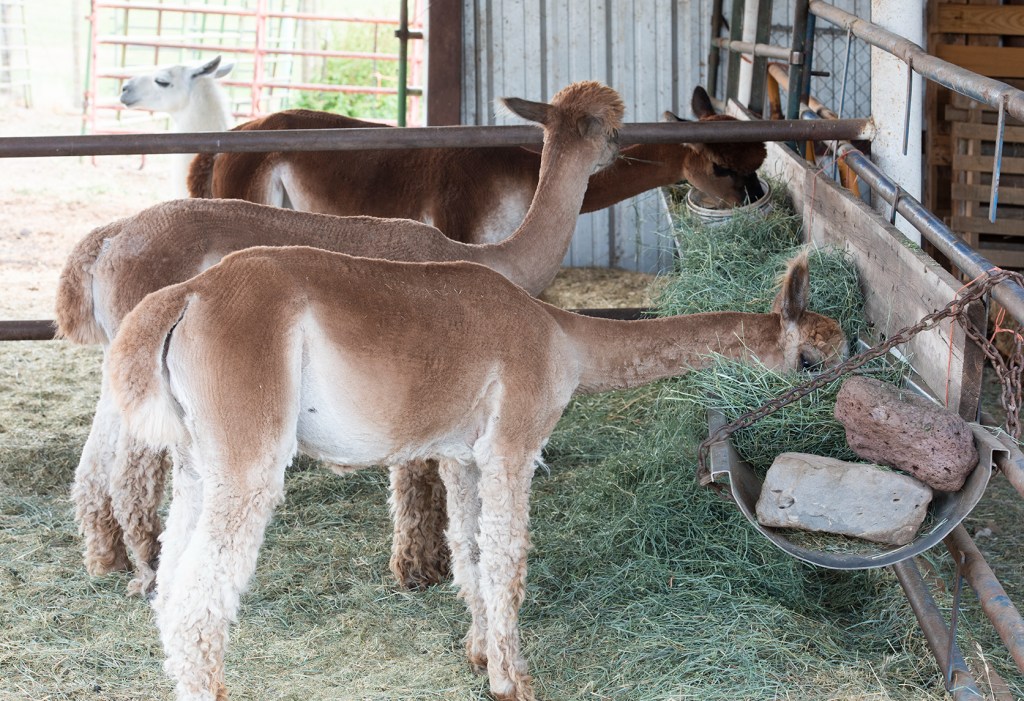
Available now as an NFT: “Untitled: Llama and Alpacas at Rest, 2021”

And finally, it’s always nice to observe our camelid herd lounging peacefully in the pasture; if they’re at rest, it means they’re getting plenty to eat. We’re regularly challenged by this rebellious bunch of feral miscreants, but they add a certain flair to Quiet Farm, and we’re glad to have them here.

Wishing you all the best during a tough time of year, dear friends.

Farm update: October 18

And in the space of a few days, our season went from lush abundance to a frozen wasteland. Such is the nature of growing food at over six thousand feet in a high-plains desert.

Our first hard frost arrived this past week, and with it a few light dustings of early snow. Up on the mesa we were thrilled to see a solid fifteen inches show up on the Sno-Tel! All of our irrigation water, of course, comes directly from the mesa, so we are always in favor of as much winter moisture as possible to boost next year’s irrigation allotment.

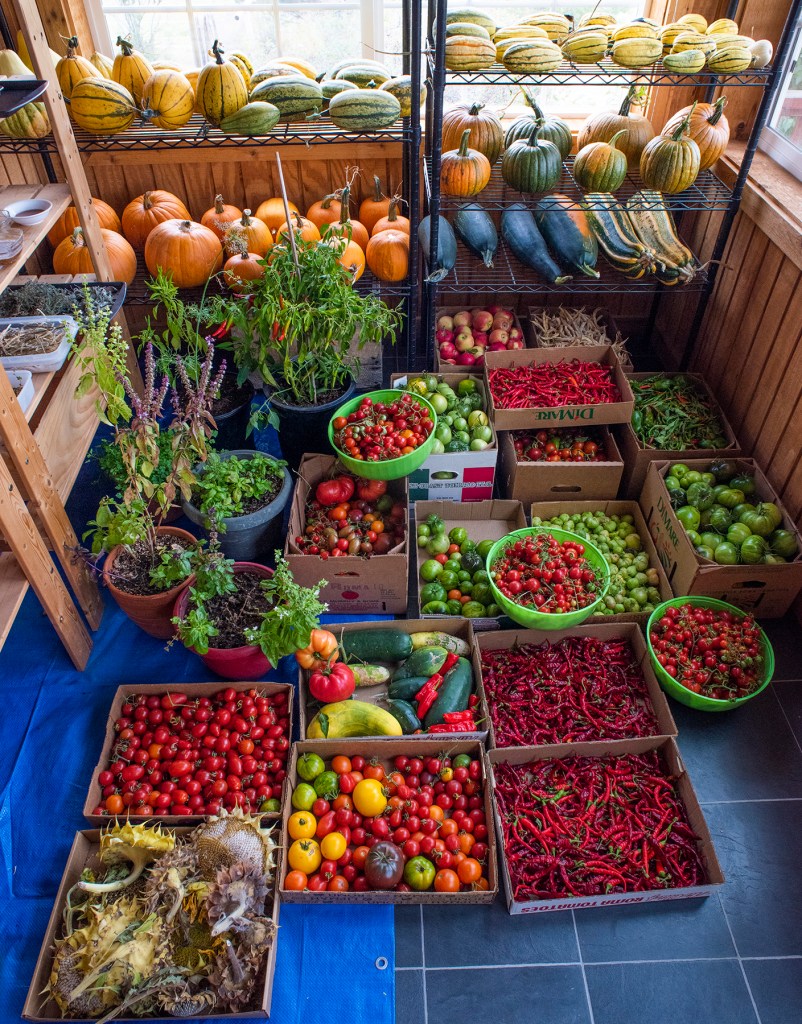
Our sunroom looks like an unusual farmers’ market!

Temperatures dropped into the high 20s overnight, which is far too cold for summer crops like tomatoes, cucumbers and peppers. (Don’t worry, the kale is fine. The kale is always fine.) Prior to the freeze we harvested everything we could – nearly four hundred pounds on Monday alone; now comes the task of preserving all of that food to enjoy through winter and spring. The cruel irony, of course, is that once the storm passed we quickly returned to bright bluebird skies and comfortable daytime temperatures in the mid-60s, which likely means we would have gotten at least another two or three weeks in the growing season. But when a hard freeze announces that you’re done, then you’re done – and there’s not much arguing.

One of our gated pipes with the season’s final run.

Our irrigation season runs through the end of October, but we balanced our account this year to fortuitously end just before the cold snap arrived. Running irrigation later in the season is already a chilly task; combine that with a hard freeze and it can be downright miserable. We were very pleased with how we managed our irrigation in a drought year and though of course we hope for higher water shares next year, we know that with smart planning we can make even a low allotment work for our land. It’s incredible how much we’ve learned in only three short years here.

A friend’s trial orchard, where new apple varieties are tested.

Prior to the hard freeze we’d picked nearly two hundred pounds of local apples for winter storage. One box has already been transformed into applesauce; the remainder will stay reasonably fresh in one of our insulated but unheated sheds. This delicious fruit will provide snacks all throughout the winter; I’ll also bake with the apples as well as dehydrate a few pounds for adding to granola. As always, the bounty of incredible local fruit is one of the greatest benefits of living where we do.

Adelaide, Paris, Paihia and Fiji contemplating the change in seasons.

Although the damp, freezing weather makes the corral a bit of a sloppy mess, the animals are entirely unfazed by the cooler weather. They’ve put on quite a bit of fleece since their shearing, so they’re ready for winter, too.

And with that, we’re off to sort produce for canning. Wishing you a calm and peaceful week, friends.

Farm update: September 20

Autumn is very much on its way here at Quiet Farm. Overnight lows plunge to the mid-40s, though our daytime temperatures remain in the mid-80s. The plants are all starting to look a bit tired, a bit yellowed, a bit lackluster. The seasonal transition has begun, and we are looking forward to the slower rhythms of late fall and winter. This remains an exceptionally busy time for us; here are a few things we’ve been up to, if you’d like to see.

One day’s harvest of an easy twenty-five pounds.

Despite a rough start, we’ve had a spectacular year for tomatoes. We planted about sixty tomato plants of about fourteen different varieties, and our yields have been simply staggering. We’ve grown full-size heirlooms that I never thought possible, believing that our growing season was simply too short, and the smaller cherry and grape tomatoes have done well too. Every night for weeks now there’s been a fresh tomato salad with supper, and we’ve put up sauce, soup and salsa for a warm and nourishing winter. I never, ever tire of fresh tomatoes, and since we don’t eat storebought tomatoes, we’re getting our fill now. We will miss these gorgeous things until next summer.

Spotted on an evening irrigation check.

As we’ve spoken of many times here, we focus our efforts on improving our land and our soil, and one of the best ways we can do that is by encouraging both native plants and the pollinator population. Monarch butterflies are an iconic pollinator species; the western U.S. monarch population is currently traveling south on its fall migration. The monarch caterpillar (Danaus plexippus) shown above feeds exclusively on milkweed; once the caterpillar has transformed into a butterfly, it has a much more varied diet. Unfortunately, milkweed is also toxic to livestock, so ranchers regularly treat pasture milkweeds with toxic herbicides – which is why the monarch population is declining, because the larvae cannot survive without these plants. We keep camelids here at Quiet Farm, and have spent hours worried about our animals becoming ill from consuming milkweed in our pastures; obviously, we’re not going to spray and we don’t particularly want to pull all these host plants.

After extensive research, our solution – for the moment – is to let things stand as they are. Hardy alpacas and llamas, native to the high Andes, aren’t nearly as delicate as domesticated cattle and sheep, so are far less likely to become sick. Plus, we’re intentionally cultivating a mixed pasture, with lots of different plants for our animals to graze; the likelihood of any of our animals eating enough milkweed to become seriously ill is slender indeed. There are never perfect methods of pasture management, but we’re working hard at figuring out what we can do to maintain balance.

Beautiful photo. Terrible plant. Just look at its horrible weaponry!

One thing that is very much not in balance is our puncturevine population. The farm is absolutely overrun with this heinous plant this year, and we’ve spent countless hours trying to eradicate it – pulling by hand, obviously, as dousing the entire farm in glyphosate is clearly not an option. Puncturevine (Tribulus terrestris) is an invasive weed, uniquely adapted to our desert climate, that grows where few other plants will; most infuriatingly, the seeds can remain dormant in the soil for seven to ten years. While we’re happy to let neutral weeds, like purslane and mullein, grow freely, the puncturevine burrs are harmful to humans and animals – and bicycle tires, too. For reasons unknown to us, this year conditions were absolutely perfect for puncturevine to take over our land and so it has. We are hoping that we’ve removed most of it, but we know that some of those viciously sharp little seeds are simply biding their time until next year. Or the year after that. Or the year after that. The battle continues.

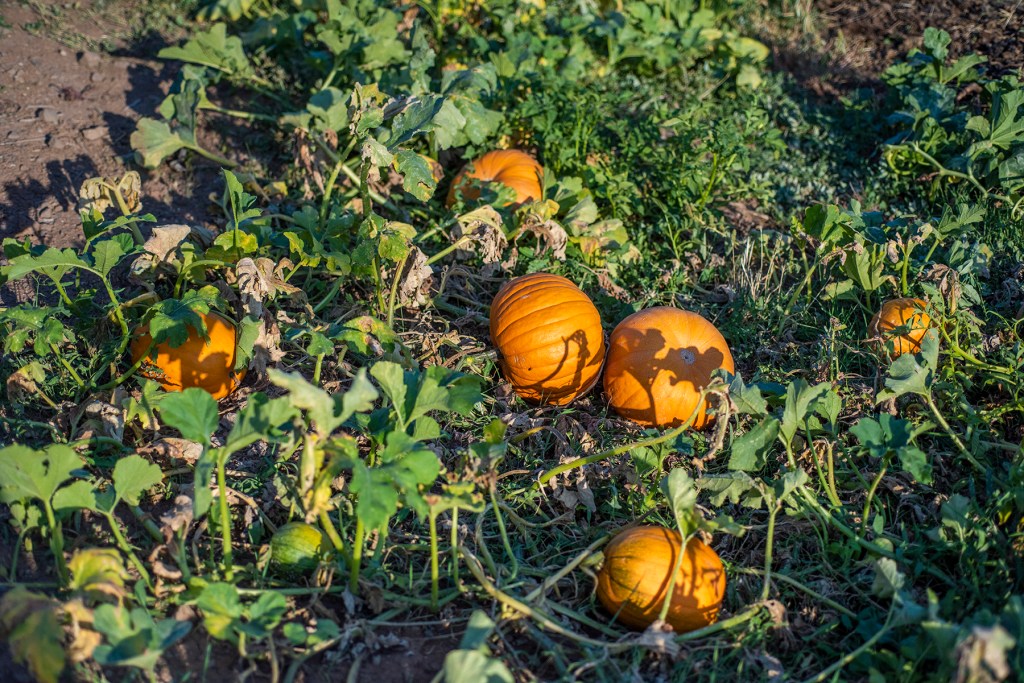
The Quiet Farm pumpkin patch.

We’ve done well with winter squash this year, though as usual there are some squashes that didn’t exactly breed true – always a risk with saved seeds and limited isolation practices. Squash plants are a reliable harbinger of fall; ours usually start showing signs of powdery mildew, and the vines themselves start to fade and turn a bit crispy. I usually trim immature fruit so that the plant devotes all its energies to ripening the larger fruits, but this year I’ve mostly left the squash patch to its own devices. Depending on the variety, most pumpkins start out dark green with stripes; the fruits turn the classic bright orange in the same way leaves change color on deciduous trees. These jack o’lantern pumpkins yielded nicely; they’ll be cured for winter storage and won’t be carved but instead used for soups, curries and muffins.

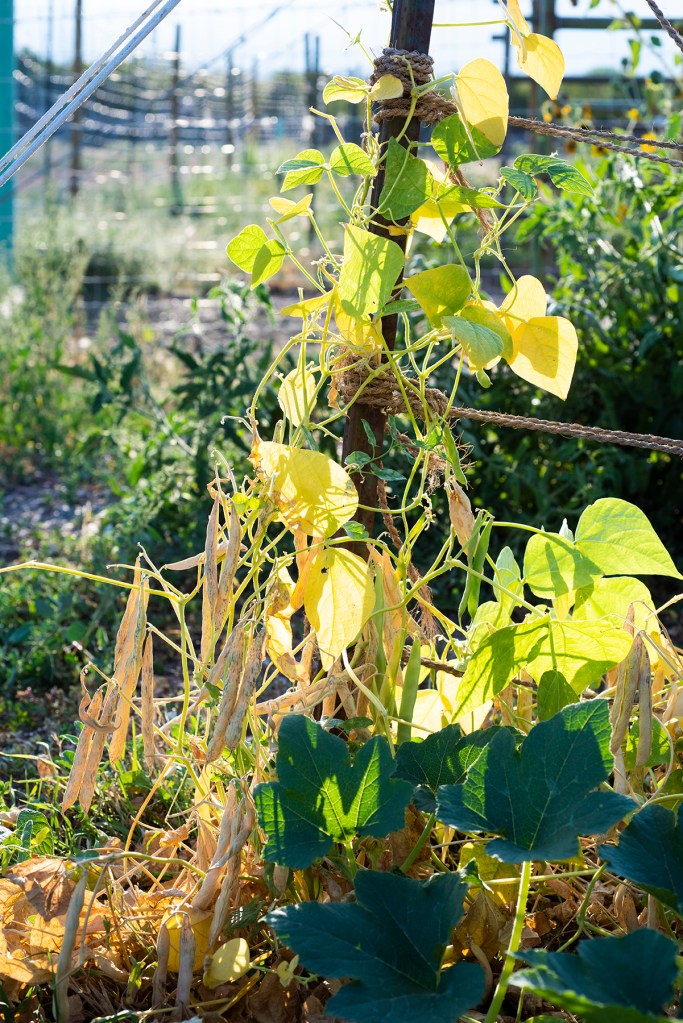
As with other annuals, the bean plants will also clearly demonstrate that they’re nearly finished for the season. These are labeled as ‘Aztec White’, but based on the small size I suspect they’re more along the lines of a true navy bean. Dry beans can stay on the vine until frost threatens, a huge bonus for the time-starved farmer; if there isn’t time to shell the beans immediately, they can be tossed into repurposed feed sacks and stored in a cool, dark, dry place, away from pests and damp. Shelling dry beans is a perfect project for a crisp, late fall day, when the more pressing tasks have been completed! Once they’re shelled I’ll hopefully have a better idea of the variety, although when it comes to heirloom beans I’m not hugely bothered about specifics, especially when seeds are freely shared amongst local growers. If the beans grow well and taste delicious, that’s really all that matters.

Farm candy.

And to end on a sweet note, we’re pleased to share that our raspberry patch is finally producing. It’s taken us a couple of years to get these canes established, but we’re now harvesting enough raspberries to actually bring a few inside, rather than just eat them all in the field. We’re hopeful that we’ll have a few more weeks before a hard frost, so that all of the unripe berries will have a chance to ripen, but we’re thrilled with anything we get – these are like candy. As with tomatoes, the difference between just-picked raspberries, still warm from the sun, and those sitting in the cold case at your local supercenter is night and day, and we’ll eat our fill for as long as we possibly can.

Wishing you a pleasant week ahead.

Farm update: July 26

And here we are at the tail end of July, scrambling to complete everything that needs doing. Each night before sleep finally arrives I focus on designing bright, colorful quilt patterns in my head – calming mental Tetris – rather than running through all of the tasks I didn’t complete during the day. The tomatoes need to be pruned and re-staked, again. The arugula and lettuce seeds need to be harvested, the straggly plants composted and the beds reseeded. The garlic needs to be pulled and cured. The mallow, bindweed and puncturevine are threatening a total takeover. And on and on and on. I feel a thousand miles behind on everything, and I remind myself to complete one task at a time. Also, I regularly remind myself to enjoy the moment I’m in, rather than race on to the next without even pausing for breath. (Easier said than done, no?)

Purple coneflower (Echinacea purpurea).

Admiring our seasonal plants is a great way for me to stop my frenzied rushing for just a moment. Many of our flowering perennials didn’t bloom this year, thanks to the drought, but we do still have a few. Echinacea, or coneflower, is one of my favorites, and the bees love it, too. (Our pollinator population is also greatly diminished this year, likely due to the lack of blossoms in the neighboring orchards.) Echinacea has been touted for years as an herbal remedy for just about any ailment, including the common cold, but legitimate scientific studies on this are lacking in substance, to say the least. Still, the coneflowers grow well here and I’m hopeful that I can expand their presence on the farm in future years.

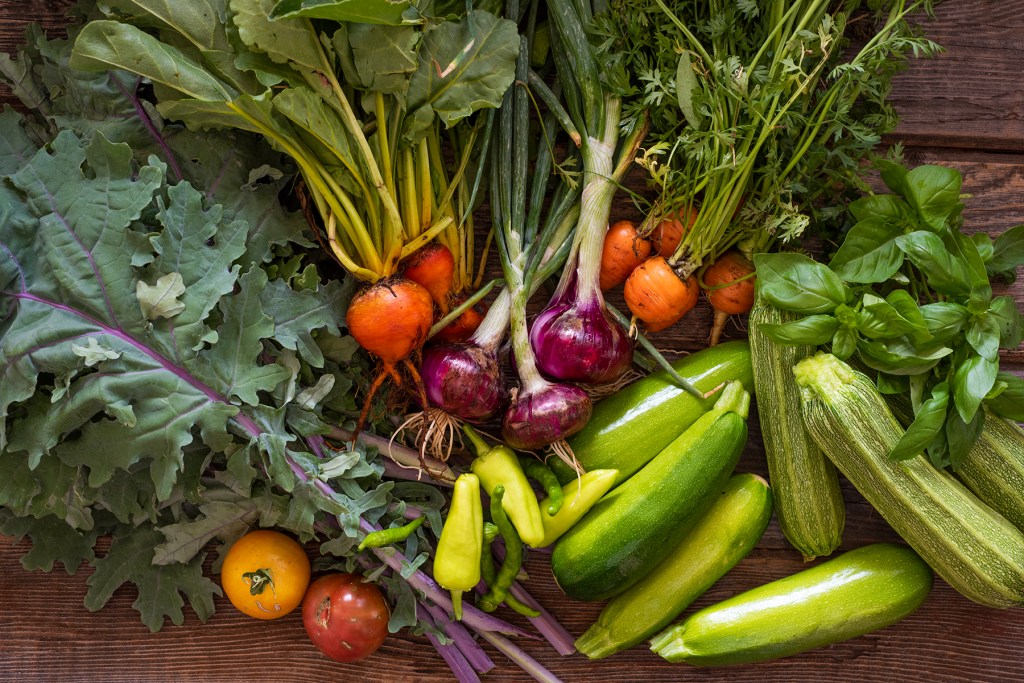
Just one day’s harvest…

Late July and August are the months we eagerly await all year – when the vegetables start rolling in. The flipside of that, of course, is that then you need to have a plan for what you’re going to do with all of that glorious food. Onions and kale are easy to deal with; they are garden stalwarts and stay fresh for weeks. Carrots and beets need to have their greens removed, at the very least; I usually don’t wash them until just before I’m ready to use them. The zucchini, of course, is where things start to feel overwhelming. Anyone who has planted zucchini knows full well that through some mysterious garden trickery you can check the plants twice a day and still end up with overgrown monsters. I like to harvest the squash when small and use it in salads, galettes and pastas; I also shred and freeze it for muffins. And our tomatoes are just now starting to come on; we’ve had a couple of early Juliets, plus a Lemon Boy and a Black Krim. The real bounty will start showing up in about ten days, and as with every year, I’m looking forward to an absurd excess of tomatoes. They never go to waste here.

So fresh! So crisp! So delicious!

We had a ridiculously abundant crop of peas this year! I adore fresh peas, but they often struggle here because we typically move so quickly from winter to summer, and peas generally like cooler, more moderate temperatures. This year, however, the plants just kept on producing, even when the temperatures accelerated into triple digits. Many, many peas were simply eaten fresh outside as a garden snack while doing chores, and many more made it inside for salads and stir-fries. The plants are mostly finished now, the peas starchy and the vines slowly crisping and browning, and all the peas still hanging will be dried and saved for seed. This year was such a roaring success that I’m very seriously considering giving the peas their own special home next to the raspberry beds, and saving the space in the raised beds for other spring crops like carrots and onions.

Neatly stacking hay bales is definitely a cardio workout.

We are thrilled to have our winter hay stores for the animals laid in. We completely guessed at the number of bales we bought last year – never having overwintered livestock – and actually came pretty close in our estimate! The animals are mostly on pasture right now but get hay in the evenings; come winter, however, this will be all the food they have. The drought has forced many producers to cull their cattle and sheep because the land can no longer support that many head, and the lack of water means that hay is obviously much more costly, too. Our hay cost fifty percent more than last year; in all honesty, we were prepared to pay double. Our focus, as always, is on ensuring that we don’t overgraze our pasture and that we always have emergency feed reserves stockpiled.

Our sunflowers are cheerful and abundant, too.

And with that, we’re off to tackle our neverending task list. Do tell, though – if you have an excess of zucchini, what are your favorite ways of using it up? I always enjoy hearing how others move through an abundance of garden produce.

Wishing you a lovely week, dear friends.

Farm update: July 12

How are you? How is your July thus far? It’s high summer here at Quiet Farm and we spend more time outdoors than in – always, always wearing long sleeves, long pants, wide-brimmed hats and plenty of SPF 50 (only reef-safe zinc, though we’re nowhere near a reef!) on any exposed skin. Skin cancer is not to be taken lightly, especially since we’re more than a mile closer to the sun. Here are a few things we’ve been up to, if you’d like to see:

Sunchokes along the eastern edge of our game fence.

Each growing season, I aim to plant at least one new fruit, vegetable, herb or flower. Last year it was fennel (and unintentionally this year, too, since it self-seeded) but this year’s choice was sunchokes (Helianthus tuberosus). Sunchokes (also called Jerusalem artichokes, though they’re native to North America, not Israel) are in the sunflower family (Asteraceae), and the plants produce showy yellow flowers and an edible tuber. They’re not well known in the U.S.; even in France they’re grown primarily for animal feed. But! The crisp, white-fleshed tubers are rich in inulin (a dietary fiber) and are absolutely delicious when roasted and salted like potatoes. I might even try some sunchoke chips in the dehydrator! I’m excited to harvest these later this season, especially because once established, they’ll likely need no water and no maintenance, and will hopefully continue to produce a nutritious winter storage crop all on their own.

Nice buns.

Anyone who has read this blog for more than one minute knows that I am constantly trying to convince the entire world to bake their own bread. Really, you should! So easy! So satisfying! So much healthier and tastier than store-bought! But perhaps you find large burnished sourdough loaves to be somewhat intimidating? No problem. Start simple, like hamburger buns. I know that I’ve just missed the Fourth of July, a classic burger holiday if ever there was one. But if you start practicing now, you’ll have mastered homemade burger buns by Labor Day! (Only joking, because you don’t need any practice at all; buns are really easy.) Use this reliable recipe – I did not make any alterations for altitude – and bake a batch to tuck in your freezer for future grilling opportunities. The recipe yields eight large; I make sixteen if I want to serve sliders. Please, try this and let me know if you have troubles – I’ll help you sort them out!

Broad Tailed Hummingbird 05 sml

Broad-tailed hummingbirds at the feeder.

Our migratory hummingbird population is thriving; if we remain still, we’re able to see them up close on our feeders. We observe two species most commonly here – the broad-tailed (Selasphorus platycercus) and the black-chinned (Archilochus alexandri), and only very rarely a rufous (Selasphorus rufus). The hummingbirds are so much fun to listen to as they dive and swoop like miniature fighter jets. We’ve even discovered a tiny nest precariously perched on the twinkle light strands on our front porch; we’ve left it alone for the moment in the hopes that there might be viable eggs in it. Although we have dozens of incredible bird species here at Quiet Farm, the fast and spirited hummingbirds are definitely one of our favorites.

Fresh, crisp, satisfying and most of all – cold.

Despite the slider rolls above, supper is entirely abandoned more evenings than not here at Quiet Farm. When it’s pushing 100 degrees at 5:30PM and we’ve been out irrigating all day, the very last thing I want to do is turn on the oven or the stove. Enter the cold noodle salad, remarkably simple and infinitely variable. I cook the noodles in well-salted water first thing in the morning, when it’s (relatively) cool. Drain and toss the still-warm noodles in sesame oil, soy sauce, rice vinegar, and chile sauce if you like things spicy. Shred a whole mess of vegetables, whatever you have on hand – carrots, cabbage, snap peas, broccoli, bell peppers, cauliflower – and toss with a bit more soy and vinegar. Chill everything. When it’s time to eat, make yourself a beautiful, colorful plate and garnish with lots and lots of fresh herbs – I like a mixture of Thai basil, cilantro, scallions and mint. Add more soy or sesame oil as desired. Chopped salted peanuts are great, too! You could serve this on a bed of fresh greens, you could top this with crispy tofu or strips of a simple scallion omelette, or you could just eat it as is. One of my very favorite low-effort/high-flavor summer meals. (P.S. When you’re making something that will later be eaten cold, remember to have a generous hand with the seasoning. Cold dulls flavor, therefore it doesn’t taste as intense. Be lavish with salt and herbs!)

Adelaide apologizes for not tidying up all the hay on her face before this photo was snapped.

And finally, our animals are thrilled with their new haircuts. Although they have access to shade, they still spend their time happily grazing away in the pasture. Even on the hottest days, when we’re melting and seeking out any cool spot we can find, they’re happy to be out in the sun. Last summer was a different story, and we’re so pleased that we were able to get them sheared so they can be more comfortable during this brutal season.

Wishing you a pleasant week ahead, friends.

Farm update: May 24

Late spring is a busy time of year for small farms and homesteads. The task list seems endless: plant this, thin these, weed that, water those and by the way, the alpacas and chickens still need food, water and clean bedding. The best we can do is simply to make list after list, and tackle those lists one item at a time. One thing we do adjust as we move into our busiest period: our daily routine. If possible, we try to be outside in the morning and inside in the afternoon, because our blustery, changeable winds make working outside even more challenging after two o’clock. This is a lovely ideal, of course, and things don’t always proceed as planned – but all we can do is our very best.

Here are a few things we’ve been up to, if you’d like to see:

Careful pasture management is helping our land stay green despite the exceptional drought.

Our irrigation season is set to launch next week, though we still haven’t learned our water allotment for this year. In preparation for running water, we purchased a three-row marker to attach to our little tractor. Because we use gated pipe to irrigate our pasture, it’s important to “mark” the fields with channels that direct the water to the correct places. Marking is usually done on a three-year rotation, but our pastures were essentially abandoned for close to seven years, so it’s going to take some time to get the irrigation pinpointed. In addition to marking the fields, we also reconnected all of our gated pipe and replaced damaged gaskets and gates. Most people don’t break down their pipes every year, but we’ve mentioned before that we have a severe rodent problem – and if they build a winter burrow in the pipes, they’ll eat the gates. It’s more work to disassemble and reassemble the pipes, but likely saves us money in the long run.

Continue reading