Food swap

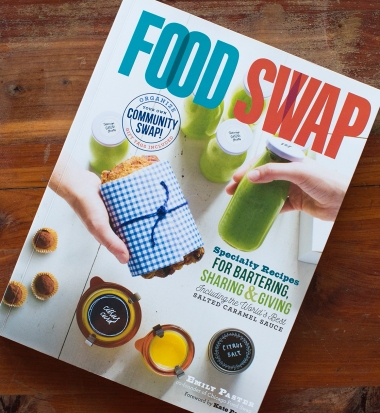
Friends, good day to you! We’ve been in absentia over here at FQF HQ for a few weeks now, as we’re in the trenches of selling our current miniature urban farm and deciding where we’re headed next. These sorts of grown-up activities are simply not for the faint of heart. This is our first home and therefore our first home sale, and the entire process has been much more challenging and elaborate and tricky and bittersweet than we imagined. But enough of all that! Let’s discuss delightful food-focused activities! How about food swaps?

food-swap-14-sml.jpg

Food Swap 13 sml

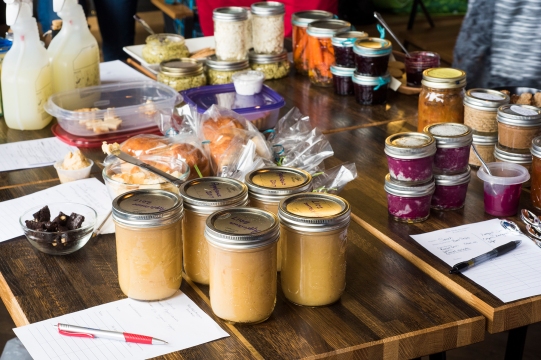
What is a food swap, you might ask? Well, it’s an incredibly fun community event where a bunch of like-minded gardeners, canners, cooks, bakers, hunters and other food-loving people come together to eat, drink and trade homemade treats. The concept is pretty simple: bring five or more of your own homemade goods and go home with the same number of other people’s delicious contributions.

Food Swap 11 sml

Our community table set up for the swap.

Food Swap 05 sml

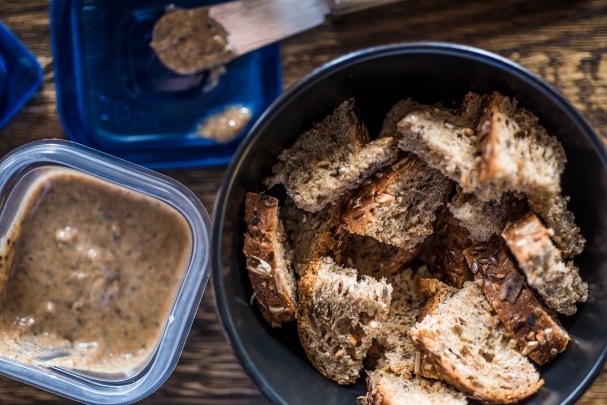
Almond-flax butter ready for sampling.

Continue reading

The FAQ Series: Eggs

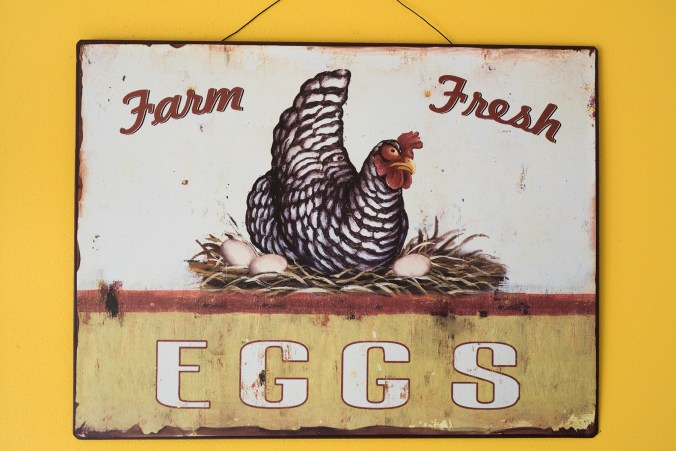
One of the things we’ve missed most since we started traveling just over a year ago is our own flock of backyard chickens. When we decided to set off on our big trip, we sent our six ladies up to live on a farm in Weld County (thanks, Tammy and Chris!), and we still get eggs from that farm occasionally. We’re really looking forward to keeping laying hens again once we find Quiet Farm.

Egg Sign 01 sml

I consider eggs to be one of the world’s most perfect complete foods. They were vilified for so long – remember when we all only ate egg-white omelettes and entire boxes of Snackwell’s fat-free cookies? – but more and more evidence demonstrates that quality eggs are an essential component of a healthy diet. They’re loaded with good fat, protein, vitamins and minerals, and the whole “eggs cause high cholesterol” myth has thankfully been debunked. (Our bodies produce the vast majority of our own cholesterol; what we eat has little impact on our cholesterol levels, though what we eat has a massive impact on every other aspect of our health.) The key, as with every other animal product, is to purchase the best eggs you can. And this is of course so much more difficult than it seems, because what are the best eggs?

Egg box 01 sml

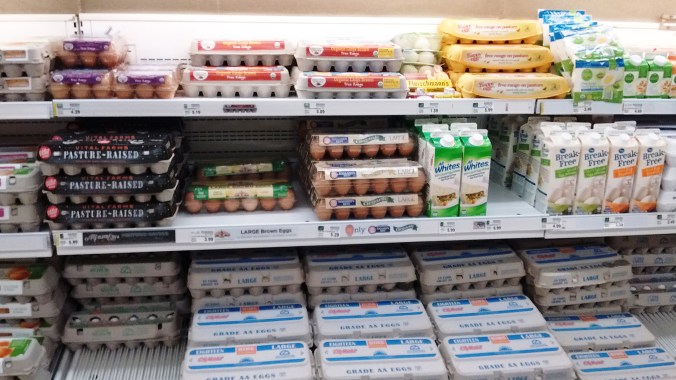
Just a tiny corner of the egg section at our grocery store.

We no longer purchase supermarket eggs; we buy them from local feed stores, where backyard chicken keepers sell their excess, or we get them from farms we volunteer on, or from friends with flocks. (In the winter, natural egg production slows down dramatically; eggs are a symbol of spring and rebirth because poultry start laying again when the days get longer.) Recently I found myself staring at the egg case at our grocery store, and I understood completely why people find food shopping so overwhelming – especially if you care about animal welfare, the environment and/or your own health. How in the world are you supposed to know which is best?

Eggs Bowl 01 sml

The answer in this case is none of the above, but we’ll get to that in a minute. First, let’s revisit and debunk a few egg myths, shall we?

  • There is no difference in nutrition or flavor between white and brown-shelled eggs. Shell color is determined by the breed of chicken and nothing else. Egg producers and grocery stores figured out that customers think brown eggs are better, so they charge more. And we pay it. Many small farmers keep Araucanas or other “Easter Eggers,” because they lay turquoise, pale blue or seafoam green eggs, and they charge a premium for these eggs. Gorgeous, to be sure, but no nutritional benefit.
  • Very few words on egg labels are regulated. Natural, free-range, pastured, cage-free, farm-fresh? These mean nothing, and egg producers can use them on any carton. The only labels that are regulated are organic and non-GMO, and even those are sketchy (you get to hire your own inspector!). And if there is any sort of pastoral farm scene with a red barn and a white picket fence, you know for certain those hens lived in a crowded, artificially-lit warehouse.

chickens3

The mouse may have been vegetarian, but the chicken certainly isn’t.

  • Chickens are NOT vegetarians. If you see “vegetarian-fed” on an egg label, you know for an absolute fact that those hens never had outdoor access. Chickens are omnivores, like humans, and they’ll gladly eat bugs, worms and mice. They’re foragers, which is one reason gardeners love them – they keep the pest population under control. “Vegetarian-fed” simply means “these chickens never foraged because they lived inside for their entire miserable lives.”

Egg boxes 02 sml

Unrefrigerated eggs in a German supermarket.

  • American eggs are kept refrigerated, while those in most of the rest of the world aren’t. When eggs are laid, they’re coated with a natural protective bacteria. The USDA requires commercial egg production facilities to wash and sanitize (i.e. bleach) all eggs, which removes this protective coating and hastens their deterioration – hence the need for refrigeration. This is because the factory farming system in this country produces decidedly filthy eggs, and the USDA has decided that washing the eggs is better than potential foodborne illness. If you buy eggs from a neighbor or local farm, store them unwashed in the refrigerator. This will extend their shelf life; wash the eggs just before you crack them.

Stone Barns 027.jpg

  • Eating eggs does not increase cholesterol levels. 
  • Eating eggs does not increase cholesterol levels.
  • Eating eggs does not increase cholesterol levels.

(I will keep repeating this until everyone in the world knows it to be true.)

  • Eggs from true free-range flocks are nutritionally superior. They’ve been repeatedly shown to have higher levels of omega-3s, plus more vitamins A, D and E. Plus, they’re actually lower in saturated fat and cholesterol, even though we all know that eating eggs does not increase cholesterol levels, right?

Chick

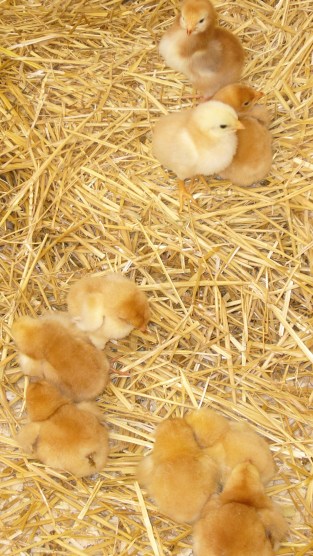
  • Laying hens have the worst lives of any factory-farmed animals. They spend their entire lives in a space less than the size of a standard sheet of paper, and they cannot perform any of their natural activities, including preening and dust-bathing. They cannot even flap their wings. Thankfully, their lives are mercifully short, about eighteen months (compared to a natural life expectancy of eight to twelve years).

Back to our original question: which of these eggs are best? Friends, we like to deliver truth here at Finding Quiet Farm. And the truth is, if a certain egg production facility is big enough to appear on the shelves of your grocery store, they’re almost certainly a battery operation. Major supermarket corporations need a guaranteed quantity of eggs delivered on a reliable schedule, and anyone who has kept chickens knows that true free-range poultry cannot be counted on to do anything reliably, except escape from their fenced area. So these operations that sell eggs to your store are large enough that their hens can’t be free-range, but because those labels aren’t regulated, you can’t do anything about it.

And please remember: just because those eggs are “organic,” it doesn’t mean the birds had a good life. Battery hens can be fed certified organic feed so that their eggs are worth more to the customer, but the hens still lived a horrific existence. Organic means nothing when it comes to an animal’s quality of life. It simply means that no pesticides were used in their feed.

What’s the answer? If you’re going to spend money on good food, upgrade your eggs first. Find someone with backyard chickens, or buy from a local farm. Lots of small, local farms keep poultry flocks, or they know someone who does. Or get your own backyard flock! Remember, you vote every time you spend money, and cheap eggs aren’t good for chickens, the environment, or your health. All of these are worth the extra pennies.

The Farm Series: Rebel Farm

Friends, we don’t want you to think that all we do is trek around wintry European countries, eating schnitzel and drinking wine. No, sometimes we also visit delightful urban hydroponic farms and we eat handfuls of just-harvested fresh greens. Balance. It’s all about balance.rebel-farm-01-sml.jpg

Rebel Farm 05 sml

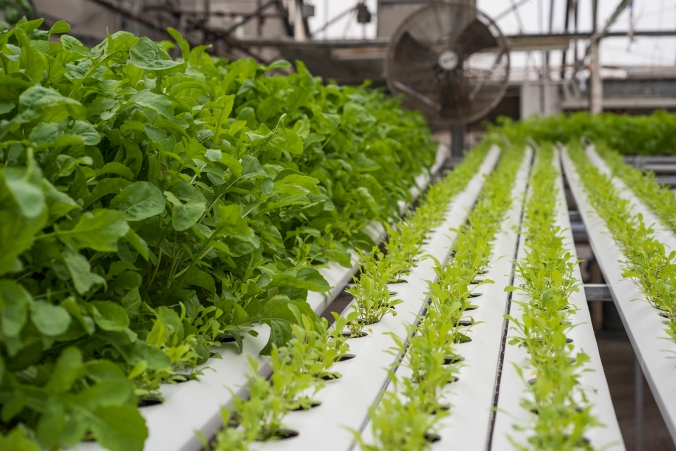
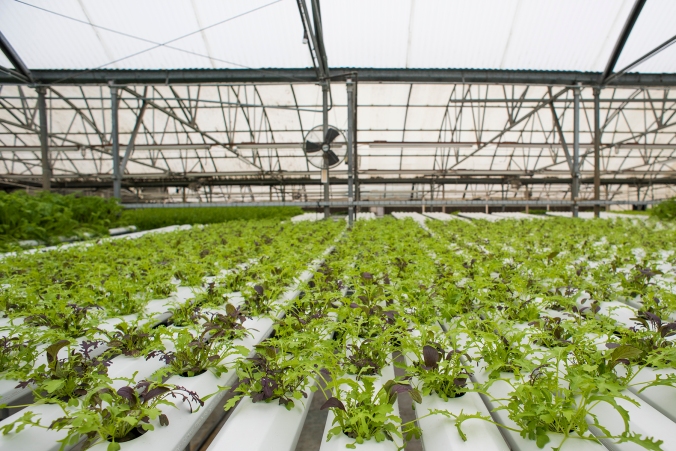
Rebel Farm, run by Jake and Lauren, is a 15,000 square-foot hydroponic greenhouse on the border of Denver and Lakewood. For those readers who live in Colorado, you may well wonder how these fine folks can afford to grow lettuce, rather than weed, considering that just about every greenhouse in the state has been snatched up by the marijuana industry. In the case of Rebel Farm, however, the greenhouse is perfectly situated between two schools – which means it cannot be a grow operation, and instead it can grow food. Brilliant.

Rebel Farm 19 sml

Purple kohlrabi, sadly underappreciated by CSA members everywhere.

Rebel Farm 08 sml

Tangy, citrusy red sorrel.

Rebel Farm 04 sml

If you’re not familiar with hydroponics, don’t feel alone. In its simplest form, hydroponics is a method of growing plants without soil. The plants can be planted in gravel, sand or other inert materials, or their roots can be suspended in a nutrient-rich water mixture. There are lots of different ways to grow hydroponically; Rebel Farm uses the NFT, or nutrient film technique, method.

Continue reading

Essen und Trinken in Berlin

Oh, have we mentioned once or maybe twice that we love food tours? In every city we visit, if there’s a food tour on offer, we’re on it – and Berlin was no exception. Thanks to Margot at Secret Food Tours for introducing us to Berlin’s classic street food!

BFT-01

BFT-02

Chicken shawarma in Turkish flatbread.

Our first stop was a classic shawarma joint; for those of you who didn’t grow up in Europe – or in a city with a strong Middle Eastern influence – shawarma is grilled meat on a spit, slowly roasted and shaved for serving in wraps and sandwiches. Shawarma can be chicken, goat, lamb or beef; ours was brightly seasoned chicken, thinly sliced and served in fresh Turkish flatbread with crunchy lettuce and a tangy, garlicky yogurt sauce. (Want to try your hand at home? Start here.)

BFT-03

This is our kind of bar.

BFT-04

It’s 10:00AM in Berlin. It’s freezing. Let’s have a beer. A dark beer.

BFT-05

Flammkuchen is a great reason to come to Germany.

Our next stop was a cozy, dark neighborhood bar that specialized in flammkuchen, also known as tarte flambée or Alsatian pizza. This was truly one of the best things we ate in Berlin; it’s a crisp crust topped with crème fraîche, smoked bacon, thinly sliced onions and chives. It sounds just okay, but it’s actually spectacular. We ordered a second one.

Continue reading

The FAQ Series: Sugar, Part Two

In Part One of our series on sugar, we discussed the most common sugars you might have at home and typically use in your own drinks and baked goods. Food processing companies, however, have access to dozens more ingredients that they can use in their products, all of which are sugar – but under different names.

sugar-19-sml-e1518656415874.jpg

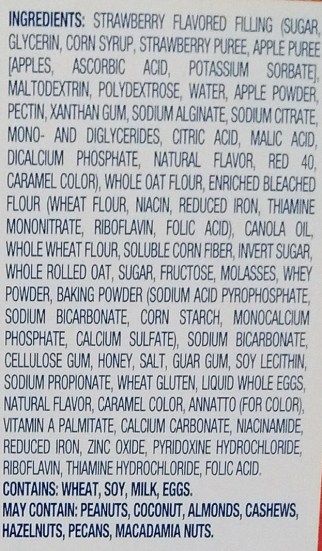
Here’s a fun game: how many different names for sugar can you find on this ingredient label?

Keep in mind that labeling laws in the U.S. require a product’s ingredients to be listed in descending weight order, with the most prevalent ingredient first and so on. Because added sugars are in at least 75% of all processed foods (a conservative estimate), manufacturers are understandably wary of listing sugar as one of the first three ingredients, even if that’s technically true. So the loophole here is to obviously identify sugars individually – that is, maltodextrin separate from high fructose corn syrup which is separate from invert sugar and so on. Did you know that sugar goes by over 60 different names on American food labels, and anything ending in “-ose” is sugar? If you see more than three of these on a product label – especially if they occur within the top three ingredients – put it back on the shelf.

  1. Agave nectar
  2. Barbados sugar
  3. Barley malt
  4. Barley malt syrup
  5. Beet sugar
  6. Brown sugar
  7. Buttered syrup
  8. Cane juice
  9. Cane juice crystals
  10. Cane sugar
  11. Caramel
  12. Carob syrup
  13. Castor sugar
  14. Coconut palm sugar
  15. Coconut sugar
  16. Confectioner’s sugar
  17. Corn sweetener
  18. Corn syrup
  19. Corn syrup solids
  20. Date sugar
  21. Dehydrated cane juice
  22. Demerara sugar
  23. Dextrin
  24. Dextrose
  25. Evaporated cane juice
  26. Free-flowing brown sugars
  27. Fructose
  28. Fruit juice
  29. Fruit juice concentrate
  30. Glucose
  31. Glucose solids
  32. Golden sugar
  33. Golden syrup
  34. Grape sugar
  35. HFCS (high-fructose corn syrup)
  36. Honey
  37. Icing sugar
  38. Invert sugar
  39. Malt syrup
  40. Maltodextrin
  41. Maltol
  42. Maltose
  43. Mannose
  44. Maple syrup
  45. Molasses
  46. Muscovado
  47. Palm sugar
  48. Panocha
  49. Powdered sugar
  50. Raw sugar
  51. Refiner’s syrup
  52. Rice syrup
  53. Saccharose
  54. Sorghum syrup
  55. Sucrose
  56. Sugar (granulated)
  57. Sweet sorghum
  58. Syrup
  59. Treacle
  60. Turbinado sugar
  61. Yellow sugar

Continue reading

The FAQ Series: Sugar, Part One

It’s February, and in America that means we’re celebrating both American Heart Month (take care of your heart!) and Valentine’s Day (so much excess sugar!). Ironic, no? We’re going to return to travel posts from our winter trip to Europe shortly, but in every single one of my recent corporate presentations, I’ve been asked about sugar. Therefore, I think it’s time that your trusted team over here at FQF HQ answer some questions about this ubiquitous yet widely misunderstood ingredient – one that we absolutely need to survive but that is also making us very, very sick.

Sugar 02 sml

Oh my goodness! So very many sugars! All in my own cupboard!

We’re going to start with the basics, and we’re going to break this post into three parts because it’s that lengthy and it’s that important. (Also, I don’t want you to tune out due to boredom.) I’d argue that no other single ingredient in our collective Western diet right now is as significant as this one, so let’s get a few things straight.

  • sugarany of the class of soluble, crystalline, typically sweet-tasting carbohydrates found in living tissues and exemplified by glucose and sucrose; present in sorghum, maple sap, honey, etc.; used extensively as an ingredient and flavoring of certain foods and as a fermenting agent in the manufacture of certain alcoholic beverages

Let’s break that definition down a bit further: almost every single food we eat – fruit, vegetables, dairy – contains some quantity of naturally occurring sugar. It’s a carbohydrate, and it exists in simple and complex forms, and we need it to survive. But it’s not so much the naturally occurring sugars that are killing us, it’s the added sugars in just about everything.

In this first section, we’re going to talk about commonly available sugars: the ones we might find in our grocery store or pantry, the ones we use every day in our own coffee and tea and cookies and other things we make at home. And in the second section, we’re going to talk about industrial sugars: the ones that are added in for us, the ones we’re totally addicted to and the ones we eat way too much of. Finally, we’re going to discuss how the sugar industry has conspired for decades to convince us that butter and cream and eggs and bacon are the true villains, not sugar, even though they’ve long known otherwise.

Continue reading

Manger et boire à Paris

Of course we went on a food tour while in Paris. How could we not? This is the city where I learned to cook (and drink), and there are far too many delicious choices to navigate on your own. Many thanks to Jennifer from Paris by Mouth, who escorted us through the Saint-Germain neighborhood with grace, hospitality and true passion for food and wine.

PFT-02

PFT-01

Our first stop: the esteemed Poilâne bakery, the most famous boulanger in the world. Poilâne is operated by Apollonia Poilâne, who took over the company when her parents died in an accident in 2002. She was eighteen, and she ran the company from her dorm room at Harvard until her graduation, four years later. Interviewed during that time, she said, “The one or two hours you spend procrastinating, I spend working. It’s nothing demanding at all.” Words of wisdom, indeed.

Continue reading

The FAQ Series: Box Meal Kits

Well, hello there! How is 2018 treating you thus far? We over here at FQF are currently swanning our way through France and Germany, and we’ll be sending you some delightful travel missives in the not-too-distant future. But until then, we’d like to talk about box meal kits, because they’ve been a popular topic of conversation lately on both our professional and personal circuits.

What are box meal kits, you might ask? They’re basically recipes and ingredients shipped to you on a regular or on-demand basis, from which you craft (hopefully) delicious, quick(ish) meals. You don’t need to shop or plan; all you need to do is decide which meals you want and how often you want them. And there are many, many companies from which to choose. HelloFresh is probably the most well-known, but there is also Blue Apron, Green Chef, Purple Carrot, Plated, Sun Basket and many others. Plus, Amazon recently bought Whole Foods, so they’re expected to enter the ring any day now, and Wal-Mart is jumping in, too.

Food Box 01 sml

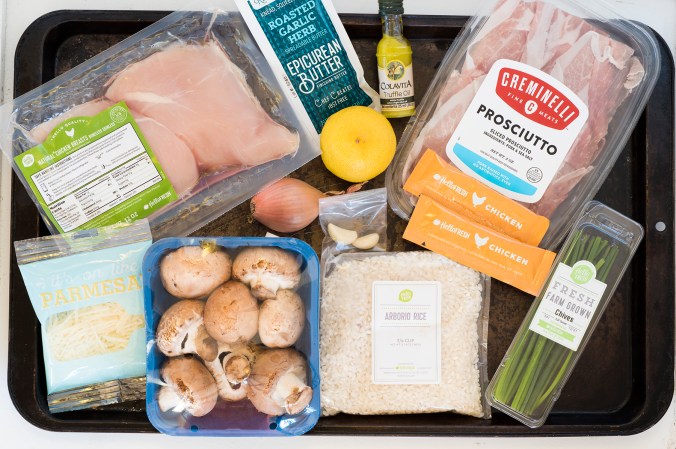
Thanks to our good friends over at Epicurean Butter, we received two HelloFresh meals to test: Prosciutto-Wrapped Chicken with Mushroom Risotto and Kale Grilled Cheese Sandwiches with Tomato Soup. Although HelloFresh offers a number of different plans to choose from, these two meals were each designed to serve two people and they cost about $20 each, or $10 per serving.

Each meal arrives much as you see above: a shopping bag contains the ingredients, plus a photo recipe card and nutritional info; the shopping bags are then all tucked into an insulated box with packing material and ice packs. Typically, you receive three different meals in a box, but again, this varies according to your plan and the company. Cooking oils, salt and pepper are not included, but everything else you need should be.

Food Box 02 sml

Despite the fact that I find following recipes very similar to being put in a choke collar, I wanted to honor the spirit of this experiment and pretend that I was a standard HelloFresh customer, rather than a professional chef. So I laid out all of my ingredients, checked them carefully against the recipe card, and followed the directions to the letter. N even read out the instructions to me while I was at the stove; this resulted in much hilarity as my natural instinct was to do everything my way – he had to correct me frequently, and of course I argued. My goal, obviously, was to see how close I could get to the presentation in the photo as well as the preparation time indicated.

Continue reading

How to eat healthier

I may not love Thanksgiving, but I do love everything about January. I love the quiet after the holidays, the fresh start, the clean slate. And of course, this is the time of year when so many of us promise to do better. When we promise to eat right, drink less, stop going out to restaurants so often, quit smoking, save our money, exercise more and all the rest.Snowy trees.jpgI don’t subscribe to the negativity often associated with New Year’s resolutions. (By mid-January, over a quarter of all New Year’s resolutions have been discarded, and only a scant 10% are actually followed through to the end of the year. Those are some pretty bleak statistics.) Changing habits is hard enough; I’d much rather start off on a positive note. I make a list of goals, not resolutions.

And with that positivity in mind, how about a quick primer on eating better in 2018? This isn’t designed to be an exhaustive list, nor a restrictive diet plan, merely a few simple tips to get your head in the right place for making healthy changes in your daily eating. Diets don’t work, but changing your mindset does.

Continue reading

How to make yogurt

There are foods and drinks we should buy, and foods and drinks we should make at home. I would place things like tofu, amazing soft-ripened cheeses, bacon and hoppy IPAs in the first category; though I can make these things, other people are doing a much better job at it. The second category, however, would include granola, bread, salsa, applesauce, hummus and yogurt, among many others – all of these are much better-tasting, healthier and certainly cheaper made at home.

I’ve been asked a number of times recently for instructions on how to make yogurt, and since I make it once a week on average, I thought it might be high time to share this magic with the world. Making yogurt is not difficult or expensive, but it does require a bit of patience and a basic understanding of fermentation – which is typically referred to as “culturing” when used in context with dairy products. Keep in mind that the instructions below are for cow’s milk yogurt; other milks, such as sheep or goat, or non-dairy products, like almond, soy or hemp, don’t turn into yogurt the same way.

Yoghurt 01 sml

Yes, that is the current temperature in our sunroom.

Let’s be clear on what you absolutely do not need to make yogurt: you do not need a fancy yogurt maker, or an Instapot, or specially-purchased mail-order yogurt cultures. You can use these things if you have them, but to me they all fall firmly into the category of “convincing people they can’t cook without expensive gadgets and hard-to-find ingredients.” Peasants have been making yogurt for literally thousands of years; I’m pretty sure they didn’t stop at Bed Bath & Beyond to grab a yogurt maker on their way back from the fields. What you do need: fresh milk, starter yogurt culture, a heavy pot, an accurate thermometer, a ladle, a wooden spoon, clean jars and lids, and a warm, safe place to keep your yogurt while it’s culturing.
Yoghurt 03 sml

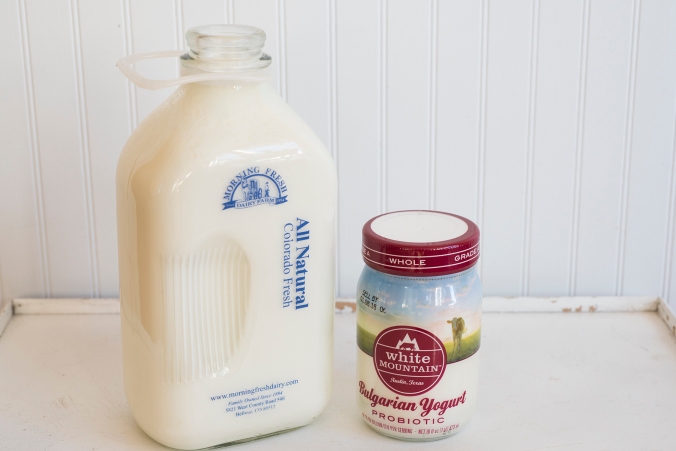
Fresh milk + starter culture = homemade yogurt!

I make my yogurt in one-gallon batches, which yields four quarts plus a bit. If your household doesn’t eat much yogurt, or if you want to start small, make a half-gallon batch. You can always scale up when you realize how much yogurt you’re eating. Don’t buy UHT or other long-life milk to make yogurt or other cultured dairy products; its protein structure has been irreparably changed by the heating process used to make it shelf-stable. And when you’re buying a starter yogurt culture, buy plain, full-fat yogurt; no fruit or other sweeteners, thickeners like carrageenan or pectin, stabilizers or other mysterious ingredients (please, no M&Ms, sprinkles or chocolate chips). Yes, you can use skim or low-fat milk to make yogurt, but why would you? I am an advocate for full-fat dairy at all times; cows don’t give skim milk, so I see no point in consuming it.
Yoghurt 04 sml

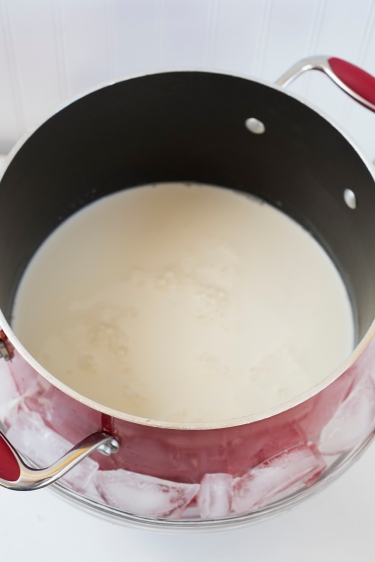
Placing your pot of hot milk in an ice bath will cool it to 110 degrees quickly.

To start, place two tablespoons (for a half-gallon) or four tablespoons (for a full gallon) of starter yogurt into a medium bowl and set aside. Pour the milk into the heavy pot. If your thermometer clips onto the side of the pan, attach it now; ensure the tip doesn’t touch the bottom of the pan or you’ll get an inaccurate reading. Heat the milk gently, stirring occasionally to prevent scorching; you’ll want to bring it up to about 175 degrees F (this could take as long as thirty minutes for a full gallon). Once it’s reached 175, remove it from heat and place it into an ice bath to rapidly bring its temperature down to about 115 degrees F. You can let it cool as is, but icing it is much quicker; stirring it frequently will bring the temperature down, too. (For those of you at altitude, please note that you do not need to adjust these temperatures.)

While you’re waiting for the milk to cool, bring a kettle of water to a boil, and place your clean jars on a folded kitchen towel on your worktop. Fill each jar with boiling water; always wash and warm one more pint jar than you think you need. Place the lids in a separate heatproof bowl and cover those with boiling water, too.

When the milk is around 110 degrees, whisk about one-half cup into the bowl you set aside with your starter culture. This tempers the culture, bringing the two liquids to a similar temperature and ensuring that the starter culture doesn’t cook when it’s added to the warm milk. Now, add the thinned and warmed starter culture to the pot of milk, and stir well. Pour the boiling water out of your first jar, and set it back on the towel. Ladle the warm milk and starter mixture into this clean, hot jar (a funnel comes in handy here). Repeat the process for the remaining jars until you’ve used all of the milk. Put the lids on the jars and close gently; the lids just need to be snug enough to keep from falling off but they shouldn’t be lumberjack tight. Wipe the jars and lids with a clean, damp towel to remove any milk residue.

You can now place the jars into a cozy spot, like a cooler lined with towels, or your (turned off) oven or microwave. The idea is to keep the jars pretty warm, which allows the culture to activate and thicken the milk. I use my dehydrator on a low setting; some people use a slow cooker or even surround the jars with heating pads or hot water bottles. You may need to experiment to figure out what works best in your household; just remember that you’re trying to keep the yogurt reasonably warm and undisturbed. Yogurt cultures love an ambient temperature range of 95 to 115 degrees; the cooler it is, the longer it will take to get a set (but it will still work!).
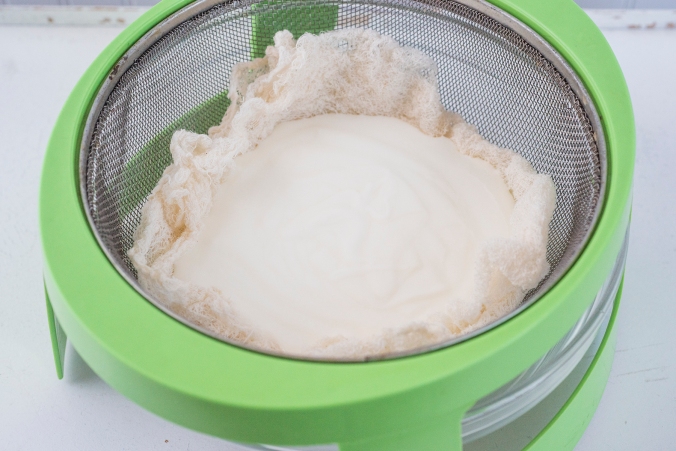
Yoghurt 05 sml

Draining the yogurt in triple-layered cheesecloth will create a thick “Greek-style” yogurt.

I typically leave my yogurt to culture overnight, depending on how much I’m making and the ambient temperature in my house. It will thicken more once it’s been refrigerated, and you can also drain the whey out, leaving you with thick, “Greek-style” yogurt. Drained whey can be added to bread doughs or smoothies, or used as a starter culture for lacto-fermented vegetables, if you’re so inclined. I almost never drain my yogurt, preferring instead to let it culture longer so I have a thicker product and can use every bit of it; when I do have leftover whey I use it to cook grains, like farro and wheatberries. I always leave my yogurt plain so I can use it in both sweet and savory applications; if you want to add in jam or vanilla or honey or maple syrup or any other sweetener or flavoring, do so on an individual basis and not to an entire batch.

Of all the hundreds of batches of yogurt I’ve made, I’ve never had a batch not set. That said, if your yogurt isn’t turning out, I’d recommend first calibrating your thermometer so you know that you’re adding culture at 110 degrees. Too hot and it will die, too cold and it will go dormant. Just like using yeast in bread baking, temperature matters a lot. If you’re confident your thermometer is accurate, I’d next change the brand of milk you’re using, and then I’d change the starter culture, again thoroughly examining that ingredient label to verify that there is nothing in the yogurt besides milk and active cultures. Storebought yogurt has a lot of junk in it; read all your food labels carefully.
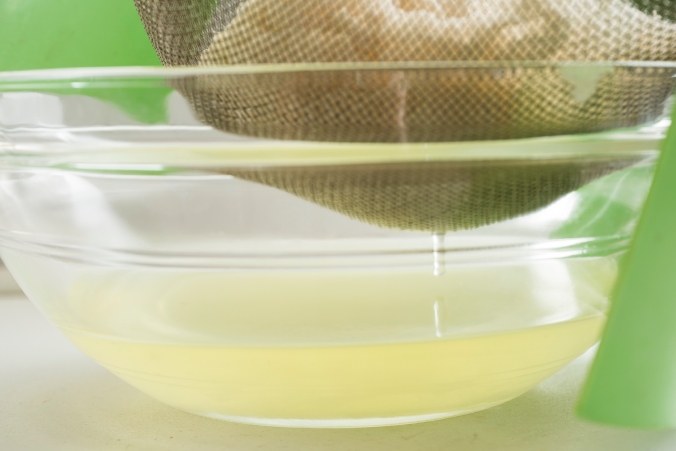
Yoghurt 06 sml

Use the drained whey to bake bread, cook grains or ferment vegetables.

The temperature and speed that your yogurt cultures at determines the thickness of the final product, so once you’ve got the basic technique down, feel free to experiment with how long you let it set, and at what temperature. I’ve read that heating the milk to 195 degrees F allows for an even thicker yogurt because it denatures the proteins further, but I haven’t tried it. Know also that eventually your starter culture will wear out; if you’re making a lot of yogurt, you might find that you need to purchase a fresh starter yogurt every few months to keep your set strong.
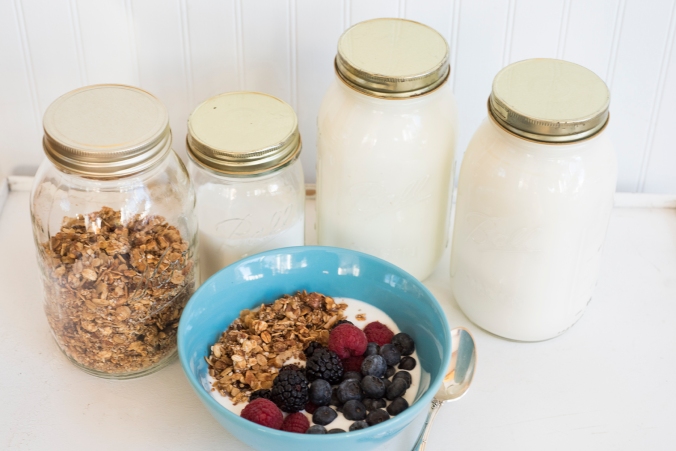
Yoghurt 02 sml

Homemade yogurt, homemade granola and fresh berries. Nom nom nom.

What else should you do with your homemade yogurt, besides enjoy it with fruit and granola? Bake with it. Blend it into smoothies. Use it to marinate meats. Freeze it in popsicle molds with swirls of jam and honey to make your own frozen treats. Add in fresh herbs and salt and make it into a tangy salad dressing or dip for fresh vegetables. Just remember to save a couple of tablespoons to start your next batch!