Farm update: March 9

How are you doing? It’s probably been a whipsaw week where you live, too. Here we are trying our best to stay busy and avoid the headlines (easier said than done). A few things we’ve been up to, if you’d like to see:

Bees Coffee Filter 01 sml

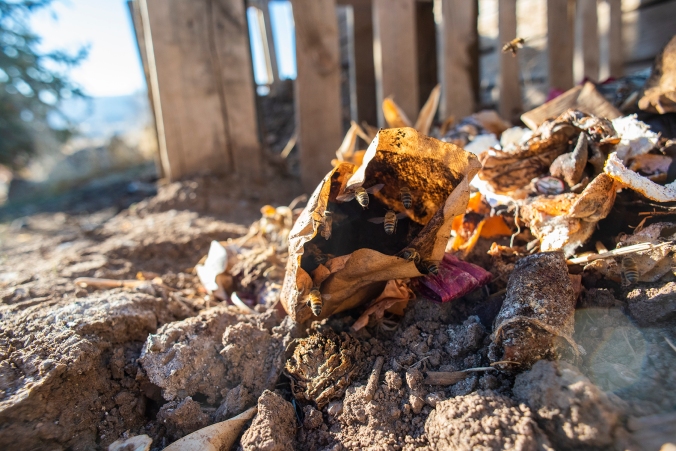
The bees love coffee as much as we do!

One sure sign of warming weather (which is coming far too early, in our opinion) is enhanced bee activity. On warm, sunny days we’re seeing lots of bees buzzing in the compost pile (they particularly love our spent coffee filters) and also near one of our big trees that’s in early bud. The apple trees in the surrounding orchards haven’t bloomed yet, but it’s always nice to know that our resident bee population survived another winter.

Continue reading

Farm update: February 24

Greetings! We are currently stuck in that awkward phase between winter and spring. Some days it’s all teasing warmth and perfect blue skies, and some days it’s bleak and grey with icy, biting winds. Most of our snow is gone, though we expect (and hope for) one or two more storms, at least. It’s a changeable season, but spring is definitely in the air and we’re starting to hear more songbirds and see new growth everywhere we look. Here are a few things we’ve been up to recently.

Prairie Falcon 01 sml

A prairie falcon (Falco mexicanus) in one of our towering cottonwoods.

We still haven’t captured a photo of our shy Northern harrier, seen regularly hunting mice in our pasture on sunny afternoons, but N did snap this lovely photo of a prairie falcon. The prairie falcon is about the size of a peregrine falcon, but with a much different hunting style (low swooping over the ground, rather than rapid dives). Unfortunately for the songbirds we’ve been hearing, much of the prairie falcon’s winter diet is the Western meadowlark, but we hope this one will focus more on our ground squirrel population. As with all falcons, the female is substantially larger than the male. Continue reading

Winter on the farm

In nautical terminology, “the doldrums” refer to an actual place – waters near the Equator where sailing ships were often stuck for days or weeks in windless seas. In common parlance, however, the doldrums mean “a state or period of stagnation, inactivity or depression.” And so here we are in deepest winter.

Raised Beds 02 sml

Our dormant raised beds, slumbering under snow.

Continue reading

Farm update: January 6

Hello there, and a very happy new year to you and yours. If you’re here for the first time, welcome! If you’re returning after our hiatus, thanks for coming back! We look forward to sharing a new year of food and farm adventures with you.

ATV Plow 01 sml

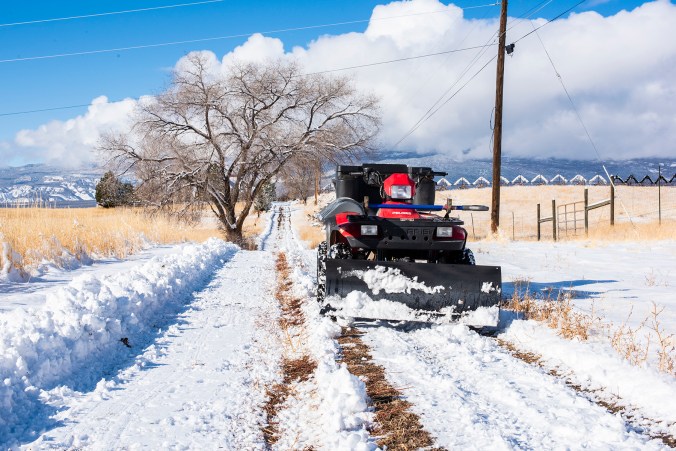
Our updated Snow Management Plan in action!

Last winter – our first winter at Quiet Farm – our area received an unprecedented amount of snow. Our inaugural Snow Management Plan was…ineffective, shall we say; we had no tractor and no plow and no way of getting out of our quarter-mile driveway with a foot of snow on the ground. At one point, we resorted to begging a friend with a truck to flatten the snow by driving up and down our lane so we could at least leave the farm (thanks, Joe!). Needless to say, that was not a sustainable long-term solution.

This winter we haven’t had nearly as much snow, but we do have a plan – a detachable plow for our ATV. And so far, the ATV plow has worked like a champion. We’re even thinking of purchasing other implements for the ATV, so that we can use it like a mini-tractor, since we’ve been unsuccessful in finding a reasonably-priced midsize tractor to manage our pasture. Stay tuned.

Continue reading

Farm update: October 21

Buck 01 sml

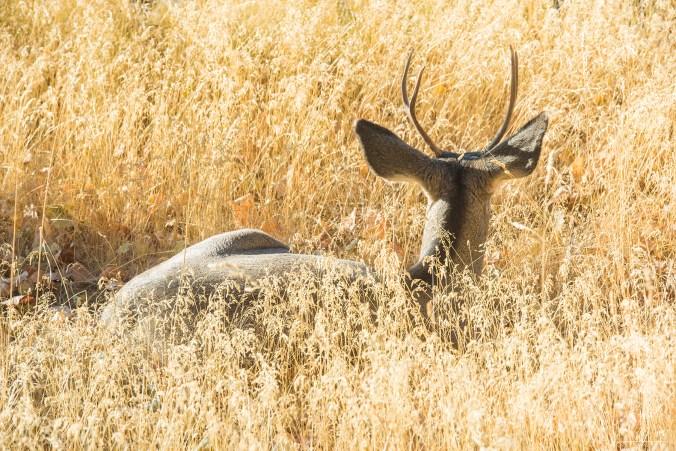
The south lawn of our house makes a peaceful resting spot.

Is it autumn where you live? Is it crisp and cool with bright scarlet and gold leaves everywhere? Is it dark when you wake up in the morning? It is here, and we’re settling into this brief transition season before winter extends its icy grip. Much of our work these days involves cleaning, tidying, preserving, covering and generally setting things in place for the colder months. We try to take advantage of these bluebird fall days for as long as we can; once the snows come, we won’t be working outside much.

Garlic Slate 01 sml

Growing garlic takes forever, but it’s worth the wait.

Ninety of this season’s largest garlic cloves have been planted in a bed newly prepared with lots of rich compost. Last year’s garlic went into an existing cinderblock bed that was here when we moved in; a few weeks ago we broke that bed down and dispersed the soil into new trenches for garlic and asparagus. The cloves will slumber quietly here over the winter, and in the spring we’ll hopefully see green garlic peeking up through mulch and snow. Every year we’ll plant more and more garlic; we eat a lot of it, of course, but since garlic adapts to its unique environment, we want a generous quantity to save for planting.

Irrigation Water 01 sml

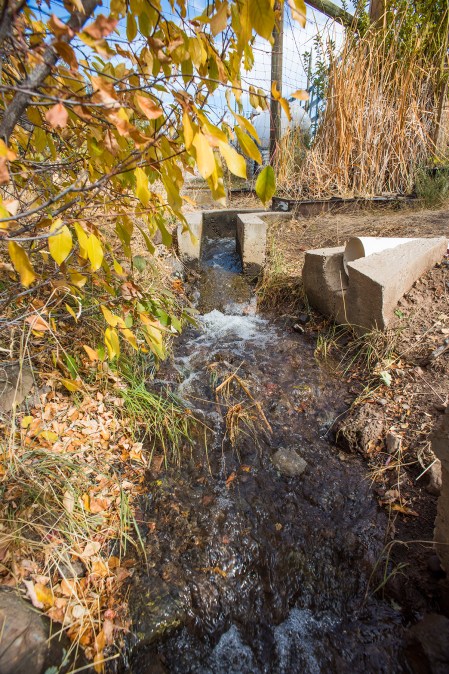
The water runs through a culvert underneath our driveway and out into our pasture. You can see our flume in the upper right.

We ran our irrigation water for the first time this season, and it went surprisingly well. Our pasture isn’t planted right now so the irrigation run was more of an experiment to see how the water would move through our gated pipe system. We own shares in a local creek that pulls water from reservoirs on the Grand Mesa; when we want to run water we order a certain amount for a certain period and that water is deducted from our account. This run was for two days (forty-eight hours straight!) and it requires a lot of hands-on management, mainly opening and closing gates manually in the big pipes. When we’re more comfortable with our irrigation we won’t need to babysit it as much, but we’re unleashing hundreds of thousands of gallons of water mere feet from our house, and we definitely want to pay close attention to where it’s going.

Tomatoes Ripening 01 sml

Our tomato crop redeemed itself after a rocky start.

We harvested all of our vegetables prior to our recent hard freeze and brought in just over one hundred pounds of green, unripe tomatoes. In the past I’ve never had good luck ripening tomatoes indoors, but for whatever reason these are ripening quite well. They’re no longer good to eat fresh – the overnight temperatures dropped too low, so the tomatoes taste as though they’ve been refrigerated – but they’re perfect for sauces, soups and purees. A pantry stocked with canned homegrown tomatoes is a winter gift indeed.

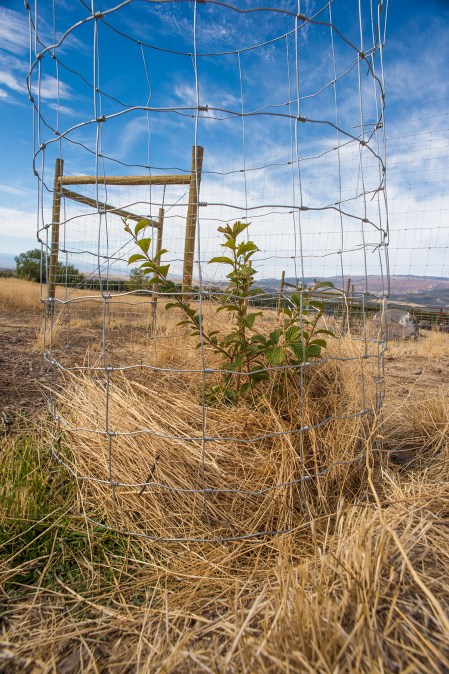
Tree Mulch 01 sml

One of our little saplings, hopefully protected from winter weather (and deer). 

We’ve hustled recently to layer all of our fruit tree saplings with warm winter mulch. Some of our little trees look healthy and others are…struggling. We’re hopeful that the mulch blanket will keep the trees protected from our harsh winter weather, since their root systems are likely to still be quite delicate. One of our priority spring projects next year will be to put a drip irrigation system in the orchard so we can stop watering the trees by hand.

We’re back to work, friends. We wish you a good week.


Lessons learned

Hello again, and please forgive us our recent absence. We’ve taken a small summer hiatus – not because we’ve actually been on vacation, but because for a period of time there we didn’t have many nice things to say about farming, and we didn’t want our space here to sound whiny and negative. We’re genuinely thrilled to be farming, even when we aren’t.

Hail 01 sml

One of early summer’s low points.

It’s been just under one year since we found Quiet Farm, and what a year it’s been. There have been highs and lows and successes and failures. And now that we’re one year wiser and can officially call ourselves farmers, we’re working hard on learning from our experiences. We always say that we’re allowed to make as many mistakes as we want, but we have to make different mistakes. If we make the same mistakes over and over, then we obviously haven’t learned anything.

Continue reading

Farm update: July 8

Hail 04 sml

This is not some sort of newfangled organic fertilizer.

Welcome to high summer. It’s hot, dry and crispy here at Quiet Farm…except when it’s hailing. We’ve had three significant hailstorms so far; the one pictured above did some pretty severe damage to our vegetables. Between the late start, our overwhelming whistle pig infestation and this extreme weather, we’ll be thrilled to harvest anything this season. Growing food is not for the faint-of-heart.

Continue reading

Deer diary, vol. 2

Game Fence 08 sml

Tools at the ready for constructing an H-brace.

Early this year, Colorado Parks and Wildlife delivered our game fencing materials. They also included a thin pamphlet with a few helpful suggestions on how to construct said fence – not really what we’d call “instructions.” As we’d never built even a simple fence before, this meant a lot of time on the University of YouTube. Our game fence is nine feet tall and composed of wood posts, metal T-posts, two strands of grid wire fencing and three strands of barbed wire. That’s a lot just to keep deer out – and each component has to be installed separately.

Game Fence 14 sml

Once we’d set our wood posts in concrete, we went around building H-braces at corners. H-braces (seen above on the left and right sides of the gate) are required when the fence turns a corner to keep it supported. The H-braces seem relatively simple – you just notch the vertical posts, insert a horizontal post, then use massive nails (3/8 inch by 12 inches!) to secure the horizontal to the vertical. As with all aspects of this fence, though, this is simpler on paper than in reality. Notching the fenceposts required climbing on a rickety stepladder on very rocky and uneven ground and holding a reciprocating saw at an awkward angle while trying not to fall off the ladder. Not at all OSHA-approved.

Game Fence 13 sml

Four completed H-braces on either side of our corral gate.

With the posts successfully notched, we set about connecting the horizontal to the vertical. Driving the heavy, thick nails in proved to be yet another challenge. After hours of frustration, we finally bought an extra-long drill bit so we could pre-drill the holes for the nails. This was an important lesson learned: don’t try to do something the hard way if a power tool can make the task easier.
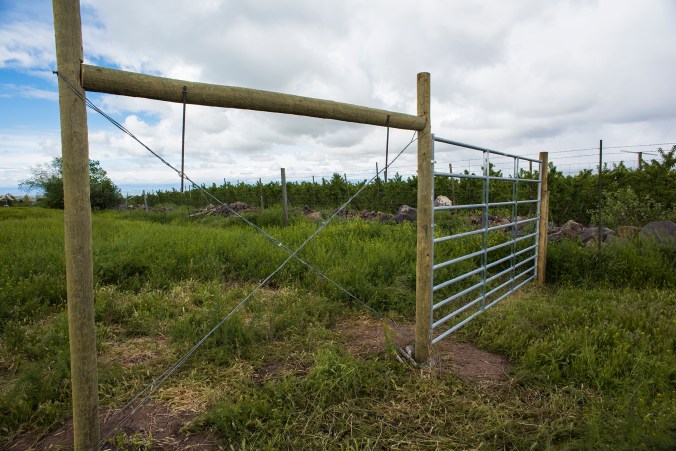
Game Fence 12 sml

Looking southwest at our pasture gate.

H-braces then have to be wrapped with nine-gauge wire in order to stabilize the posts. As with the nails, this was much easier in theory than in practice. The wire was delivered to us in huge coils which were absolutely unmanageable – no matter where you wanted the wire to go, it was set on uncoiling the wrong way somewhere else, usually slapping you in the face along the way. We each bear our fair share of fence scars.

Game Fence 15 sml

Using a come-along and a wood clamp to stretch the grid fencing.

Now that the H-braces are up and wrapped, the two strands of grid fencing have to be installed. We could have opted for one-strand fencing, but the fencing comes in 330-feet rolls and the two of us could barely lift one of the smaller rolls. So we chose to wrap two strands, which most small farms do. It takes longer, but it’s much easier for two people to handle.

We unrolled the coils along the fence line, then used a come-along and N’s very crafty wood plank clamp to stretch the fencing. It’s imperative that the fencing be as tight as possible, but because our posts aren’t exactly straight, we had to adapt a bit. We’ll call it “accounting for the curvature of the earth.” Once in place, the fencing was secured to the wood posts using thick staples, and to the T-posts using clips.

Game Fence 16 sml

Using the wood clamp and the ATV hook and cable to install the top row.

Installing the top row offered additional challenges, since we had to hold up hundreds of feet of fencing while stretching and then securing it. Our ATV’s hook and cable set-up helped a great deal here, as did some sturdy chains attached to our wood plank clamp.
Game Fence 20 sml

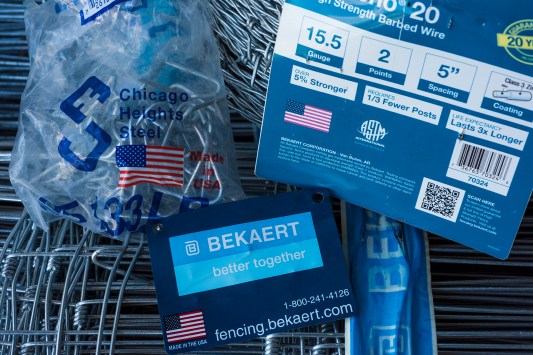
We were pleased (and surprised!) to find that all of our fencing materials were made in the USA.

Game Fence 18 sml

Waiting for barbed wire along the top and bottom.

Game Fence 17 sml

Nearly finished!

The complexity of the fence might seem like a bit much just for some deer…but we have watched these animals easily leap a six-foot fence from a standstill. The power in their strong legs and their lean bodies is remarkable, and the fence has to be nine feet tall to have any hope of keeping them out, especially when they’re moving at a full, panicked run.
Game Fence 19 sml

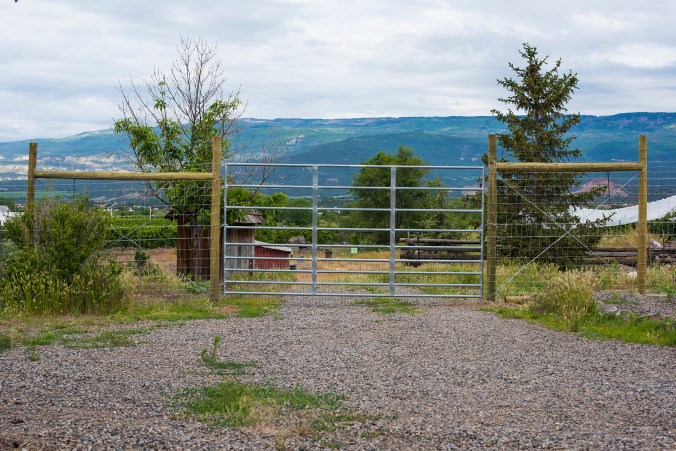
Dear deer: the Quiet Farm salad bar is officially closed. Go torment someone else.

Building our game fence is the most extensive, complex and difficult project we’ve tackled yet here on Quiet Farm, and we are so proud of the results. The fence isn’t perfect, but we did it ourselves for about one-tenth what it would have cost to hire a fencing company, and we learned so much along the way. This sense of accomplishment and self-sufficiency is why we’re out here.

Thanks for reading!


Farm update: June 10

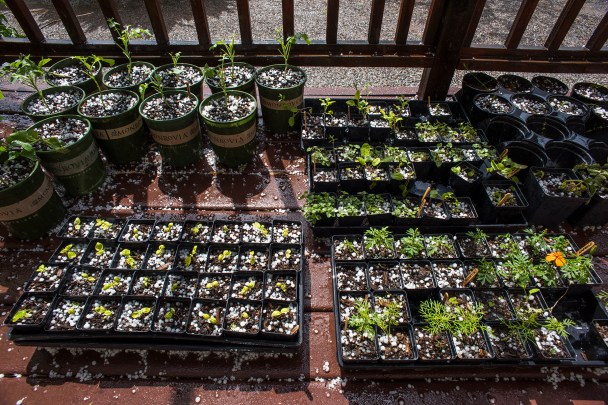
Seedlings 02 sml

Still relatively safe on our west deck.

Why aren’t these plants in the ground, you say? Because our fence still isn’t finished. I know, I know…we’ve been going on about this game fence for what seems like decades; trust us, it’s twice as long when you’re actually building it. And we’re progressing, we really are – but it isn’t complete. And so these seedlings wait patiently on our sun porch, getting leggier and more rootbound every day. We’re glad this is a year focused on building infrastructure and learning, because if we actually had to harvest these crops on a specific schedule in order to make money, our season would already be shot. Most of them will thrive once they’re finally planted into raised beds, but some, like the pak choi, have already set flowers and are on their way to going to seed, so their life cycle is nearly complete. Had we known the pest pressure we’d face here, we would have started building the game fence last fall. Live and learn.

Whistle Pigs 01 sml

Look carefully…there are at least four visible in this photo. And probably four hundred hidden in the rocks.

Speaking of pest pressure, our resident whistle pigs have had a wildly successful breeding season. Not familiar with whistle pigs? They’re part of the large marmot family (Marmota monax), commonly known as ground squirrels, and they’re related to woodchucks, gophers and prairie dogs. They do actually whistle to warn their brethren of impending doom (like when we stroll down the lane to pick up the mail) and they live amongst our extensive rock collection. While they haven’t done much damage to crops yet (mostly because there aren’t any – see above), we do believe they’re orchestrating a stealthy and coordinated campaign to creep ever closer to the vegetables. They are exceptionally quick despite their awkward bulk, and they have lush, glossy pelts – perfect for a fashionable winter hat! Right now we’re offering a special: come collect one rock, and you get a free whistle pig. (Some trapping required.)

Continue reading