
The “before” photo of the beauty makeover.
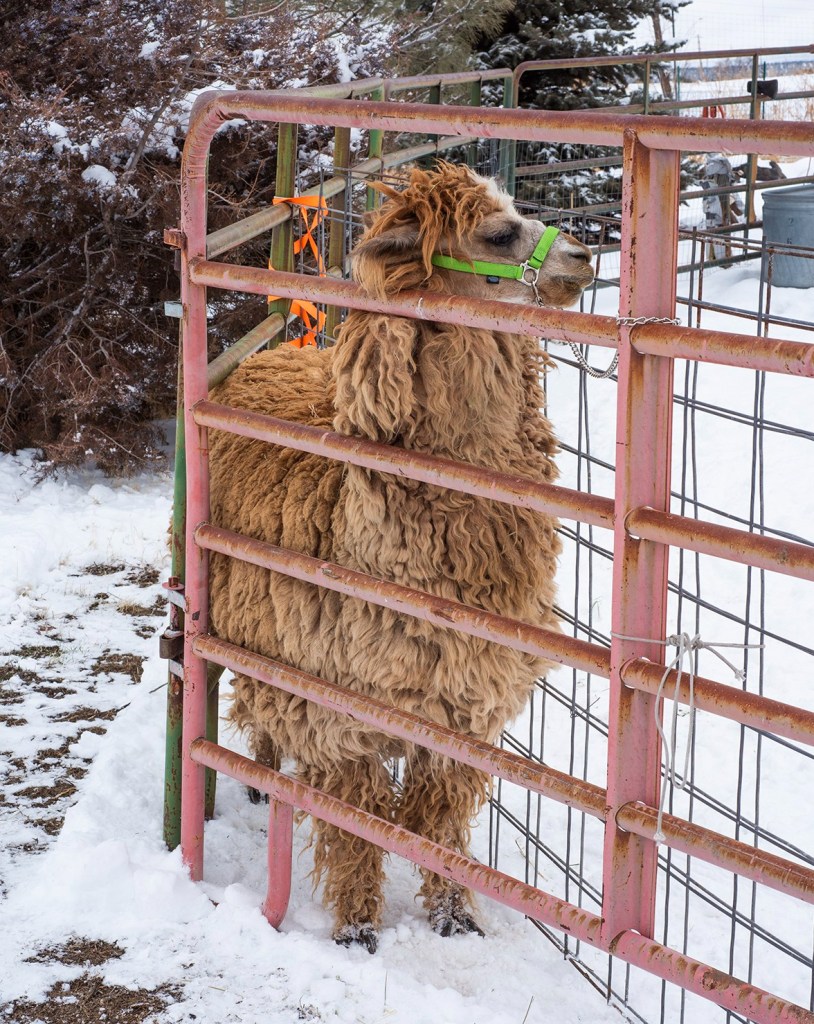
A big event happened recently at Quiet Farm: our five rescue alpacas were successfully sheared.
Continue readingThe “before” photo of the beauty makeover.
A big event happened recently at Quiet Farm: our five rescue alpacas were successfully sheared.
Continue readingLate spring is a busy time of year for small farms and homesteads. The task list seems endless: plant this, thin these, weed that, water those and by the way, the alpacas and chickens still need food, water and clean bedding. The best we can do is simply to make list after list, and tackle those lists one item at a time. One thing we do adjust as we move into our busiest period: our daily routine. If possible, we try to be outside in the morning and inside in the afternoon, because our blustery, changeable winds make working outside even more challenging after two o’clock. This is a lovely ideal, of course, and things don’t always proceed as planned – but all we can do is our very best.
Here are a few things we’ve been up to, if you’d like to see:
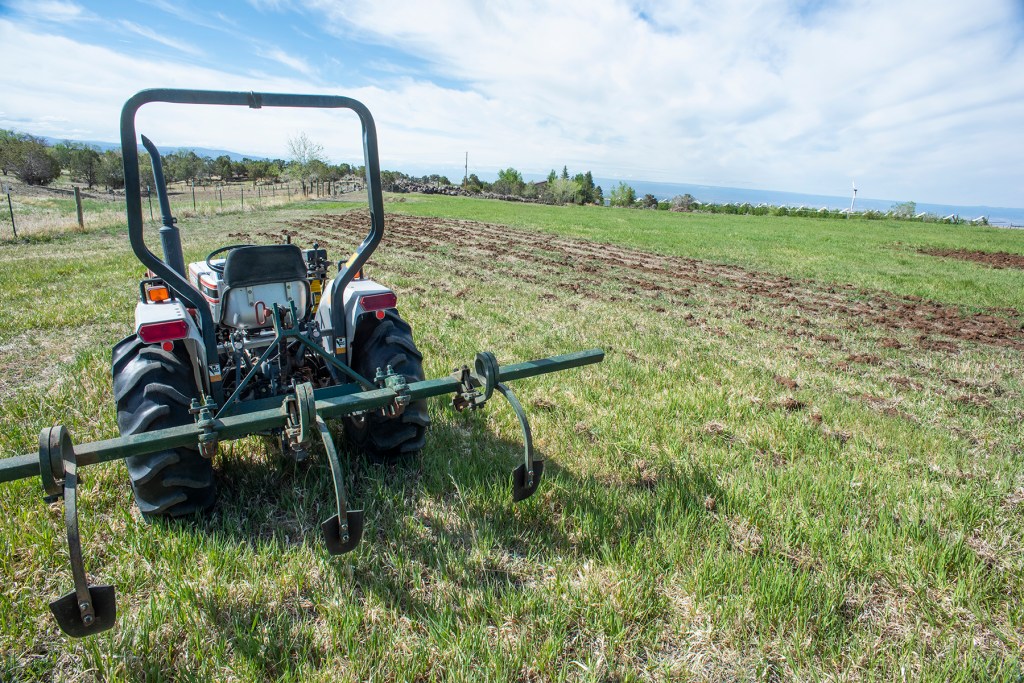
Careful pasture management is helping our land stay green despite the exceptional drought.
Our irrigation season is set to launch next week, though we still haven’t learned our water allotment for this year. In preparation for running water, we purchased a three-row marker to attach to our little tractor. Because we use gated pipe to irrigate our pasture, it’s important to “mark” the fields with channels that direct the water to the correct places. Marking is usually done on a three-year rotation, but our pastures were essentially abandoned for close to seven years, so it’s going to take some time to get the irrigation pinpointed. In addition to marking the fields, we also reconnected all of our gated pipe and replaced damaged gaskets and gates. Most people don’t break down their pipes every year, but we’ve mentioned before that we have a severe rodent problem – and if they build a winter burrow in the pipes, they’ll eat the gates. It’s more work to disassemble and reassemble the pipes, but likely saves us money in the long run.
Continue reading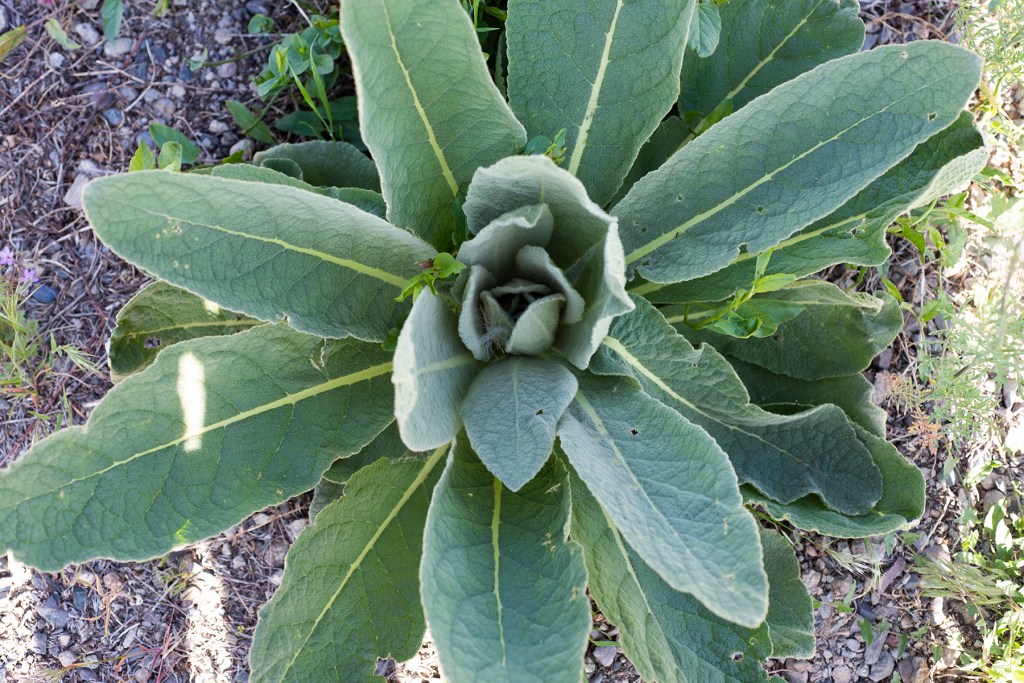
Soft and fuzzy common mullein (Verbascum thapsus).
A couple of years ago, a film titled The Biggest Little Farm was released in the U.S. It received quite a lot of publicity, especially unusual for a farm documentary, and was shown at film festivals and charity screenings across the country. The film opened shortly after we purchased Quiet Farm and was mentioned to us by scores of friends and acquaintances, so of course we had to watch it. The story follows John and Molly Chester as they attempt to regenerate an abandoned farm outside of Los Angeles.
Continue readingThis post likely would have been much more helpful about fourteen months ago, when the baking craze started in full force, but better late than never. Hopefully people still bake on occasion? Today we’re going to talk about yeast, a reasonably simple subject that gets complicated surprisingly quickly.
Before we get into the precise details of the baking yeast we use today, it’s important to understand just a bit about the history of bread and leaveners in general. A leavener – basically anything that makes dough rise – can be physical, chemical or biological in nature. Physical leavening agents are air and steam, which might be incorporated either through mixing or through the oven’s heat. Chemical leaveners, most often baking soda and baking powder, create a chemical reaction that causes doughs to rise. And finally, yeast acts as a biological leavener; yeast is a microscopic organism that consumes simple sugars and creates carbon dioxide gas as a byproduct of fermentation, which in turn causes dough to expand. Yeast cells used in baking are found either in commercial packaged form or wild in a starter.

Yeast-risen doughs really are simpler than this picture makes them seem.
Continue reading
Hello there. We want to say that we’re still here on Quiet Farm, and that it’s been a rather challenging start to the growing season. One hundred percent of our county is currently in “exceptional drought” – the scale doesn’t go any higher! In official government parlance that translates to “dust storms and topsoil removal are widespread; agricultural and recreational economic losses are large.” We’d agree with that assessment – and it’s only May.
We have not yet received our official irrigation allotment for the season, but are expecting less than half of what we had last year. Wildfire season (now really year-round rather than just a season) has already started in California, New Mexico and Arizona, and promises to be grim here again, too. Dust storms and relentless wind are a regular feature of our days, and it’s impossible to keep the cool-weather crops properly irrigated. We have not had any moisture at all since January.
To compound our troubles, our hundreds of plant seedlings in the sunroom have been infected by an unknown disease or other ailment, and as a result are tiny, stunted and definitely not thriving. They should be going outside in about three weeks, but at this point it’s unlikely that we’ll have any at all, and it’s too late now to start more warm-weather crops. Perhaps the universe is sending a clear message that this isn’t our year.
That said, what else can we do but keep going? This blog isn’t meant to be a place for complaints and whining. We have a comfortable house, plenty to eat and we’re healthy and safe. Many, many people have it far worse than we do, and we’re well aware of that. We will do what we can with what we have, and perhaps the growing season will stage a recovery of sorts. And if it’s a total write-off, then we’ll try again next year.
Tip your hat to a farmer the next time you meet one – this growing food thing is no joke. Thanks as always for reading, and we hope you and yours are safe, healthy and well.
The world feels far too heavy and sad, particularly here in Colorado, for some absurdly cheerful post about alpacas or chickens or whatever we’re doing on the farm. Instead, we’ll offer a brief round-up of some favorite gardening books, in the hopes that you might be inspired to search these out at your local library or favorite independent bookseller. As with cooking, there is always something new to learn about gardening and growing food, no matter how long you’ve been doing it. And as with cooking, where feeding hungry people nourishing, healthy food feels like an act of pure hope and a direct rebellion against the stupid, meaningless tragedy of the world, so does planting a seed or a sapling.

We are sorely disappointed to report that we did not receive even one paltry inch of snow from the massive spring storm that walloped Denver and the Front Range last weekend. To add insult to injury, snow was in the forecast again today, to no avail – I promise you that it is clear and dry outside right now. We joke regularly about checking (In)AccuWeather on our phones, where it’s always “currently snowing in Delta County” – no. No, it isn’t. We have learned from our time here to only trust the weather that we can actually see and feel. All other promises and forecasts ring hollow.
So what we’re not doing on the farm right now is plowing or shoveling snow. But here are a few other things we’ve been up to lately, if you’d care to see.
Continue readingHello there, and welcome to March. (March?!? Really? We are completely not prepared for all of our spring tasks yet.) Also, welcome to the nearly one-year anniversary of the pandemic lockdowns. A year of this madness. How is everyone doing out there? The “pandemic wall” is a real thing, make no mistake, and I think a lot of us have hit it. Hard.
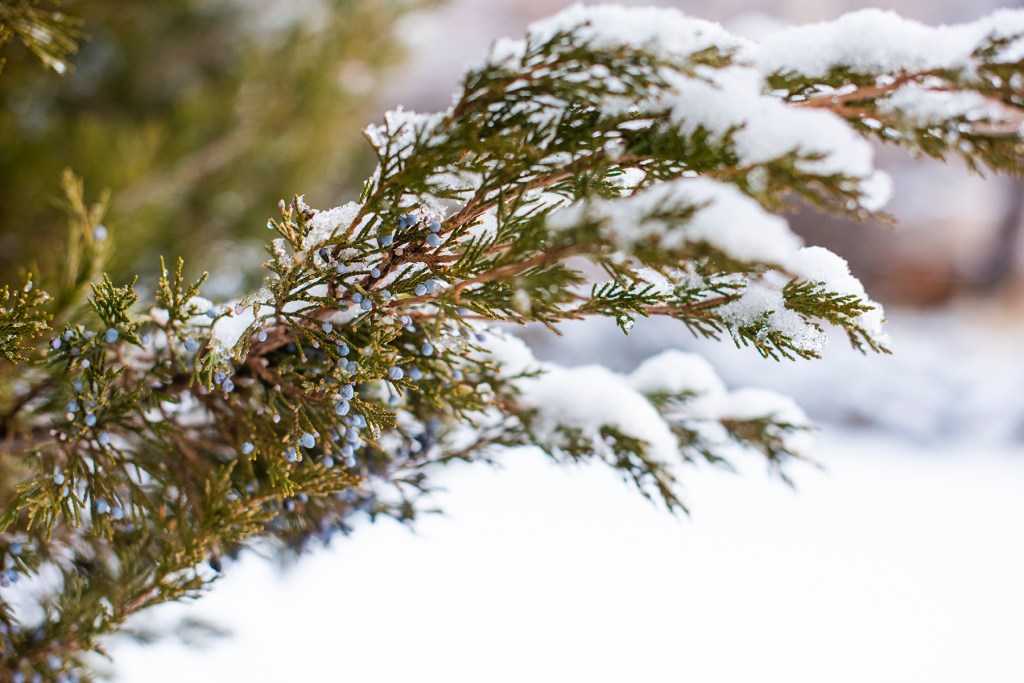
The images in this post might convince you that we’re buried in snow over here at Quiet Farm; sadly, that is not at all true. We have gotten a bit of snow both here and up on the mesa, and of course we’re grateful for every last flake, but it’s still looking as though it’s going to be a painfully dry year. As always, the only thing within our control is how we use the water we do have, so we’ll be focusing our efforts on making sure that not a drop goes to waste.
Paris secured in our makeshift crush before the vet’s arrival.
One great accomplishment that we’ve had recently is to successfully geld one of our male alpacas, Paris. His behavior had become increasingly aggressive and since we are not running a breeding program, there is no reason to keep an intact male on the farm. We were able to safely secure him in a “crush,” and our terrific local vet took care of the rest. It takes about sixty days for all the testosterone to leave his system, but his aggressive behavior has definitely lessened since the fateful day. We’re also pleased to announce that we’re on the mobile shearing schedule for the spring, so the alpacas will be getting a tidy cut in late May or early June, which will make them much more comfortable this summer. We are working on halter-training all the animals so that we can handle them in a safe and calm manner – this is much easier said than done, and frequently both humans and alpacas stomp off in frustration and tears. (Okay, maybe not the alpacas. Definitely the humans.)

Our game fence is good for more than just keeping out deer!
I’m also proud to announce that I’ve finished a patchwork quilt I started late last year. I won’t lie: I made approximately ten million mistakes on this quilt and learned so much about what not to do in quilting. I also unknowingly caused a lot of my own problems by designing a somewhat complicated pattern that required an excessive amount of piecework and stop/start stitching. (It’s only my fourth full-size quilt, however, so perhaps I should cut myself a bit of slack. I am very much a novice.) I read an article recently about different crafting hobbies people had taken up during the pandemic; one woman tackled a complicated shawl using fairly advanced knitting techniques. She wrote, “I almost quit a lot of times. But I kept at it, and I was both miserable and joyful at times – it was a good emotional process for me. The challenge was a great distraction from the chaos and stress of the unknown.” That accurately sums up my feelings about making this quilt – and I’m already excited about starting my next one.

Snowshoeing is a surprisingly challenging workout!
We’ve mentioned on more than one occasion how much we adore our local library system; to make us love them even more, they’ve started loaning snowshoeing equipment! We’re about twenty minutes’ away from some of the best snowshoe/cross-country trails in the West, and borrowing equipment and just running up the mountain for a couple of hours has been a terrific break. (Even better: many of the trails ban loud, obnoxious snowmobiles.) We’re hopeful that we’ll be able to go a few more times before the demands of spring on the farm limit our time away.

This is an ideal afternoon snack with a strong cup of PG Tips.
There’s been more comfort baking than usual ’round these parts lately. One favorite is a long-ago classic that I’ve resurrected because for once I have a massive bag of spelt flour and plenty of fresh rosemary on hand: this rosemary-chocolate olive oil cake, originally from Kim Boyce’s Good to the Grain. This may not be to everyone’s liking – rosemary isn’t frequently used in desserts – but I love it and don’t find the piney herb flavor overwhelming at all. The cake is tender, delicate and not too sweet, and is a perfect afternoon pick-me-up. I highly recommend a good-quality 70% dark chocolate bar here, cut into rough chunks, plus a generous sprinkling of turbinado sugar on top for extra crunch and texture. (For high-altitude bakers: I reduced the baking powder to 1 tsp. but didn’t make any other changes.) As with most things I bake, more than half of this cake promptly went straight into the freezer as a gift to my future self.

Stay calm and stay sane out there, dear friends. The best thing we can do is just to keep going.
Let it be hereafter known to all and sundry that I am not cool. I am definitively not trendy. The only time in recent memory I’ve been on-trend is when activities I’ve cheerfully pursued for years – baking bread! sewing! growing food! raising chickens! – happened to intersect neatly with a (hopefully) once-in-a-lifetime pandemic. All of a sudden, my previously-mocked Laura Ingalls Wilder skills were wildly in demand. All of a sudden, I was cool.
Sadly, it looks as though my coolness has worn off as we tentatively, gradually, carefully tiptoe back to our “real” lives. Most people have given up on sourdough, everyone is wearing cheap counterfeit N95s, gardening is probably finished and I don’t want to think too hard about what happened to all those pandemic chicks. My point here, if you were wondering, is that I am once again proudly not cool and I am still baking muffins.
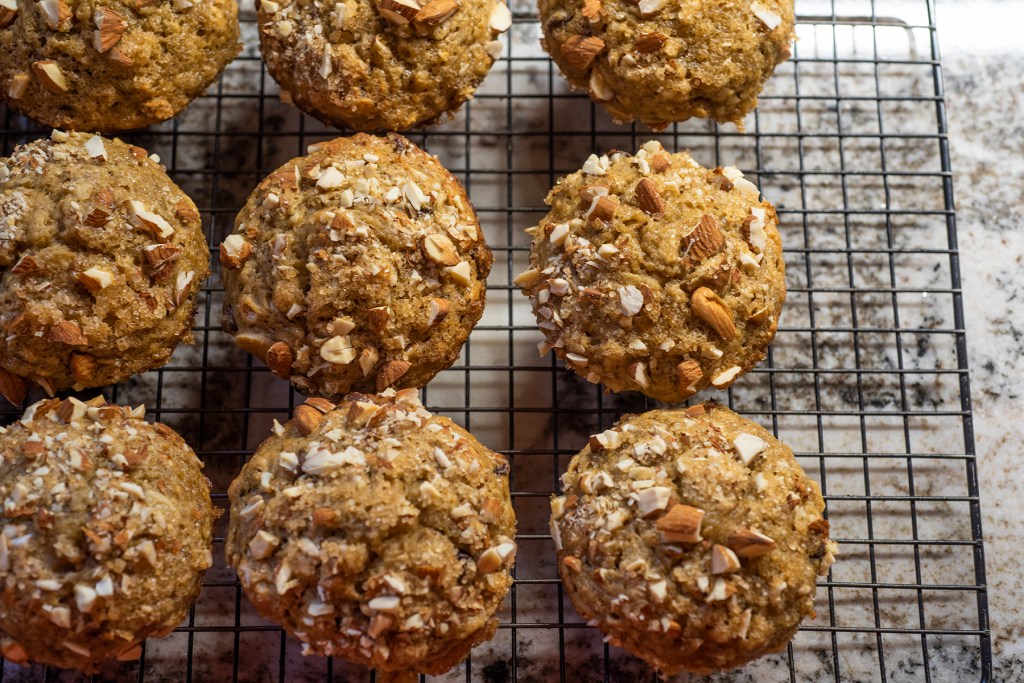
Homey. Comforting. Just what we need right now.
Muffins are not cool, either. They are not a cronut or a cake pop or a brookie or a rainbow layer cake. I am doubtful that muffins have a massive following on Instagram. Perhaps there have never been muffins on Instagram? I’m pretty sure no one has made a fortune off of them recently. They’re just…muffins. They’re humble and comforting and kind and homely and they’re basically just a hug from your grandmother in pastry form and therefore they’re perfect for this weird purgatory we all find ourselves in, where things are sort of looking up but the pandemic definitely isn’t over and we haven’t exactly leaped into normal life again. It’s an odd, unsettled time, to be certain.
If I haven’t sold you on muffins yet with that confusing pitch, allow me to continue proselytizing: muffins are far and away one of the simplest things you can bake, even at altitude. They’re infinitely customizable with whatever you might have lurking in the freezer or pantry. You can use up fruits or vegetables that might otherwise get thrown out. It’s easy to make them reasonably healthy, and they freeze like a dream. What more could you ask from a baked good, honestly?
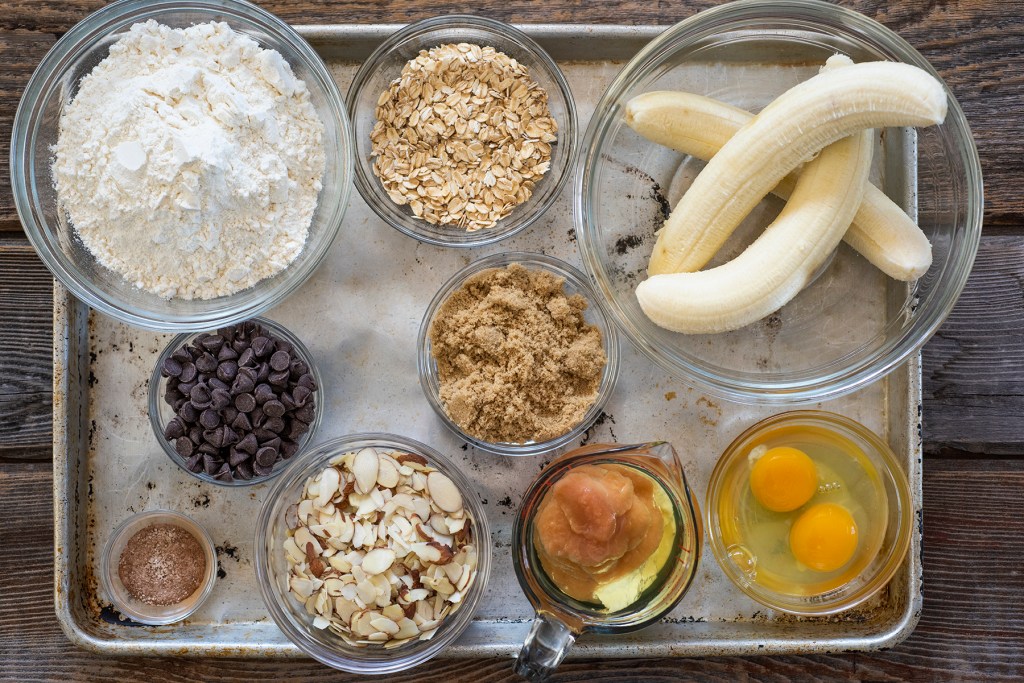
Get your mise-en-place together first!
Gather round, children, and I’ll share my own personal hard-and-fast rules for muffins. You might want to take notes! First and foremost – and I’m going to say this loud for the people in the back – MUFFINS ARE NOT CUPCAKES. Did everyone hear me? I abhor the standard Costco-style blueberry muffin which has forty grams of sugar and may as well be a dessert. That is not an acceptable muffin – my limit is one-half cup of sugar in a twelve-muffin batch. With natural sweetness from whatever fruit I’m using, plus a bit of turbinado sprinkled on top for crunch, that’s plenty sweet. There’s simply no need to eat that much sugar for breakfast or any time of day, really.
Second, I much prefer baking muffins fresh first thing in the morning, and fresh muffins are much easier when all of the ingredients are prepped the night before. How can you manage this neat pro trick? Whisk together the dry ingredients in a large bowl, and leave covered on the counter. Combine wet ingredients in another lidded container and refrigerate overnight. In the morning, gently fold wet and dry together and bake. By the time the coffee is finished brewing, the muffins are practically ready. Simple and effortless and especially useful if you have overnight guests, if that will ever be a thing again.
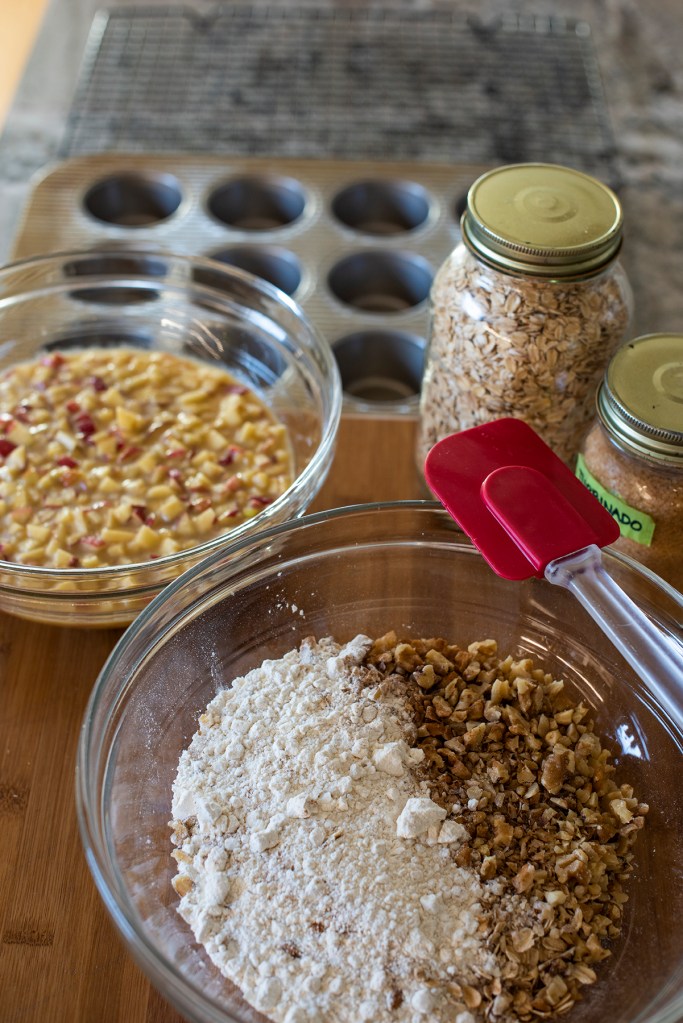
Wet ingredients (back left) will overnight in the fridge, dry ingredients on the counter.
A few other muffin-making tips: even if you choose to prep your ingredients the night before, never mix wet and dry together until just before you’re ready to bake. The leavening agent – in this case, baking soda – will be activated by the acidic yogurt and will start a chemical reaction. If you combine the batter and let it sit without baking it, you’ll likely get no rise and a bitter, metallic flavor. Wet and dry always stay separate until the last minute.
When combining wet and dry ingredients in a muffin or quick bread batter, it’s imperative not to overmix. You only want to fold things together until it’s mostly homogenized; a few streaks of flour are not an issue. Muffins and quick breads do not benefit from vigorous mixing, as this activates the gluten strands and toughens the crumb. Gentle is the way forward here.
I love using fruit purees in muffins, including but not limited to overripe bananas, home-canned applesauce, and unsweetened jam. Whenever a recipe calls for overripe bananas, they should be well-speckled or even fully brown; as they ripen, the natural sugars intensify so you’ll achieve sweeter flavor without extra sugar. If you’ve got overripe bananas but no plans to bake soon, peel the bananas and freeze on a sheet pan lined with waxed paper, then store in a zip-top bag. You can pull out the amount you need, and they’ll soften quickly – plus less food waste!
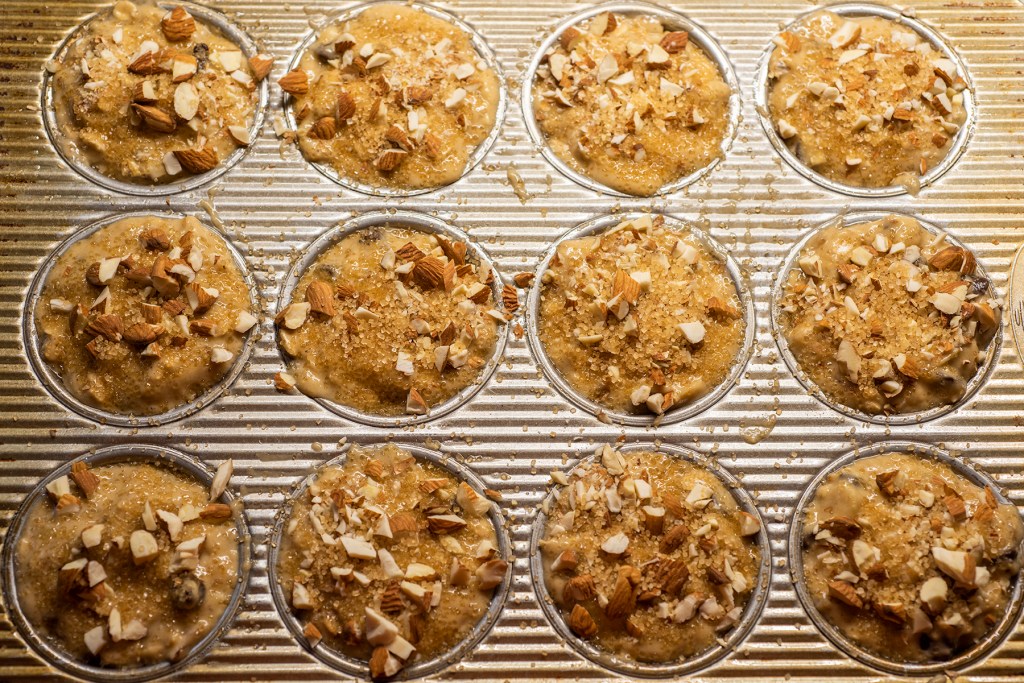
I fill the muffin cups to the rim, then sprinkle with turbinado and chopped nuts before baking.
When the muffins are fully baked, get them out of the pan immediately and set them on a cooling rack. Most baked goods (with the exception of a few delicate cakes) should be removed from the baking pan as soon as possible, and allowed to cool with good air circulation so the bottom crust doesn’t become soggy from heat and moisture. If you don’t have a cooling rack, grab one of the wire racks from the oven and use that instead.
Though muffins, like most pastries, are at their best the day they’re baked, they do freeze surprisingly well. I freeze cooled muffins on a sheet pan; once solid, they’re tucked into a zip-top bag to enjoy throughout the week. Since the muffins are small they’ll thaw quickly at room temperature, but thirty seconds in the microwave can speed that process along, if necessary.
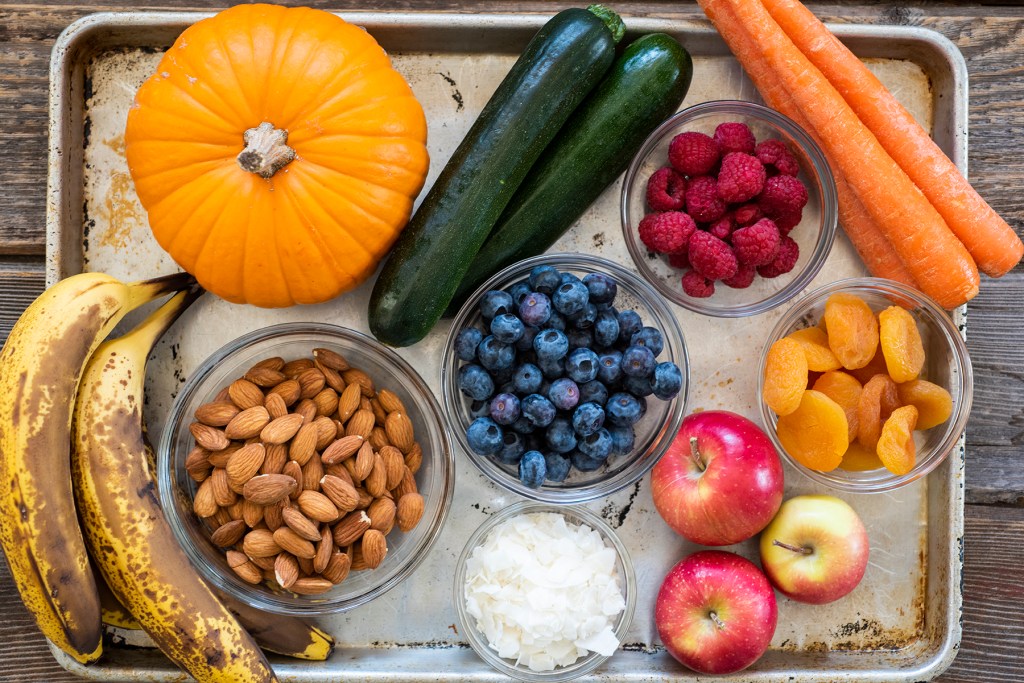
Just a few ideas for what you can use in your muffins!
I use a basic muffin recipe that works well at 6,300 feet, and I customize it according to what I have on hand. Dry ingredients: two cups all-purpose flour (you can sub out up to half with spelt, whole wheat, or white whole wheat), 1/2 cup rolled oats, 1/2 tsp. salt, 3/4 tsp. baking powder (leavening agents are typically reduced at altitude), 1/2 tsp. cinnamon, 1/2 cup chopped nuts, 1/2 cup dried fruit. Wet ingredients: two eggs, 1/2 cup brown sugar, 1/3 cup neutral oil (such as grapeseed), 1/3 cup unsweetened applesauce, 1/3 cup yogurt, milk or buttermilk, 1 to 1 1/2 cups mashed banana, pumpkin puree, shredded zucchini and carrot, or other fruit and vegetable combination (adjust liquidity as needed). Bake in a preheated 425-degree oven for five minutes, then lower the temperature to 400 degrees and bake for about another twelve minutes, depending on your oven. (My oven has notorious hot spots, so I rotate the tray at least once. You know your oven best; adjust accordingly.)
Muffins are pretty forgiving; if you bake a lot, as I do, you’ll learn to adjust the liquidity in the batter. Mashed bananas generally won’t require additional liquid, but if you’re just using chopped fresh fruit or vegetables, like apples or carrots, you might need a bit more yogurt or milk. If you find your muffins to be either overly mushy or overly dry, you’ll know to adjust for next time – and that’s how you get better.
Some of my favorite tried-and-true flavor combinations: apple cinnamon walnut :: banana chocolate almond :: blueberry coconut vanilla :: zucchini carrot apple raisin :: pear pecan ginger :: peach coconut macadamia :: raspberry apricot :: pumpkin hazelnut raisin. There are a million more variations possible here, with a little experimentation.
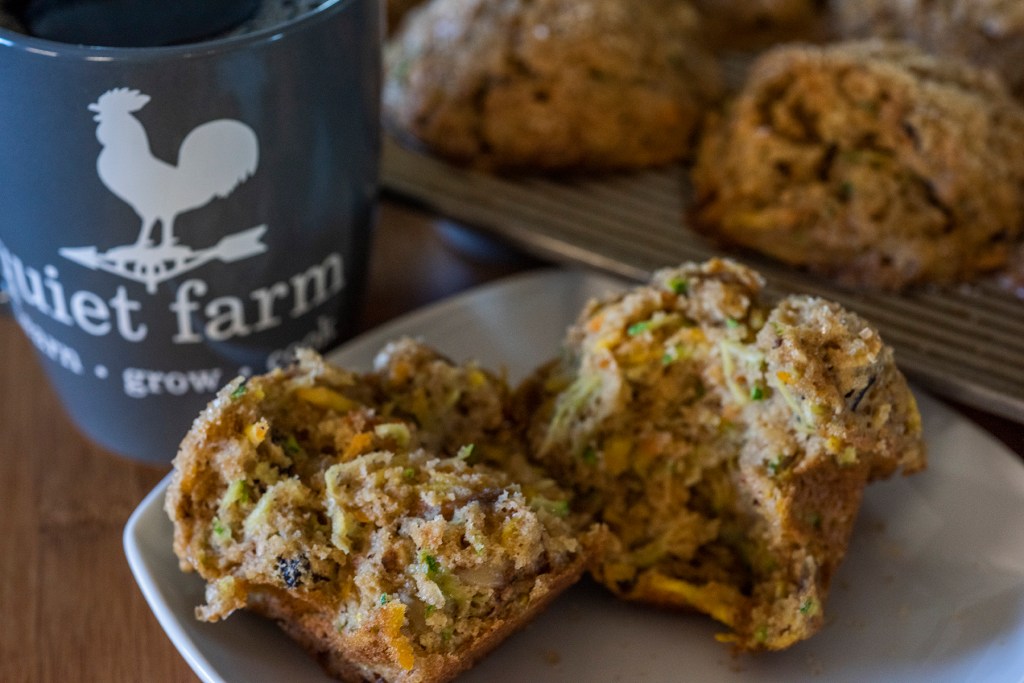
Wishing you plenty of strong, hot coffee and fresh, uncool muffins this week, dear friends.
P.S. If you’re one of my treasured bakery regulars, please immediately forget everything you’ve just read. There’s no way you can possibly make these at home. Muffins are really super difficult and complicated. Just keep ordering from me.
I think we can all agree that the World Wide Web is, for the most part, a fetid swamp of horrors. But! On rare occasions, the Internet can produce some magic, too. Helpful sewing tutorials! Funny commercial parodies! Everything useful we’ve learned on YouTube about how to renovate a house! And above all else, there is the Grub Street Diet from New York magazine, which is very hit-or-miss – but when it’s on, there’s nothing better. (See this fabulous example.) I absolutely adore food diaries, and if someone combined a daily food diary with a personal finance diary and threw in some quilting tips for good measure I’d probably never read anything else ever again.
Here’s the thing: as someone who has spent the vast majority of her life thus far working with food, thinking about food, reading about food and generally obsessing over food, I need to know what everyone is eating at all times. And also why you’re eating that particular thing. Are you enjoying it, or just eating it because it’s there? Are you even hungry right now? Did you make it or buy it or was it made for you? Did you plan on eating it? Did you seek it out? Would you eat it again? And that brings me neatly to my next question: do you plan your meals?

No need to plan: we eat this lovely breakfast every single day.
One might argue that this question was more relevant pre-pandemic, when Americans ate well more than half their meals outside the home and our schedules were totally different. Of course, since the world stopped eleven months ago, our eating and cooking habits have altered pretty dramatically. One thing that hasn’t changed, though – and I know I have some audience support on this one – is that dinner still, for no apparent reason, happens every single night. How and why this metaphysical error is possible I cannot explain, as each afternoon around 4:30PM I invariably think, “Didn’t I just make dinner?” This situation is particularly embarrassing, of course, because a) I am a professional chef and making dinner really shouldn’t be quite so challenging and b) I voluntarily never leave our gorgeous farm and so if dinner doesn’t appear I can’t even come up with a reasonable excuse about traffic or working late or some such. I’m here, and I’m available, and I have the time, and still, dinner regularly takes me by surprise.
For the record, we didn’t eat out or order delivery even pre-pandemic. In the nearly three years that we’ve lived here, we’ve eaten out precisely once, and in our rural area I’m not even sure where you would get take-out or delivery. (DoorDash is not exactly staking its business success on our county.) So that means we eat all our meals at home, like much of the world these days, and that means not losing interest in your own cooking. It’s a tough challenge, even for a professional chef.

The makings of a stir-fry.
In my years teaching cooking classes, I’ve learned that most households tend to be on about a ten-day rotation of standard meals, which accounts for a few nights of leftovers or take-out in a two-week period. I can completely understand wanting to grab for those “known quantities,” meals that will please everyone without too much time and effort. There are few things more heartbreaking to a dedicated home cook than hours spent slaving away over a spectacular new recipe, only to have your loved ones politely ask you to please, please never make that again. (Looking at you, ma po tofu.) If spaghetti bolognaise works, and you’re tired and hungry, and everyone else is tired and hungry, why not just have spaghetti bolognaise, even though this is the third time in two weeks? Just about everyone can relate to this familiar situation.
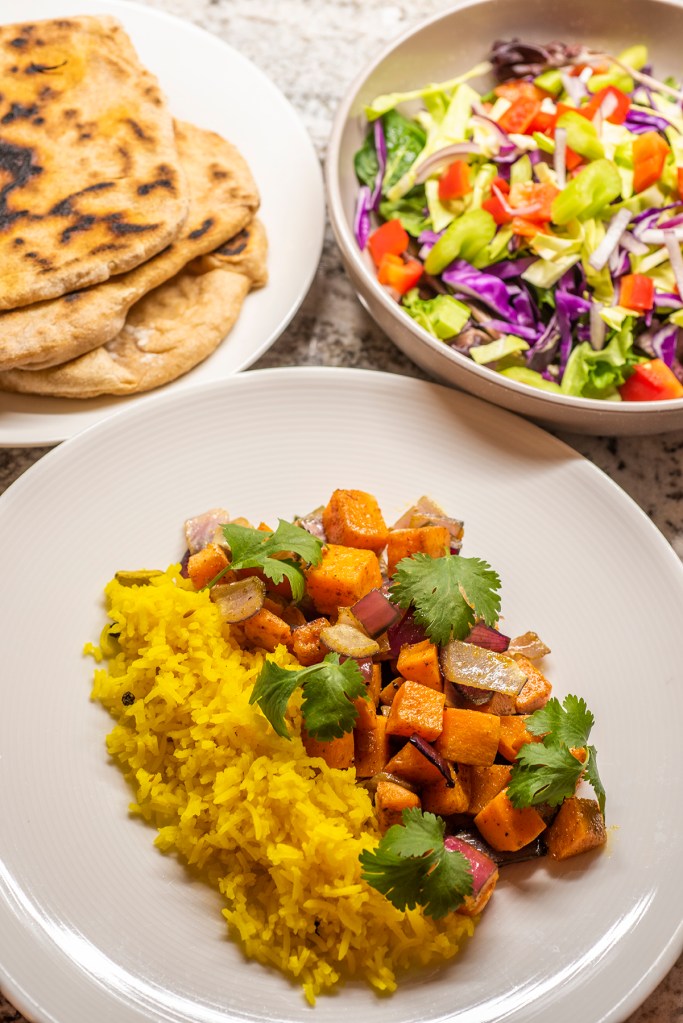
Curry-roasted sweet potatoes, pilau rice, fresh naan and salad.
Even in our calm household, which does not have the added complications of varying sports schedules or child care issues or long commutes, I’ve found that planning meals in advance makes a huge difference in how I view the daily chore of dinner. Knowing what I have in the fridge, freezer and pantry, and what meals I can compose from those ingredients, is essential. This is especially true because our “big” grocery store (in a relative sense) is nearly twenty miles away, so we grocery shop infrequently. In a rural county, I don’t have the luxury of running to the store for a bunch of cilantro or a box of pasta fifteen minutes before serving, so we keep a very well-stocked kitchen.
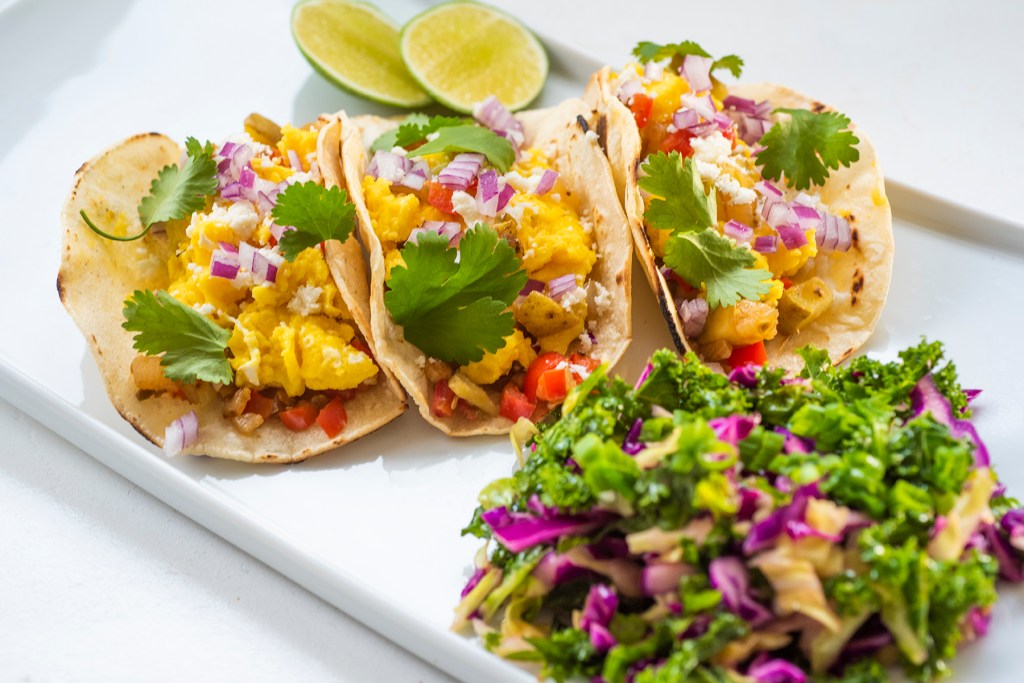
Breakfast tacos are a household staple – usually for dinner.
I also make an effort to cook in batches, so if I’m making a roasted pumpkin soup with coconut and ginger, I’ll make a big pot of it and freeze it in quart deli containers for a quick and easy meal. I make batches of “components,” too – versatile prepped foods, like steamed brown rice, beans, hard-boiled eggs, roasted potatoes or sautéed peppers and onions – that can be utilized in a variety of different meals. Of course we also can and freeze lots of our farm produce, too, but as N famously once said while staring at a packed fridge: “There isn’t any food in here. Just ingredients.” Joking aside, his point was that there was nothing ready to eat, and even the best cook can sometimes look at a full pantry and feel no inspiration whatsoever. That’s when a list of favorite recipe ideas pinned to the side of the fridge can come in handy.
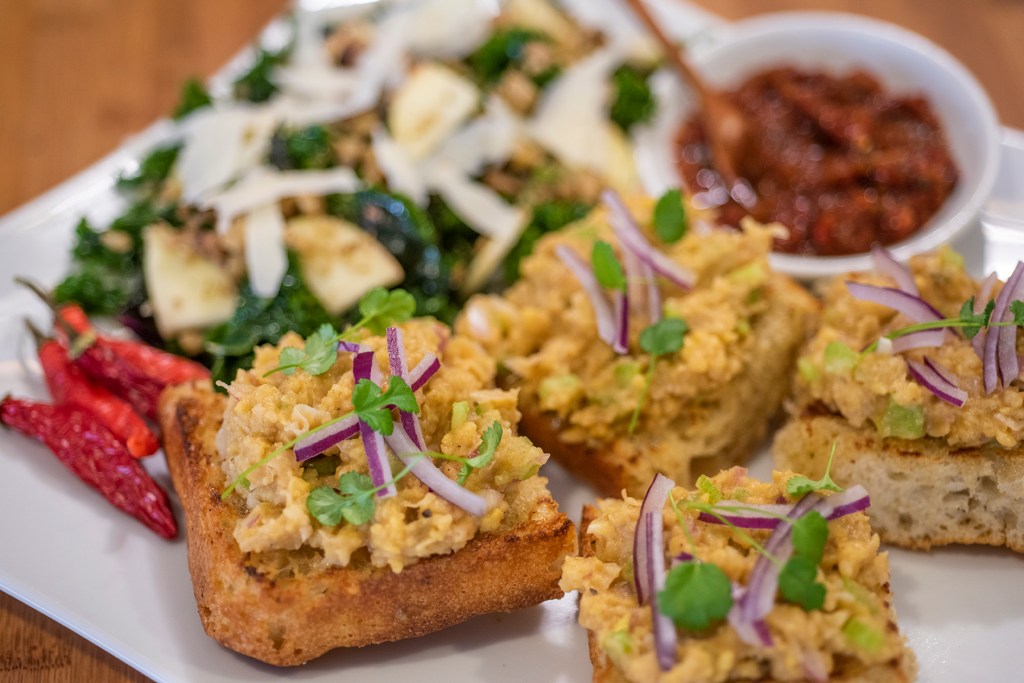
Chickpea smash on toasted focaccia is another favorite in heavy rotation.
The classic American meal typically starts with a protein as the main course – mostly chicken breasts or ground beef. Occasionally a steak, or salmon, or maybe something exotic like shrimp or scallops. A starch and a green vegetable might be on the plate, but they’re side dishes, merely afterthoughts. Here, though, we eat meat barely once or twice a month, and seafood never, so we start with vegetables or legumes, and build from there. We frequently eat stir-fries; they’re quick and easy to pull together. Lots of spicy, warming soups, especially in the colder months. Roasted vegetables feature regularly as do variations on curries. We eat eggs for dinner, usually as breakfast tacos, and many, many incarnations of flatbreads are consumed here. Pasta is a stalwart; loaded with vegetables, it doesn’t deserve its unhealthy reputation. Warmer weather brings lots of main course salads, packed with grains and eggs and myriad vegetables. And sometimes, we just have “snack plate dinner,” which is pretty much exactly what it sounds like: cheese, crackers, vegetables with hummus, good toasted bread with a variety of dips and spreads and anything else that can be used up in the fridge.

My meal planning starts with cookbooks, magazines, a recipe idea file and a pantry inventory.
I will freely admit that strict meal planning doesn’t happen every week; sometimes it’s a bit more impromptu. The weeks when I do write a meal plan, however, absolutely feel much calmer and easier and less stressful than when I don’t. But if we lived in a stereotypically frenetic American household, with lots of people running hither and thither, and various schedules to manage, a meal plan would be an absolute necessity for maintaining order. Here, though, we eat lots of plants and do our best not to waste any food – and a weekly menu plan helps make that happen.
So please share, dear friends: do you plan your meals? Do you stick to the plan? Do you have tried-and-true favorites, or are you regularly tucking in new experiments? Do you do all the cooking, or do other members of the family pitch in? This avid Grub Street Diet reader is longing to know!
 Finding Quiet Farm