How things are made, vol. 2

Visiting workshops or homes to watch people make things by hand is one of our favorite traveling activities; in southeast Asia, we learned how to make incense, rice noodles and tofu. And now in India, where traditional handicrafts are still a way of life for millions of people, we’ve had more opportunities to see beautiful things take shape.

NJB_5900

India is justifiably famous for its textile industry.

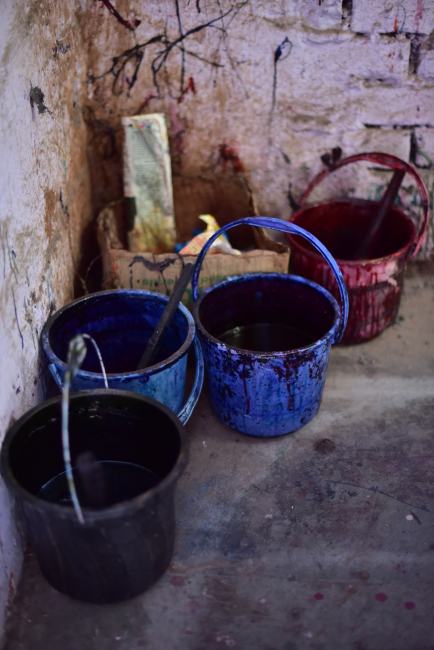
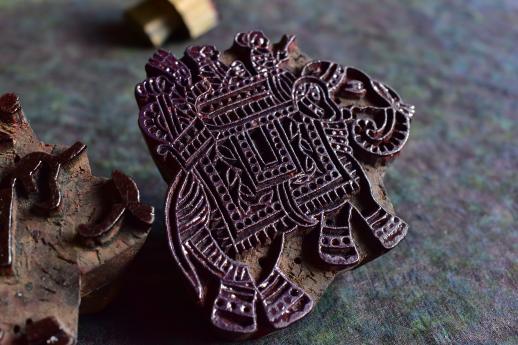
In Jaipur, we visited a traditional block-printing house. Block-printing is pretty much exactly what it sounds like: designs are hand-carved into blocks of teak, then dipped in ink and stamped onto fabric. Different colors can be layered in, and the design is dried then set permanently through a special chemical treatment.

NJB_5901

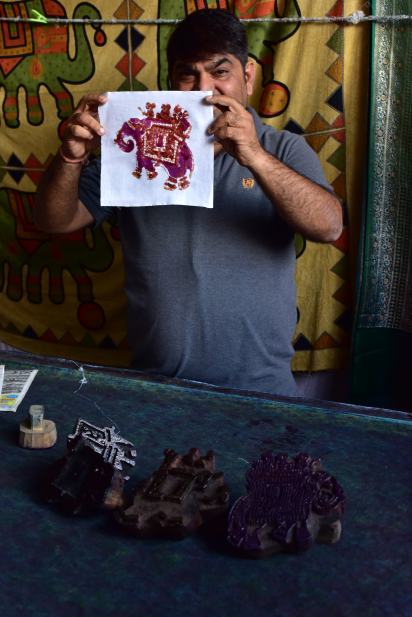
A hand-carved teak elephant block used for printing on fabric.

NJB_5906

Please do not trip over these.

NJB_5907

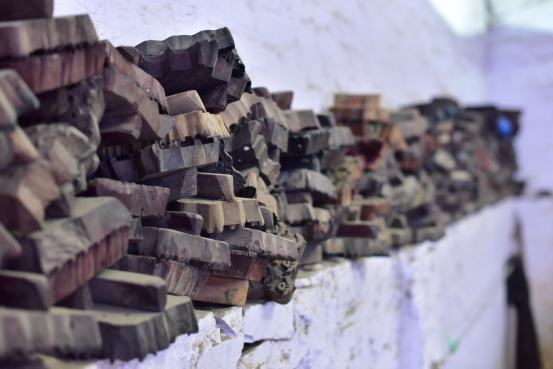
Hundreds of teak blocks in various designs.

Each block can only be used about two thousand times before the design becomes fuzzy and indistinct. That seems like a lot, but a single tablecloth might have three hundred or more imprints.

NJB_5899

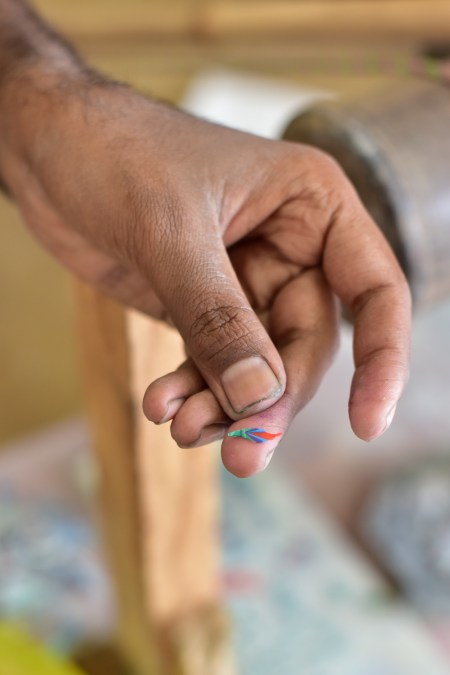
Skilled artisans can layer in different colors within the same design.

NJB_5893

The fabric is placed in a chemical bath that alters some colors and sets the final design.

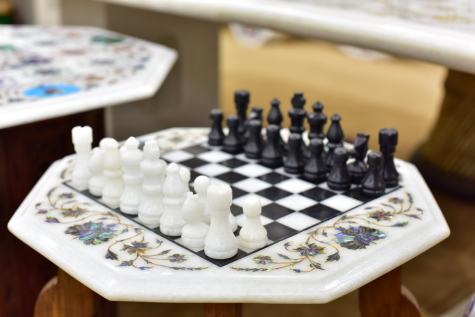
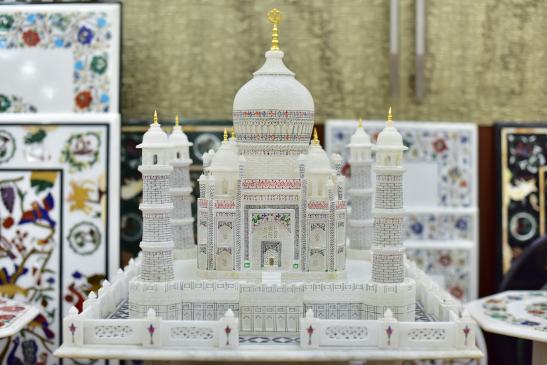
The city of Agra, in Uttar Pradesh, is known not only for India’s most famous attraction but also for its classical marble inlay work. This work involves carving shapes into marble, then filling those cut-outs with precisely cut semi-precious stones such as agate, turquoise, amethyst and onyx. Many of India’s significant monuments, including the Taj Mahal, showcase this craft; we were lucky enough to see it done up close.

NJB_5640

A marble inlay serving platter in its early stages.

NJB_5641.JPG

These artisans are carefully cutting semi-precious stones. The bamboo pole is attached to the wheel with string and operates the grinding wheel in a simple but ingenious manner. 

NJB_5643

Carving the design into marble; flowers and other natural motifs are traditional.

NJB_5644

Carved semi-precious stone pieces ready to be placed.

NJB_5646.1

This flower is made up of six individually carved pieces. The craftsmanship and attention to detail in this sort of work is staggering.

Like so many other traditional arts and crafts, marble inlay work, which requires thousands of hours of painstaking hand labor, is slowly being revived as people learn to value quality and authenticity again. The workshop we visited ships their marble pieces – some as large as tabletops! – all over the world.

NJB_5654

An array of elaborate pieces for sale in the attached shop.

NJB_5649

Can you imagine how many hours this took to make?

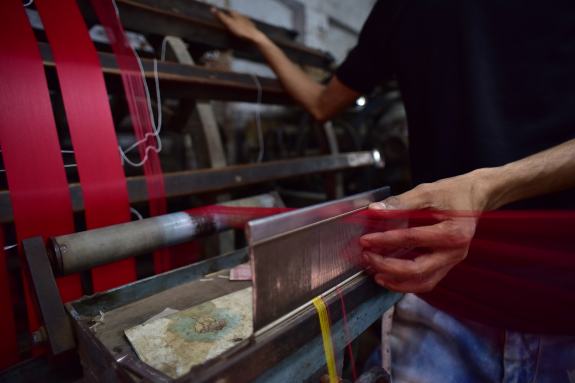
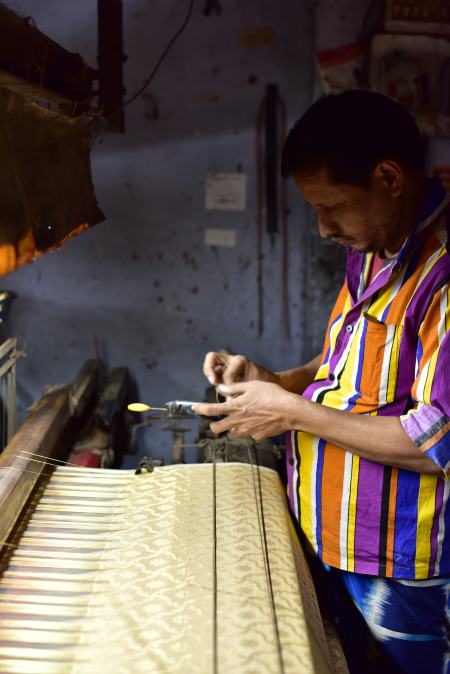
In the heart of Varanasi’s old city, thousands of people make their living spinning thread and weaving fabric into gorgeous, colorful saris, scarves and bedcoverings. The industry is centered in a rabbit warren-like area that houses both people and machinery. The clacking sound of the looms can be heard throughout the neighborhood.

NJB_4901

Thread spools awaiting the loom.

NJB_4909

Threading the loom is a complicated process.

NJB_4885

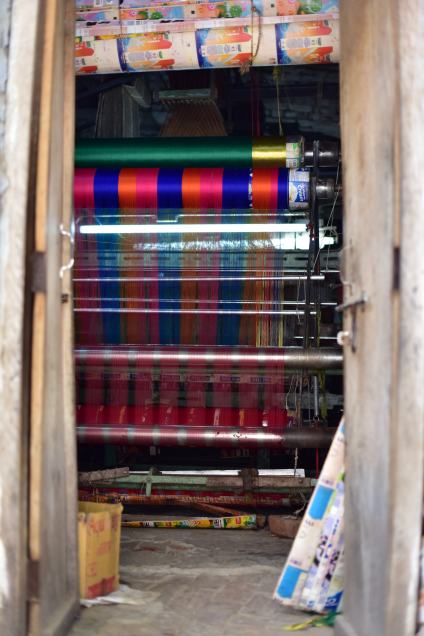
Almost every doorway in the old city offers a peek into Varanasi’s main industry.

NJB_4893

Even fabrics of a single color have such depth and texture.

NJB_4894

More elaborate designs might require numerous thread colors.

Interestingly, the Jacquard loom, which revolutionized the textile industry, was also an important precursor to modern-day computers. The loom, still in use today, holds specially-punched cards laced together in a specific sequence, allowing the creation of complicated designs in the fabric. Early computers received programming instructions from paper tape punched with coded holes. Now go win at your next bar trivia night.

NJB_4897

The noise of the looms operating was almost unbearable; of course, people still managed to live and sleep there.

NJB_4919

Finished shawls and scarves.

Travel is not always about crumbling monuments and boring history!


Dinner at a gurudwara

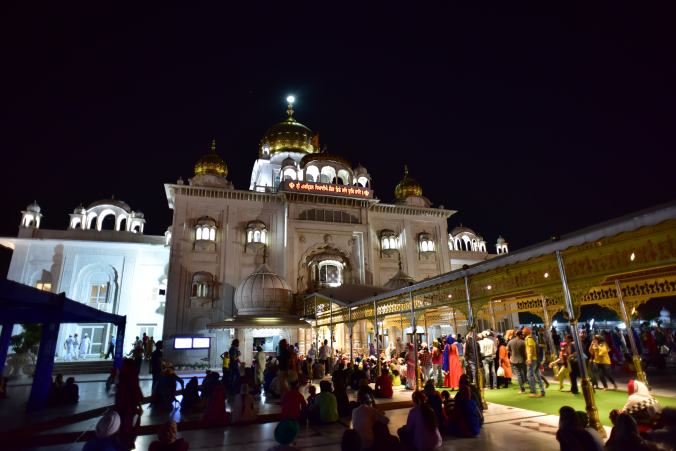
We’ve had a number of remarkable experiences in India, but one of our favorites so far has been the evening we spent at Gurudwara Bangla Sahib, a massive Sikh temple complex in Delhi.

NJB_5596.1

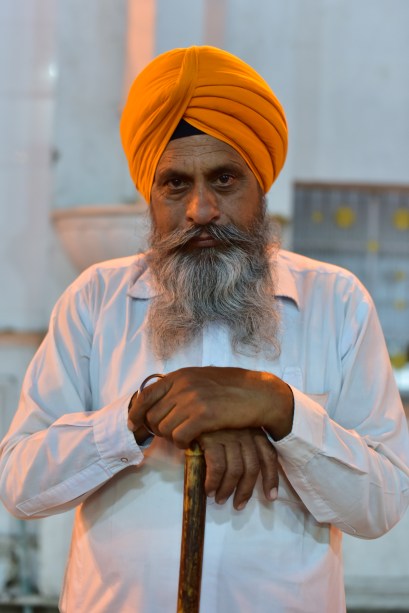
Male Sikhs are most recognizable by their distinctive turbans.

A gurudwara (or sometimes gurdwara) is a place of worship for Sikhs; the word literally translates as “door to the guru.” Sikhism is a fascinating religion; it’s one of the youngest major religions and has about 28 million adherents worldwide. It originated in India in the 15th century and broke from Hinduism primarily due to its rejection of the caste system.

NJB_5570

The gurudwara in Delhi sees a constant stream of visitors.

As we’ve mentioned, India is an intense place, and it’s easy to become overwhelmed rather quickly here. When your tour guide casually mentions that he’s taking you to dinner at a place that serves fifteen to twenty thousand meals a day, it doesn’t really engender a lot of confidence that the meal will be peaceful or calm. Yet that was exactly how the evening turned out.

NJB_5577

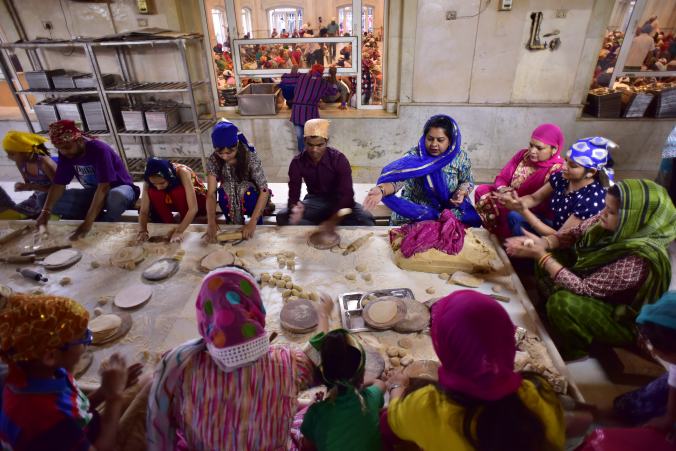
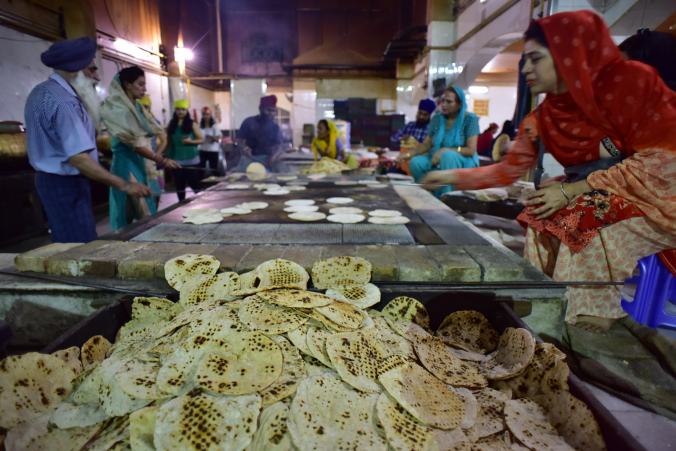
Making chapatis for the communal meal.

Everyone is welcome at a Sikh temple, whether or not you adhere to a specific belief system. All gurudwaras in the world have a langar hall, where vegetarian meals are served free of charge to anyone, sometimes twenty-four hours a day. No money ever changes hands, but it is understood that visitors to a gurudwara will participate in “selfless service” in exchange for their meal, which may mean assisting with cooking, cleaning, serving or any other necessary tasks.

NJB_5574

Chapati dough waiting to be rolled.

NJB_5578

Cooking chapatis on the griddle.

NJB_5576

The Sikh gentleman on the left is supervising the cooking of the chapatis.

For our service, we sat down on the floor to roll out hundreds of chapatis, unleavened wheat flatbreads. It was a lovely experience to join the people already in the kitchen; though we don’t speak Hindi, no explanations were necessary. It was simple enough just to watch what others were doing and follow along.

NJB_5580

Rather a lot of food is produced in this kitchen.

NJB_5571

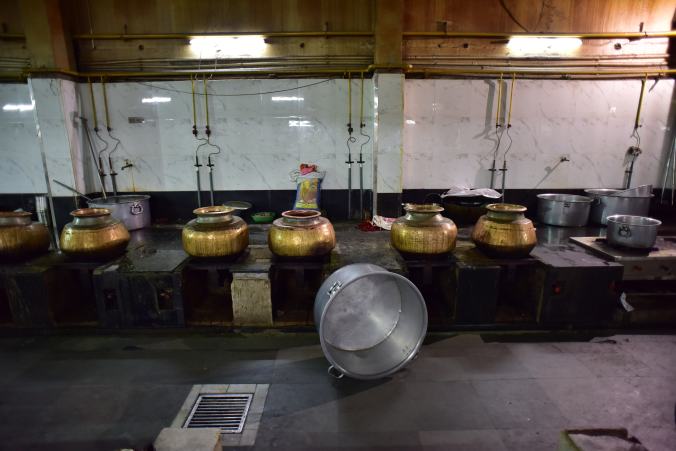
Vats of delicious dal bubbling away.

NJB_5582

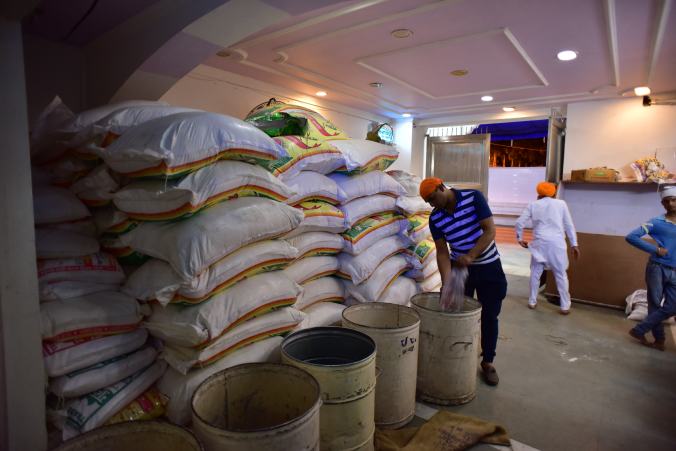
Bags of flour and rice in the temple’s pantry.

In addition to volunteering at the temple, most guests also provide an offering of food to the temple’s pantry. Fifty-pound bags of flour and rice line the walls, along with vegetables, lentils and anything else that can be used in the preparation of thousands of daily meals. All the food is strictly vegetarian, and nothing goes to waste.

NJB_5583

Cleaning the langar between meal shifts.

Around five hundred people eat in shifts in the langar hall; everyone sits on the floor. Guests queue outside in an orderly manner; in a country where patiently waiting in line doesn’t really happen, we were amazed at how smooth and orderly the process was.

NJB_5586

Seating the next round of guests in the hall.

As we filed in, we were given metal trays and shown where to sit. Our guide cautioned us against wasting any food; although you’re welcome to eat as much as you’d like, it is considered hugely disrespectful to take more than you will eat. We enjoyed dal, or spiced lentils, plus a vegetable curry, rice and of course our extremely well-made chapatis.

NJB_5587

Volunteers beginning the meal service.

Because there are always more people waiting to eat, everyone basically starts and finishes around the same time, then the hall is cleaned and readied for the next group. The efficiency and elegance of the entire evening was spectacular. The best part was looking around and knowing that the very rich and the very poor and everyone in between were sitting on the floor together, eating the same food. Truly a highlight of our visit to India.

NJB_5589

Regardless of gender, everyone is required to cover their heads in the temple. Scarves are provided in case you forgot yours.

After the meal, guests leave the hall, wash their hands and feet (as with most temples, shoes are left at the door) and enter the main temple for worship, chanting and fellowship.

NJB_5591

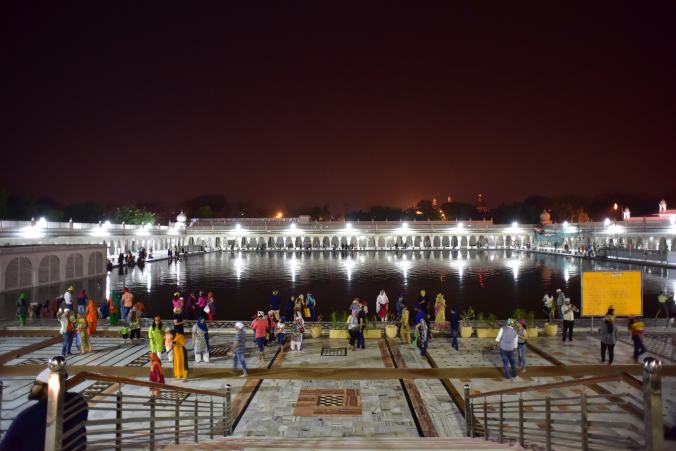
The temple also has a gorgeous reflecting pool.

One of the most interesting parts of our visit happened afterwards, when we were readying to leave. Our group was approached by a young woman with a small child who begged us for money – a very common occurrence in India, particularly for Western tourists. A Sikh immediately saw this and politely but firmly put a stop to it. Our guide explained that since everything is given for free at the temple – food, water, even a safe place to sleep, if necessary – they do not permit any begging on their grounds. This is extremely unusual in India.

NJB_5593

Sikh temples can be found all over the world, and a quick Google search will find one near you. If you have the opportunity, please visit your local gurudwara and spend a bit of time making delicious food in the kitchen, then sit down to enjoy it with friends and strangers alike. It is an experience not to be missed!

Interlude: Indian book club

(Forgive our extended absence, friends; we’re in rural India and Internet access is sporadic at best, and we need a really strong connection to upload photos. How about a suggested reading list to keep you busy until we return?)

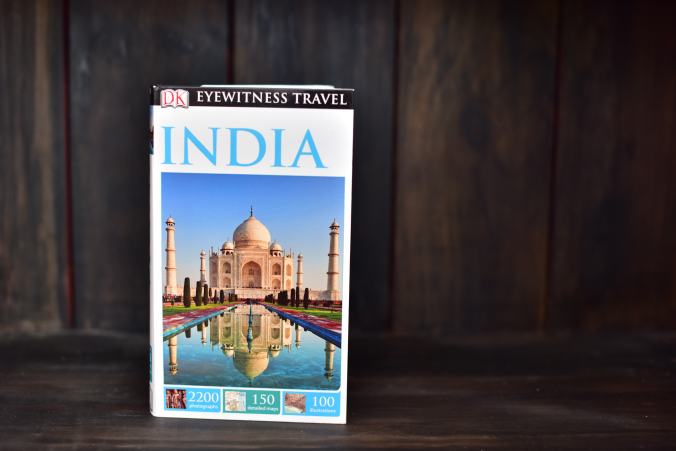
Prior to a five-month trip, some people might well worry about how many pairs of shoes they can bring, or whether their hairdryer will fit in their backpack. Me? I stress about books.

NJB_2716.JPG

I am aware, dear reader, that there apparently exist magical devices powered entirely by witchcraft that allow one to carry dozens – nay, thousands! – of books on a tiny little computer. I, however, am an avowed Luddite and therefore refuse to succumb to the temptation of this modern silliness. I like books. Actual books. I like paper and covers and words printed on a page and I find e-readers inordinately difficult to, well, read. And I love reading so much that I don’t want anything to detract from my enjoyment. Plus, traveling in underdeveloped countries means on-demand electricity isn’t always a given, so what am I supposed to read once my e-reader fails? At least I have a battery-powered flashlight with which to read my paper books. And a lighter after that, although it’s admittedly a bit risky.
NJB_2294.JPG

So, I pack books. Lots of books…like ten, which takes up a seriously ridiculous amount of space in my backpack. And I pack with the expectation that those ten will maybe set me up for the first couple of months of travel but I’ll certainly be able to swap books out along the way…if in fact there is anyone else in the world who still reads books on paper. When we traveled New Zealand by campervan, I was thrilled to find that almost every campground we visited had a great book swap.
NJB_2714

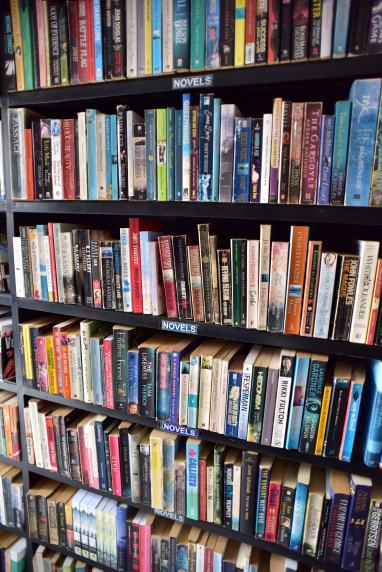
This photo was taken in a used book store in Phnom Penh and not in our house, although the quantity isn’t far off. Also I haven’t labeled the shelves…yet.

In preparation for the trip, I scoured the hundreds of books I have at home to find some that were in some way relevant to where we’d be traveling. I read mainly modern fiction, but am pretty open-minded in my literary tastes and will read just about anything that crosses my path. I grabbed a couple on Japan, couldn’t find anything set in New Zealand, struggled with southeast Asia, and hit the mother lode with India. India-themed fiction has become quite popular in the past twenty years or so, and I already owned a good sampling.
NJB_2287.JPG

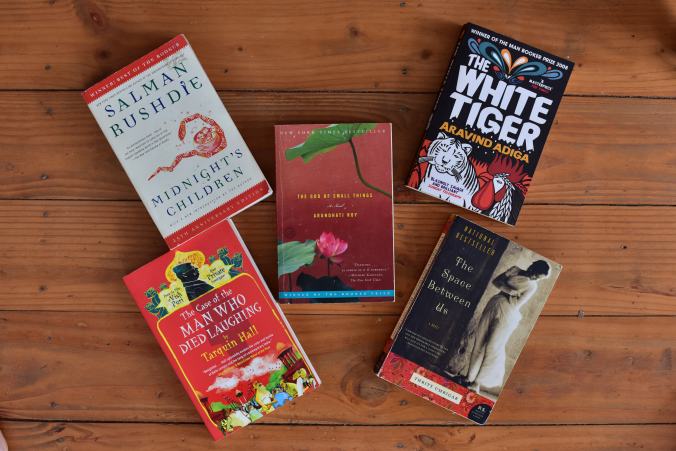
Without further ado and in no particular order, brief reviews of the selections chosen for my ongoing one-member Indian book club!

Shantaram, Gregory David Roberts

This book had been recommended to me repeatedly for years, and though it’s been on my bookshelf for some time I never got around to reading it. I grabbed it for this trip and am so glad I did. Shantaram is lengthy and twisty and convoluted and involves about ten thousand different characters, and yet the story grabs your heart and won’t let go. Bombay (now Mumbai) is its own vivid character in this book, and although Shantaram‘s claim as an accurate autobiography (is there such a thing?) has been repeatedly disputed, it absolutely holds up as a novel. I’m still thinking about this one months later, especially since we visited some of the book’s key locales while in Mumbai.

What Young India Wants, Chetan Bhagat

An unexpected find at a book exchange at our Mumbai hotel and by far the best book I read on India while in India. This book is intentionally simplistic: it’s a collection of very short non-fiction pieces by an Indian author who is essentially begging the youth of India to stand up and care about their country. India is without question the most complicated, difficult place I’ve ever traveled, and I’ll admit that I was often infuriated here. This book helped me to understand some of the country’s issues better, and I can only hope that young Indians are paying attention.

The Case of the Man Who Died Laughing, Tarquin Hall

Light, fluffy Indian detective fiction, in the vein of The Number One Ladies’ Detective Agency series. This is gentle social satire and although perhaps not particularly insightful, it gives a good feel for the scents, sights and – most importantly – the unrelenting heat of Delhi.

The God of Small Things, Arundhati Roy

There is nothing light and fluffy about this book. It is a stunning debut novel that took the author four years to finish, and it’s dense, layered, challenging and brutal. It won the Booker Prize…in my opinion, that committee loves books like this. Not an easy read; this one is firmly in the difficult-but-beautiful category.

The White Tiger, Aravind Adiga

Also a Booker Prize winner. I read this towards the end of our first week in India on a lengthy bus/train trip between Darjeeling and Varanasi, deep in the throes of severe culture shock. While the book’s first-person depiction of the sordid underbelly of India’s servant-to-master relationship intrigued me, I couldn’t get past the infuriating, hopeless, complicated frustrations of the country – mostly because we were experiencing them in real life one after another. And that was because I hadn’t yet learned how to see India for India, rather than what I expected India to be. I suspect if I read this book again, I’ll have a different opinion.

The Space Between Us, Thrity Umrigar

This is the story of two Indian women: a middle-class Parsi in an abusive marriage and her servant, who lives in a slum. At its heart, it’s a tale of class and status and the roles we’re born into, but it’s also about how women are treated as disposable property in much of the world (most definitely in India). I should have loved it, honestly, but it left me completely cold. I didn’t care about the characters and found the overwrought writing tedious. This book definitely didn’t represent the color and warmth of India for me.

Midnight’s Children, Salman Rushdie

In the U.S., at least, Rushdie is most famous for his controversial 1988 book The Satanic Verses and for introducing Americans to the concept of fatwa, which in his case was a Khomeini-issued death sentence that earned him British police protection after numerous failed assassination attempts. Midnight’s Children was released in 1981 and won Best of the Booker twice, which is pretty remarkable. Like all Booker Prize winners I’ve read (see above – maybe the committee really likes books set in India?), this one is complex and messy and confusing – like India itself – and just a huge, broad tale of a man and his beloved country. Midnight’s Children is considered magical realism, and Rushdie’s writing style took a bit for me to get into – I had to work at this one more than I usually do when reading. (It would help greatly to have a working knowledge of Indian history since Partition to assist in reading this book; I didn’t and it was more difficult because of that.) Ultimately, a complicated love letter to a complicated country.

Atlas Shrugged, Ayn Rand

Not Indian-themed, obviously, but I’ve read it numerous times and have taken – and given away – copies on all of my big trips. If you’re reading this in an airport or other public venue, I can almost guarantee you’ll be approached by someone who wants to discuss it, which has happened to me on more than one occasion. Really, there isn’t anything else to say about this one that hasn’t already been said. It is a love-it-or-hate-it manifesto and it’s about a thousand pages. Please don’t cheat and watch the film.

On the to-read list for when we return: The Things They Carried and A Rumor of War. I’ve realized how little I know about the Vietnam War, and visiting Vietnam has made me exceptionally curious to learn more.

Have any book recommendations? I would love to hear them, so please share!

P.S. If you’re an avid reader (and live in the U.S. – sorry) and you’re not a member of this site? Get there now.

Tea party

After water, tea is the most-consumed beverage in the world. It is produced in forty different countries in Asia, Africa and South America; China is the world’s largest tea grower, followed by India.

NJB_4728

The eastern Himalayan range as seen from Tiger Hill, Darjeeling.

NJB_4820

Recognize that famous red circle and blue bar logo?

India is particularly famous for its Darjeeling and Assam teas, from the regions of the same names. We visited Darjeeling, which sits at close to 7,000 feet and was a famous “hill station” during the colonial era.

NJB_4645

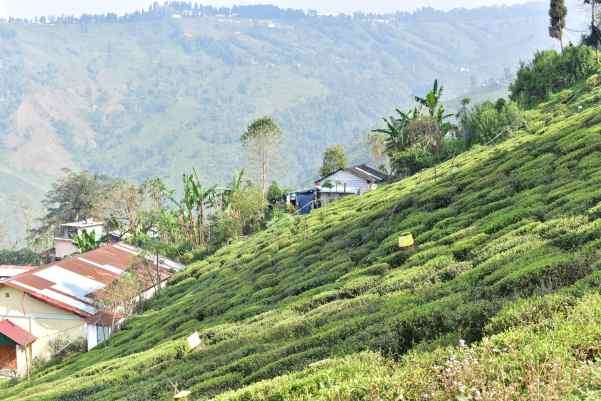
Tea plantation, Darjeeling.

In Darjeeling, tea is grown on steep slopes like these. Pickers – always women – harvest tea leaves into bamboo baskets they carry on their heads or backs. The pickers are paid about $2 a day for a minimum of ten hours of work. Leaves are harvested no matter the weather; the flush refers to the season when the tea was harvested. We visited during first flush, which is the first time the plant is harvested after its winter dormancy and produces the most flavorful and sought-after tea.

NJB_4643.1

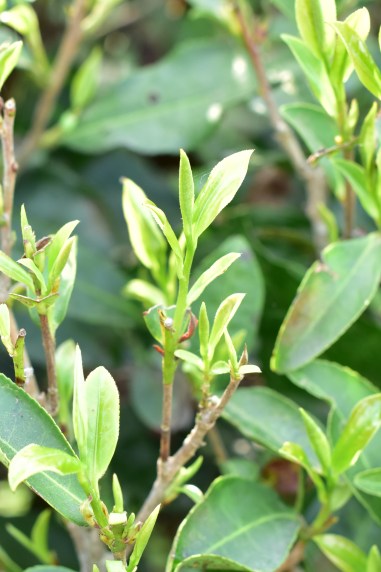
Camellia sinensis, or tea plant.

All true tea – white, green, oolong and black – comes from the leaves of the camellia sinensis plant, an evergreen shrub native to Asia. Herbal teas, like mint, chamomile or lemongrass, are technically tisanes and not teas since they contain no camellia sinensis. Once a tea bush is healthy and established, it can produce healthy leaves for about eighty years.

NJB_5237

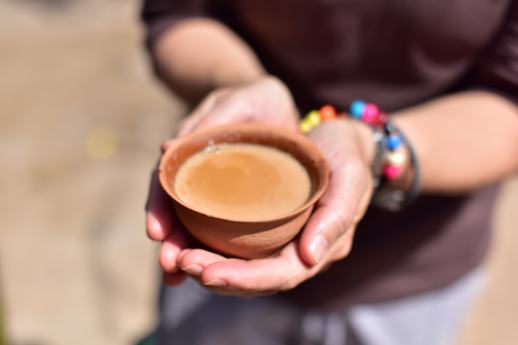
On the street, chai is sold everywhere in tiny terra cotta cups for 10 rupees (about 15 cents). After drinking, the cups are smashed on the ground.

India is famous for its chai tea, which is black tea blended with fragrant spices like cinnamon, cardamom and cloves, and served hot, milky and sweet. On the trains, chaiwallahs prowl the carriages selling drinks to passengers. Sometimes you even get little cookies, too!

NJB_4568

As with any agricultural crop, monitoring temperature and rainfall is paramount.

NJB_4578

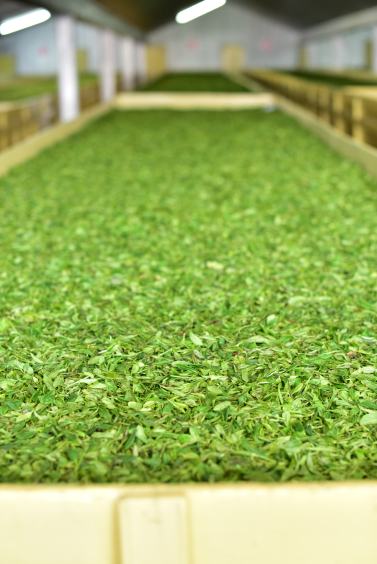
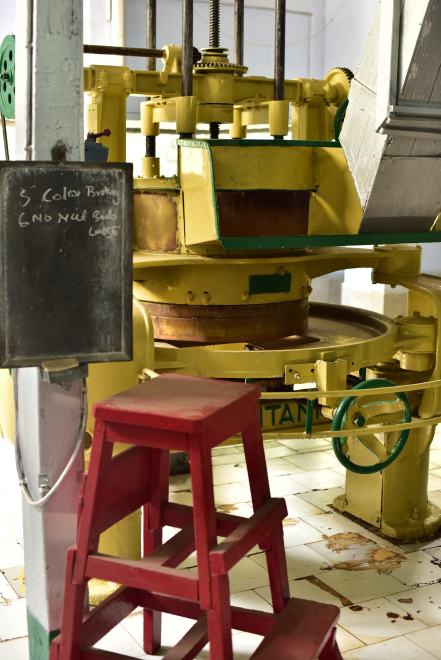
After harvesting, the green tea leaves are “withered” to reduce moisture.

The difference in teas simply comes from how it’s processed. White tea is the most expensive and only comes from the very best tips of the plant. Green tea isn’t fermented, leaving it delicate and soft; both black and oolong teas are fermented, which gives them a stronger flavor. True tea will always contain at least a small amount of caffeine; the amount depends on how the tea was processed and fermented. Herbal “teas” will only contain caffeine if it’s been added in.

NJB_4580

The tea leaves are exceedingly delicate before they’re dried and rolled.

NJB_4571

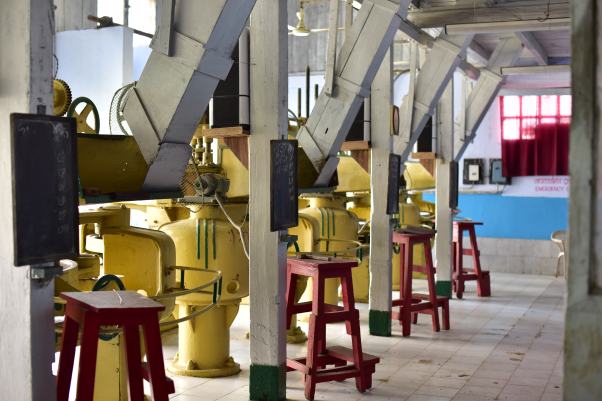
Withered leaves are funneled into rolling machines.

NJB_4584

The rolling machines crush the dried leaves to start the oxidation process.

The Darjeeling region is famous for delicate black teas that are traditionally served without milk or sugar. Because these teas aren’t as strong or tannic as Assam teas, they can be enjoyed straight. Darjeeling isn’t actually that big and produces a relatively small amount of tea; it’s common to find tea labeled as “100% Darjeeling” when it’s simply lower-grade tea from elsewhere in India. As with places like Champagne or Stilton that also produce unique foods or drinks, the name itself is a valuable brand and one that’s often misappropriated.

NJB_4570

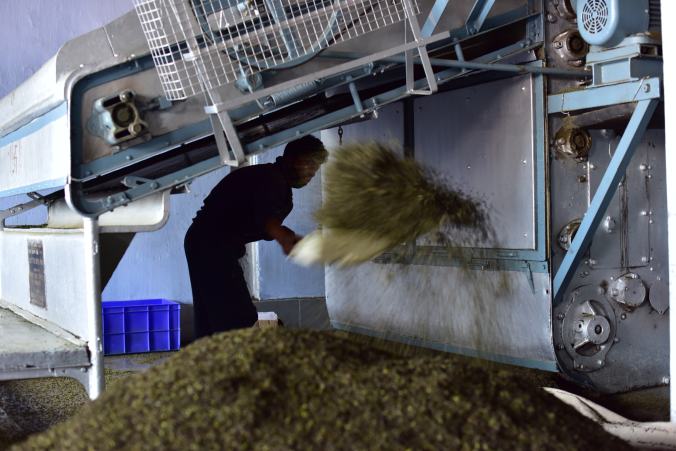
The tea is placed into drying machines to remove remaining moisture.

NJB_4609

Moving the dried tea.

NJB_4593

NJB_4595

NJB_4623

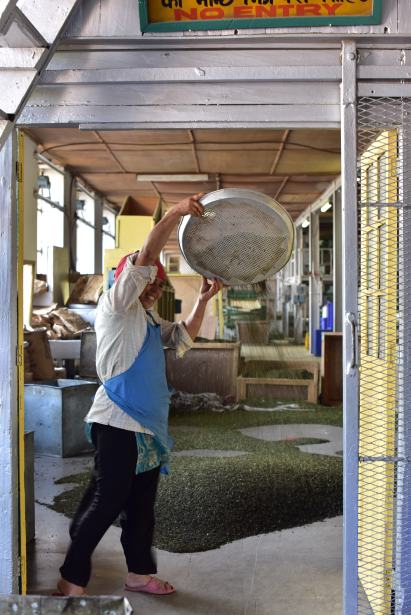
The dried tea is sifted and graded.

After the tea has been dried and sifted, it’s separated into grades of loose tea and “tea dust,” for bagged tea. Tea purists will always opt for loose tea; it is definitely of much higher quality than bagged tea. There is no arguing the convenience of tea bags, however.

NJB_4614

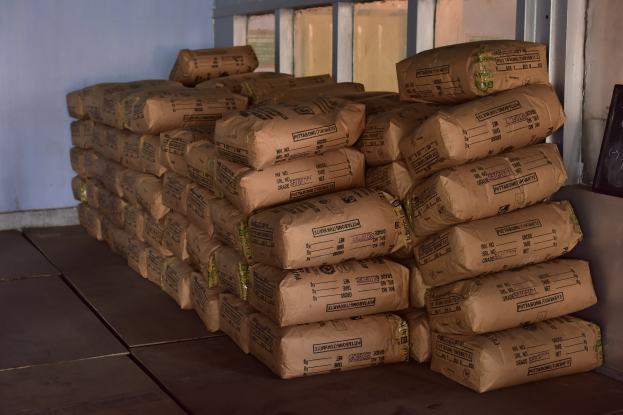
Finished tea in linen bags.

True tea aficionados will swear that you must use exact measurements when brewing tea, such as two grams of tea for eight ounces of water. Like cooking, however, I believe that what matters most is your own palate. Start with the professional guidelines and adjust from there to find out what you like best – I prefer my tea much stronger than most “experts” recommend, so that’s how I drink it. Ultimately, it’s your tea and you should drink it the way you like it.

NJB_4588

Loose tea ready for transport.

NJB_4629

NJB_4628

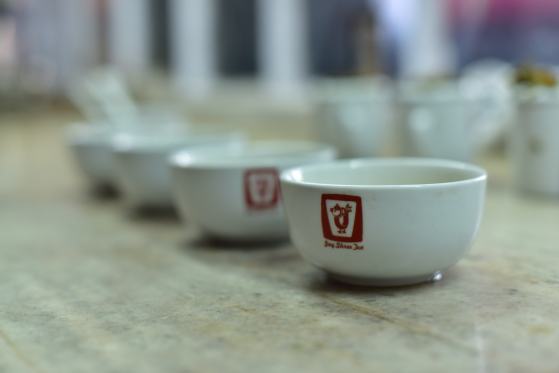
Tea tasting.

Tea is without question one of the world’s healthiest beverages (when it’s not loaded with sugar, obviously!) and Americans are slowly starting to explore the range of delicious teas available. Interested in learning more about teas and how to taste properly? Try here, here or here!


Welcome to India

A friend mentioned recently that she describes India with “the three C’s”: color, chaos and contradiction. We couldn’t have said it better. There is literally nothing in the world that can prepare you for this country – not the noise, the heat, the traffic, the pollution, the incomprehensible number of people, nor the breathtaking beauty. India is almost too much – too much to absorb, to photograph, to process – but we’re doing our best. This is not easy travel, that’s for damn sure, but it is amazing and completely unlike any place we’ve ever been.

NJB_4926

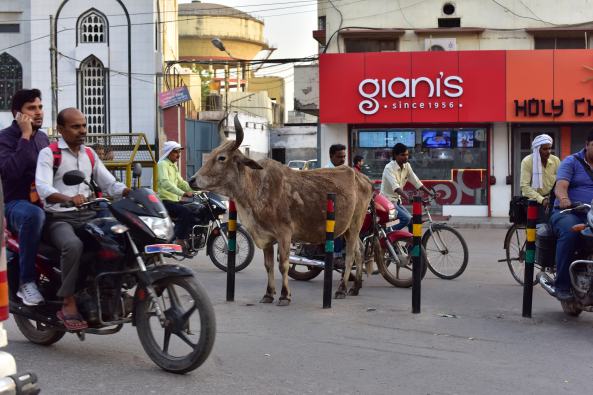
The iconic sacred cows are found just about everywhere, most often in the middle of the street.

NJB_4122

Chickens on their way to market.

NJB_4142

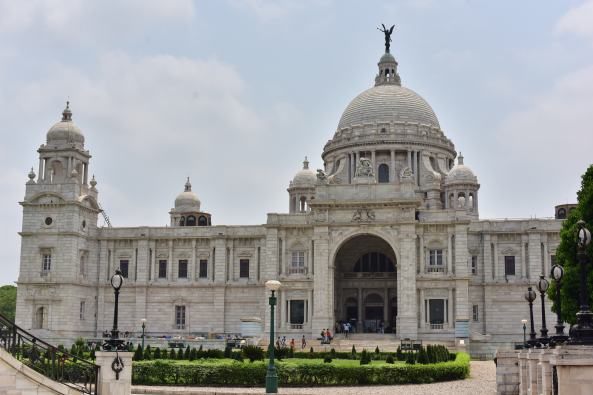
Victoria Memorial, Kolkata.

NJB_4429

The hill station of Gangtok, plus efficient solar drying of laundry.

NJB_5297

Milk delivery.

NJB_4318 - Copy.JPG

Mandala prayer wheels at a Buddhist monastery.

NJB_4068

Outside of New Market, Kolkata.

NJB_4444

Car and motorbike parts for sale.

We have been absolutely amazed – both in India and in southeast Asia – at the sheer number of tiny storefronts and street stands selling all manner of goods, from food to housewares to fabric. The typical American “big box” store definitely isn’t part of the lifestyle here.

NJB_4217

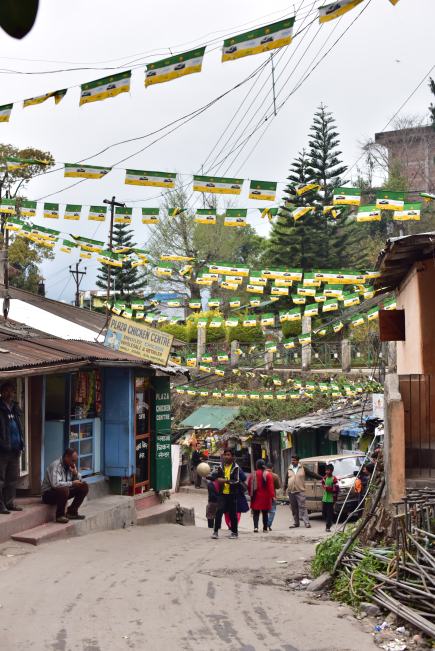
It’s election season in India and there are lots of flags, posters and rallies.

NJB_5247

Tractor repair shop.

NJB_4134

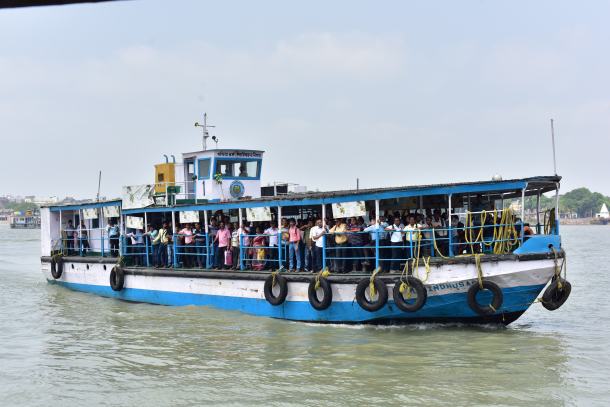
A ferry on the Ganges.

NJB_4228

See those apples? They’re from Washington! The U.S. is not the only country importing produce from thousands of miles away.

NJB_4056

Street scene, Kolkata.

NJB_4065

India’s classic Ambassador taxicab.

NJB_4225

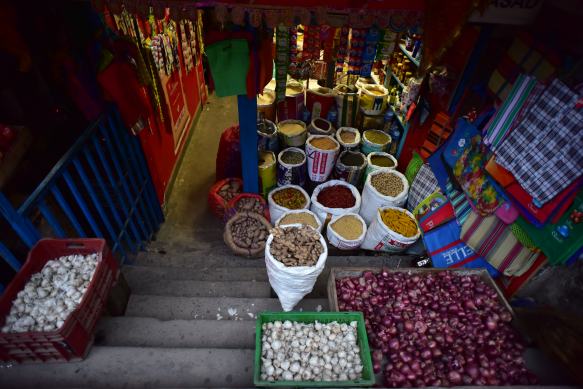
Spices and aromatics for sale at a basement shop.

NJB_4363

No room to build? Just put it on top of something else.

NJB_4304

A monk at Rumtek Monastery in Gangtok.

NJB_4389

Much like geisha culture in Japan, families often rent traditional costumes for photo shoots, like this group at a temple near Darjeeling.

NJB_4690

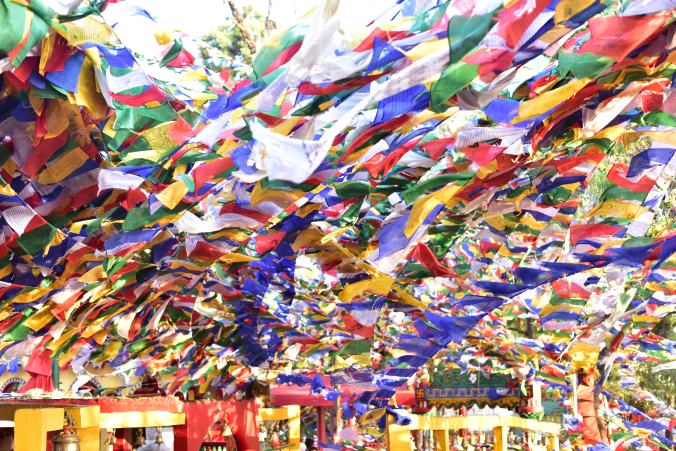
Prayer flags at a Tibetan Buddhist temple in Darjeeling.

Scenes from the Banana Pancake Trail

We’ve never claimed to be the world’s most adventurous travelers, and our travel in southeast Asia definitely adhered to the classic Banana Pancake Trail. Nevertheless, we had a phenomenal time here and loved seeing countries that were new to both of us. We visited Cambodia, Vietnam and Thailand in just under a month; below, some of our favorite images from this portion of the trip. We’re off to India!

NJB_3399

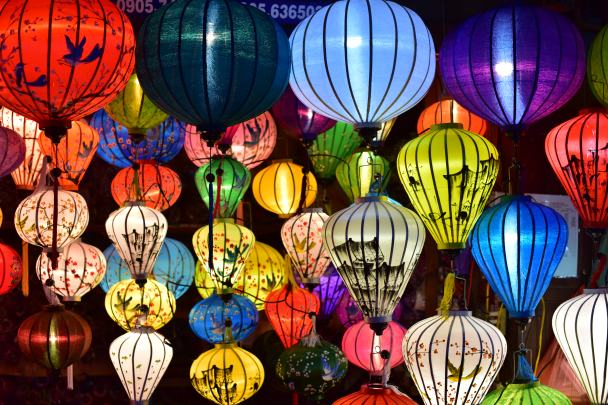
Illuminated lanterns in Hoi An’s Old Quarter.

Hoi An, near Da Nang on Vietnam’s central coast, was most certainly our favorite place in the country. We loved its antiquated feel and the charming Old Quarter, which is decorated with tens of thousands of brightly colored lanterns hung all over the shops and streets. Strolling here after sunset was such a pleasure.

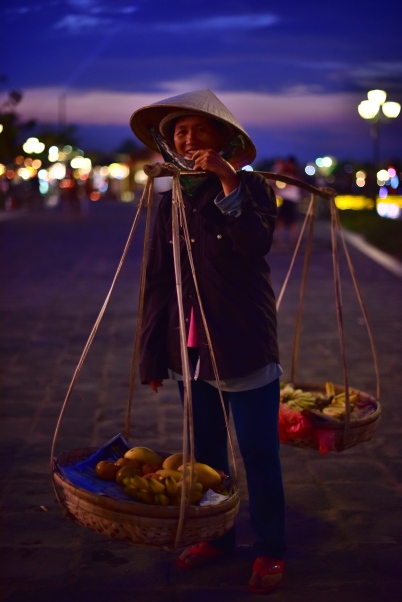
NJB_3433.1

A fruit vendor in Hoi An.

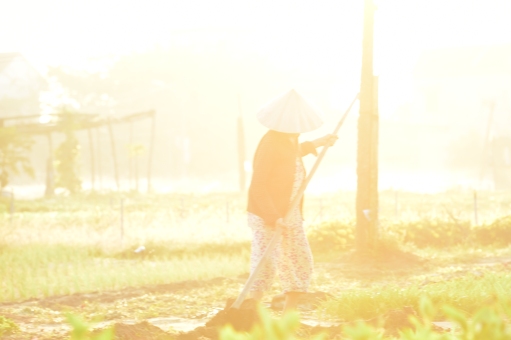
NJB_3349.1

Early morning gardening in Vietnam.

In Hoi An, we participated in a sunrise bicycle tour that took us to the daily market, an organic farm and out to the rice paddies. Truthfully, most small village farms in developing countries are organic because labor there is cheap and chemicals are expensive. In the U.S., unfortunately, the opposite is true.

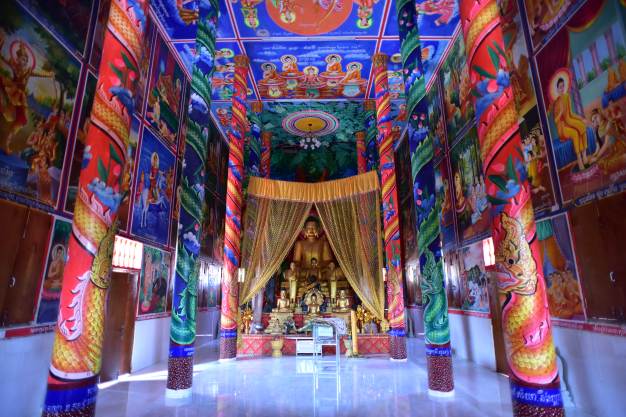
NJB_2552

The stunning interior of a village temple outside of Siem Reap.

This gorgeous temple was on a dusty road leading out of Siem Reap; from the outside, you’d never know that the interior was this incredible. Each fresco had a number painted in the corner; this indicated the amount of money raised by the village to pay for that particular painting.

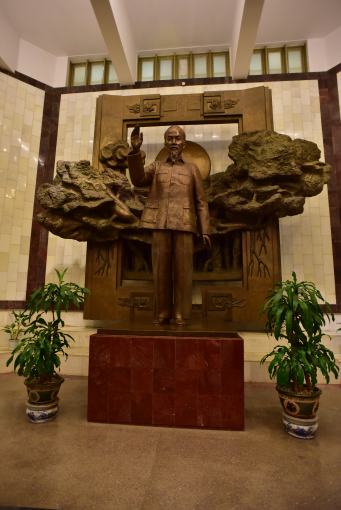
NJB_3491

Vietnam’s favorite son is absolutely revered in this country.

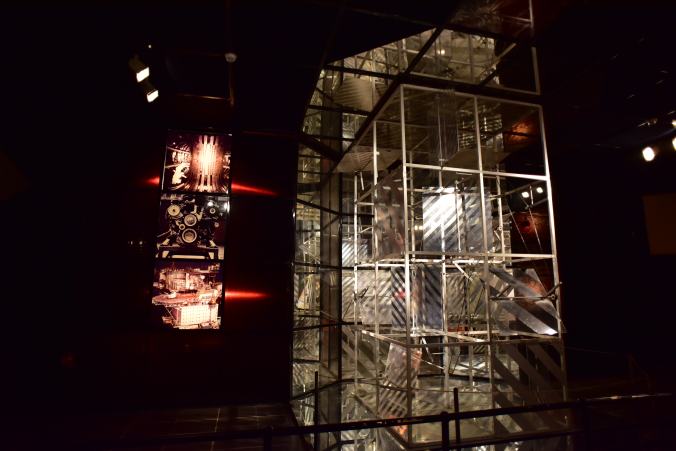
Vietnam’s national hero, Ho Chi Minh, is celebrated all over the country but nowhere more so than in his namesake museum in Hanoi. The museum is one of the strangest and darkest – both in terms of actual light and the overall mood – places we’ve ever visited. It’s an unsettling combination of blatant propaganda and modern art installation, and worth seeing just for the weirdness.

NJB_3495

See how dark this museum is?

The placard on this exhibit in the Ho Chi Minh Museum read, in part, “The models in this hall give visitors information about how scientific and technical achievements have been made use of for peaceful and beneficial purposes. The models at the same time condemn those who have utilized these achievements for aggressive and destructive purposes.” What?

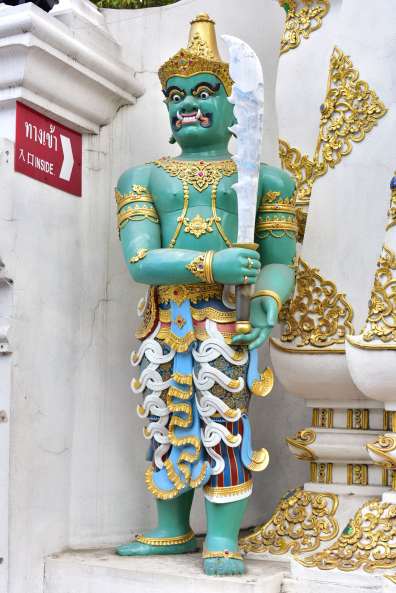
NJB_3717

A ferocious temple guardian in Chiang Mai.

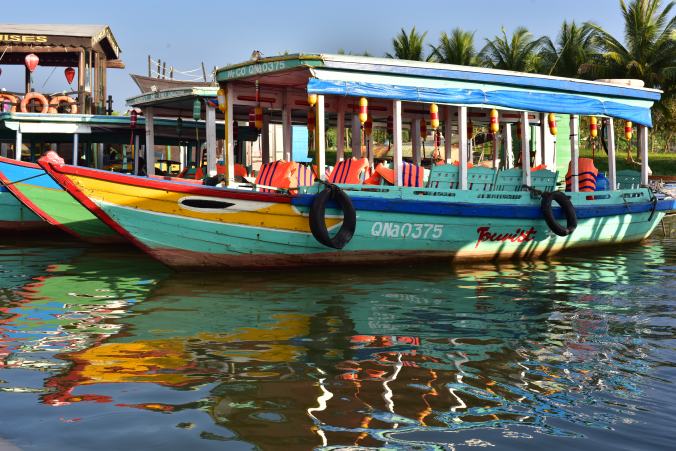
NJB_3353

Look closely: the labeling on these boats in Hoi An lets everyone know you’re a tourist.

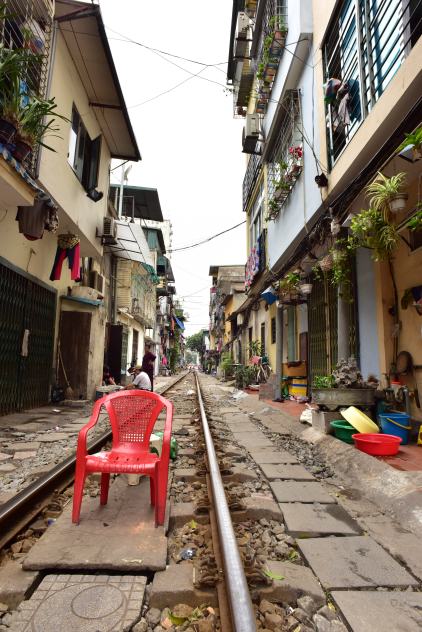
NJB_3482

Trainspotting might be a bit risky in Vietnam.

NJB_3827

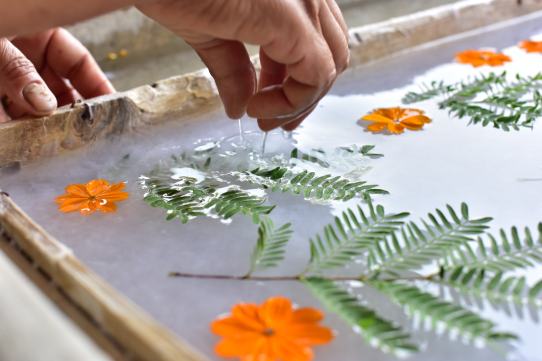
Adding decoration to our handmade paper.

In Thailand, we took a papermaking class and created gorgeous papers with leaves and blossoms. It’s simple and rewarding and beautiful; we’re hoping to make our own to wrap our handmade cheeses in at Quiet Farm.

NJB_2953

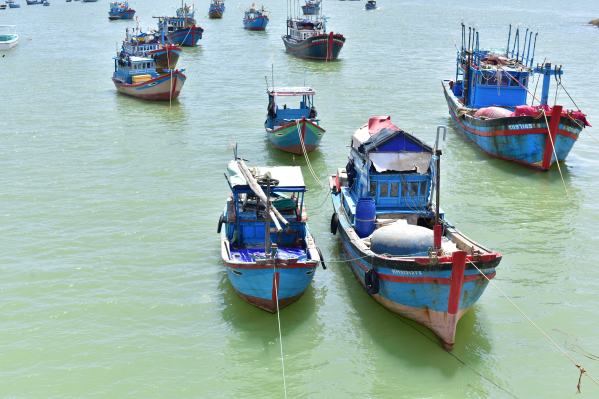
Fishing boats on the river in Nha Trang.

NJB_3700

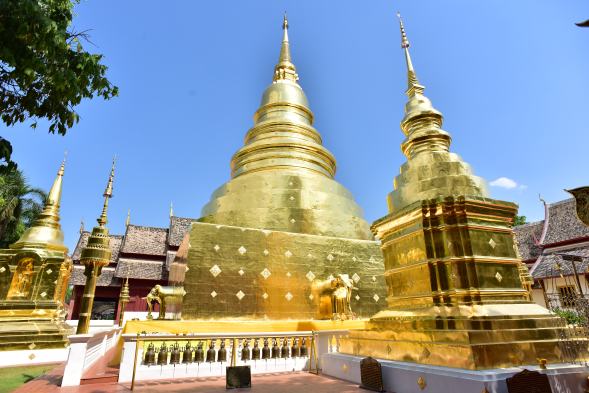
One of Chiang Mai’s many elaborately decorated temples.

NJB_3138

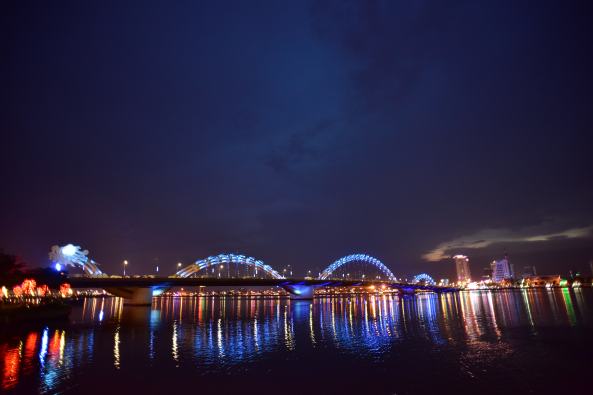
Da Nang’s famous (and very expensive) Dragon Bridge changes colors – and on weekend nights, it also sprays water and breathes fire!

NJB_3389

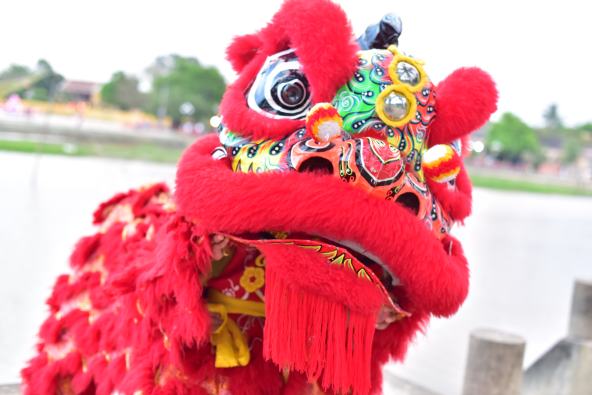
We found this lion dancer at an international food festival in Vietnam.

NJB_2917

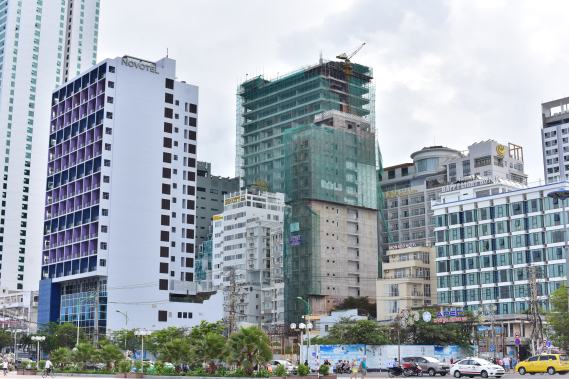
The building boom in Nha Trang, a beach resort popular with Russian tourists.

Vietnam is in a mad rush to modernize, so hotels are constructed at a breakneck pace. This means that not only are there hammers and saws competing with motorbike horns at all hours, but that a lot of construction is left partially finished when workers move on to the next project.

NJB_3550

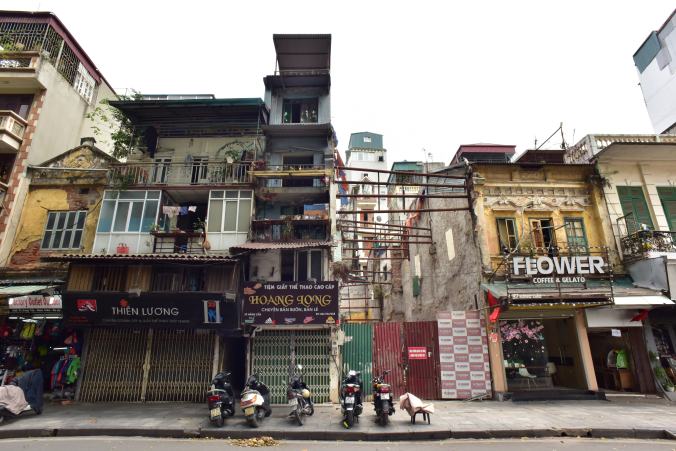
A “skinny house” in Hanoi.

Even more common than all the new construction is making do with what’s already there. The skinny house above has been tucked in; notice that the bamboo poles are actually structural and are keeping the two buildings from leaning in. Presumably something will be quickly built in that empty space. But there’s a fancy coffee shop! With gelato!

NJB_3565

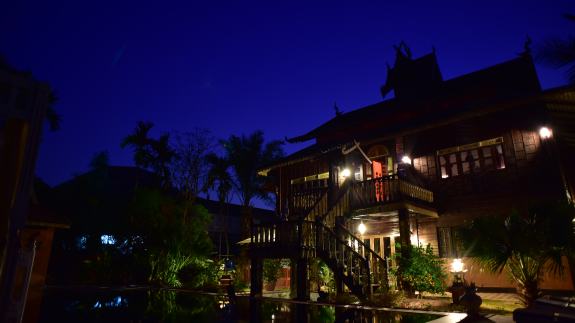
The exterior of the traditional lanna house we stayed at outside Chiang Mai.

NJB_2742

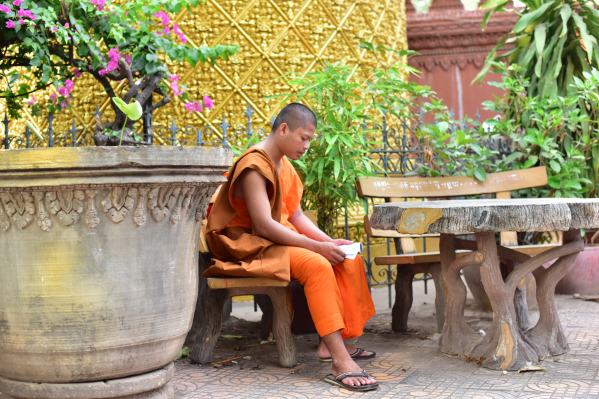
A monk studying at a temple in Phnom Penh.

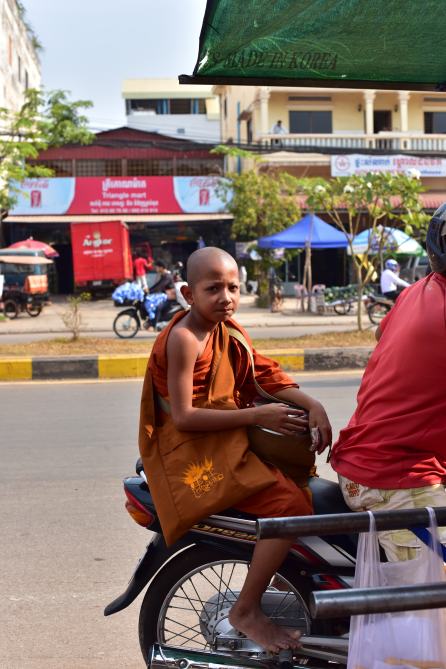
Monks in orange robes with shaved heads are a common sight throughout southeast Asia; it’s amusing to see them with earbuds and mobile phones, too. Even monks have to modernize.

NJB_3747

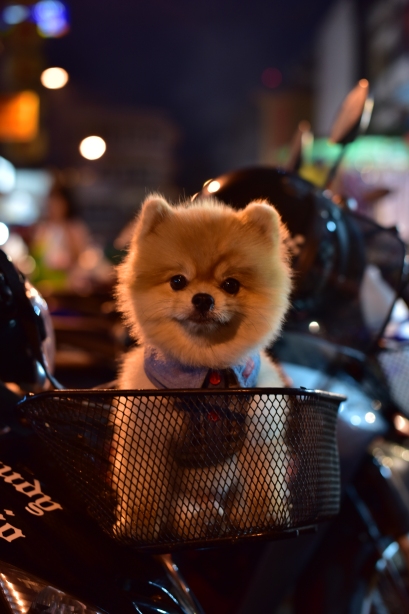
Is this for here or to go?

And we leave you with this photo, and dare you not to smile. While dogs are still eaten in southeast Asia, as the region grows in economic prosperity, its people want what they perceive as middle-class luxuries – and that includes house pets. So now it’s more common here to see dogs on a leash rather than on a grill.

Street food

After the markets, street food vendors are one of the most colorful sights in southeast Asia. From fresh fruits and vegetables to juices, meat and snacks, just about anything you fancy is available from a street stall. Although you might not know exactly what you’re eating, it’s worth watching just for the show.

NJB_2928

A lobster stall in Nha Trang setting up for business.

NJB_2926

Crocodile farming – for both meat and leather – is big business in central Vietnam; the industry is definitely not PETA-approved. This enticement is outside a restaurant in Nha Trang.

NJB_2645

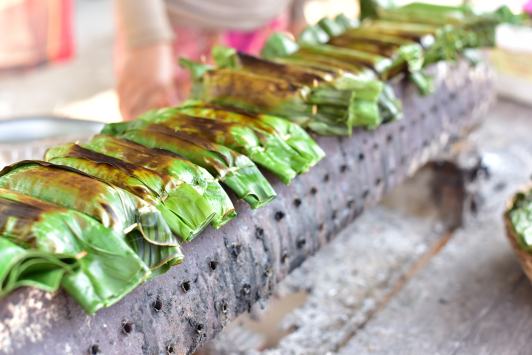
These delicious little packets contain sticky rice stuffed with bananas, eaten as a snack or dessert.

NJB_3735

These lovely women are running a rotee stand. Rotees in Thailand fall somewhere between a crêpe and a pancake and are filled with sweet or savory ingredients.

NJB_3723

Carts are set up along just about every street.

NJB_2923

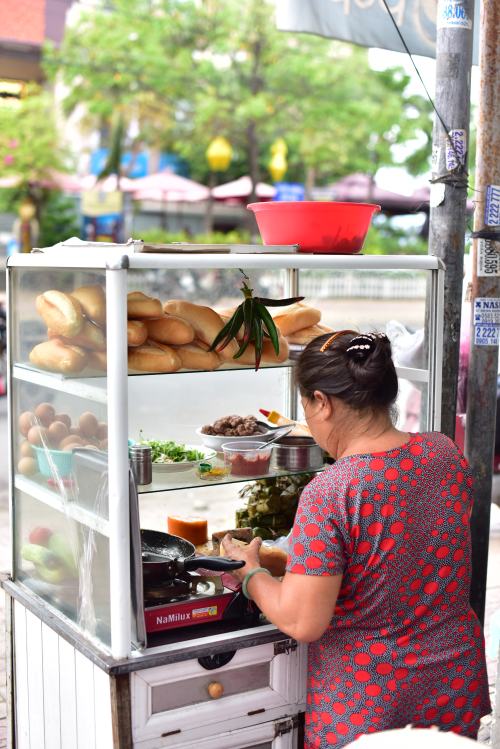
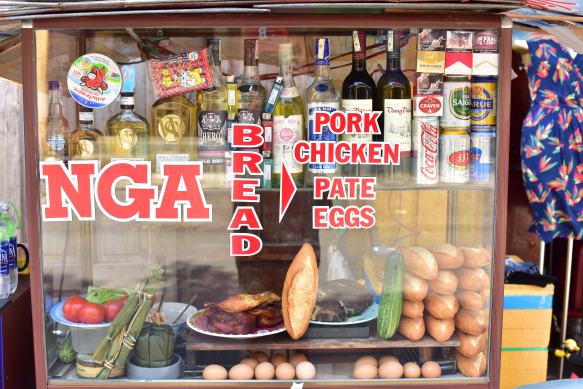
This woman is making Vietnam’s world-famous banh mi sandwich, sold for about 75 cents.

NJB_2911

These tiny bananas (about the length of a finger) are so much more flavorful than the standard Cavendish variety we get at home.

NJB_3173

Fancy some whiskey or red wine with your street food meal? You can have it.

NJB_3743

Perhaps you’d like a meatball skewer?

NJB_2496

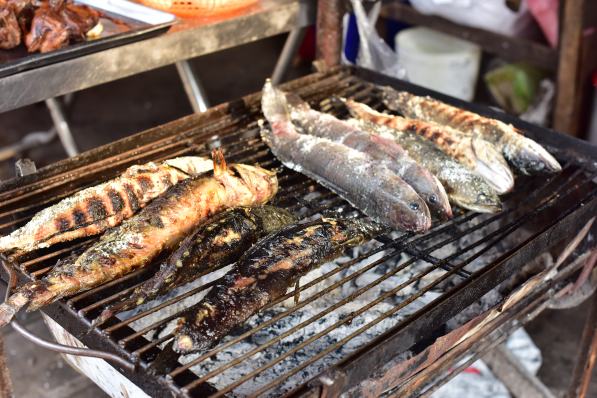
Salted whole fish, ready to eat.

NJB_2486

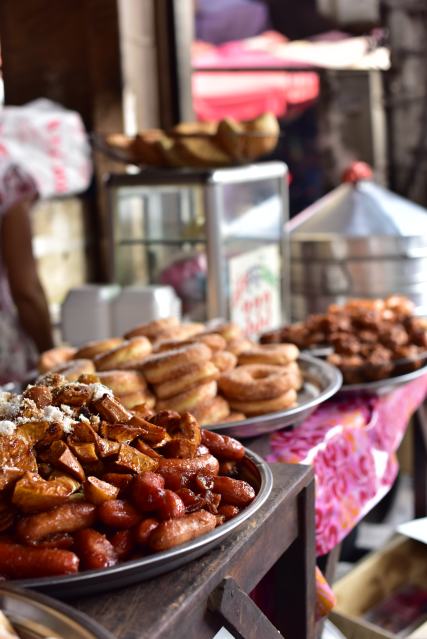
Fried sweet potato, banana and other tasty treats.

NJB_2597

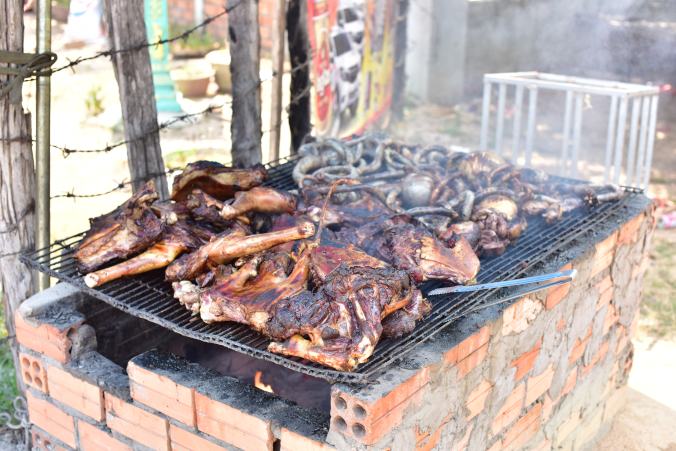
The “special meat” restaurant outside of Siem Reap. Sit, stay…good dog.

NJB_2488

Little sweet cakes, served hot.

NJB_2781

Skewers and more, ready for the grill.

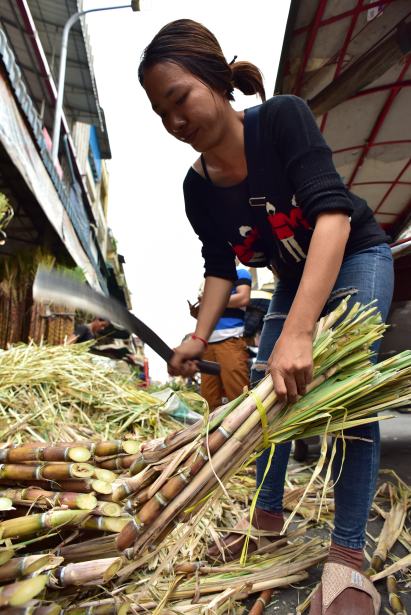
NJB_2755

Baling sugarcane on the streets of Phnom Penh.

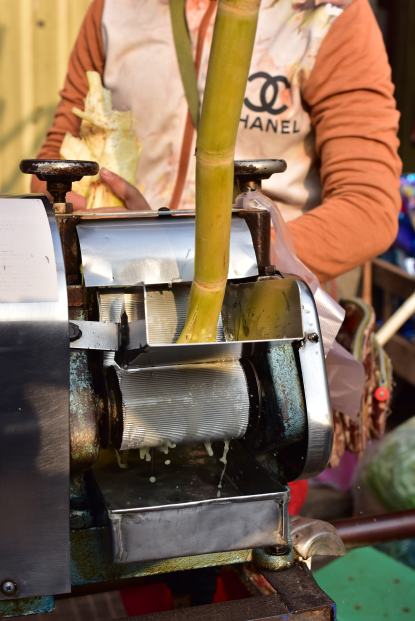
NJB_2479

The sugarcane is crushed through a press to produce delicious juice, which is flavored with fresh lime and sold in little baggies as a refreshing drink.

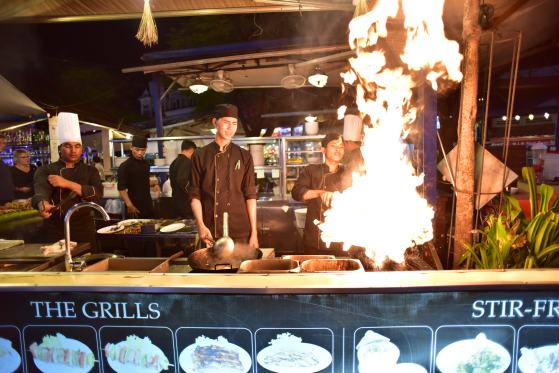
NJB_2656

Chefs demonstrate their stir-fry skills at Siem Reap’s night market.

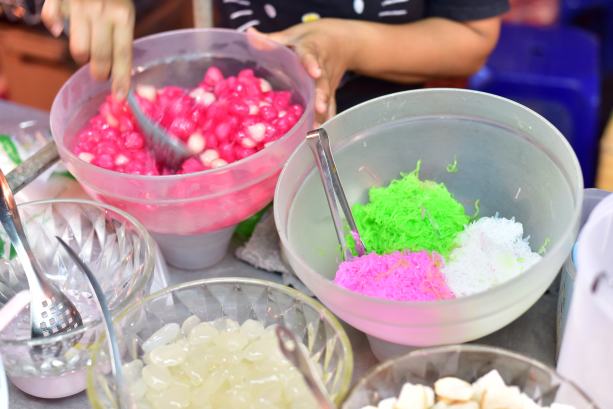
NJB_3740

Honestly, I don’t know. But what colors!


Vietnam by train

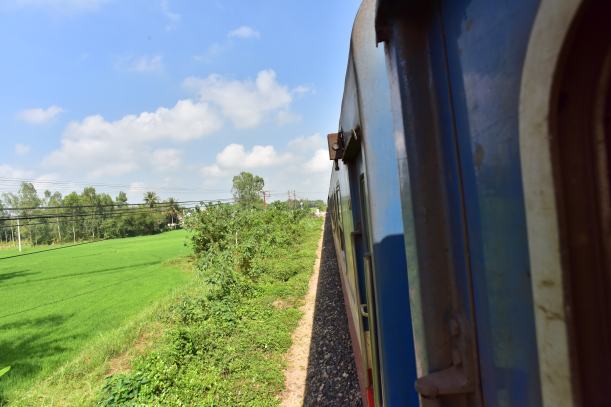
Thus far on this trip, we’ve used just about every imaginable method of transportation, so long-distance trains in Vietnam fit perfectly into our plans.
NJB_3279

Hazy sunrise over the rice paddies.

Long-distance trains were established by the French in Vietnam in the 1880s; the North-South line, connecting Hanoi and Ho Chi Minh City (formerly Saigon), opened in 1936. The line was cut in 1954 at the beginning of Vietnam’s war against the French when the country divided into North and South. It was rebuilt in 1976 and is still known to many as the Reunification Express.

NJB_2900

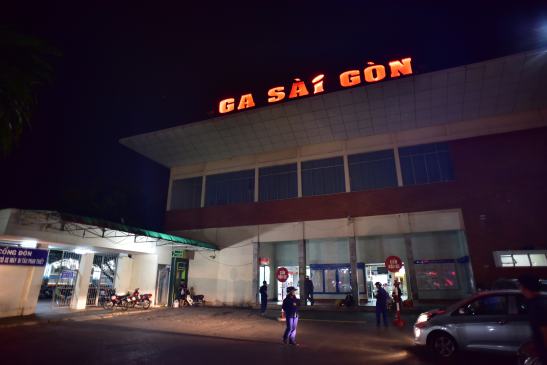
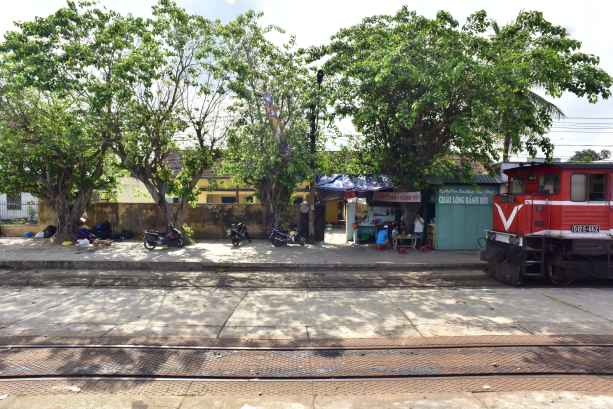
No one is striving for architectural greatness at these train stations.

NJB_2985

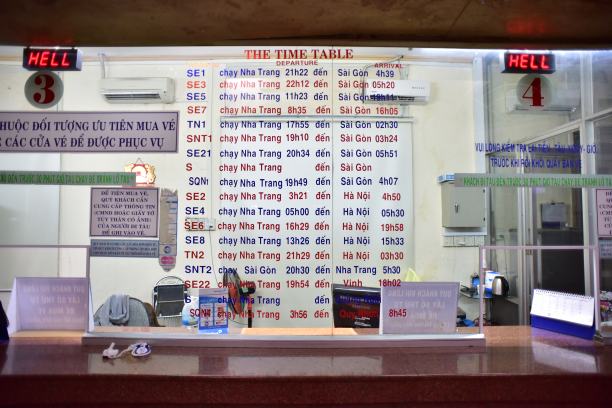
Though it’s officially called Ho Chi Minh City, the station signage and the timetables still use Saigon. We’re not certain which one is socially correct.

NJB_2904

It is advisable to purchase snacks for the journey from the station vendors, though they will almost certainly shortchange you.

NJB_2982

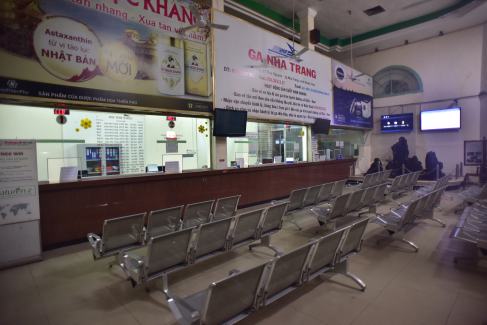
This doesn’t show the large family groups camped in the room behind, but the waiting rooms are clearly both luxurious and comfortable.

NJB_2986

Unlike the precision of Japan, Vietnamese trains are on a bit more of a casual schedule.

NJB_2992

A four-bed “soft sleeper” cabin.

Train accommodations in Vietnam come in fairly self-explanatory flavors: hard seat, soft seat, hard sleeper and soft sleeper; sleepers can be either four-bed or six-bed. We first used soft seats for day trains, but learned the hard way that this meant we’d be subjected to Vietnamese musicals played on the communal televisions at ear-splitting volume. Presumably this was very enjoyable for the Vietnamese passengers, but it did diminish our love of train travel somewhat. So did the physically aggressive food vendors who hopped on board at stations.

NJB_2994

NJB_3000

NJB_3005

This rice paddy photo is clearly lacking the iconic tiny Vietnamese woman in a conical cap.

NJB_3023

Everything – and we mean everything – is under construction in Vietnam. This includes every single hotel we stayed at.

NJB_3018

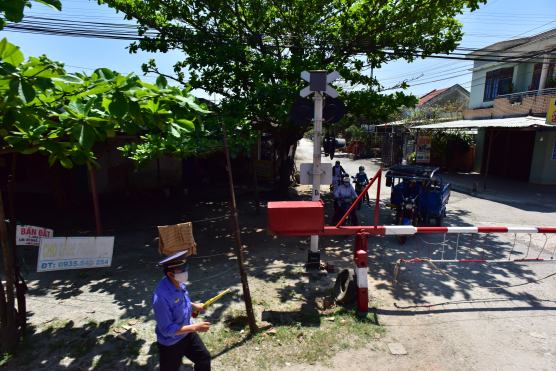
Railway crossings are not automated, so the train employee runs to shut the barrier as the train passes.

NJB_3025

NJB_3016

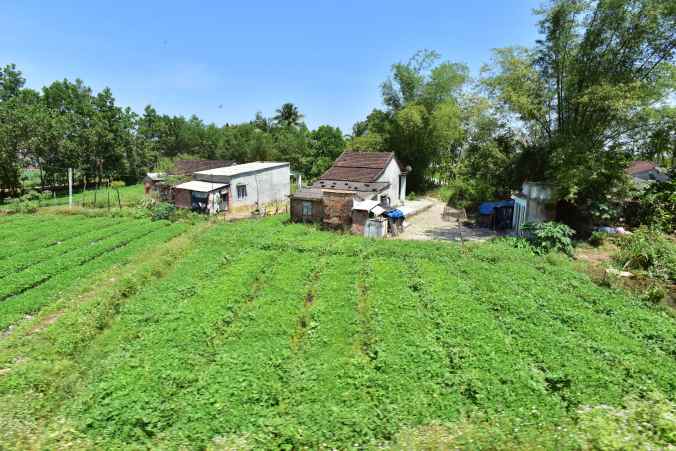
Almost every house we passed had a large vegetable garden.

In addition to the vegetable gardens we saw at most homes, families also harvest part of communal rice paddies. Their allotment is determined by the size of the family, so there is certainly an incentive to have more children. Obviously, no one actually owns land here; land is theoretically owned collectively by the people, but of course in reality controlled entirely by the government.

NJB_3010

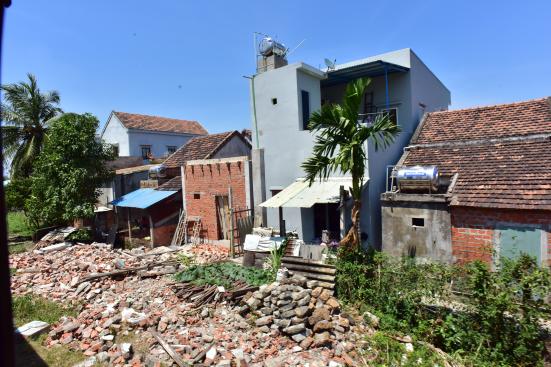
On many occasions, we passed close enough to touch the buildings outside.

NJB_3026

We were a little surprised by the cavalier attitude towards crossing live tracks, but when in Vietnam…

Here’s the honest truth: trains are not the most efficient way to travel around Vietnam, and unfortunately they’re not the most economical, either. Though we had planned on doing all of our travel up the coast via train, budget airlines like AirAsia and JetStar have made the decision much more difficult. From Da Nang to Hanoi, for example, it’s sixteen hours by train and about ninety minutes by plane. The trains are by no means particularly comfortable or clean, and the airline tickets are often cheaper! So we’d love to tell you that we honored the backpacker credo and traveled slow, but that’s not the entire story. This is a complicated, difficult country, and the vagaries of train travel are just the beginning.

NJB_3040

We finished our train journey about halfway up the coast at Da Nang, or “China Beach” to Americans.

Walk this way

We believe that one of the best ways to explore a big city is by walking it. During this adventure, N and I have tackled Kyoto, Tokyo, Auckland and Wellington, plus numerous small towns and villages. Never before, however, have we encountered as much danger as we did when exploring Ho Chi Minh City (formerly and still sometimes Saigon) and Hanoi in Vietnam.

NJB_2811

NJB_2791

It’s every man (or woman) for themselves out here.

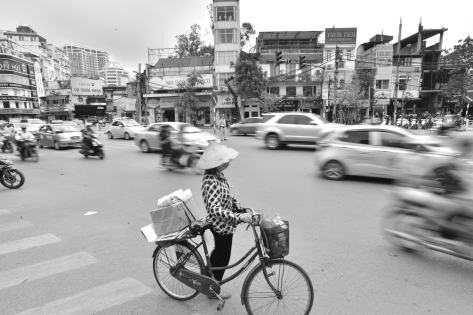
Imagine the biggest non-motorway road you can. Now envision it filled entirely with cars, and fill in the empty spaces with thousands of motorbikes. Add more motorbikes. Throw in pedestrians, elderly women on bicycles, wheeled carts filled with vegetables, tuk-tuks, and a few more motorbikes, just for good measure. Feel free to paint in lane lines and dividers on your imaginary road, but don’t worry too much as everyone will assiduously ignore these. Now imagine that everyone who has access to a horn or a bell or any other noisemaking device is using it – at the same time. Oh, and don’t forget to let everyone text while they’re driving. Now you might just barely have the tiniest inkling of the risk involved in walking Vietnamese city streets.

NJB_3544

Southeast Asia is absolutely overrun with motorbikes. Tourists can rent them, but do so at your own risk; serious accidents are common.

NJB_3542

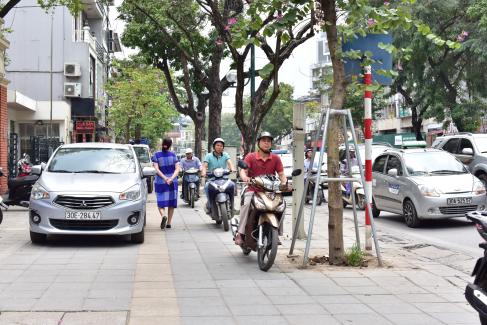
We love walking (maybe me just a touch more than N, especially in the southeast Asian heat) but never before has it been quite so difficult. Even on the sidewalk – ostensibly a safe haven – we faced myriad obstacles.

NJB_3474

Sidewalks in Vietnam aren’t so much for walking as they are for sitting down to catch up with friends.

NJB_3529

If the road traffic is too much, the motorbikes will join the pedestrians on the sidewalks. Also, feel free to park your car wherever you’d like, as demonstrated on left.

NJB_3475

Pop-up meat markets, like this one, also make navigating sidewalks in Hanoi somewhat challenging.

NJB_3458

Oranges, anyone?

NJB_3176

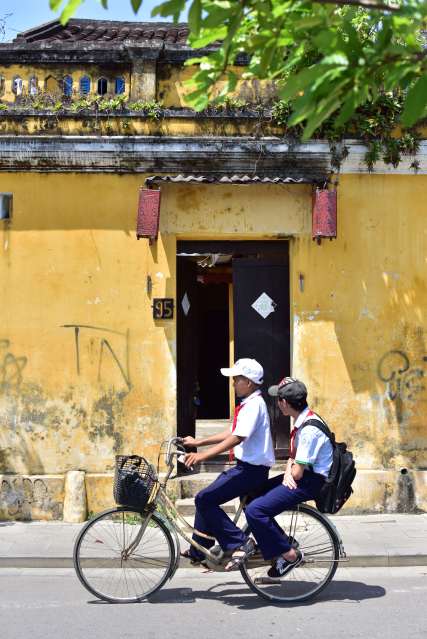
We regularly saw bicycles and motorbikes loaded with two, three or four family members. Child safety seats? Not so much.

NJB_2858

The kid sandwiched on the motorbike in the foreground apparently doesn’t need a helmet.

NJB_2869

Even when the crosswalk light says it’s the pedestrians’ turn, this is typically the gauntlet you face. Beware.

NJB_3535

No, that isn’t a crashproof bike helmet.

NJB_3531

We saw motorbikes carrying all manner of goods, from extension ladders to mini fridges to lengths of steel pipe to balloon bouquets.

NJB_3486

The bicycle on the right is loaded with ceramics for sale. Imagine how heavy and unwieldy it must be to ride.

We learned quickly that the only way to make progress was to take a deep breath and step out into traffic. No one is actually driving all that fast, and the motorbikes will elegantly navigate around pedestrians like a shoal of fish. As long as you move smoothly and consistently – and don’t stop in the middle – the system actually works, surprisingly. It defies all Western conventions. Numerous times, we saw panicked tourists frozen on the side (or the middle!) of the big roads. Know that a good degree of faith is required.

NJB_2521

Apprentice monks have places to go, too.

NJB_2853

Yes, N was crossing the road when he snapped the shot. Risky job, this.

NJB_3195

Drivers wait for a fare…these carts only seat one passenger, so they’re not practical unless you’re traveling solo.

NJB_3476

Notice here that lane lines and directional traffic are merely a suggestion.

NJB_2887

NJB_3465

We read a helpful travel trip: “If taking a motorbike taxi, ensure your driver is sober and lucid.” Honestly, how would you know? Our airport shuttle bus driver fell asleep with alarming regularity along the journey.

NJB_3553

4AM and we can finally use the pedestrian crosswalk safely.

Navigating Vietnamese cities on foot has been one of the trickiest and most tiring parts of our travel thus far, but it certainly qualifies as an adventure!


To market, to market

For a chef and a photographer, traditional food markets are a wonderland. We visit markets whenever possible and do our best to capture the scents, sounds and tastes through our words and photos. These markets are often messy, fragrant, hot and noisy, to say the least, but they capture a place and its people the way few other tourist attractions do.

P.S. If you’re in the Denver area, I’m teaching an incredible cooking class on exploring ethnic markets in June at the Botanic Gardens. Learn more here!

NJB_2489.JPG

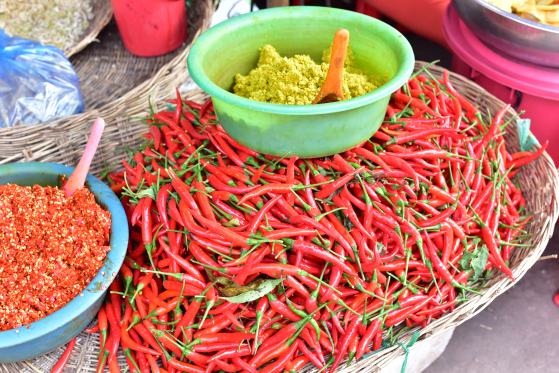
Chile paste, fresh chiles and ground turmeric.

NJB_2513.JPG

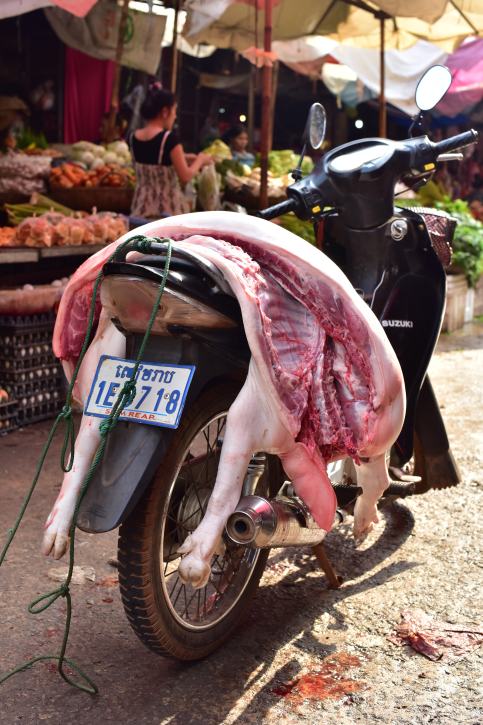
This little piggy went to market…

NJB_3271

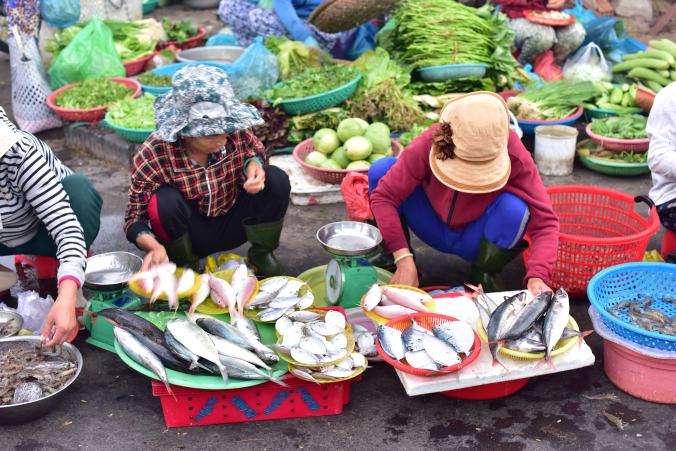
The morning fish market in Hoi An.

NJB_2504.JPG

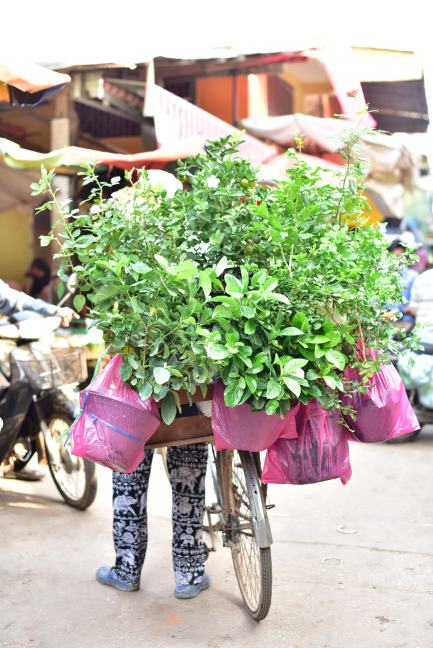
Fresh herbs, delivered by bicycle.

NJB_2491.JPG

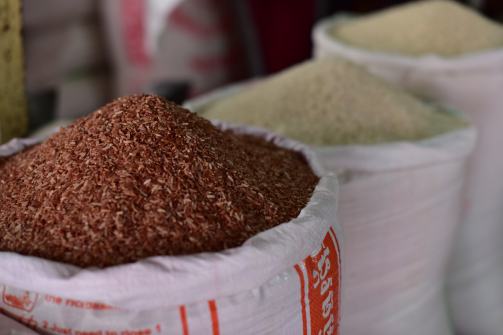
Rice is the staple food for more than two-thirds of the world’s population, unsurprisingly, there is a lot available for purchase here.

NJB_2510.JPG

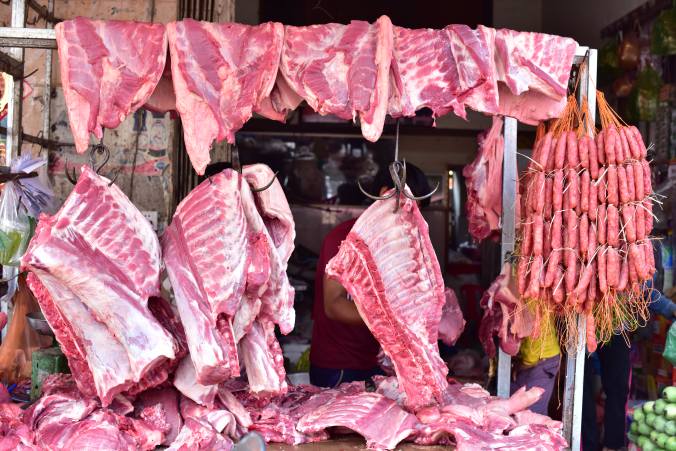
Know where your meat comes from.

NJB_2317.JPG

Siem Reap’s famous Night Market.

NJB_2503

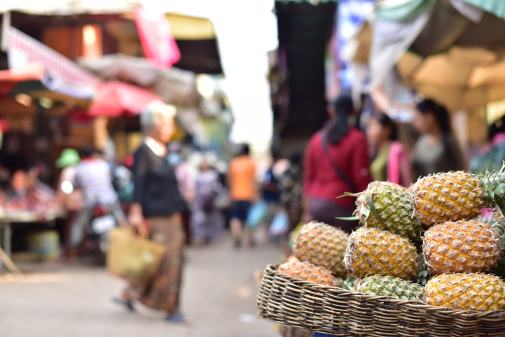
Fresh pineapples are often sold peeled and cut for an easy to-go snack. 

NJB_2472.JPG

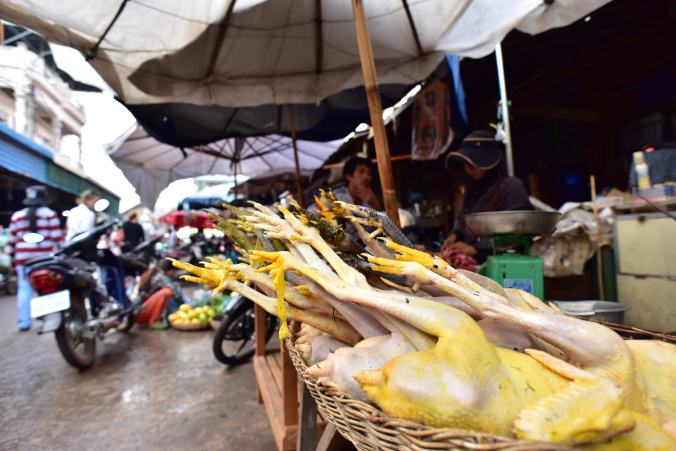
The “blackfoot chicken” is just one of the many poultry options available. Every conceivable type and size of bird is eaten here.

NJB_2763.JPG

Lots of unusual fruit varieties that I’ve never seen before!

NJB_2500.JPG

This is what chefs mean when they talk about “nose-to-tail” cooking.

NJB_2477.JPG

Most markets we’ve seen are conducted primarily on the ground.

NJB_2519.JPG

This is not the gluten-free section.

NJB_2493

Spices ready to blend into fiery curry pastes.

NJB_2306

NJB_2304

Markets in southeast Asia aren’t just for food; Cambodia and Vietnam produce a great deal of the world’s “fast fashion,” typically in abysmal working conditions.

NJB_2507.JPG

Everything you need to garnish pho.

Needless to say, I’m looking forward to cooking again when we get home!