Apparently this country is electing a president this year and probably electing some other people too, though over here at Quiet Farm we’re doing our damnedest to ignore the entire circus. One thing that still surprises (and infuriates!) me immensely in every single election cycle is that we never, ever discuss national food policy. Neither side even mentions it in passing, unless a hotdish fundraiser happens. We talk about defense, and education, and occasionally the climate crisis, and of course health care, and yet we never discuss the single issue that unites every one of us, regardless of party affiliation. We never talk about the fact that if we changed our food system, we’d naturally change our health care system for the better. And that changing our food system would be a huge step towards repairing our devastated planet. Changing our food system would also mean more military readiness, since we’re now too fat to fight. And our children would gain a better education if they had access to better nutrition for growing brains and bodies. We always ignore the food, when it’s the one issue we should talk about more than any other.
environment
Save our seeds

Our first hard frost is forecast this week, so there is much to be done. In addition to lots of canning and preserving, autumn on a small homestead means saving seeds. We’ve talked about the importance of seed saving previously, and each season we’re working on expanding our seed bank. Never before has it been so important to save our own seeds and thereby take responsibility for our own food supply; as seed companies are again and again snapped up by massive agrochemical conglomerates, our control of our own seeds – our fundamental birthright, and the source of our food supply – becomes ever more tenuous.
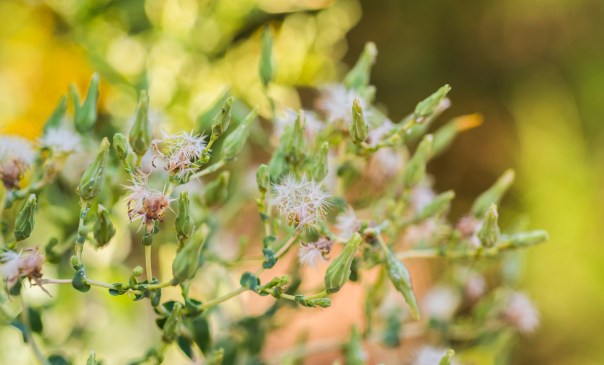
Most lettuces and other salad greens encase their seeds in little windblown puffballs.
As I wrote in our previous seed post, “Today, nearly three-quarters of all seeds planted in the U.S. – both unmodified and genetically engineered varieties – are privately owned and controlled by three large agrichemical corporations. Growing food is a basic human right, and we are quickly moving towards a future in which we will no longer own the source of our food. Lack of food leads to hunger, which leads to unrest, which leads to revolution, which leads to profitable wars benefitting those same corporations. Building our own seed banks, even if technically illegal, means we still have some say in our food supply. Seed saving is a small but powerful act of resistance.”
Lessons learned
Hello again, and please forgive us our recent absence. We’ve taken a small summer hiatus – not because we’ve actually been on vacation, but because for a period of time there we didn’t have many nice things to say about farming, and we didn’t want our space here to sound whiny and negative. We’re genuinely thrilled to be farming, even when we aren’t.
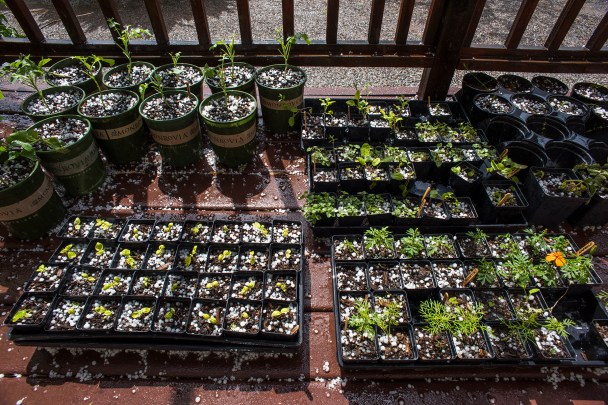
One of early summer’s low points.
It’s been just under one year since we found Quiet Farm, and what a year it’s been. There have been highs and lows and successes and failures. And now that we’re one year wiser and can officially call ourselves farmers, we’re working hard on learning from our experiences. We always say that we’re allowed to make as many mistakes as we want, but we have to make different mistakes. If we make the same mistakes over and over, then we obviously haven’t learned anything.
This week in flowers: July 1
There are lots of amazing aspects of living where we do now, but one of the most rewarding has to be watching the farm change with the seasons. Since we’re still learning our land, we’re constantly surprised by plants or blooms or bushes that appear seemingly overnight. Summer is here, and we’ve got lots of lovely flowers all over.

‘English Munstead’ lavender (Lavandula angustifolia), fragrant and bee-friendly. Continue reading
Deer diary, vol. 2

Tools at the ready for constructing an H-brace.
Early this year, Colorado Parks and Wildlife delivered our game fencing materials. They also included a thin pamphlet with a few helpful suggestions on how to construct said fence – not really what we’d call “instructions.” As we’d never built even a simple fence before, this meant a lot of time on the University of YouTube. Our game fence is nine feet tall and composed of wood posts, metal T-posts, two strands of grid wire fencing and three strands of barbed wire. That’s a lot just to keep deer out – and each component has to be installed separately.

Once we’d set our wood posts in concrete, we went around building H-braces at corners. H-braces (seen above on the left and right sides of the gate) are required when the fence turns a corner to keep it supported. The H-braces seem relatively simple – you just notch the vertical posts, insert a horizontal post, then use massive nails (3/8 inch by 12 inches!) to secure the horizontal to the vertical. As with all aspects of this fence, though, this is simpler on paper than in reality. Notching the fenceposts required climbing on a rickety stepladder on very rocky and uneven ground and holding a reciprocating saw at an awkward angle while trying not to fall off the ladder. Not at all OSHA-approved.

Four completed H-braces on either side of our corral gate.
With the posts successfully notched, we set about connecting the horizontal to the vertical. Driving the heavy, thick nails in proved to be yet another challenge. After hours of frustration, we finally bought an extra-long drill bit so we could pre-drill the holes for the nails. This was an important lesson learned: don’t try to do something the hard way if a power tool can make the task easier.
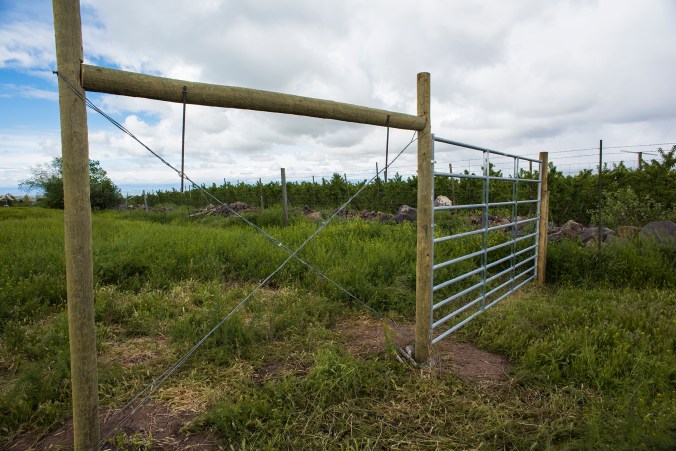
Looking southwest at our pasture gate.
H-braces then have to be wrapped with nine-gauge wire in order to stabilize the posts. As with the nails, this was much easier in theory than in practice. The wire was delivered to us in huge coils which were absolutely unmanageable – no matter where you wanted the wire to go, it was set on uncoiling the wrong way somewhere else, usually slapping you in the face along the way. We each bear our fair share of fence scars.

Using a come-along and a wood clamp to stretch the grid fencing.
Now that the H-braces are up and wrapped, the two strands of grid fencing have to be installed. We could have opted for one-strand fencing, but the fencing comes in 330-feet rolls and the two of us could barely lift one of the smaller rolls. So we chose to wrap two strands, which most small farms do. It takes longer, but it’s much easier for two people to handle.
We unrolled the coils along the fence line, then used a come-along and N’s very crafty wood plank clamp to stretch the fencing. It’s imperative that the fencing be as tight as possible, but because our posts aren’t exactly straight, we had to adapt a bit. We’ll call it “accounting for the curvature of the earth.” Once in place, the fencing was secured to the wood posts using thick staples, and to the T-posts using clips.

Using the wood clamp and the ATV hook and cable to install the top row.
Installing the top row offered additional challenges, since we had to hold up hundreds of feet of fencing while stretching and then securing it. Our ATV’s hook and cable set-up helped a great deal here, as did some sturdy chains attached to our wood plank clamp.
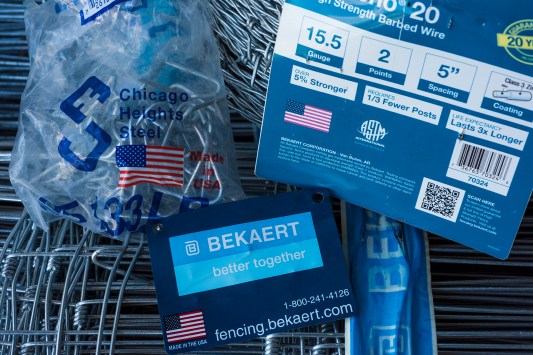
We were pleased (and surprised!) to find that all of our fencing materials were made in the USA.

Waiting for barbed wire along the top and bottom.

Nearly finished!
The complexity of the fence might seem like a bit much just for some deer…but we have watched these animals easily leap a six-foot fence from a standstill. The power in their strong legs and their lean bodies is remarkable, and the fence has to be nine feet tall to have any hope of keeping them out, especially when they’re moving at a full, panicked run.
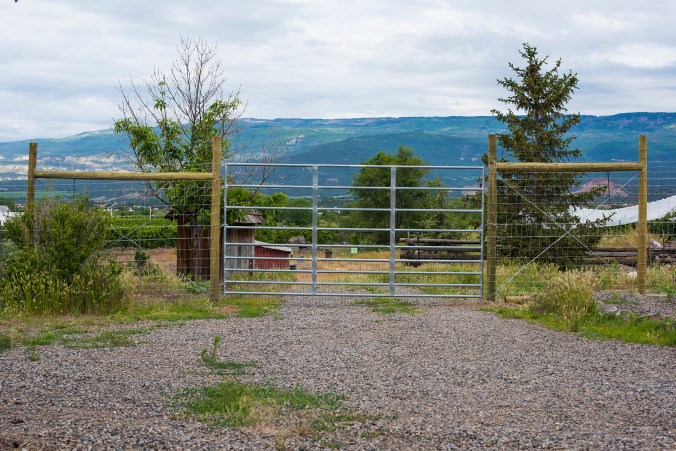
Dear deer: the Quiet Farm salad bar is officially closed. Go torment someone else.
Building our game fence is the most extensive, complex and difficult project we’ve tackled yet here on Quiet Farm, and we are so proud of the results. The fence isn’t perfect, but we did it ourselves for about one-tenth what it would have cost to hire a fencing company, and we learned so much along the way. This sense of accomplishment and self-sufficiency is why we’re out here.
Thanks for reading!
Farm update: May 20
Our average last frost date here at Quiet Farm is May 13; as a rough guideline, this means that it’s generally safe to plant warm-weather crops (tomatoes, peppers and so on) outside after this date. Except that we had about an inch of light, fluffy, powdery snow plus some shockingly low overnight temperatures this past week, and if we’d had all of these plants outside they would have died a chilly death. While some vegetables can handle low temperatures, our summer stars want heat and more heat, so ours are still safely tucked away in the sunroom. What do we learn from this? Always check the forecast, and never trust Colorado weather to do what you expect.
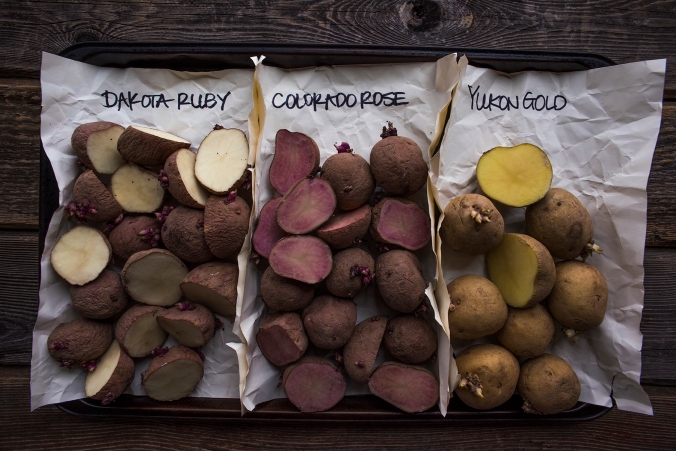
These seed potatoes are bred for the Rocky Mountain West.
We’re expecting another week of cool, wet weather, which makes it impossible to pour concrete for our fence posts. But there is always something that can be planted, even if it’s not tomatoes and peppers. Our locally-grown seed potatoes have been planted in “potato towers,” which we constructed from galvanized fencing and layers of newspapers, compost and straw. I planted a little over a pound of each variety; theoretically each pound planted should yield about ten pounds of fresh potatoes in maybe July or August. I’ve never planted potatoes in towers so am excited to see how this experiment turns out! (If you want to plant potatoes, buy certified seed potatoes and don’t plant those from the grocery store – they’ve typically been treated to prevent sprouting and therefore won’t grow.)
Farm update: May 6
It’s been mostly cool and rainy this week. We’re of course grateful for the moisture and lower temperatures, which might keep our snowpack in place longer, but the weather has literally put a damper on our excavator plans. Never mind, though; there are always plenty of other things to do!

A male black-chinned hummingbird getting its sugar fix.
One of our most successful ventures recently has been installing hummingbird feeders around our house. We’ve been utterly astounded at the sheer number of hummingbirds that have appeared, including both the black-chinned and broad-tailed varieties. They’ve apparently informed all their friends that the bar is open!
Farm update: April 15
Things are getting busy here at Quiet Farm! The weather is (mostly) conducive to working outside, and we’ve got a list of projects lined up. More trays of seedlings are potted up every day, we’re working hard on finishing the chicken house so we can bring pullets home, and plans for installing our game fence are coming together (I get to drive an excavator!).

Run, Pony, run. But not right at us, please. It’s scary when you do that.
Temporary Pony is alive and well and running around our pasture at top speed while performing complicated dance moves. Someday soon she’ll leave for her new home, but she’s certainly provided plenty of entertainment (and no small amount of terror) during her time here.
Farm update: April 8

The hills are alive…with weeds! But we call them “wildflowers.”
The snow is finally gone at this elevation, even though plenty can still be seen on the mesa. Our pasture is coming back with a vengeance, and we spend our days walking the land, looking at what plants are coming up and trying to decide whether they’re helpful or harmful to us. Since we bought Quiet Farm at the end of a blistering summer in the midst of a hundred-year drought, pretty much everything was crispy and dormant. We hadn’t yet determined what bushes and trees might survive, and what would need to be removed. We’re giving everything a generous opportunity to stage a spring comeback before we tear it out.
The cranes are here!

There are so many benefits to living where we do now, including but not limited to lots of fresh, local fruit in the summer. But just now, coming off a long, dark winter, we’re most excited to see one of the true harbingers of spring: the greater sandhill crane on its annual migration between New Mexico and the Yellowstone ecosystem (northern Idaho and Montana).

Greater sandhill cranes are big, gorgeous, elegant birds; adults stand about four feet tall and have a six-foot wingspan. They’re most easily recognized by their sooty gray coloring and the red patches on their eyes and head, and that they flock by the thousands. Their plumage can take on a rusty red sheen, because they often preen by rubbing their feathers with iron-rich mud.

In Colorado, a flock of about twenty thousand birds gathers in February and March in the San Luis Valley, where they rest and forage before heading further north. About five thousand of these birds then make their way straight over Delta County, where we live, often stopping at Fruitgrowers’ Reservoir just to the east of our farm.
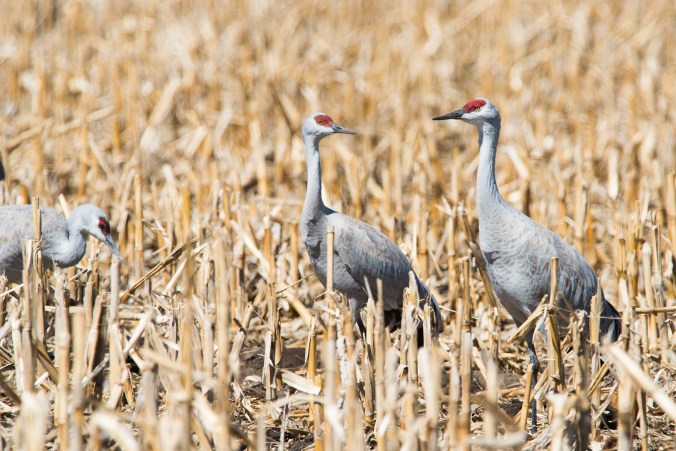
Greater sandhill cranes are the oldest birds still living today; fossil records from two and a half million years ago indicate that they’ve changed hardly at all. Rock art and other artifacts in the San Luis Valley show that cranes have been important to the region’s people for as long humans have inhabited the area. Their annual migration is a sure sign that we’ve survived another winter, and spring is on its way.
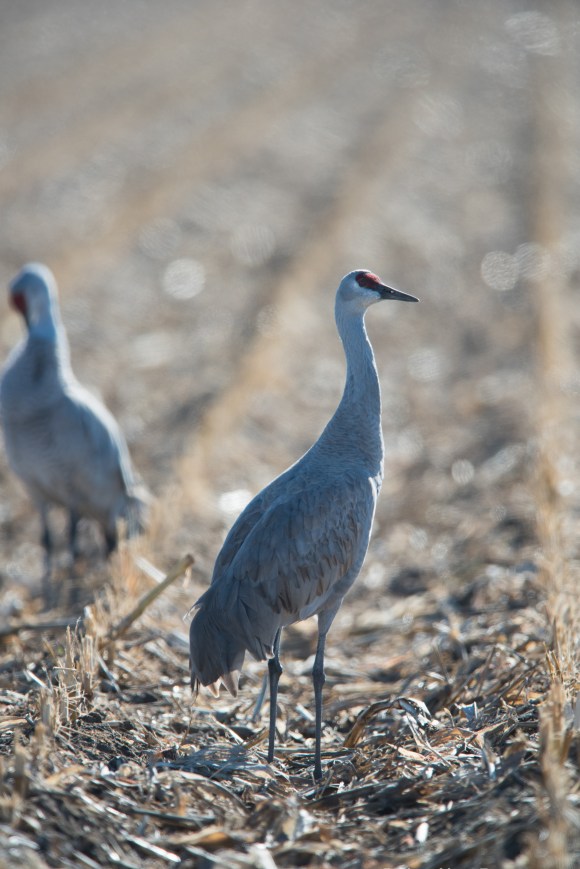
Sandhill cranes sleep in shallow, calm water to keep themselves safe from predators, so a reservoir like Fruitgrowers’ is a perfect stopover location. These birds are opportunistic feeders; they most often eat plants and grains, but they’ll also feast on invertebrates and small mammals, if available. The Western Slope and the San Luis Valley offer thousands of acres of fallow cornfields in which to forage.
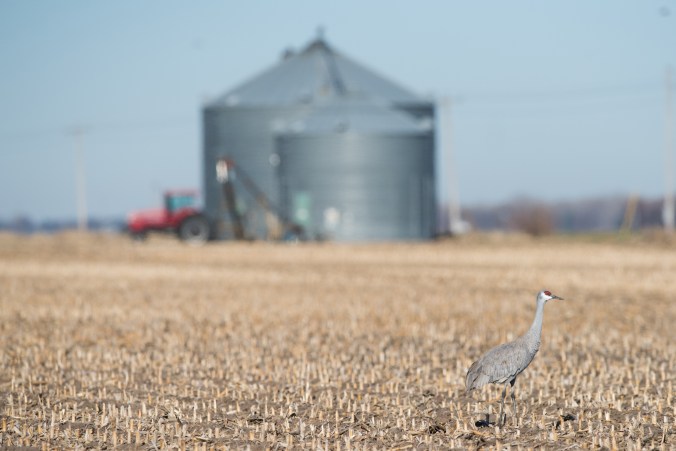
The cranes are most active at dawn and dusk when they “commute” to and from their daytime feeding grounds. The population along the Platte River in Nebraska is so large – half a million birds – that the cranes’ noise can drown out normal conversation. Sandhill cranes have a distinctive call, and the birds can frequently be heard even when they can’t be seen. The cranes are often spotted along the same transitory route in fall, but they rarely stop over in Delta County. Local experts believe this is because the reservoir is dry in the autumn, so there is no place to for the birds to sleep safely.

Although sandhill cranes aren’t quite as demonstrative as the famous dancing prairie chicken, the birds will perform for their prospective mate. Sandhill cranes mate for life and can live up to twenty years, a remarkable lifespan for a wild bird. These cranes don’t nest here in Colorado but instead lay their eggs up north; the female typically lays two eggs and the male guards the nest. It takes a month for the eggs to hatch and two months for the chicks to reach maturity, although only one chick usually survives.
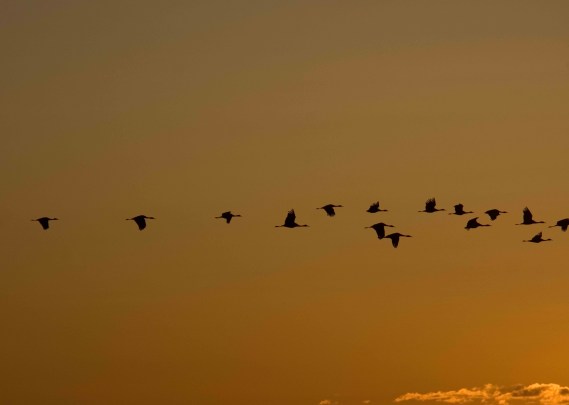
We are thrilled to share space with these magnificent birds, and we look forward to their migration every spring.
P.S. If you’re interested in seeing the cranes in huge numbers, the two best locations are Monte Vista in southern Colorado and along the Platte River in central Nebraska. Both are definitely worth the trip!


