Hello, friends. It is the busiest time of the year on the farm and we have ten thousand different projects on at the moment. Here are a few things we’ve been up to lately, if you’d like to see.
Tomato starts before splitting.
The sunroom is packed with hundreds of starts, mostly warm-weather crops like tomatoes and peppers. I’ve started seventeen different tomato varieties this year, some new and some tried and true classics, plus thirteen different peppers ranging from mild and sweet to incendiary. After last year’s pepper bounty, I’m committed to expanding our production of the larger bell peppers; I believed that our growing season was too short for the full-size peppers but 2021 certainly proved me wrong. As always, the vast majority of the plants we grow are from saved open-pollinated seed so that we’re protected from the vagaries of the seed market. That said, I tried starting ‘Sungold’ tomatoes again this year; they’re a hybrid but if you’ve ever tasted these incredible gems, you know exactly why people go mad for them. I’ve obviously grown thousands of tomato plants and consider myself a pretty experienced grower, but three years in a row now my purchased ‘Sungold’ seed has failed to germinate. I contacted the seed company – a reputable Front Range outfit – about the poor germination and have yet to receive a response. Frustrating situations like this are exactly why we save our own seed, because we cannot rely upon companies to provide our food.
We will ship you a free kitten.
We live in an exceptionally impoverished county; a direct consequence of that is an absurd population of stray dogs and cats, because people do not spay or neuter their animals. In late March we unfortunately discovered that a feral cat had chosen our hay barn as a warm, protected nursery; now we have one adult cat and six kittens. While we’re happy to have some assistance in controlling the mouse population, we definitively do not keep any household pets so fate will run its course with this lot. An apocryphal quote attributed to Gandhi reads, “The greatness of a nation and its moral progress can be judged by the way its animals are treated.” In this (see also: CAFOs) and in so many other respects, the U.S. is failing entirely.
So pretty! So aggressive! So invasive!
If 2021 was The Year of the Goathead, 2022 looks to be The Year of the Thistle. We’ve written before about cotton thistle (Onopordum acanthium), which is hugely invasive in our area and produces massive, thorny plants that are dangerous to humans and animals. As we work on spring cleaning and tidying around the farm, Thistle Patrol is a key task. If we can dig out the plants by the roots when they’re small, we can prevent them from becoming these treacherous four-foot monsters and of course from spreading seed to produce even more thistles. We travel around with a small shovel at the ready, prepared to vanquish our spiky foe wherever it might be found.
All the little blue tape pieces mark areas that have to be repaired. Sigh.
We are also at work on The World’s Lengthiest and Most Tedious Tiling Project, involving a complicated and not particularly interesting tale of obtuse angles, poorly manufactured countertops, a rickety garage sale tile cutter and many, many other challenges, surprises and obstructions. When (if?) we ever finish this project, it will hopefully look incredible; the road to reach that lofty point, however, still appears long and winding. Also someone in all those DIY YouTube videos should really mention that charcoal grout against white tile shows every chip, imperfection and error. “We didn’t know what we didn’t know” has never seemed so apt; we’ll chalk this one up to hard-won learning.
Will we harvest any fruit this year? Time will tell.
And finally, we’re excited to see blossoms on most of the fruit trees we planted in our first full season here. We of course live in the heart of Colorado’s commercial fruit territory, but the changing climate means that no plant is guaranteed survival any longer. Of late, we’ve endured punishing fifty-mile-per-hour winds plus overnight temperatures in the 20s; the big propane-fueled fans in the surrounding orchards have been on a few times recently in a desperate attempt to save their year’s harvest because these frigid temperatures are devastating for the fragile blossoms. The cherry trees in our area are likely gone for good, thanks to last year’s freeze. Many growers have started culling their delicate peach trees in favor of hardier apples; though peaches sell for far more per pound, the risk of losing the entire crop is also far greater. We are doing our best to adapt to a drier, hotter, windier place and to keep our plants (and ourselves) healthy while doing so.
And with that, we’re back to work! Wishing you a pleasant week ahead.
“We are bewildered at what can happen out in the world in such a short time. We are not qualified to make heads nor tails of it all, and it is humbling to be able to do so little in response. However, we do our work of peaceful and close-to-home living as best we can. Try not to depend too much on the larger greedy systems that perpetuate war and its profits. The daily points where our bodies remain connected simply and physically to the Earth still need looking after – food, shelter, warmth, family – the seeds sown, the wood chopped, the flour ground, the dough mixed. It’s a blessing to be given the time and space to do those things, thoughtfully and with humility.”
-Barn Owl Bakery, Lopez Island, WA, March 2022
Kale: strong, resilient, nutritious. The plant I aspire to be.
Hello there. We are here, and we hope you are, as well. In a world that feels ever more suffused with madness each passing day – e.g., the IPCC thoughtfully released its latest report three days after the invasion, thereby guaranteeing we will all continue to ignore the existential crisis staring us right in the face while we focus instead on a pointless and devastating and intentionally distracting war – we are planting seeds, tidying winter debris, plowing new beds and generally readying ourselves for another productive growing season at Quiet Farm. Collectively, we’ve careened wildly from one catastrophe to the next over the past two years, and we are all exhausted, drained, sad and anxious. Once again, getting our hands into the soil and quietly producing something real, substantial, edible and nourishing seems far and away the most useful response to the ever-increasing chaos out there.
We hope you, too, will plant something this year. We’ll be back again soon.
“Build back better. Blah, blah, blah. Green economy. Blah, blah, blah. Net zero by 2050. Blah, blah, blah. This is all we hear from our so-called leaders. Words that sound great but so far have not led to action. Our hopes and ambitions drown in their empty promises.”
I don’t pay a great deal of attention to teenagers, mostly because I’m not learning dance moves on The TikTok, but I’d have to agree with Greta Thunberg’s comments above. The preposterous dog and pony show currently taking place in Glasgow is just so much performative rhetoric with absolutely no follow-through. Honestly, the planet likely warmed another ten degrees from all of the hot air passionately emoted in Scotland. Please note that this summit is titled COP26 for a reason – because twenty-five conferences have been held previously, and precisely nothing was accomplished through any of those gatherings, either. Also, pro tip for the U.N.: everyone knows that if you want to host the most glamorous climate-change party you should invite some big-name guests, and when Russia and China both decline your invitation, your party starts to look a little sad.
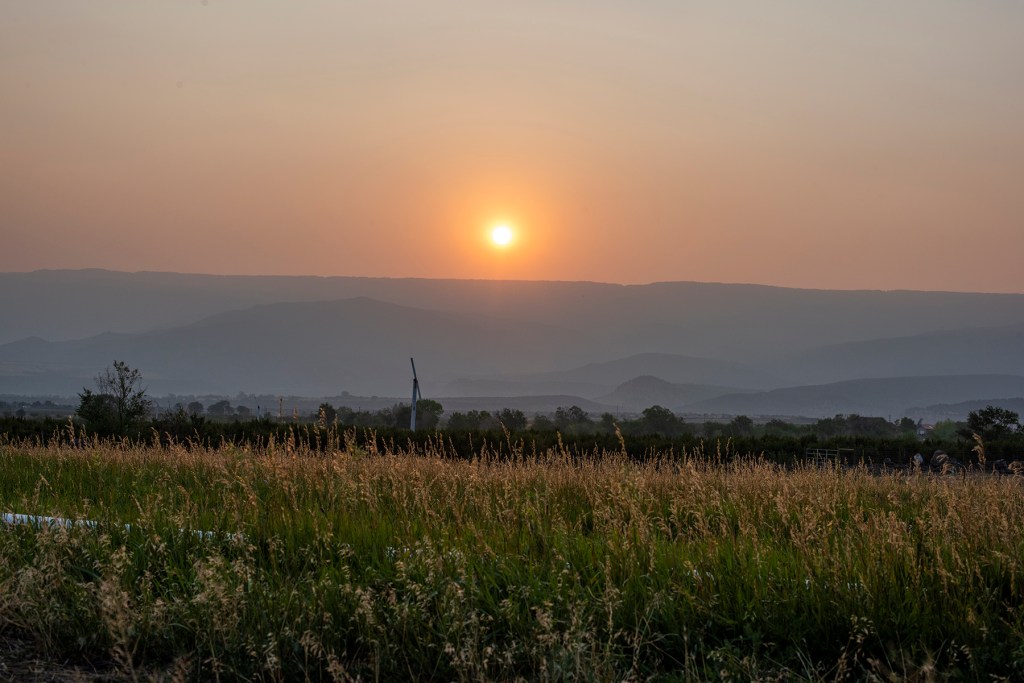
Our smoky, hazy, summer wildfire sky.
Let’s look on the bright side: we’re finally, finally having some hard conversations about the devastating realities of climate change! Now let’s look on the realistic side: it’s far past time for us to acknowledge that we cannot stop or even slow climate change! The moment for that was forty years ago, when scientists first started warning of these eventualities. Countries have never once even met emission-reduction goals, never mind exceeded them, and we’re quickly headed for a far greater increase than the oft-mentioned 2°C. In late 2021, the only realistic approach is to concentrate all of our efforts on adapting to our changing weather patterns and our warming planet. It’s ridiculous to think that we can alter the current trajectory, but we may as well acknowledge that adaptation is what humans do best – it’s exactly why we’re in this doomsday scenario, because we’ve adapted to living and breeding everywhere, limited resources be damned.
What frustrates me most about a bunch of useless politicians prattling on about green economies and renewable energy – plus a bunch of shouty protesters taking to the streets with their cobalt-filled smartphones! – is that collectively, we’ve chosen to ignore the solutions that already exist. It’s almost as though we didn’t think that climate change was a tricky-enough problem, so we said, “How can we make this more difficult and more expensive?” Instead, all we actually have to do is look at the answers we already have – and the two best and most obvious both save people money AND have a huge impact on overall methane emissions. Yes! Everyone talks about decarbonization, but perhaps our energy would be better focused on methane reduction.
Lovely car, but electric vehicles aren’t going to save us. Not by a long shot.
This is not intended to broadly oversimplify the hugely complex problem of climate change, but the Environmental Defense Fund puts it like this: “Cutting methane emissions is the fastest opportunity we have to immediately slow the rate of global warming, even as we decarbonize our energy systems. It’s an opportunity we can’t afford to miss. Methane (CH4) has more than eighty times the warming power of carbon dioxide over the first twenty years after it reaches the atmosphere. Even though CO2 has a longer-lasting effect, methane sets the pace for warming in the near term. At least 25% of today’s warming is driven by methane from human actions.”
And so, the obvious question would be as follows: what can we, as individuals, do to reduce our methane emissions? The answer is remarkably simple yet hugely impactful: eat less (or no) meat and stop wasting food. These are basic actions that don’t require complicated technology, new infrastructure, job retraining or trillions of incentive dollars. They also directly benefit our health and save us money.
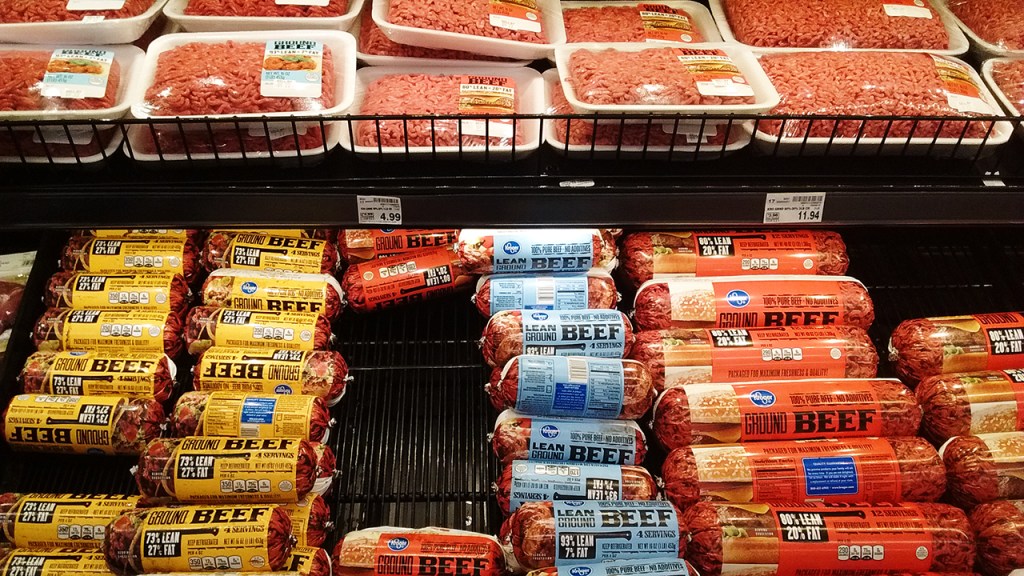
Cheap hormone-drenched feedlot beef in plastic tubes. Yummy yummy!
According to the EPA, well more than a third of the United States’ methane emissions originate from agriculture, primarily feedlots and manure lagoons (such an attractive phrase – the American meat industry is decidedly grim). “When livestock and manure emissions are combined, the agriculture sector is the largest source of CH4 emissions in the United States.” Obviously, then, reducing the number of animals we raise for food is a simple way to reduce methane emissions. In Glasgow, however, not much was said about meat consumption, likely because at least in America, the livestock and agriculture industries are incredibly powerful. Shaking that tree is going to take quite a bit more than twenty-six international climate summits.
It’s no surprise that Americans are one of the top consumers of animal flesh in the world; we were raised, of course, on “meat and potatoes.” When it comes to our food expenditures, meat represents the lion’s share of our grocery budget. Using broad-brush statistics, Americans consumed about 265 pounds of meat per person in 2020, at a cost of $4 per pound. (These numbers are roughly averaged, as beef is substantially more expensive than chicken and pork.) That’s three-quarters of a pound of meat per person, per day, every day. Considering that we have the highest rates of diabetes, heart disease and cancer in the developed world – lifestyle diseases strongly correlated with our excessive meat consumption and shockingly poor diets – decreasing the amount of meat we eat would reduce methane and save lives, plus save us all money on groceries and health care. (The hospital industry is a huge GHG emitter, too, so if we stayed out of hospitals because we were healthier we’d again be helping both ourselves and the planet. See how it all comes together?)
Livestock should be on pasture, not in feedlots.
As an additional incentive, millions of acres of land are cleared to raise livestock and feed, primarily corn and soy. Returning these acres to natural prairie grassland in the U.S. or tropical rain forest, as in the Amazon, would also help sequester tons of carbon dioxide in the soil, rather than pushing it into the atmosphere. Raising livestock also uses astonishing amounts of water; in the American West, where most beef cattle can be found, there is no longer any water to spare. In short, the overall benefits of minimizing or eliminating meat consumption are staggering – and certainly not discussed nearly as often as EVs or taxes on oil and gas companies.
Methane is generated not only from livestock and their waste, but from any decomposing organic matter thrown into landfills. Food waste, then, is another massive beast entirely; more than 40% of all food produced in the United States is never eaten. If food waste were a country, its emissions would be third-highest in the world, after the U.S. and China; globally, food waste accounts for about 8% of the world’s total greenhouse gases. This is such low-hanging (and obviously rotting) fruit – when organic matter is decomposed properly in a well-managed compost pile, it produces nutrient-rich humus that can then be used to grow more food. When smothered in non-biodegradable plastic trash bags in a landfill, however, its emissions are greater than the entire airline industry. And the solution is just so simple and again, saves money – buy less food, don’t cook more than you’ll eat, use up your leftovers and scraps and start a compost pile. The answers really aren’t that complicated, and no one needed to convene tens of thousands of people in Scotland to figure this out. Sure looks impressive on social, though.
Composting organic matter is such a simple way to reduce methane emissions.
It’s easy to lose faith entirely when our world leaders are so smug and so hypocritical, and so intent on making blah blah blah promises they have no intention of keeping. If you’re feeling entirely depressed and hopeless about the state of the world – as most of us likely are – just know that individual choices do make a difference when taken collectively. Reduce or eliminate meat in your diet and stop throwing away food. These small actions might not seem like much, but it’s certainly a better approach than giving up entirely.
“The best way to oppose a system is often to create something better to replace it.”
Scarlet runner beans, grown mostly to attract hummingbirds but also delicious to eat. Plus the beans are gorgeous.
I read a Wall Street Journal piece recently that really stuck in my craw. The article details the ongoing global supply chain challenges, specifically focusing on the Halloween season:
“Ben Wieber, a 27-year-old professional services consultant in Kalamazoo, Mich., struck out trying to purchase a miniature haunted house in-store to add to his Lemax Spooky Town collection, a line of Halloween-themed animatronic figurines and buildings. He was also broadly disappointed in the amount of Halloween décor available at stores near him.
“I went to Lowe’s, Home Depot, T.J. Maxx, HomeGoods and I’m already seeing Christmas stuff replace the Halloween stuff, which is ridiculous,” Mr. Wieber says. “I’m like, hello? Are we just skipping Halloween this year?”
This appalling anecdote immediately brings to mind two things: 1. Obviously the pandemic is over and 2. Even more obviously the apocalypse is nigh. Late in 2021, after more than eighteen months of crushing loss and death and isolation and sickness and disinformation and loneliness and unrest and economic devastation and fury, we have clearly reached the point at which all of our mental energies – and our time and gas! – can be laser-focused on buying yet another cheap trinket that we don’t need but are angry that we can’t get. I’m like, hello?
We grew spectacular peas this season.
I am particularly caught up in this obsessive need to buy tacky, energy-intensive, disposable, Chinese-made plastic holiday decorations because at the moment, much of my own time and energy is focused on saving seeds from this growing season. We’ve talked about seedsregularly here at FQF HQ, but in the wake of what’s occurred over the past year and a half, and what’s certainly coming down the pipeline (I’m like hello, irreversible climate change!) seeds have taken on a new significance.
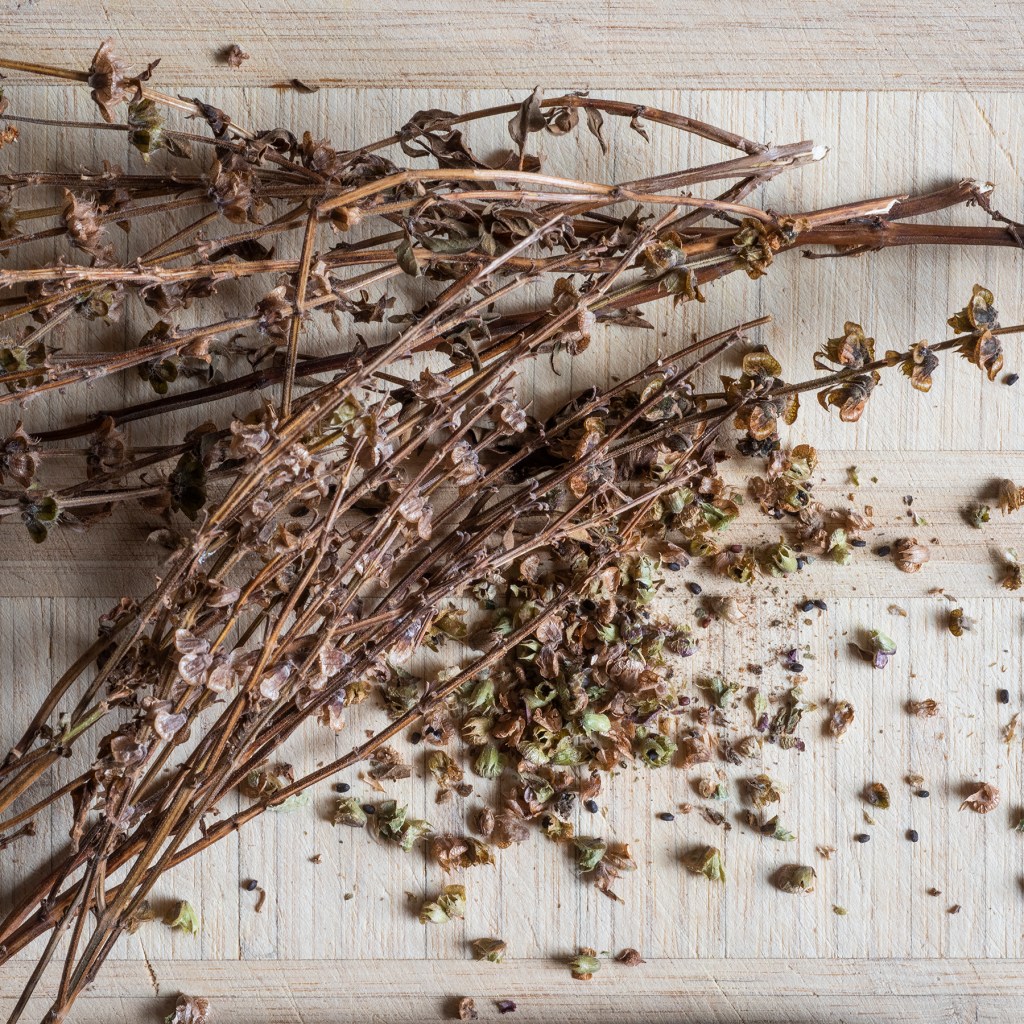
Cleaning saved basil seeds is a bit labor-intensive – the seeds are actually those tiny black specks in the lower right – but worth the effort.
To understand why seeds are so essential to human survival, it’s important to understand just how much has changed in only the past century. For about ten thousand years, since the shift from nomadic hunter-gatherer tribal living to established agriculture, humans have saved seeds. No seed companies existed until recently, of course, so the only way to ensure food for the following year was to save seeds from this season’s harvest, and to trade and barter with neighboring farmers for their seeds. Because seeds were so necessary for human survival, they were rarely shipped and therefore didn’t travel long distances; by their very nature, these seeds were perfectly adapted over generations to the unique microclimate of the area in which they were grown. Saving seed is so painfully obvious – the ability to grow food so clearly a basic human right – that it never occurred to small farmers that a seed could be patented as intellectual property, like a song or a book.
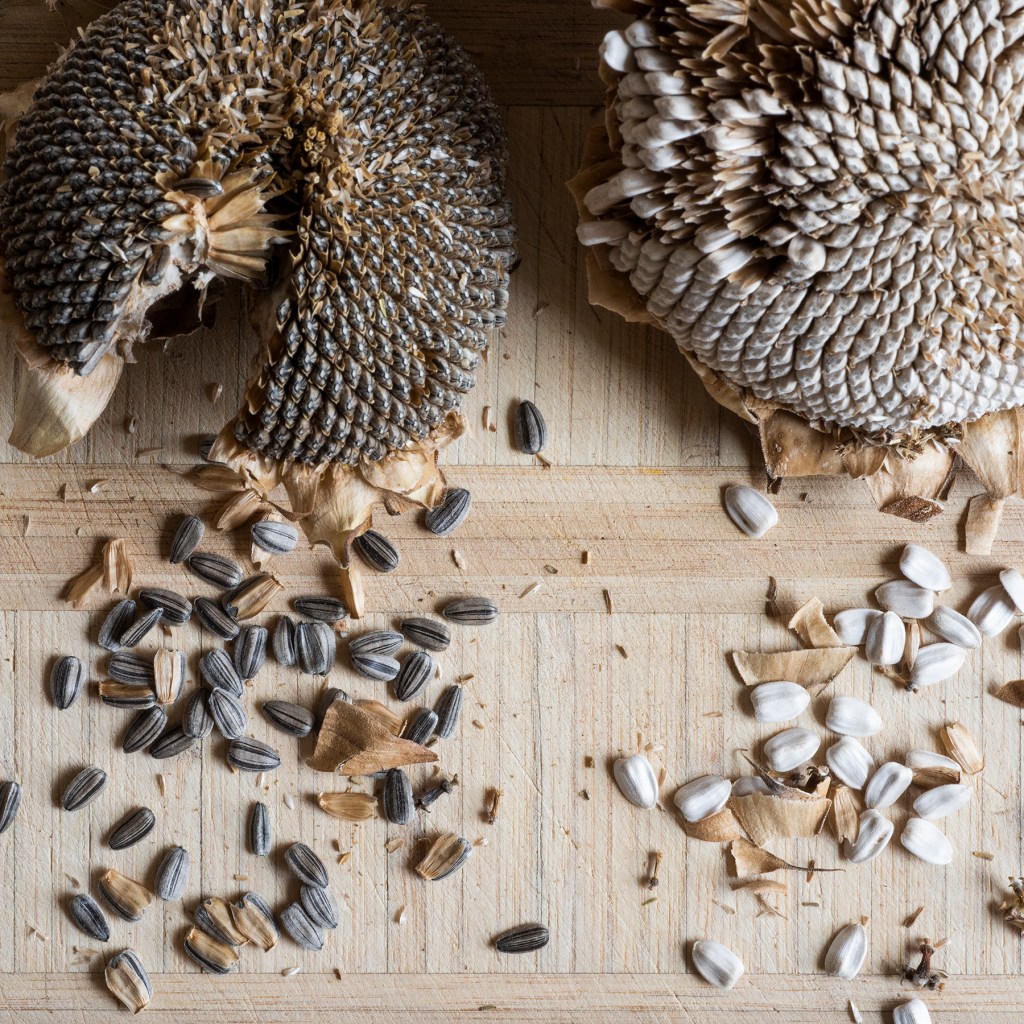
The squirrels didn’t steal all of our sunflower seeds this season!
This system worked beautifully until Big Ag wanted in on the action after World War II concluded. To summarize an incredibly complex situation in a few glib words: much of the world’s food supply is now based on patented hybrid and/or GMO seeds. Three large multinational corporations now control over 70% of the world’s seeds, and therefore over 70% of the world’s food. It is illegal under a variety of laws to save and propagate these seeds, and in most cases the seeds won’t breed true anyway. This global movement away from seed sovereignty (“the farmer’s right to breed and exchange diverse open-source seeds which can be saved and which are not patented, genetically modified, owned or controlled by emerging seed giants”) threatens everyone on the planet, yet apparently we’re too busy looking for unavailable Halloween decorations to care about that.
Even now, there are only a handful of seed companies in the U.S.; there used to be thousands, each with their own regional specialties. Buy from Johnny’s or High Mowing and you’ll likely get seeds grown out in Maine or Vermont or somewhere else in New England. They’ll probably produce, yes, but Maine and Vermont are pretty different climactically from the high-plains desert we grow in, and I’d like to have a greater chance at success with seeds adapted to my region. And of course we all remember what happened in the spring of 2020. Seed companies were entirely overwhelmed by demand once it became clear that the pandemic was here to stay, and seeds weren’t available anyway; if they did arrive, it was long after planting season. I’m simply not willing to stake my household’s food security on the rickety scaffolding of unprepared seed companies, global panic and the USPS.
Onion seeds are easy to harvest and save, but they must be collected before they’re wind-dispersed.
Back in September, the U.N. – an utterly useless pretend mafia of pompous self-important incompetent blowhards, if you want to know my real opinion – convened the first Food Systems Summit, which was theoretically designed to “determine the future of agriculture.” Yet the small farmers who actually grow the majority of the world’s food were not offered a seat at the table. Instead, in a move surprising to precisely no one, the loudest and most prominent voices were those of Big Ag and Big Pharma, mainly companies who have committed grievous biopiracy by patenting landrace seeds and inventing GMO crops that threaten both the planet and human health. Dear United Nations: Praising Monsanto/Bayer for its breathless promises to cure global hunger – an issue it directly causes AND profits from – by patenting seeds is like praising Jeff Bezos for his commitment to solving climate change. In effect, you don’t win a prize for claiming to “fix” a problem that you directly helped create (and made billions along the way!).
All this is to say: convening a bunch of billionaires – who have probably never grown a single tomato in their lives – in some sparkly ballroom in some fancy city far from any actual agriculture isn’t likely to solve the world’s food problems. And for that reason, hundreds of food sovereignty organizations, indigenous and smallholder farmer groups, and scientists boycotted the U.N. summit, and rightfully so. It is absurd to think that Big Ag and Big Pharma would have even the slightest interest in working in tandem with small farmers on improving food systems; their respective interests are entirely at odds. Seed companies don’t make money if people save their own seeds! To maintain the very profitable status quo, power must be kept in the hands of the few, and making seed saving illegal (and useless, in the case of GMOs and hybrids) is one very effective way to maintain that power. (These corporations would still do well to remember the other side of the coin: most revolutions start when people are hungry.)
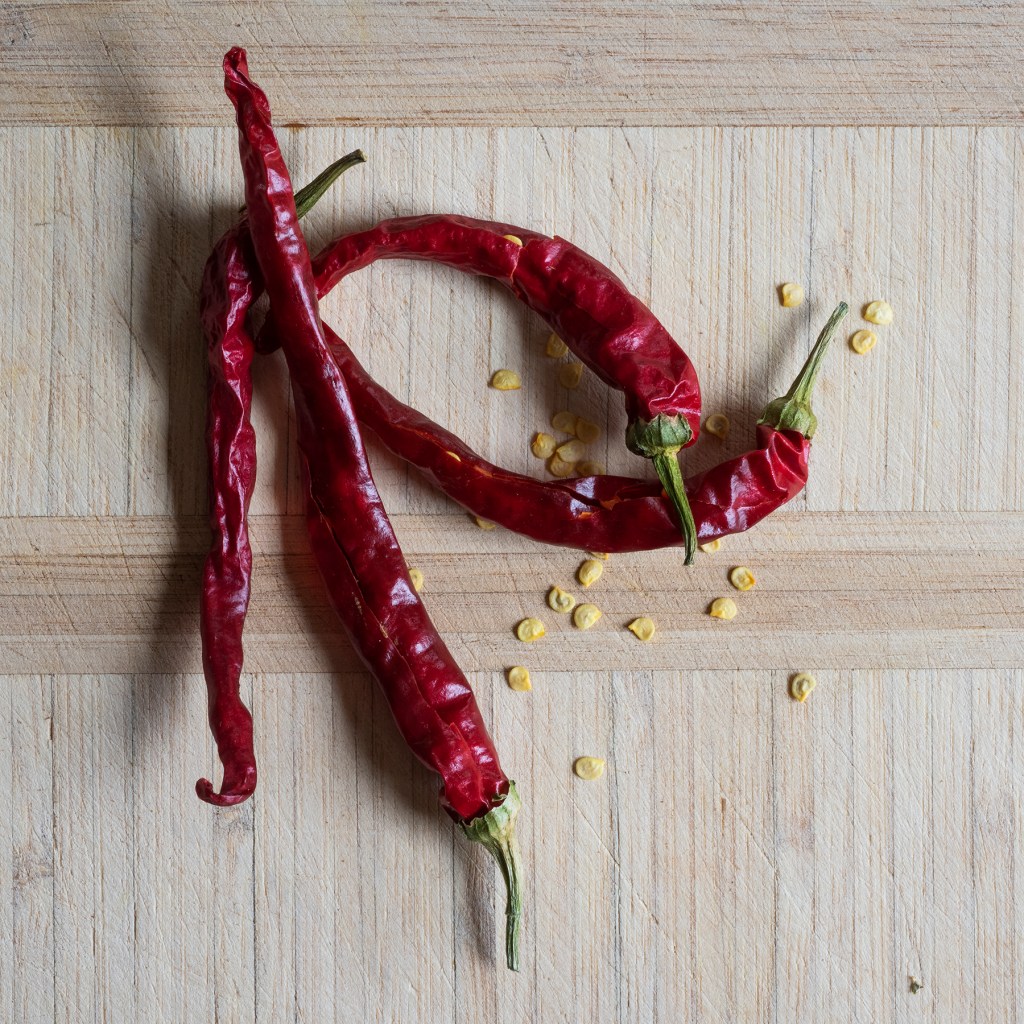
Be careful with cayenne pepper seeds – gloves are recommended!
It is so easy to feel entirely hopeless and dejected in the face of the world’s mounting problems, and to feel as though our own actions don’t count in the slightest. It doesn’t matter that we conscientiously sort our recycling and bring it to the drop-off center; virtually all of America’s “recycling” is actually dumped straight into the landfill. It doesn’t matter that we don’t use A/C or heat in our house, and instead try to maintain comfort with fresh air and warm sweaters; most of the country is now accustomed to perfectly-calibrated indoor temperatures requiring vast amounts of energy. What does matter, however, is our seed bank. Saving our own heirloom, open-pollinated seeds, and sharing them widely with other growers in our area, actually makes a difference. That classic question about what you’d save in case of a fire? It’s a real consideration where we live, and our small, compact, lightweight, portable seed bank would be at the top of the list. With those seeds, we can feed ourselves, and there is no greater human accomplishment than self-reliance.
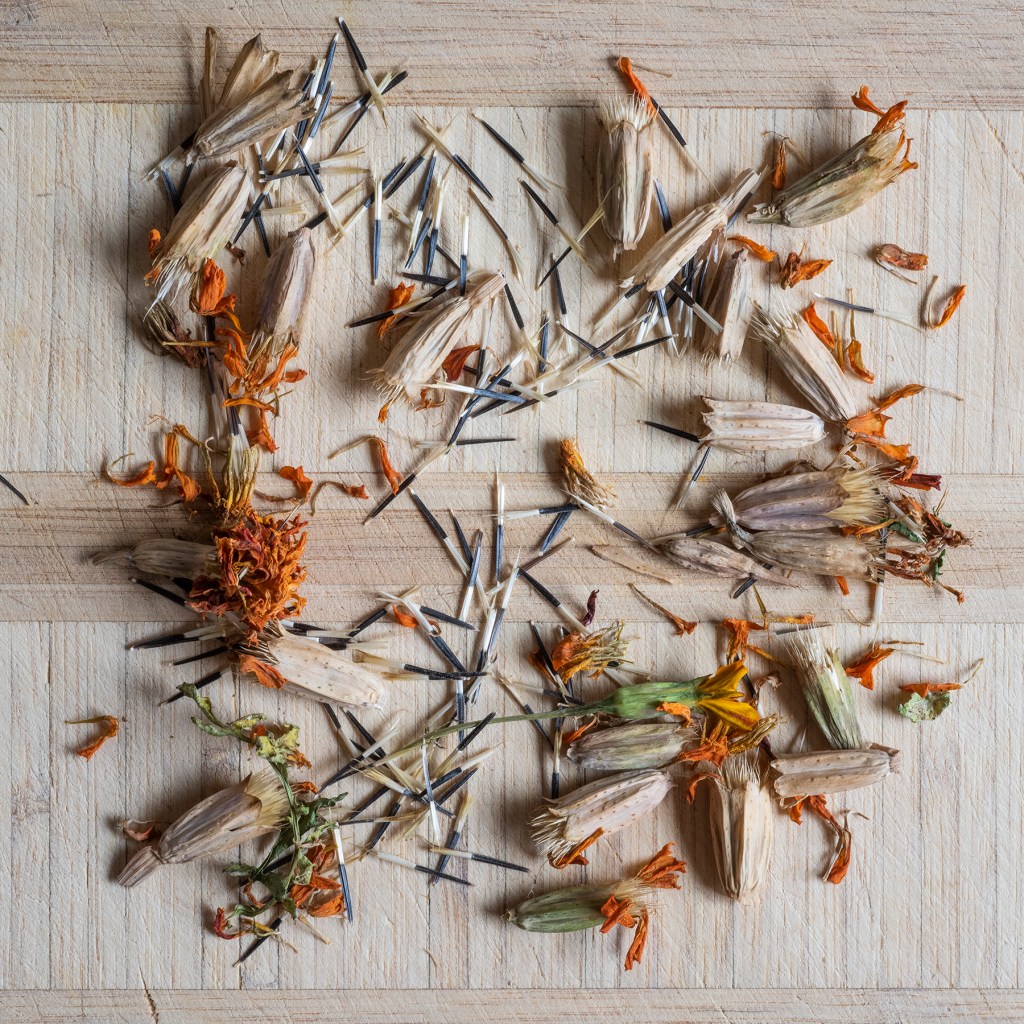
Marigolds always remind me of our travels in India.
We save seeds here at Quiet Farm because we want control over our own food supply. We save seeds because we want to share seeds and encourage others to grow food. We save seeds because we want to steward unique, rare varieties of plants that grow well in our challenging climate. We save seeds because we believe the only way to reasonably face climate change is through adaptation. We save seeds because we do not believe that Big Ag and Big Pharma have our best interests at heart. We save seeds because anyone can claim to be an ‘activist’ while not actually doing anything – but stewarding a seed bank is a tangible, useful, productive way to protest against our rapidly dwindling power as small farmers. We save seeds because it matters.
So save your seeds, friends. You might well need them someday. And save your animatronic haunted houses too – apparently they have some value on the resale market. Try Ben in Michigan.
Kale typically only sets seed after its second growing season here.
P.S. If you’re in our area (or even if you’re not!) and you’d like to learn more about saving seeds, please consider joining the Rocky Mountain Seed Alliance, “a nonprofit organization working to assure an abundant and diverse supply of local seeds for the Rocky Mountain region through education, networking, and establishing community-based models of seed stewardship.”
Lots of newspapers and magazines like to publish “summer reading lists,” implying that the only thing you have to do this summer is relax on a lounge chair by the pool, languidly sipping cold drinks and tearing through page after page of the latest bestseller. For us, at least, this aspirational vision bears absolutely zero resemblance to our real lives – we actually read less in summer, mainly because maintaining the farm is more than a full-time occupation. (Also we don’t have a pool. ) Even with all of our tasks and projects, however, I have managed to read more this year than I did in 2020 – I know plenty of avid readers who struggled with focus and the inability to finish books last year. Based on the round-up below, it certainly looks as though non-fiction, specifically focused on human psychology and behavior, is my genre of choice these days; with that in mind, we offer a few book recommendations. As always, we’d love to hear yours, too!
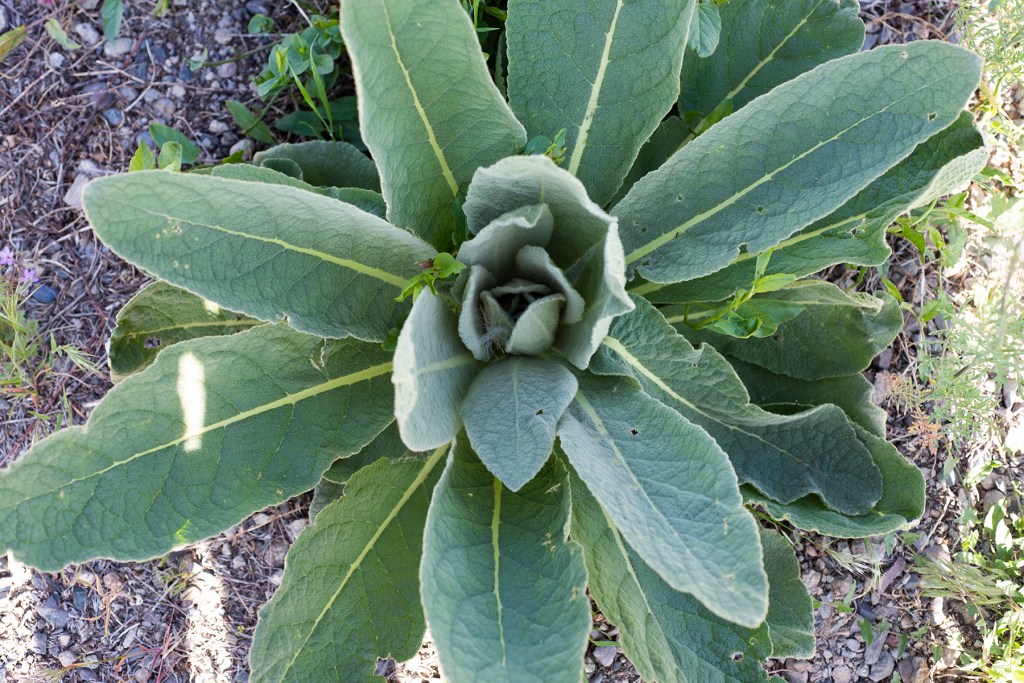
Soft and fuzzy common mullein (Verbascum thapsus).
A couple of years ago, a film titled The Biggest Little Farm was released in the U.S. It received quite a lot of publicity, especially unusual for a farm documentary, and was shown at film festivals and charity screenings across the country. The film opened shortly after we purchased Quiet Farm and was mentioned to us by scores of friends and acquaintances, so of course we had to watch it. The story follows John and Molly Chester as they attempt to regenerate an abandoned farm outside of Los Angeles.
Hello there. We want to say that we’re still here on Quiet Farm, and that it’s been a rather challenging start to the growing season. One hundred percent of our county is currently in “exceptional drought” – the scale doesn’t go any higher! In official government parlance that translates to “dust storms and topsoil removal are widespread; agricultural and recreational economic losses are large.” We’d agree with that assessment – and it’s only May.
We have not yet received our official irrigation allotment for the season, but are expecting less than half of what we had last year. Wildfire season (now really year-round rather than just a season) has already started in California, New Mexico and Arizona, and promises to be grim here again, too. Dust storms and relentless wind are a regular feature of our days, and it’s impossible to keep the cool-weather crops properly irrigated. We have not had any moisture at all since January.
To compound our troubles, our hundreds of plant seedlings in the sunroom have been infected by an unknown disease or other ailment, and as a result are tiny, stunted and definitely not thriving. They should be going outside in about three weeks, but at this point it’s unlikely that we’ll have any at all, and it’s too late now to start more warm-weather crops. Perhaps the universe is sending a clear message that this isn’t our year.
That said, what else can we do but keep going? This blog isn’t meant to be a place for complaints and whining. We have a comfortable house, plenty to eat and we’re healthy and safe. Many, many people have it far worse than we do, and we’re well aware of that. We will do what we can with what we have, and perhaps the growing season will stage a recovery of sorts. And if it’s a total write-off, then we’ll try again next year.
Tip your hat to a farmer the next time you meet one – this growing food thing is no joke. Thanks as always for reading, and we hope you and yours are safe, healthy and well.
I think we can all agree that the World Wide Web is, for the most part, a fetid swamp of horrors. But! On rare occasions, the Internet can produce some magic, too. Helpful sewing tutorials! Funny commercial parodies! Everything useful we’ve learned on YouTube about how to renovate a house! And above all else, there is the Grub Street Diet from New York magazine, which is very hit-or-miss – but when it’s on, there’s nothing better. (See this fabulous example.) I absolutely adore food diaries, and if someone combined a daily food diary with a personal finance diary and threw in some quilting tips for good measure I’d probably never read anything else ever again.
Here’s the thing: as someone who has spent the vast majority of her life thus far working with food, thinking about food, reading about food and generally obsessing over food, I need to know what everyone is eating at all times. And also why you’re eating that particular thing. Are you enjoying it, or just eating it because it’s there? Are you even hungry right now? Did you make it or buy it or was it made for you? Did you plan on eating it? Did you seek it out? Would you eat it again? And that brings me neatly to my next question: do you plan your meals?
No need to plan: we eat this lovely breakfast every single day.
One might argue that this question was more relevant pre-pandemic, when Americans ate well more than half their meals outside the home and our schedules were totally different. Of course, since the world stopped eleven months ago, our eating and cooking habits have altered pretty dramatically. One thing that hasn’t changed, though – and I know I have some audience support on this one – is that dinner still, for no apparent reason, happens every single night. How and why this metaphysical error is possible I cannot explain, as each afternoon around 4:30PM I invariably think, “Didn’t I just make dinner?” This situation is particularly embarrassing, of course, because a) I am a professional chef and making dinner really shouldn’t be quite so challenging and b) I voluntarily never leave our gorgeous farm and so if dinner doesn’t appear I can’t even come up with a reasonable excuse about traffic or working late or some such. I’m here, and I’m available, and I have the time, and still, dinner regularly takes me by surprise.
For the record, we didn’t eat out or order delivery even pre-pandemic. In the nearly three years that we’ve lived here, we’ve eaten out precisely once, and in our rural area I’m not even sure where you would get take-out or delivery. (DoorDash is not exactly staking its business success on our county.) So that means we eat all our meals at home, like much of the world these days, and that means not losing interest in your own cooking. It’s a tough challenge, even for a professional chef.
The makings of a stir-fry.
In my years teaching cooking classes, I’ve learned that most households tend to be on about a ten-day rotation of standard meals, which accounts for a few nights of leftovers or take-out in a two-week period. I can completely understand wanting to grab for those “known quantities,” meals that will please everyone without too much time and effort. There are few things more heartbreaking to a dedicated home cook than hours spent slaving away over a spectacular new recipe, only to have your loved ones politely ask you to please, please never make that again. (Looking at you, ma po tofu.) If spaghetti bolognaise works, and you’re tired and hungry, and everyone else is tired and hungry, why not just have spaghetti bolognaise, even though this is the third time in two weeks? Just about everyone can relate to this familiar situation.
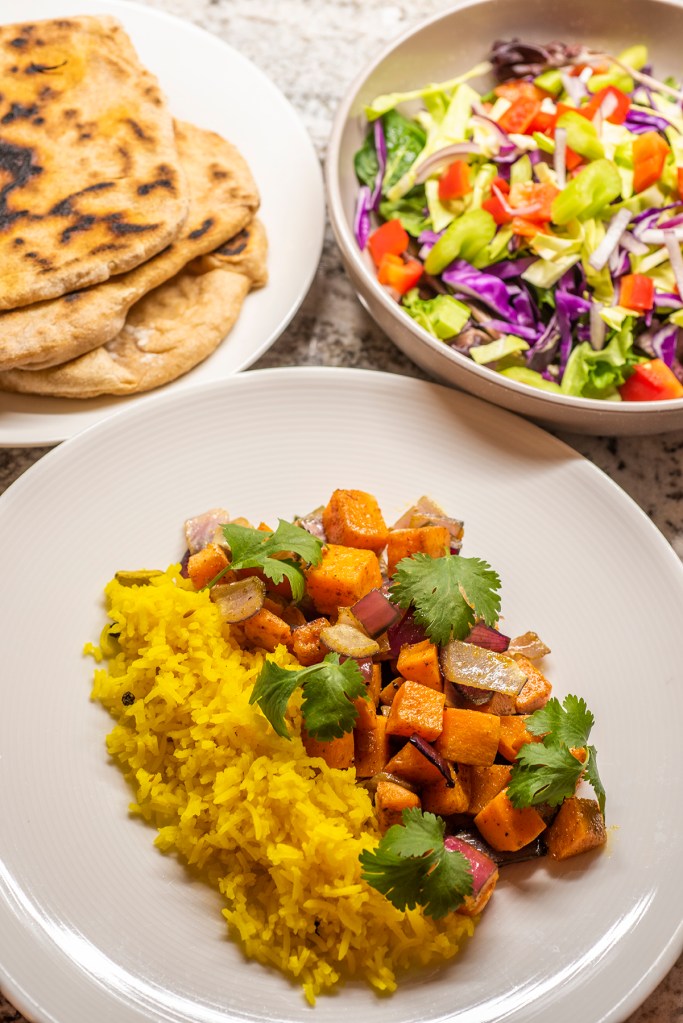
Curry-roasted sweet potatoes, pilau rice, fresh naan and salad.
Even in our calm household, which does not have the added complications of varying sports schedules or child care issues or long commutes, I’ve found that planning meals in advance makes a huge difference in how I view the daily chore of dinner. Knowing what I have in the fridge, freezer and pantry, and what meals I can compose from those ingredients, is essential. This is especially true because our “big” grocery store (in a relative sense) is nearly twenty miles away, so we grocery shop infrequently. In a rural county, I don’t have the luxury of running to the store for a bunch of cilantro or a box of pasta fifteen minutes before serving, so we keep a very well-stocked kitchen.
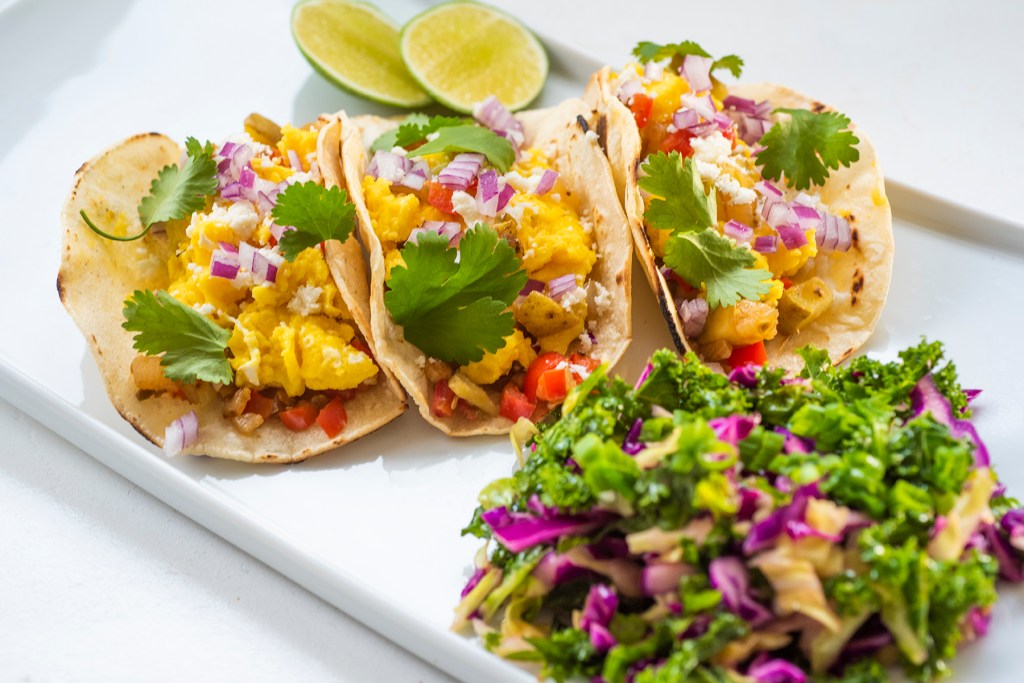
Breakfast tacos are a household staple – usually for dinner.
I also make an effort to cook in batches, so if I’m making a roasted pumpkin soup with coconut and ginger, I’ll make a big pot of it and freeze it in quart deli containers for a quick and easy meal. I make batches of “components,” too – versatile prepped foods, like steamed brown rice, beans, hard-boiled eggs, roasted potatoes or sautéed peppers and onions – that can be utilized in a variety of different meals. Of course we also can and freeze lots of our farm produce, too, but as N famously once said while staring at a packed fridge: “There isn’t any food in here. Just ingredients.” Joking aside, his point was that there was nothing ready toeat, and even the best cook can sometimes look at a full pantry and feel no inspiration whatsoever. That’s when a list of favorite recipe ideas pinned to the side of the fridge can come in handy.
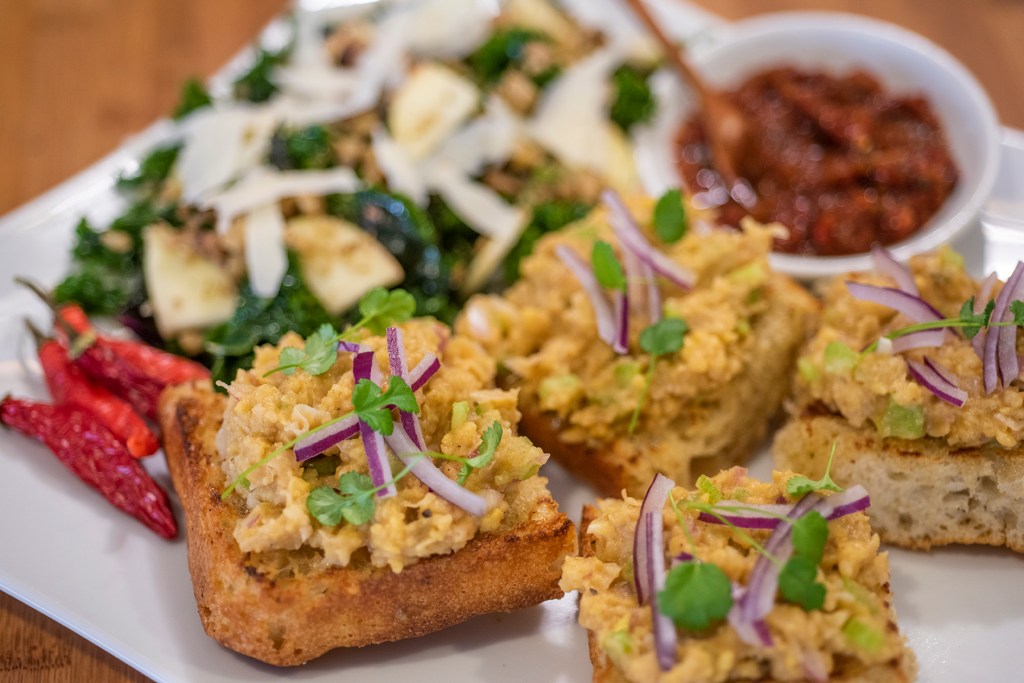
Chickpea smash on toasted focaccia is another favorite in heavy rotation.
The classic American meal typically starts with a protein as the main course – mostly chicken breasts or ground beef. Occasionally a steak, or salmon, or maybe something exotic like shrimp or scallops. A starch and a green vegetable might be on the plate, but they’re side dishes, merely afterthoughts. Here, though, we eat meat barely once or twice a month, and seafood never, so we start with vegetables or legumes, and build from there. We frequently eat stir-fries; they’re quick and easy to pull together. Lots of spicy, warming soups, especially in the colder months. Roasted vegetables feature regularly as do variations on curries. We eat eggs for dinner, usually as breakfast tacos, and many, many incarnations of flatbreads are consumed here. Pasta is a stalwart; loaded with vegetables, it doesn’t deserve its unhealthy reputation. Warmer weather brings lots of main course salads, packed with grains and eggs and myriad vegetables. And sometimes, we just have “snack plate dinner,” which is pretty much exactly what it sounds like: cheese, crackers, vegetables with hummus, good toasted bread with a variety of dips and spreads and anything else that can be used up in the fridge.
My meal planning starts with cookbooks, magazines, a recipe idea file and a pantry inventory.
I will freely admit that strict meal planning doesn’t happen every week; sometimes it’s a bit more impromptu. The weeks when I do write a meal plan, however, absolutely feel much calmer and easier and less stressful than when I don’t. But if we lived in a stereotypically frenetic American household, with lots of people running hither and thither, and various schedules to manage, a meal plan would be an absolute necessity for maintaining order. Here, though, we eat lots of plants and do our best not to waste any food – and a weekly menu plan helps make that happen.
So please share, dear friends: do you plan your meals? Do you stick to the plan? Do you have tried-and-true favorites, or are you regularly tucking in new experiments? Do you do all the cooking, or do other members of the family pitch in? This avid Grub Street Diet reader is longing to know!
I think it’s fair to say that things are not going well out there. Between incessant doomscrolling and paralyzing anxiety attacks, I’m desperately searching out reading material that calms and soothes, rather than inflames and terrorizes – so I scoured our rainbow library for books that I thought fit the bill. Read on for a few suggestions.
This is a lovely book, filled with precisely what the title advertises: prominent, successful women write letters to their younger selves, offering guidance, wisdom, consolation, advice and solace. I’ve thought a lot about how we’ll look back on this intensely difficult time, and what I might like to tell my own younger self. I particularly loved this quote from photographer Joyce Tenneson: “Your best work will come in moments of grace.” Perhaps we all need to focus on showing more grace to both ourselves and others.
Cheryl Strayed is certainly best known for Wild, but she also wrote a gorgeous, heartbreaking advice column called Dear Sugar, which has been translated into plays and podcasts and all sorts of other media. In a dark time, the thing you need most might be to know that others have experienced pain and heartache and betrayal and trauma too, and have still survived even after all that, and that’s exactly what this book offers. Plus, there are some laugh-out-loud moments which will have you guffawing through your tears. This one hits all the right notes.















 Finding Quiet Farm