This Saturday, I’m teaching Visible Mending and Practical Textile Repairs at our local arts center. Keeping your clothes in good repair and keeping textiles out of the landfill is one tangible way you can actively fight the climate crisis, plus your clothes will be one-of-a-kind. Come sew with me! I’d love to see you there.
Friends! The preservation season is fully upon us and our Preservation Series has been such fun so far! If you’re in the Surface Creek or North Fork Valleys, join us this Saturday, September 27, for our class on salsa, hot sauce and pickles!
And we’ve got another food swap coming up November 1 – contact me for more details!
Hi! Would you like to learn how to can and preserve your own food? Come take a fun preservation class with me! I teach small-group classes (never more than eight guests) in our dedicated studio space. We learn a lot! We eat delicious food! We build community and self-reliance!
Peaches / Saturday, August 16 / 9AM-11AM / Showcasing our area’s legendary local peaches! Learn the basics of water-bath canning, plus how to dry and freeze peaches. Opening a jar of home-canned peaches in frigid January is a beacon of warm sunlight!
Jams & Chutneys / Saturday, August 30 / 9AM-11AM / You need homemade jam to enjoy with your homemade sourdough! Learn the basics of water-bath canning, plus how to make delicious homemade jams, chutneys and condiments.
Tomatoes / Saturday, September 13 / 10AM-12PM / Preserved tomatoes are an incredibly versatile addition to your home pantry. Learn the basics of water-bath canning, plus how to dry and freeze tomatoes. This class showcases our farm’s heirloom tomatoes (grasshopper-permitting)!
Salsas & Hot Sauces / Saturday, September 27 / 10AM-12PM / What to do with all those peppers? Learn the basics of water-bath canning, plus how to make delicious mild and spicy condiments like salsa, hot sauce and chile powder. Featuring our farm’s unique peppers and heirloom tomatoes!
Apples / Saturday, October 11 / 10AM-12PM / Keep the Applefest vibes rolling and enjoy more local apples! Learn the basics of water-bath canning for applesauce and apple pie filling, plus how to dry and freeze apples.
Fermentation, Vinegar & Kombucha / Saturday, October 25 / 10AM-12PM / Learn the basics of fermentation, and make your own incredible homemade vinegars and kombuchas! Sauerkraut and pickles, too!
If you would like more information on these or any other cooking classes or events, please send me a message!
A visible mend on a favorite pair of thrifted vintage jeans.
Do you choose a significant word or guiding principle for each year? My word for 2025 is “mend.” I love both the literal and metaphorical meanings of this word, and how it ties in beautifully with my current sewing practice as well as my overarching goal to build and strengthen my community ties. As Austin Kleon wrote recently, “The idea of ‘being local’ is becoming more and more important to me. In times like these I crave the company of humans living near me who care about the same things I do.”
It’s surprisingly cold now, in late November, although dry and clear. As always, we’d love for some of the snow blanketing other parts of the country (hello, six feet in Buffalo!) to bestow its generosity upon us here, but nothing shows in the forecast as yet. Days are crisp and blue, and nights definitely require extra quilts. The sunroom is still full of cardboard trays of slowly ripening tomatoes and peppers; this unheated room works perfectly for cold storage and allows these vegetables to ripen slowly with sunlight but without so much warmth that they’d rot. Certainly something is sacrificed in terms of flavor when crops aren’t allowed to ripen outside, but we have a reasonably short growing season here so we have to work with what we have – and it’s a lovely treat to enjoy our own fresh tomato salads well into winter.
Those cardboard trays are slowly transforming into rustic, delicate ristras and canning jars of salsa and sauce; seeds are mostly dried and packed away. The winter squash bounty hasn’t been tapped into yet; that will carry us through the coldest months and into fragile spring with warming soups and curries. New planting rows for next year have been plowed and filled with compost. The plants we pulled out have been mowed into bits to break down into compost over winter; the beds have been mulched with spent straw and next year’s garlic has been planted. In all ways, our season is gradually winding down and we’re more than ready to tuck ourselves in for a couple of months of much-needed rest.
We’re still reviewing our season, cataloguing our successes and noting what changes and improvements we plan to make for next year. This year certainly had its challenges, but it definitely offered wins, too! Read on for more about the 2022 growing season.
Hello there. It’s been a minute, no? This growing year has presented a new array of challenges and learning opportunities. We will shortly mark the fall equinox; like most (all?) farmers, we pay close attention to these seasonal transitions and how the gradual changes in light and warmth impact everything we do. Things are winding down here and we can tell that our bodies and minds are ready for the natural rest offered in late fall and winter. Humans may think they’ve evolved ‘beyond seasons,’ but the truth is, we are still agricultural beings at heart, and paying close attention to those shifting rhythms benefits everyone.
Before the much-welcomed slowdown, however, there is still lots of preserving to be done for the (hopefully long) winter ahead! And to that end, I’m teaching a free canning and preserving class this weekend at our local library. More information can be found here. If you’re in the area, please come out and say hello!
We’ll be back again soon with tales of our growing adventures, book recommendations and project highlights. Wishing you all a safe, healthy and pleasant fall.
Hello and what’s new in your world? Here at Quiet Farm we very much wish that winter would appear already. We haven’t had even a dusting of snow since that frost back in October, and it’s barely cold enough to freeze the animals’ water or kill off all the aphids on the kale. Far too warm for late November – but don’t you worry, our trusty politicians are taking care of that pesky climate collapse issue even as we speak.
Our fall harvest has all been successfully preserved; the last of the ripe tomatoes went into the sauce pot yesterday. Chiles are drying in the sunroom, ready to be pulverized into chile powder; pumpkins and squash are neatly stacked on shelves; apples and onions remain in cold storage in our insulated woodworking shed. We are stocked and ready, and we invite Serious Winter to show up immediately if not sooner.
Here are a few more things we’ve been up to recently, if you’d like to see:
Bright, tart pomegranate seeds make these amazing waffles even better.
Obviously we’ve discussedthe waffles previously, but yet here we are again. I made a fresh batch last weekend and since holiday brunches and family gatherings and all sorts of festivities are lurking just around the corner, I must evangelize the waffles once more. Please, dear friends, if you do not make one other thing from scratch this holiday season, please make these waffles. I know this level of devotion to a seemingly innocuous breakfast food seems a bit over the top, but trust me – these are the best waffles ever, and you can stop Googling ‘best waffle recipe.’ Plus they’re very easy to make, and they freeze beautifully – you can just have fabulous homemade toaster waffles any time you like, and you can also stop buying expensive processed frozen waffles with mysterious ingredients! The recipe hails from Fannie Farmer by way of Marion Cunningham’s brilliant The Breakfast Book, which I highly recommend. (But seriously, go make these waffles. Do it now.)
Hot sauce doesn’t have to be just painfully ‘hot.’
Making hot sauce is always part of our farm preservation work each year. Although I’ve experimented with lots of different types of hot sauces, for the moment I’m keeping it simple – one fiery-sweet red version, very loosely based on Sriracha and this Melissa Clark recipe, and one fermented serrano version, a rough knock-off of green Tabasco. The red hot sauce is definitely milder, with a gentle undertone of sweetness from the red bell peppers, while the green is a tangier, sharper vinegar-based sauce, used more sparingly. As a personal rule, I don’t love aggressive, punch-in-the-face hot sauces; I want a bit of heat but would still like to taste whatever I’m eating. Hot sauce is simple and inexpensive to make at home, keeps indefinitely and is a thoughtful consumable gift for anyone on your list who likes things spicy. (P.S. If you buy classic Sriracha, save, wash and reuse the iconic squeeze bottles for your own homemade hot sauce.)
Small part. Big impact.
I don’t in any way fancy myself an influencer, but if I can influence you to NEVER, EVER buy GE appliances, please allow me to do so. We have a full suite of GE appliances in our kitchen – all of which came with the house – and every single one has failed at least once. Most recently we found ourselves without a functioning oven, which is quite challenging for someone who bakes on a more or less daily basis. Some investigation and a few helpful YouTube tutorials later, we ordered a new igniter. (Of course, I foolishly ordered the first igniter from GE and it arrived pre-broken, thanks to their careless packing. The second igniter, from an entirely different company, arrived in perfect condition, but obviously it was now two weeks later. Thanks again, GE. You’re tops.) We successfully installed the new igniter – a five-minute job, though gaining access to the compartment and putting everything back together neatly made it more like an afternoon – and lo and behold, we thankfully once again have a working oven. As always, successfully learning to repair things ourselves goes a long way towards our goal of self-sufficiency.
Crispy, salty, savory and delicious hot or at room temperature – galettes are winners.
And of course with a working oven, we can once again make delicious meals like galettes! Like the waffles above, we’ve extolled the virtues of galettes previously – they can be sweet or savory, hot or cold, made in advance or pulled fresh from the oven – and they lend themselves well to using up whatever odd bits and ends you might have on hand. They’re also beginner-friendly, if you’re intimidated by all the perfect pies you’re seeing right now; galettes are designed to be “artisanal” and “rustic” which – fun fact! – are both Latin for “messy” and “imperfect.” This time of year our galettes are most likely to have fall flavors, like delicata squash, caramelized onion, peppery goat cheese, sage and rosemary – but honestly, you can put pretty much anything you want in one. If you’ve got a couple rounds of pastry dough in the freezer you’re halfway there; galettes are easy to prep for holiday gatherings and perfect as a vegetarian main dish or as a simple, impressive dessert.
Available now as an NFT: “Untitled: Llama and Alpacas at Rest, 2021”
And finally, it’s always nice to observe our camelid herd lounging peacefully in the pasture; if they’re at rest, it means they’re getting plenty to eat. We’re regularly challenged by this rebellious bunch of feral miscreants, but they add a certain flair to Quiet Farm, and we’re glad to have them here.
Wishing you all the best during a tough time of year, dear friends.
How are you? How is your July thus far? It’s high summer here at Quiet Farm and we spend more time outdoors than in – always, always wearing long sleeves, long pants, wide-brimmed hats and plenty of SPF 50 (only reef-safe zinc, though we’re nowhere near a reef!) on any exposed skin. Skin cancer is not to be taken lightly, especially since we’re more than a mile closer to the sun. Here are a few things we’ve been up to, if you’d like to see:
Sunchokes along the eastern edge of our game fence.
Each growing season, I aim to plant at least one new fruit, vegetable, herb or flower. Last year it was fennel (and unintentionally this year, too, since it self-seeded) but this year’s choice was sunchokes (Helianthus tuberosus). Sunchokes (also called Jerusalem artichokes, though they’re native to North America, not Israel) are in the sunflower family (Asteraceae), and the plants produce showy yellow flowers and an edible tuber. They’re not well known in the U.S.; even in France they’re grown primarily for animal feed. But! The crisp, white-fleshed tubers are rich in inulin (a dietary fiber) and are absolutely delicious when roasted and salted like potatoes. I might even try some sunchoke chips in the dehydrator! I’m excited to harvest these later this season, especially because once established, they’ll likely need no water and no maintenance, and will hopefully continue to produce a nutritious winter storage crop all on their own.
Nice buns.
Anyone who has read this blog for more than one minute knows that I am constantly trying to convince the entire world to bake their own bread. Really, you should! So easy! So satisfying! So much healthier and tastier than store-bought! But perhaps you find large burnished sourdough loaves to be somewhat intimidating? No problem. Start simple, like hamburger buns. I know that I’ve just missed the Fourth of July, a classic burger holiday if ever there was one. But if you start practicing now, you’ll have mastered homemade burger buns by Labor Day! (Only joking, because you don’t need any practice at all; buns are really easy.) Use this reliable recipe – I did not make any alterations for altitude – and bake a batch to tuck in your freezer for future grilling opportunities. The recipe yields eight large; I make sixteen if I want to serve sliders. Please, try this and let me know if you have troubles – I’ll help you sort them out!
Broad-tailed hummingbirds at the feeder.
Our migratory hummingbird population is thriving; if we remain still, we’re able to see them up close on our feeders. We observe two species most commonly here – the broad-tailed (Selasphorus platycercus) and the black-chinned (Archilochus alexandri), and only very rarely a rufous (Selasphorus rufus). The hummingbirds are so much fun to listen to as they dive and swoop like miniature fighter jets. We’ve even discovered a tiny nest precariously perched on the twinkle light strands on our front porch; we’ve left it alone for the moment in the hopes that there might be viable eggs in it. Although we have dozens of incredible bird species here at Quiet Farm, the fast and spirited hummingbirds are definitely one of our favorites.
Fresh, crisp, satisfying and most of all – cold.
Despite the slider rolls above, supper is entirely abandoned more evenings than not here at Quiet Farm. When it’s pushing 100 degrees at 5:30PM and we’ve been out irrigating all day, the very last thing I want to do is turn on the oven or the stove. Enter the cold noodle salad, remarkably simple and infinitely variable. I cook the noodles in well-salted water first thing in the morning, when it’s (relatively) cool. Drain and toss the still-warm noodles in sesame oil, soy sauce, rice vinegar, and chile sauce if you like things spicy. Shred a whole mess of vegetables, whatever you have on hand – carrots, cabbage, snap peas, broccoli, bell peppers, cauliflower – and toss with a bit more soy and vinegar. Chill everything. When it’s time to eat, make yourself a beautiful, colorful plate and garnish with lots and lots of fresh herbs – I like a mixture of Thai basil, cilantro, scallions and mint. Add more soy or sesame oil as desired. Chopped salted peanuts are great, too! You could serve this on a bed of fresh greens, you could top this with crispy tofu or strips of a simple scallion omelette, or you could just eat it as is. One of my very favorite low-effort/high-flavor summer meals. (P.S. When you’re making something that will later be eaten cold, remember to have a generous hand with the seasoning. Cold dulls flavor, therefore it doesn’t taste as intense. Be lavish with salt and herbs!)
Adelaide apologizes for not tidying up all the hay on her face before this photo was snapped.
And finally, our animals are thrilled with their new haircuts. Although they have access to shade, they still spend their time happily grazing away in the pasture. Even on the hottest days, when we’re melting and seeking out any cool spot we can find, they’re happy to be out in the sun. Last summer was a different story, and we’re so pleased that we were able to get them sheared so they can be more comfortable during this brutal season.
Hello there, and how are things in your world? Here at Quiet Farm it’s hot, dry and smoky. The Pack Creek Fire, burning southeast of Moab, Utah – started by an unattended campfire! Thanks, thoughtful and responsible campers! – has filled our blue skies with thick smoke and turned our sunsets into a terrible neon orange ball of scorching flame. We’re forecast to spend the week ahead melting under triple-digit temperatures, and we plan to only be outside for the bare minimum of tasks between noon and six o’clock. This week will be all about survival – ensuring that we, and all of our plants and animals, have plenty of shade and fresh, cool water.
A few activities we’ve been up to recently on the farm:
Look at all those vitamins!
Our harvests lately have been greens, greens and more greens – no complaints, since we eat salad every day. The arugula, kale, spinach and mixed lettuces have all been crisp and delicious this season, but this week’s furnace-like temperatures will put an end to that abundance; as a rule, most lettuces and greens do not care for excessive heat and often turn unpalatably bitter. I’ve harvested just about every leaf out there; as usual, I leave a number of plants to intentionally go to seed for future plantings. I regularly replant salad greens underneath the tomatoes; by the time the greens are up, the tomato plant will shield the tender leaves from the scalding summer sun. We’re also harvesting garlic scapes (the squiggly things on the left side of the photo) to encourage the garlic plant to put all its energy into the underground bulb. Scapes are delicious in pesto, salad dressing or stir-fried. And we’re picking strawberries, too, which are spectacular and have never once made it all the way into the house except for this photo, after which they were promptly devoured.
Late spring is a busy time of year for small farms and homesteads. The task list seems endless: plant this, thin these, weed that, water those and by the way, the alpacas and chickens still need food, water and clean bedding. The best we can do is simply to make list after list, and tackle those lists one item at a time. One thing we do adjust as we move into our busiest period: our daily routine. If possible, we try to be outside in the morning and inside in the afternoon, because our blustery, changeable winds make working outside even more challenging after two o’clock. This is a lovely ideal, of course, and things don’t always proceed as planned – but all we can do is our very best.
Here are a few things we’ve been up to, if you’d like to see:
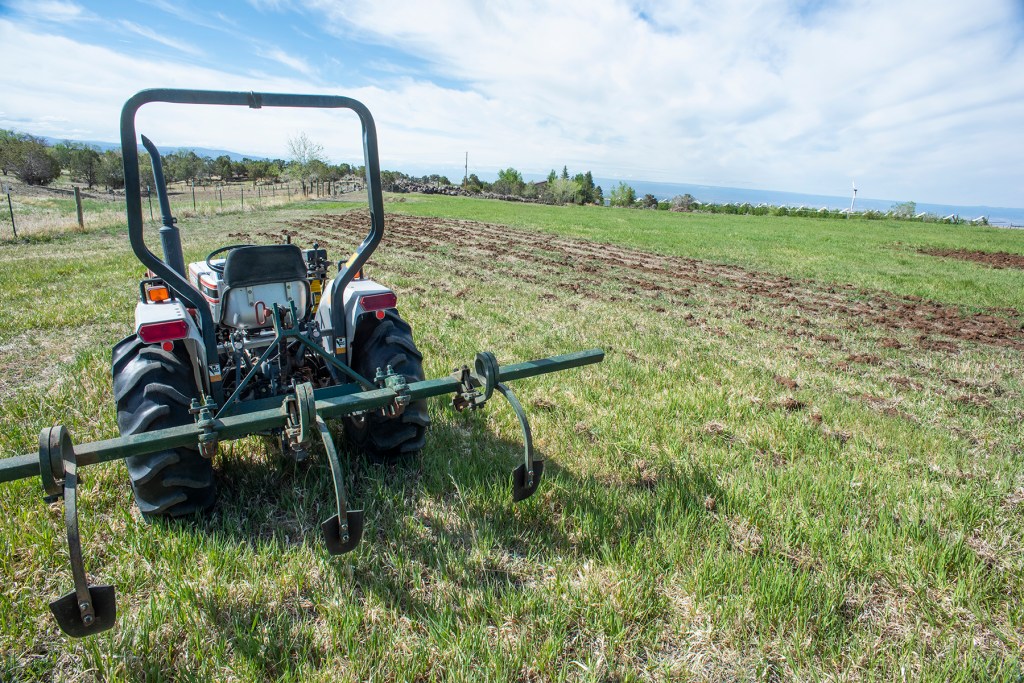
Careful pasture management is helping our land stay green despite the exceptional drought.
Our irrigation season is set to launch next week, though we still haven’t learned our water allotment for this year. In preparation for running water, we purchased a three-row marker to attach to our little tractor. Because we use gated pipe to irrigate our pasture, it’s important to “mark” the fields with channels that direct the water to the correct places. Marking is usually done on a three-year rotation, but our pastures were essentially abandoned for close to seven years, so it’s going to take some time to get the irrigation pinpointed. In addition to marking the fields, we also reconnected all of our gated pipe and replaced damaged gaskets and gates. Most people don’t break down their pipes every year, but we’ve mentioned before that we have a severe rodent problem – and if they build a winter burrow in the pipes, they’ll eat the gates. It’s more work to disassemble and reassemble the pipes, but likely saves us money in the long run.



 Finding Quiet Farm