On bread (and gluten)

It is not hyperbole to state that wheat is the reason human civilization exists today. As always, Michael Pollan says it best:

“Compared with earlier and simpler methods humans have devised for turning plants and animals into foods – the roasted chunk of meat, say, or pot of stew, either of which an individual or small group can pull off – a loaf of bread implies a whole civilization. It emerges only at the end of a long, complicated process assuming settlement and involving an intricate division of human, plant and even microbial labor. In addition to an agriculture and a culture of milling and baking, the loaf of bread depends on a nonhuman culture as well: it won’t rise without the active contribution of some highly specialized living creatures besides the baker, the miller and the farmer. Few things are as ordinary as a loaf of bread, yet the process by which it is made is extraordinary – and still something of a mystery even to those who study it or practice it every day.”

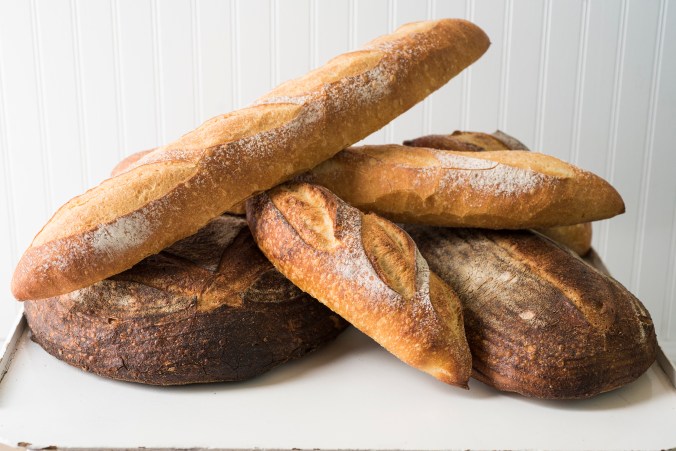
Bread Loaves.jpg

Nom nom nom.

That last sentence says it all: it’s ordinary, it’s extraordinary, and it’s a mystery, even when you do it every day. Is it any wonder people refer to baking bread as a religion?

It’s impossible to put into words how much I love good bread. I’d much rather eat bread than just about any dessert. With olive oil, with cheese, perhaps homemade jam or backyard honey, a thick smear of salted butter or just on its own, well-made bread is one of life’s great edible pleasures. Like Mr. Pollan, I particularly adore rustic breads with rugged, crunchy crusts that are thisclose to burned and conceal a “soft, custardy interior.” Many people don’t like this type of bread; they think the outside is cooked too much while the inside isn’t cooked enough. But as we know, one of the many magical pleasures of cooking at home is that you get to make things exactly the way you like them.

Bread Bowl-01

My namesake grandmother’s bread bowl and one of my most treasured possessions.

Before we left on our round-the-world trip, when I was stressed and overwhelmed with all the things that needed to be done, I wrote a short post about baking bread. I honestly think it’s one of life’s most cathartic activities, and when you’re done with your cheap therapy you’re rewarded with a loaf of homemade bread. What I’m trying to understand nowadays is why we’ve so wholeheartedly rejected a truly time-honored and pleasurable task. It seems unreasonable to mourn bread when there are so many other things to mourn in the world right now, yet over the past decade, very few foods have been as maligned as the humble loaf of bread. More accurately, it’s rare that we collectively have found something to vilify on the scale that we’ve vilified wheat.

Humans have been eating wheat for about ten thousand years. Wheat represents one-fifth of all the food consumed worldwide, and it’s also the world’s most important source of non-animal protein. Its production surpasses every other grain, including rice and maize, and it can be grown almost everywhere on the planet. Human civilization as we know it would not exist without wheat and all the agricultural settlement that goes along with its production, processing, storage and conversion into digestible foodstuffs.

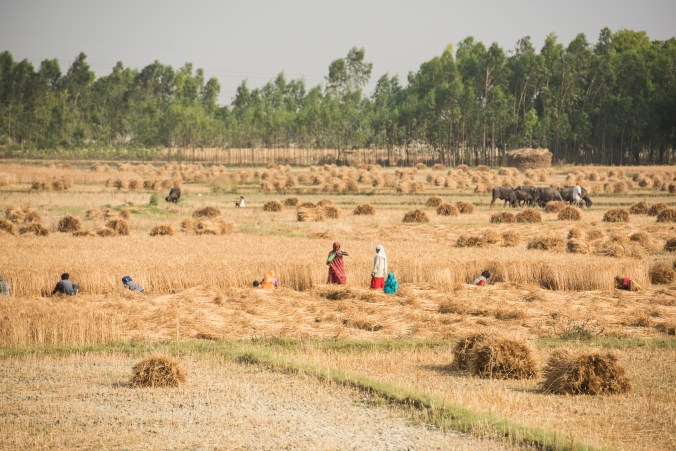
Wheat Field.jpg

Wheat fields in India.

Gluten is a protein that occurs naturally in wheat as well as other grasses such as rye, triticale and barley. Gluten is one of the primary factors responsible for that amazing chew we get in pizza crusts and breads; softer baked goods, like flaky pie crusts and tender cakes, don’t perform well with high-gluten flours. The type of wheat, i.e. soft spring or hard red winter, determines the amount of gluten in the final flour.

Despite its importance, about 20% of the U.S. avoids gluten; numbers are increasing in the UK, Australia and other Western countries as well. Chefs and other food and nutrition professionals have questioned (both covertly and openly) why everyone has suddenly gone gluten-free. A very small percentage of the population – less than 1%, depending on which sources you choose to believe – has celiac disease, which makes digesting gluten difficult. But it is scientifically impossible for one-fifth of the Western world to suddenly, collectively develop the same allergy or intolerance. It simply can’t happen.

What can happen is for everyone to decide that a gluten-free diet is somehow healthier and – by extension – will help one lose weight with very little effort. People who go gluten-free say they feel better, and that may well be true. If you legitimately feel better eating a gluten-free diet, then by all means, please carry on. But I’d unscientifically attribute “feeling better” to avoiding processed foods, eating more fruits and vegetables and generally being more conscious of your diet, although a gluten-free doughnut is, ultimately, still a doughnut. “Gluten-free” also means profit; sales of gluten-free foods have increased nearly 70% over the past four years, which translates to billions of dollars. The vast majority of gluten-free devotees are middle- to upper-class white women, and savvy food manufacturers know well that there is an enormous amount of money to be made from this market.

YetiCake.1

Chocolate stout cake. Yes, please.
Why have we all decided that gluten is making us sick? Some sources believe that GMOs are responsible, although there is no commercially available GMO wheat. (There are, however, escaped volunteer plants in Washington.) Many say it’s because we’ve hybridized our wheat, though we hybridize a lot of plants. And still others claim that it’s because we grind all of the nutrition out of the wheat to produce white flour, which travels better, stays fresher longer and produces the light, fluffy taste and texture that most people prefer. Once the bran and germ are removed and the flour is enriched, they say, we struggle to digest it.

If I had to choose, I’d fall firmly into the third camp, but I simply refuse to acknowledge that good bread is somehow singlehandedly responsible for the Western world’s catastrophic increase in diabetes, heart disease and other lifestyle-related diseases. Bread isn’t the problem; our entire industrialized, inhumane, chemically-drenched food system is the problem. As usual, though, we’ve chosen one villain to attack because to address the actual issue would be tantamount to admitting that our shockingly profitable agricultural fiefdom – based on cheap corn, soy, and animal protein – isn’t working. We somehow selected gluten, an ingredient most people can’t actually define, and decided that it was to blame for all of our health issues. Plain and simple: I disagree.

CCA-64.jpg

Every single culture in the world has some form of bread.
Ever wondered about what is actually in Wonder Bread? I’ve conveniently assembled the ingredient list here for your consideration: unbleached enriched flour (wheat flour, malted barley flour, niacin, reduced iron, thiamin mononitrate, riboflavin, folic acid), water, high fructose corn syrup, yeast, contains 2% or less of each of the following: calcium carbonate, soybean oil, wheat gluten, salt, dough conditioners (contains one or more of the following: sodium stearoyl lactylate, calcium stearoyl lactylate, monoglycerides, mono- and diglycerides, azodicarbonamide, enzymes, ascorbic acid), vinegar, monocalcium phosphate, yeast extract, modified corn starch, sucrose, sugar, soy lecithin, cholecalciferol (vitamin d3), soy flour, ammonium sulfate, calcium sulfate, calcium propionate (to retard spoilage).

Do you even know what most of these words mean? Can you buy those ingredients (separately) in your local grocery store to assemble your own homemade version of Wonder Bread? The simplest bread made at home contains four ingredients: flour, salt, yeast and water. No commercial yeast, even, if you’re using a wild starter. Review that ingredient list above once more. I don’t deny that we’re pretty sick, but we cannot logically blame gluten.

Food politics book club

Our house is filled with books. On shelves, stacked by the bed, in my office…the only place that doesn’t contain any books is the kitchen. N reads a lot of military history mixed with an eclectic selection of farming books and autobiographies, and my choices tend to be modern fiction plus just about anything on food. I feel as strongly about books as I do about food: if they’re not good, I won’t finish them. I have no sense of obligation having started a book; there are simply too many stellar books out there to waste time on the appallingly bad ones. I’ve written before about how choosing books for our trip was one of the toughest parts of packing; I didn’t care at all about which tattered shirts and frayed cargo pants I brought, but I cared a lot about the reading material.

cookbooks-4-sml.jpg

Because I talk a lot about food politics both here and in my cooking classes, I’m often asked for book recommendations. I’ve put together a compilation of some of my favorite books on food politics and America’s desperately compromised food system. Know that there are many more great selections out there, and if you have recommendations for books I haven’t included, please share them! If you’re looking for an even more comprehensive list of some of the best books on food politics, go here.

Cookbooks 1 sml

It is not possible to have a discussion about food politics in America without mentioning Michael Pollan. In my opinion, no author has done more to explain how what was once just “food” evolved into “industrialized agriculture.” I think Cooked is by far his most accessible work; even for me, The Omnivore’s Dilemma and The Botany of Desire get a little…technical. But really, anything by Mr. Pollan is guaranteed to get you questioning your assumptions. And if you can’t commit to reading his books, watch his Netflix series based on Cooked. Plus, his breathtakingly simple manifesto “Eat food. Not too much. Mostly plants.” is by far the best seven-word statement on food I’ve ever encountered.

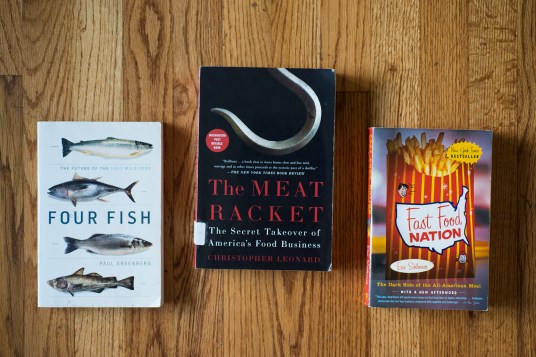
Cookbooks 2 sml

Four Fish, Paul Greenberg

It is virtually certain that certain species of fish currently used as food will become extinct within our lifetimes; our visit to Japan’s famous Tsukiji fish market simply stunned us with the sheer quantity of seafood caught and sold every single day. There isn’t much positive that can be said about the world’s fishing industry, but this book explains it in a clear, simple manner. (Please, if you’re in the U.S. and you choose to eat fish: consider buying only sustainably caught or responsibly farmed American seafood. Or eat much, much lower on the ocean food chain, like sardines and anchovies. Whatever you do, please don’t buy farmed fish from southeast Asia; their abuse of both humans and the environment makes ours here in the U.S. look positively benign.)

The Meat Racket, Christopher Leonard

One of the best and most difficult books I’ve ever read on our industrial meat supply, The Meat Racket exposes the brilliantly cruel “bracket” system used in modern CAFOs. This book is a carefully researched and shockingly grim portrait of the massive corporations like Tyson currently controlling the vast majority of America’s meat market, and of the farmers trying desperately to stay afloat in a game totally rigged against them. Read at your own risk; you’ll have a hard time buying frozen chicken nuggets after this one.

Fast Food Nation, Eric Schlosser

This book, published in 2001, is subtitled “The Dark Side of the All-American Meal” and could be rightfully argued as the one that started it all. No one really has anything nice to say about fast food in general; it is toxic to the people who eat it, the people who work there, the animals sacrificed for it and most definitely the planet. But it’s great for shareholders…or at least it was, until the fast food industry started slowing down after decades of growth. This is one area where there may actually be something positive on the horizon: fewer Golden Arches across our country.

Cookbooks 3 sml

Twinkie, Deconstructed, Steve Ettlinger

Ever been curious about sodium caseinate? How about modified food starch? Hydrolyzed soy protein? Polysorbate 60? Learn more than you ever wanted to know about how our processed food is made. (Remember, food at home is “cooked.” Food in packages is “processed.”) And we wonder why our gut microbes can no longer handle anything.

The Third Plate, Dan Barber

Last December, N and I had the honor of attending the Young Farmers Conference, held annually at Chef Barber’s Blue Hill at Stone Barns just outside of New York City. I’ve admired and respected this chef since his early days of farm-to-table cuisine; in the professional chef world, he is at the forefront as an advocate for less food waste and a more conscious approach to cooking and food overall. Simply one of my very favorite food books.

Tomatoland, Barry Estabrook

This book sort of pretends to be just about tomatoes and is actually much more about the workers planting and picking them, but it’s still worth a read. We’ve had out-of-season produce in supermarkets for so long that we rarely think about it anymore, but it’s not just the earth that takes a beating – the people do, too. This book almost singlehandedly brought about a very public and (somewhat) successful battle with fast food companies and supermarkets over fair pay for farmworkers; learn more here.

Animal, Vegetable, Miracle, Barbara Kingsolver

Kingsolver might be more known for her fiction, but when she and her family packed up and left Arizona for rural Kentucky, then documented their attempts to eat solely from their own land for a year, the food cognoscenti paid attention. It’s a deceptively simple book (with recipes!) that explains why modern turkeys can’t reproduce naturally and why organic certification is almost impossible for small farms to get and why you should bake your own bread, but there is a lot more under the surface. If you’re thinking about running away to your own piece of land as we are, this book will push you farther in that direction.

Other books I recommend not pictured here (most likely because I loaned them to someone):

The American Way of Eating, Tracie McMillan

Eating Animals, Jonathan Safran Foer

Salt, Sugar, Fat, Michael Moss

Anything by Marion Nestle

Anything by Joel Salatin


Comer y beber en Madrid

Dear friends, it should come as no surprise by now that eating (comer) and drinking (beber) are two of our favorite travel activities. We are quick to search out food and market tours wherever we go, and Madrid was no exception. Many thanks to Jorge at Secret Food Tours for taking us on a gastronomic adventure through his city!

NJB_7856

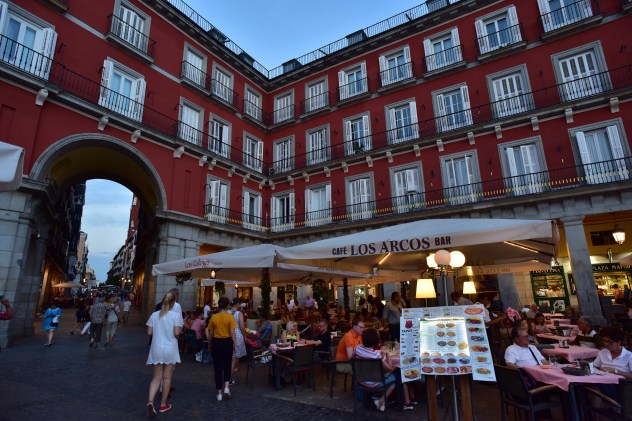
Madrid’s Plaza Major, a perfect example of Spain’s café culture.

NJB_7886.JPG

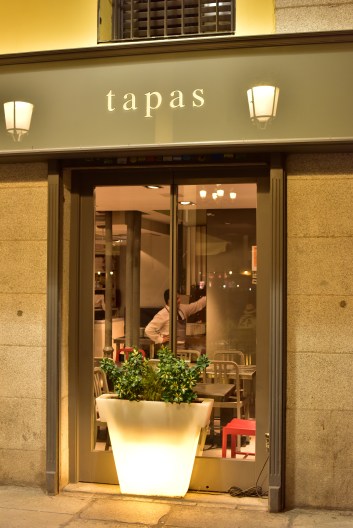
The Spanish verb tapear translates literally as “to eat small portions” – and of course from that we get tapas.  

NJB_7842

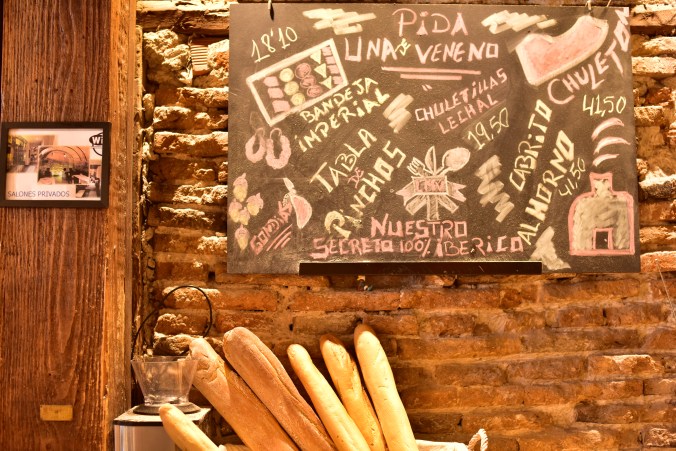
Chalkboard menus (and fresh baguettes) dot the city.

NJB_7841.JPG

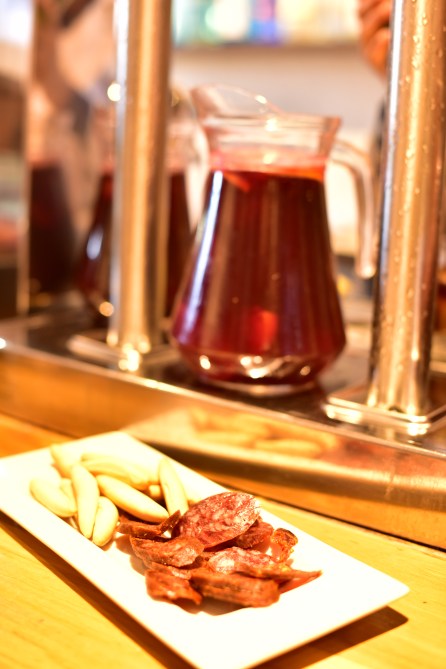
Chorizo and sangria. What more do you need, really?

NJB_7787

The city of Madrid issues plaques like the one above to stores and restaurants of historical significance in the city; this one dates from 1837. Many of these places pay rent that is far below market rates to keep their businesses open, because Madrid’s government has decided that they don’t wish to have the center of town filled with Starbucks, McDonald’s and tacky tourist stores able to pay inflated prices. Smart decisions like this help cities maintain their cultural character instead of becoming homogenized corporate copies.

NJB_7792

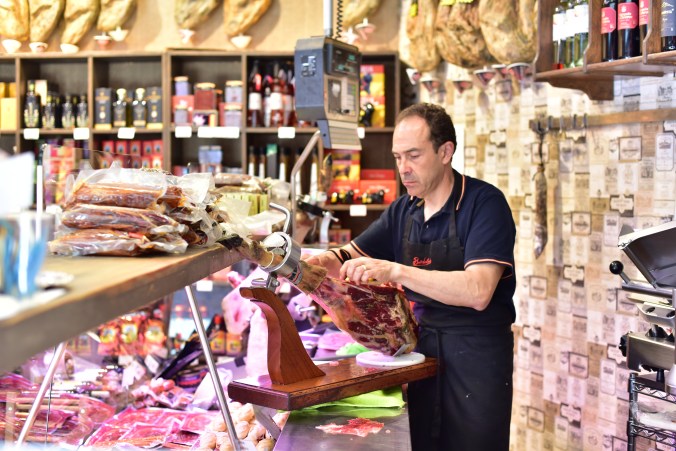
Slicing jamón by hand.

NJB_7851

Legs are hung for months or years to cure properly.

NJB_7795

Spain is justifiably famous for its jamón, which comes in different grades. Jamón ibérico, or Iberian ham, can only be made in Spain and Portugal from pigs that are at least 50% Iberian. The very best is called jamón ibérico de bellota, which comes from pigs allowed to forage in the wild for acorns, giving the flesh a sweet taste and silky texture. Jamón ibérico de bellota is so valuable that individual pigs often have armed bodyguards, since the entire pig can be worth as much as $4,000. Traditionally, it’s always shaved very thinly by hand and served as tapas with tiny breadsticks, above.

NJB_7849

Notice how the leg is stamped? Since they’re so valuable, it’s important that they can be traced to prevent forgeries and theft.

NJB_7798.JPG

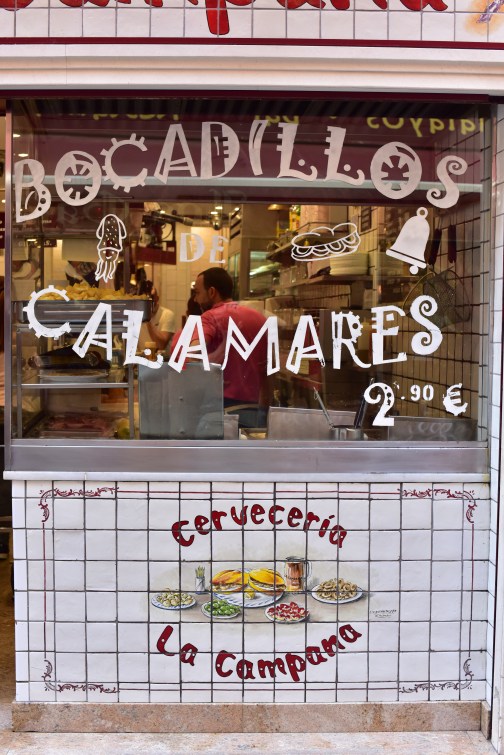
Calamari sandwiches are another classic snack in Madrid.

NJB_7809.JPG

NJB_7800.JPG

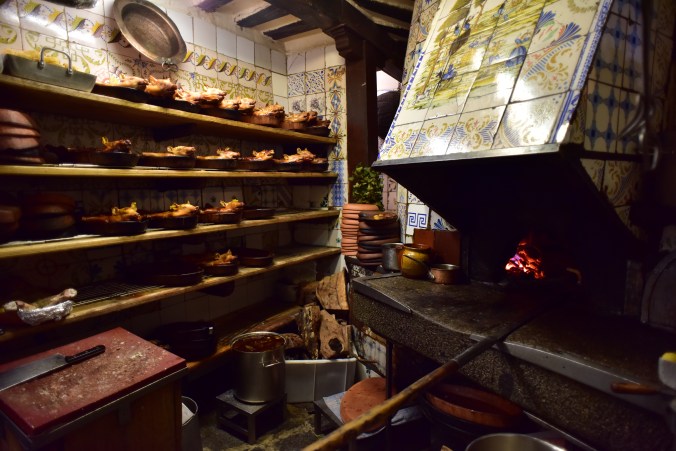
Did you know that the oldest continuously operating restaurant in the world is in Madrid? It’s famous for suckling pig, which you can see in the dishes on the left.

NJB_7775

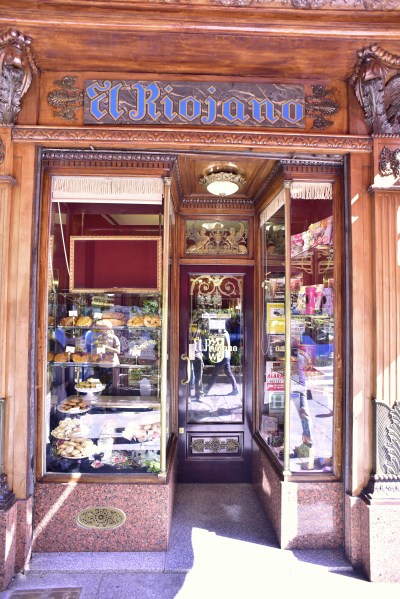
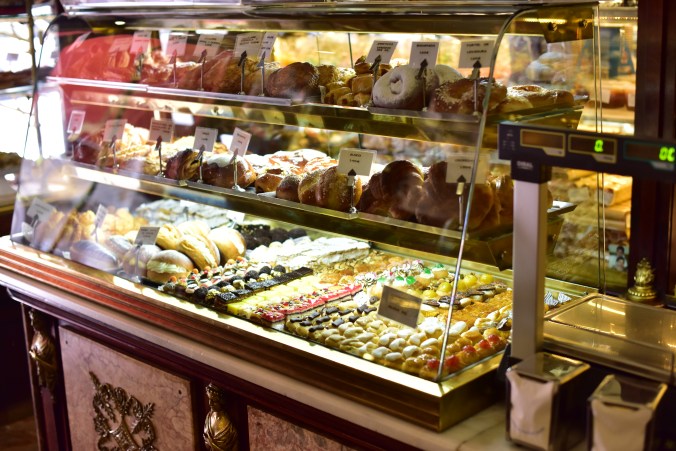
One of the oldest pastry shops in Madrid…

NJB_7779.JPG

…and their famous ponche segoviano, a layered pastry made with marzipan.

NJB_7780.JPG

France gets all the press, but Spain makes its fair share of incredible pastries.

NJB_7838

NJB_7822

Jorge demonstrating how to pour Spanish cidre, made from apples grown in the north of Spain.

NJB_7835.1

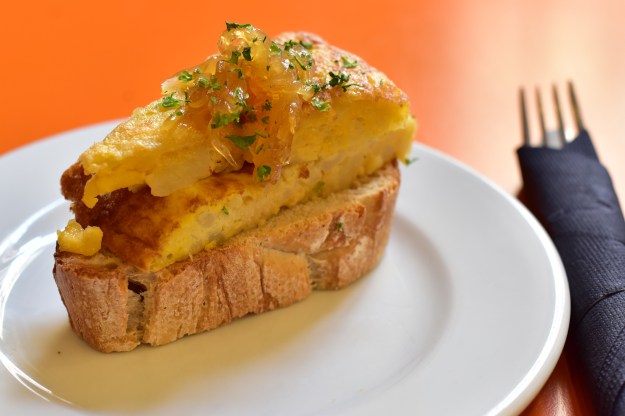
Classic tapas: a Spanish omelette, or tortilla, made of eggs, potatoes and onions, served on fresh bread. Simple, filling and delicious.

NJB_7831

A perfect pair: manchego and cidre.

NJB_7814

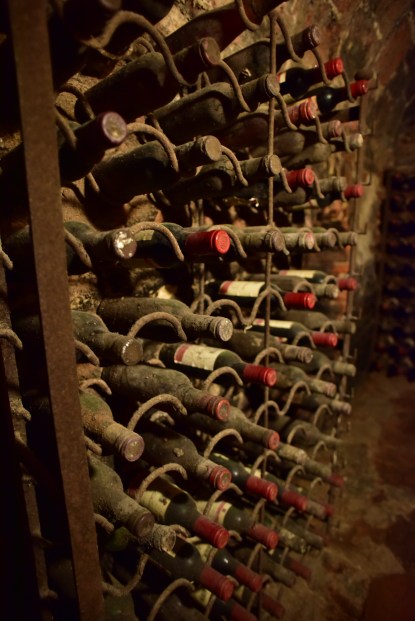
I’ll be in the cellar if anyone needs me.


Dinner at a gurudwara

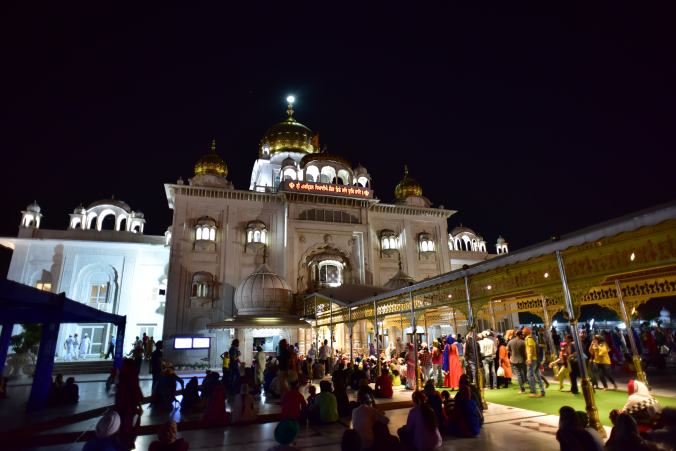
We’ve had a number of remarkable experiences in India, but one of our favorites so far has been the evening we spent at Gurudwara Bangla Sahib, a massive Sikh temple complex in Delhi.

NJB_5596.1

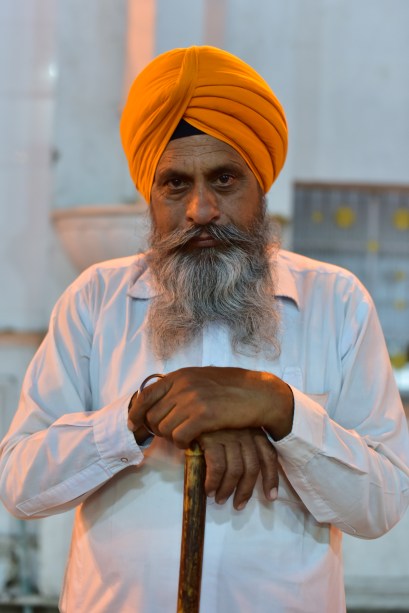
Male Sikhs are most recognizable by their distinctive turbans.

A gurudwara (or sometimes gurdwara) is a place of worship for Sikhs; the word literally translates as “door to the guru.” Sikhism is a fascinating religion; it’s one of the youngest major religions and has about 28 million adherents worldwide. It originated in India in the 15th century and broke from Hinduism primarily due to its rejection of the caste system.

NJB_5570

The gurudwara in Delhi sees a constant stream of visitors.

As we’ve mentioned, India is an intense place, and it’s easy to become overwhelmed rather quickly here. When your tour guide casually mentions that he’s taking you to dinner at a place that serves fifteen to twenty thousand meals a day, it doesn’t really engender a lot of confidence that the meal will be peaceful or calm. Yet that was exactly how the evening turned out.

NJB_5577

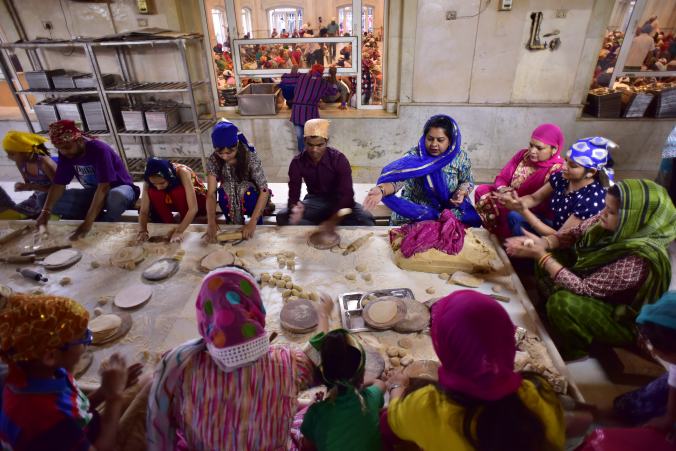
Making chapatis for the communal meal.

Everyone is welcome at a Sikh temple, whether or not you adhere to a specific belief system. All gurudwaras in the world have a langar hall, where vegetarian meals are served free of charge to anyone, sometimes twenty-four hours a day. No money ever changes hands, but it is understood that visitors to a gurudwara will participate in “selfless service” in exchange for their meal, which may mean assisting with cooking, cleaning, serving or any other necessary tasks.

NJB_5574

Chapati dough waiting to be rolled.

NJB_5578

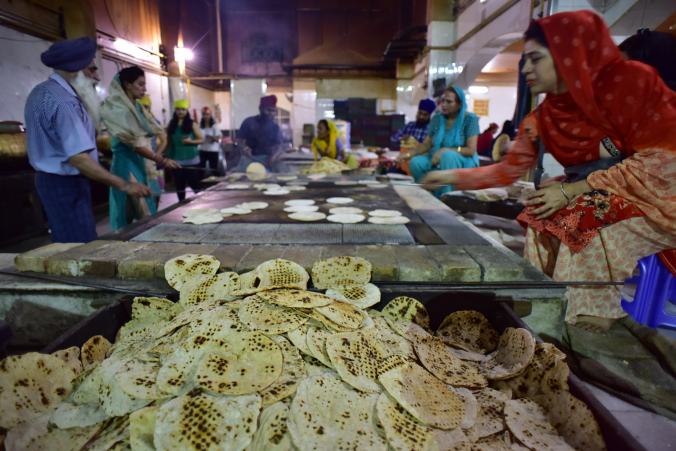
Cooking chapatis on the griddle.

NJB_5576

The Sikh gentleman on the left is supervising the cooking of the chapatis.

For our service, we sat down on the floor to roll out hundreds of chapatis, unleavened wheat flatbreads. It was a lovely experience to join the people already in the kitchen; though we don’t speak Hindi, no explanations were necessary. It was simple enough just to watch what others were doing and follow along.

NJB_5580

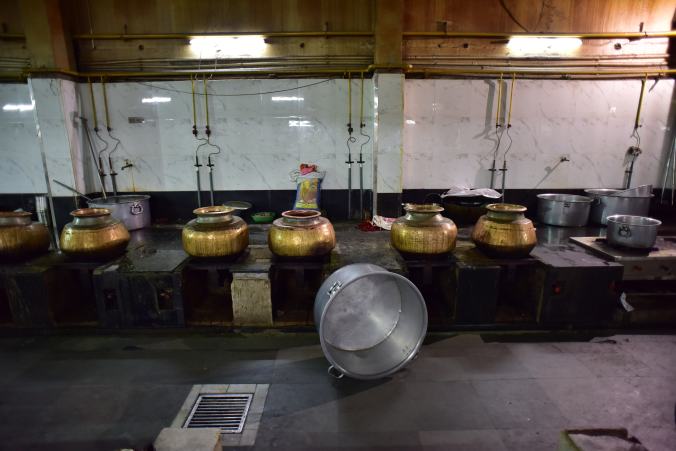
Rather a lot of food is produced in this kitchen.

NJB_5571

Vats of delicious dal bubbling away.

NJB_5582

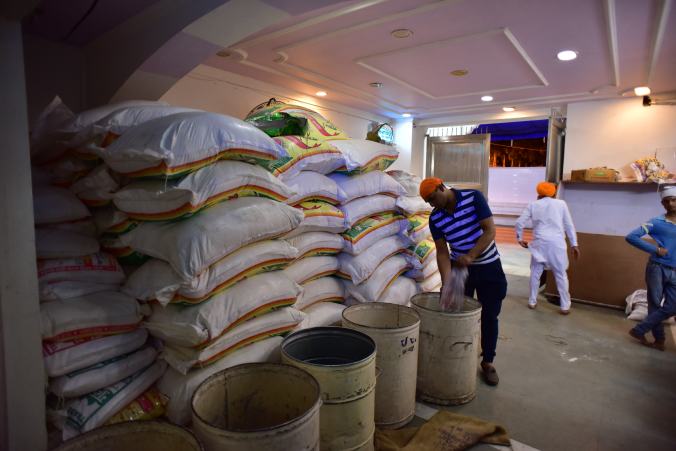
Bags of flour and rice in the temple’s pantry.

In addition to volunteering at the temple, most guests also provide an offering of food to the temple’s pantry. Fifty-pound bags of flour and rice line the walls, along with vegetables, lentils and anything else that can be used in the preparation of thousands of daily meals. All the food is strictly vegetarian, and nothing goes to waste.

NJB_5583

Cleaning the langar between meal shifts.

Around five hundred people eat in shifts in the langar hall; everyone sits on the floor. Guests queue outside in an orderly manner; in a country where patiently waiting in line doesn’t really happen, we were amazed at how smooth and orderly the process was.

NJB_5586

Seating the next round of guests in the hall.

As we filed in, we were given metal trays and shown where to sit. Our guide cautioned us against wasting any food; although you’re welcome to eat as much as you’d like, it is considered hugely disrespectful to take more than you will eat. We enjoyed dal, or spiced lentils, plus a vegetable curry, rice and of course our extremely well-made chapatis.

NJB_5587

Volunteers beginning the meal service.

Because there are always more people waiting to eat, everyone basically starts and finishes around the same time, then the hall is cleaned and readied for the next group. The efficiency and elegance of the entire evening was spectacular. The best part was looking around and knowing that the very rich and the very poor and everyone in between were sitting on the floor together, eating the same food. Truly a highlight of our visit to India.

NJB_5589

Regardless of gender, everyone is required to cover their heads in the temple. Scarves are provided in case you forgot yours.

After the meal, guests leave the hall, wash their hands and feet (as with most temples, shoes are left at the door) and enter the main temple for worship, chanting and fellowship.

NJB_5591

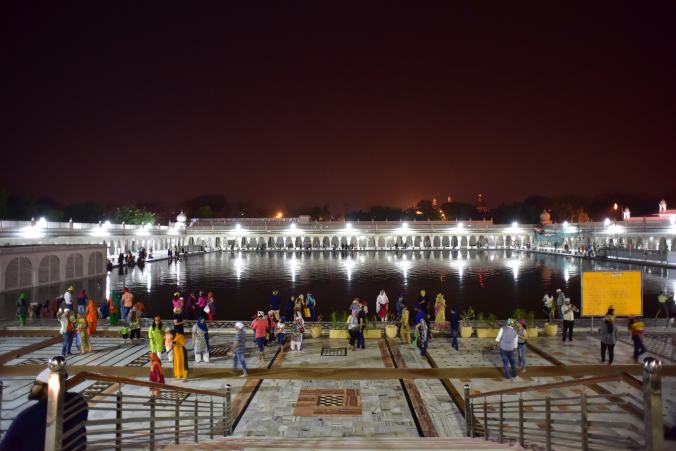
The temple also has a gorgeous reflecting pool.

One of the most interesting parts of our visit happened afterwards, when we were readying to leave. Our group was approached by a young woman with a small child who begged us for money – a very common occurrence in India, particularly for Western tourists. A Sikh immediately saw this and politely but firmly put a stop to it. Our guide explained that since everything is given for free at the temple – food, water, even a safe place to sleep, if necessary – they do not permit any begging on their grounds. This is extremely unusual in India.

NJB_5593

Sikh temples can be found all over the world, and a quick Google search will find one near you. If you have the opportunity, please visit your local gurudwara and spend a bit of time making delicious food in the kitchen, then sit down to enjoy it with friends and strangers alike. It is an experience not to be missed!

Scenes from the Banana Pancake Trail

We’ve never claimed to be the world’s most adventurous travelers, and our travel in southeast Asia definitely adhered to the classic Banana Pancake Trail. Nevertheless, we had a phenomenal time here and loved seeing countries that were new to both of us. We visited Cambodia, Vietnam and Thailand in just under a month; below, some of our favorite images from this portion of the trip. We’re off to India!

NJB_3399

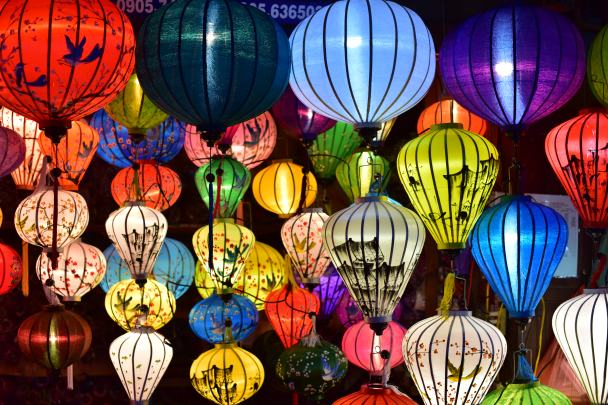
Illuminated lanterns in Hoi An’s Old Quarter.

Hoi An, near Da Nang on Vietnam’s central coast, was most certainly our favorite place in the country. We loved its antiquated feel and the charming Old Quarter, which is decorated with tens of thousands of brightly colored lanterns hung all over the shops and streets. Strolling here after sunset was such a pleasure.

NJB_3433.1

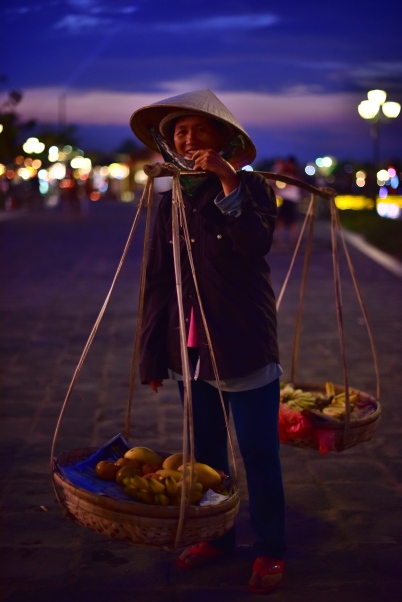
A fruit vendor in Hoi An.

NJB_3349.1

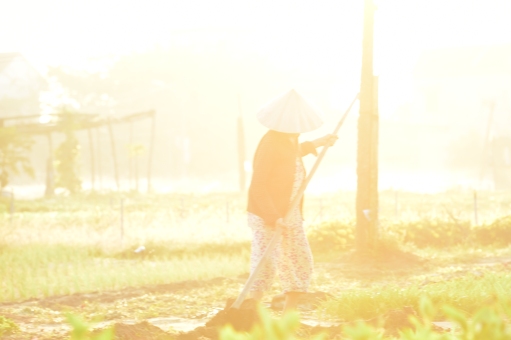
Early morning gardening in Vietnam.

In Hoi An, we participated in a sunrise bicycle tour that took us to the daily market, an organic farm and out to the rice paddies. Truthfully, most small village farms in developing countries are organic because labor there is cheap and chemicals are expensive. In the U.S., unfortunately, the opposite is true.

NJB_2552

The stunning interior of a village temple outside of Siem Reap.

This gorgeous temple was on a dusty road leading out of Siem Reap; from the outside, you’d never know that the interior was this incredible. Each fresco had a number painted in the corner; this indicated the amount of money raised by the village to pay for that particular painting.

NJB_3491

Vietnam’s favorite son is absolutely revered in this country.

Vietnam’s national hero, Ho Chi Minh, is celebrated all over the country but nowhere more so than in his namesake museum in Hanoi. The museum is one of the strangest and darkest – both in terms of actual light and the overall mood – places we’ve ever visited. It’s an unsettling combination of blatant propaganda and modern art installation, and worth seeing just for the weirdness.

NJB_3495

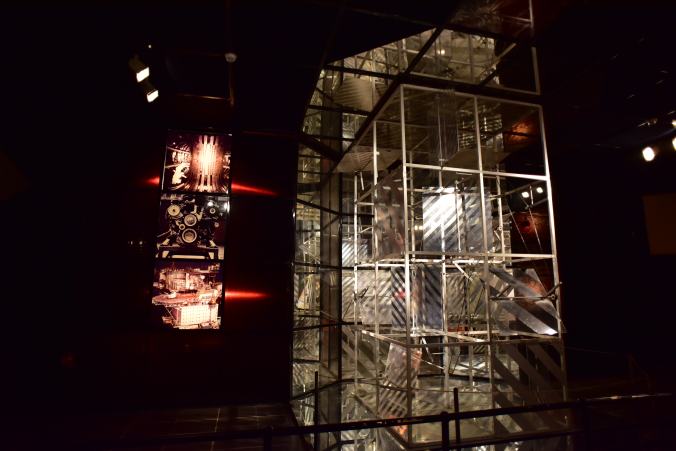
See how dark this museum is?

The placard on this exhibit in the Ho Chi Minh Museum read, in part, “The models in this hall give visitors information about how scientific and technical achievements have been made use of for peaceful and beneficial purposes. The models at the same time condemn those who have utilized these achievements for aggressive and destructive purposes.” What?

NJB_3717

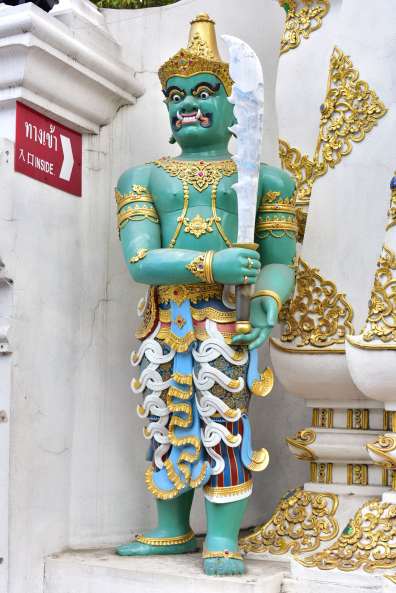
A ferocious temple guardian in Chiang Mai.

NJB_3353

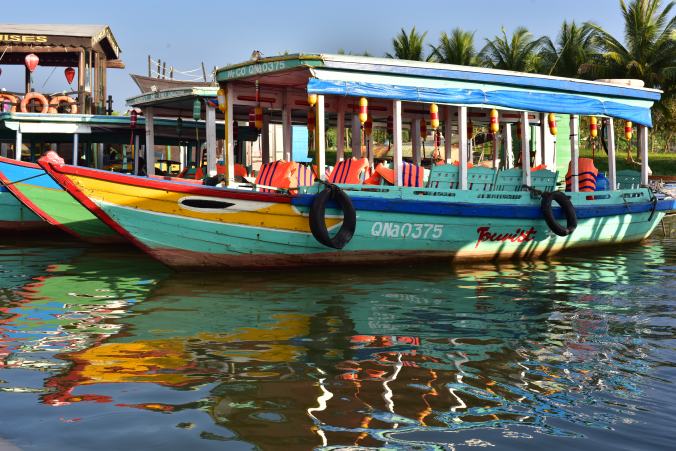
Look closely: the labeling on these boats in Hoi An lets everyone know you’re a tourist.

NJB_3482

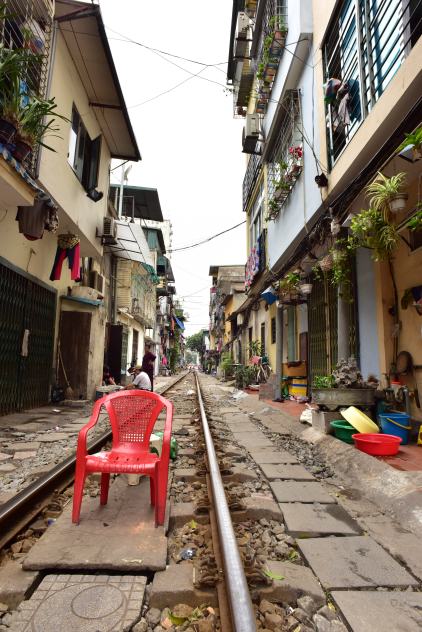
Trainspotting might be a bit risky in Vietnam.

NJB_3827

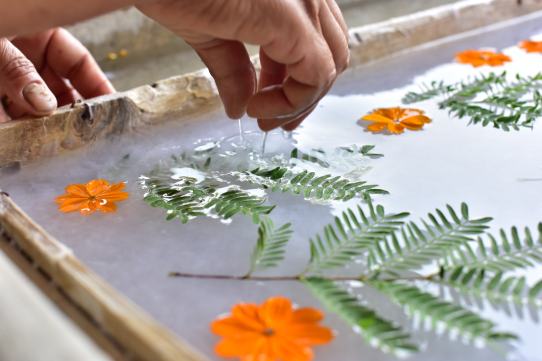
Adding decoration to our handmade paper.

In Thailand, we took a papermaking class and created gorgeous papers with leaves and blossoms. It’s simple and rewarding and beautiful; we’re hoping to make our own to wrap our handmade cheeses in at Quiet Farm.

NJB_2953

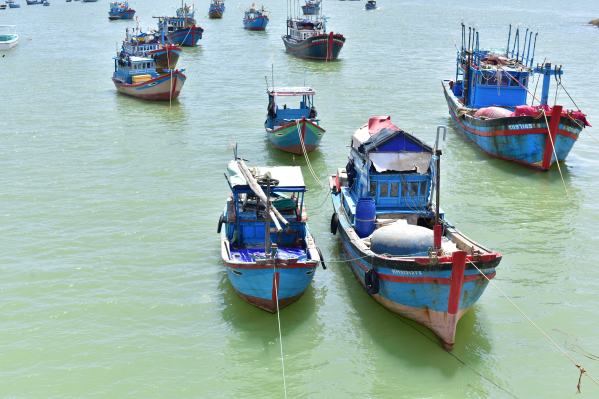
Fishing boats on the river in Nha Trang.

NJB_3700

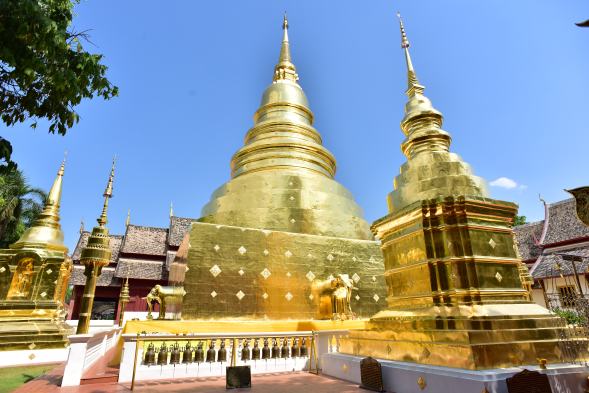
One of Chiang Mai’s many elaborately decorated temples.

NJB_3138

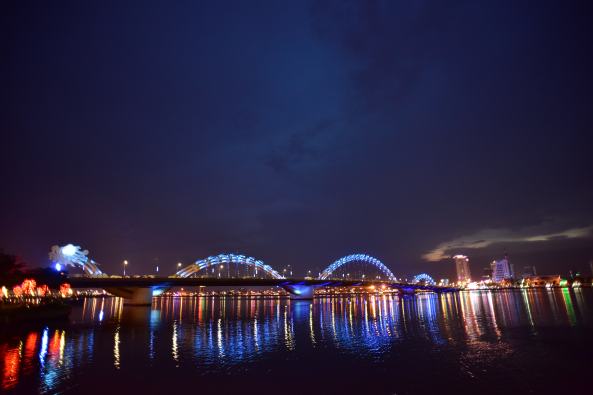
Da Nang’s famous (and very expensive) Dragon Bridge changes colors – and on weekend nights, it also sprays water and breathes fire!

NJB_3389

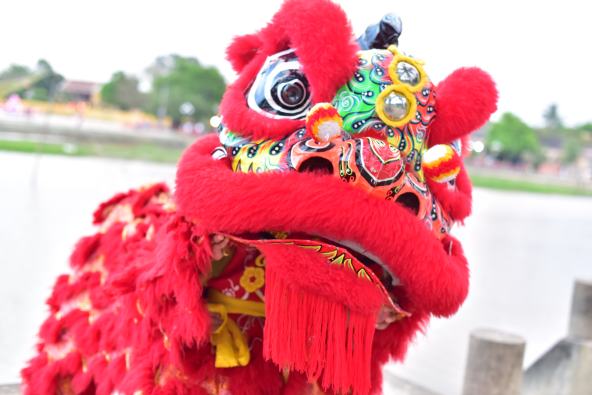
We found this lion dancer at an international food festival in Vietnam.

NJB_2917

The building boom in Nha Trang, a beach resort popular with Russian tourists.

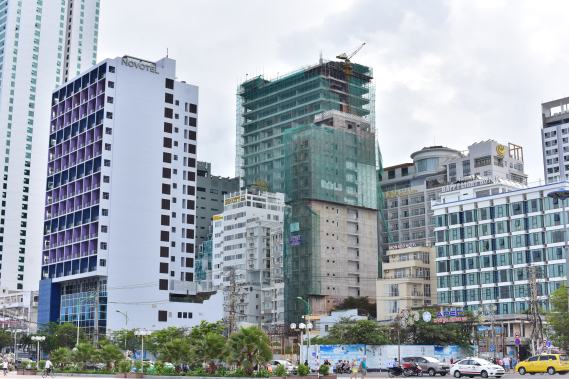
Vietnam is in a mad rush to modernize, so hotels are constructed at a breakneck pace. This means that not only are there hammers and saws competing with motorbike horns at all hours, but that a lot of construction is left partially finished when workers move on to the next project.

NJB_3550

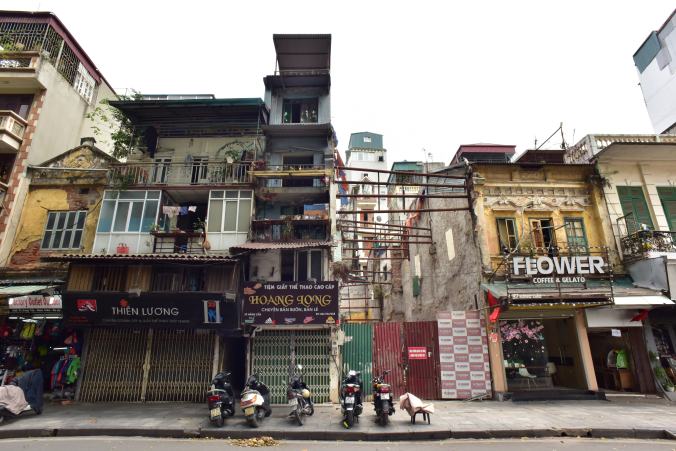
A “skinny house” in Hanoi.

Even more common than all the new construction is making do with what’s already there. The skinny house above has been tucked in; notice that the bamboo poles are actually structural and are keeping the two buildings from leaning in. Presumably something will be quickly built in that empty space. But there’s a fancy coffee shop! With gelato!

NJB_3565

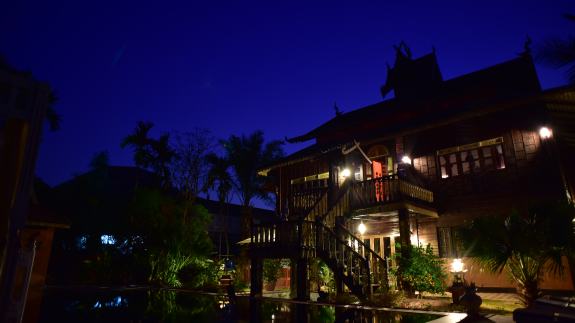
The exterior of the traditional lanna house we stayed at outside Chiang Mai.

NJB_2742

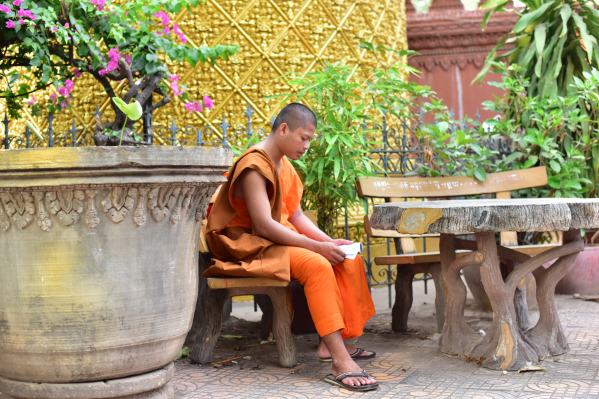
A monk studying at a temple in Phnom Penh.

Monks in orange robes with shaved heads are a common sight throughout southeast Asia; it’s amusing to see them with earbuds and mobile phones, too. Even monks have to modernize.

NJB_3747

Is this for here or to go?

And we leave you with this photo, and dare you not to smile. While dogs are still eaten in southeast Asia, as the region grows in economic prosperity, its people want what they perceive as middle-class luxuries – and that includes house pets. So now it’s more common here to see dogs on a leash rather than on a grill.

Street food

After the markets, street food vendors are one of the most colorful sights in southeast Asia. From fresh fruits and vegetables to juices, meat and snacks, just about anything you fancy is available from a street stall. Although you might not know exactly what you’re eating, it’s worth watching just for the show.

NJB_2928

A lobster stall in Nha Trang setting up for business.

NJB_2926

Crocodile farming – for both meat and leather – is big business in central Vietnam; the industry is definitely not PETA-approved. This enticement is outside a restaurant in Nha Trang.

NJB_2645

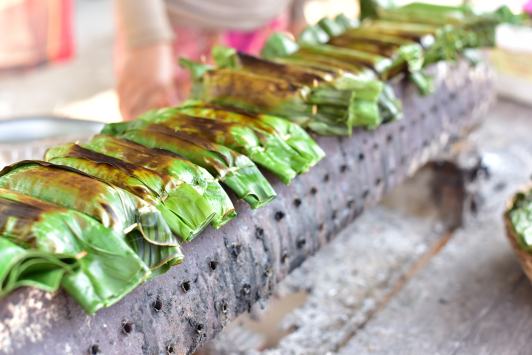
These delicious little packets contain sticky rice stuffed with bananas, eaten as a snack or dessert.

NJB_3735

These lovely women are running a rotee stand. Rotees in Thailand fall somewhere between a crêpe and a pancake and are filled with sweet or savory ingredients.

NJB_3723

Carts are set up along just about every street.

NJB_2923

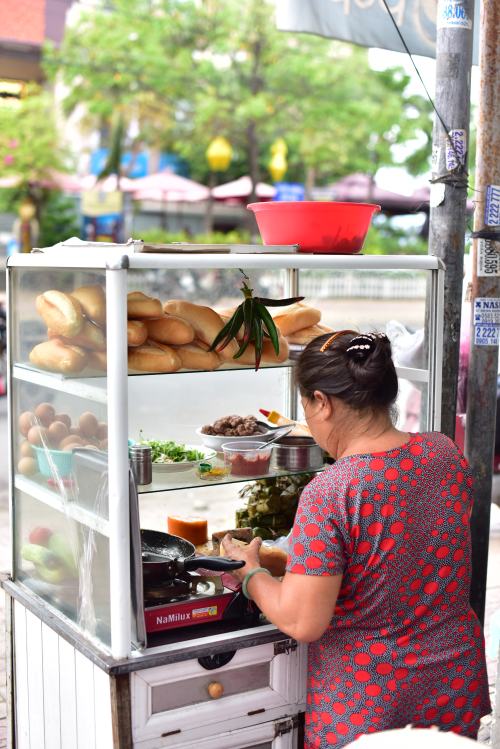
This woman is making Vietnam’s world-famous banh mi sandwich, sold for about 75 cents.

NJB_2911

These tiny bananas (about the length of a finger) are so much more flavorful than the standard Cavendish variety we get at home.

NJB_3173

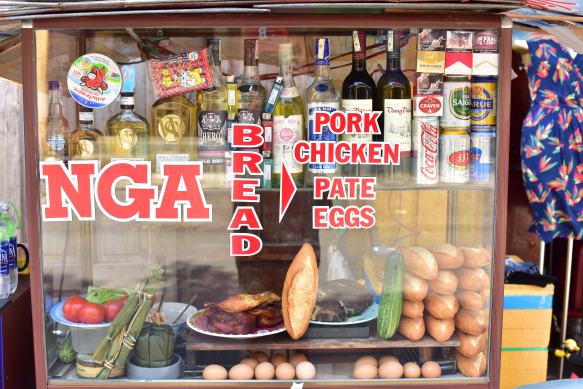
Fancy some whiskey or red wine with your street food meal? You can have it.

NJB_3743

Perhaps you’d like a meatball skewer?

NJB_2496

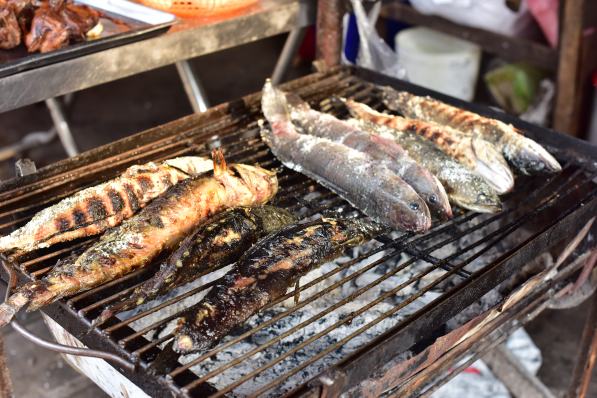
Salted whole fish, ready to eat.

NJB_2486

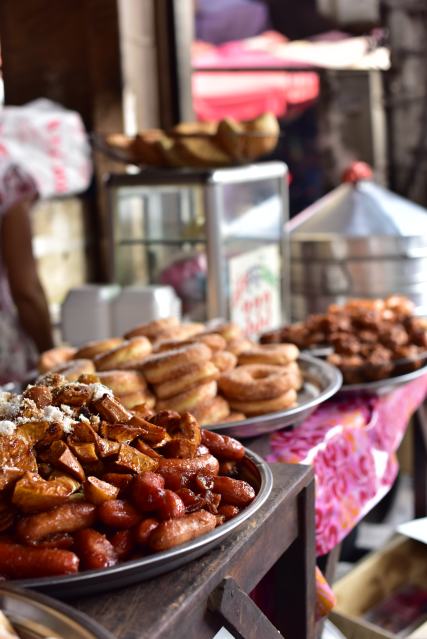
Fried sweet potato, banana and other tasty treats.

NJB_2597

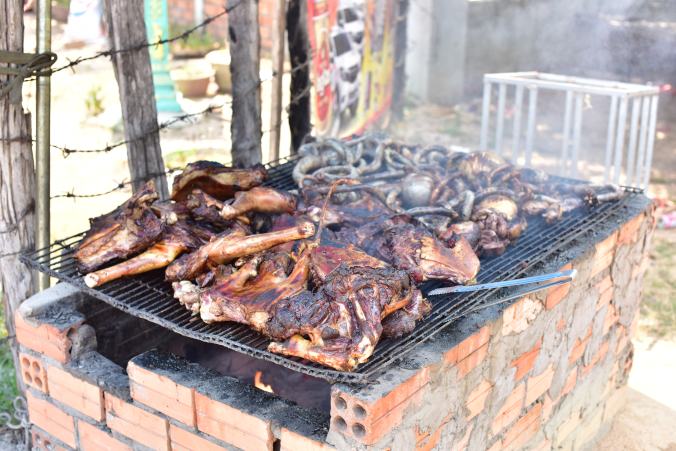
The “special meat” restaurant outside of Siem Reap. Sit, stay…good dog.

NJB_2488

Little sweet cakes, served hot.

NJB_2781

Skewers and more, ready for the grill.

NJB_2755

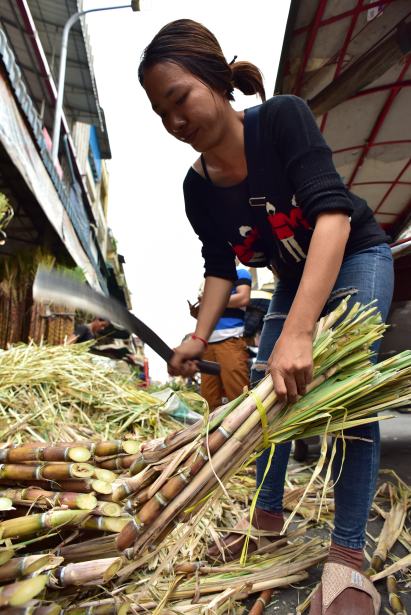
Baling sugarcane on the streets of Phnom Penh.

NJB_2479

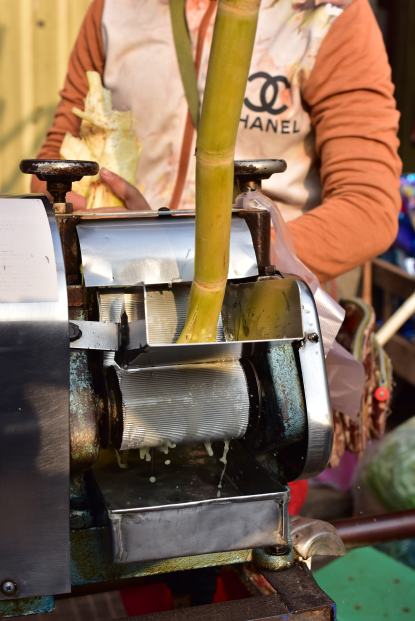
The sugarcane is crushed through a press to produce delicious juice, which is flavored with fresh lime and sold in little baggies as a refreshing drink.

NJB_2656

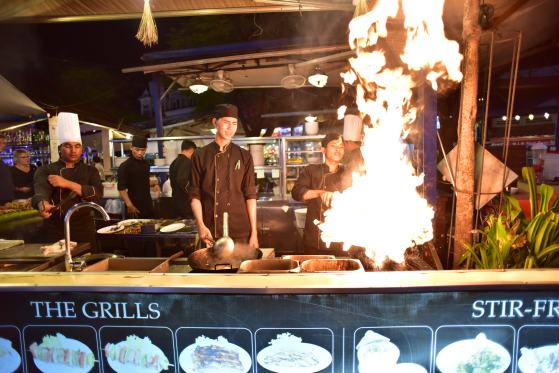
Chefs demonstrate their stir-fry skills at Siem Reap’s night market.

NJB_3740

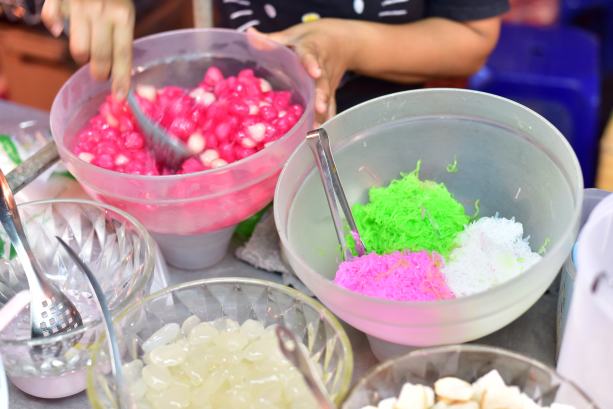
Honestly, I don’t know. But what colors!


To market, to market

For a chef and a photographer, traditional food markets are a wonderland. We visit markets whenever possible and do our best to capture the scents, sounds and tastes through our words and photos. These markets are often messy, fragrant, hot and noisy, to say the least, but they capture a place and its people the way few other tourist attractions do.

P.S. If you’re in the Denver area, I’m teaching an incredible cooking class on exploring ethnic markets in June at the Botanic Gardens. Learn more here!

NJB_2489.JPG

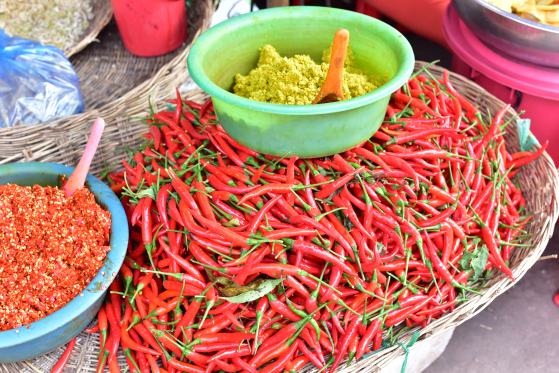
Chile paste, fresh chiles and ground turmeric.

NJB_2513.JPG

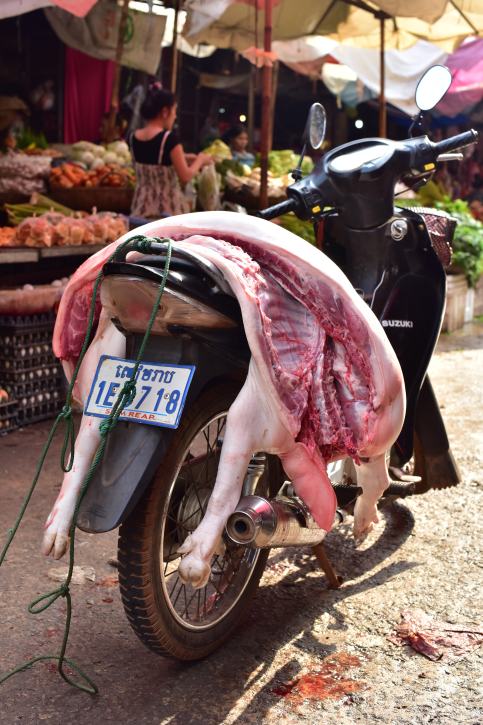
This little piggy went to market…

NJB_3271

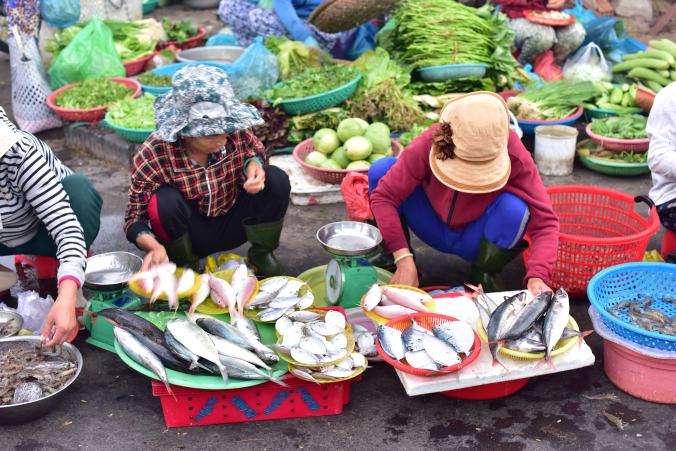
The morning fish market in Hoi An.

NJB_2504.JPG

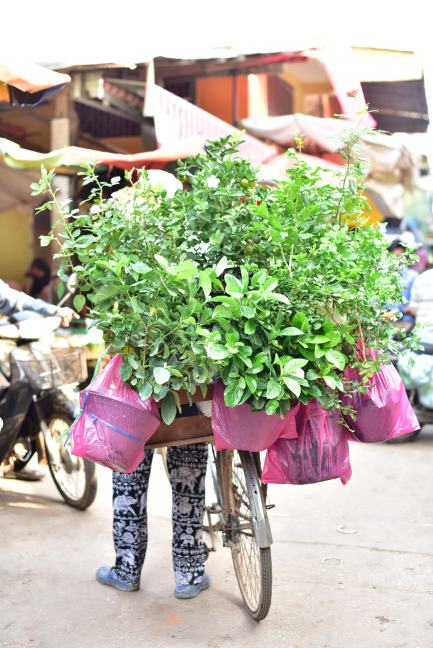
Fresh herbs, delivered by bicycle.

NJB_2491.JPG

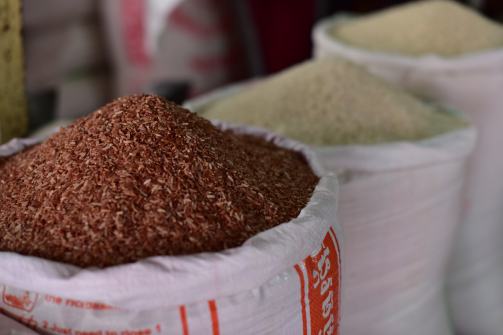
Rice is the staple food for more than two-thirds of the world’s population, unsurprisingly, there is a lot available for purchase here.

NJB_2510.JPG

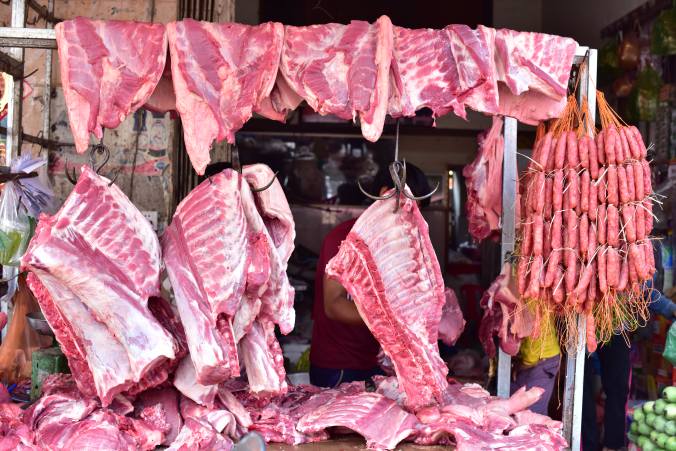
Know where your meat comes from.

NJB_2317.JPG

Siem Reap’s famous Night Market.

NJB_2503

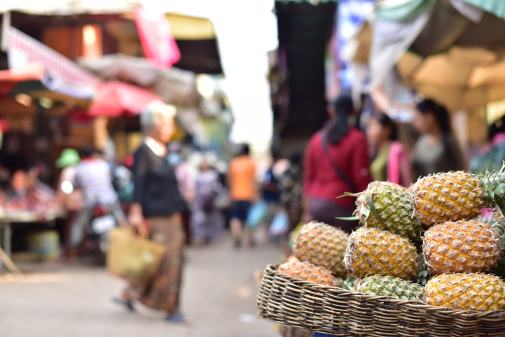
Fresh pineapples are often sold peeled and cut for an easy to-go snack. 

NJB_2472.JPG

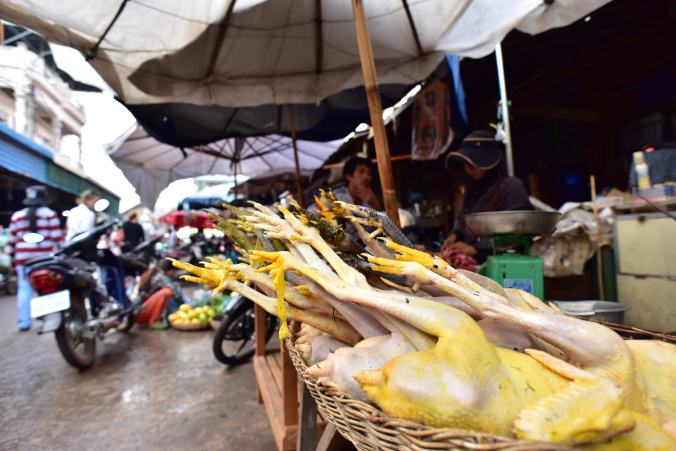
The “blackfoot chicken” is just one of the many poultry options available. Every conceivable type and size of bird is eaten here.

NJB_2763.JPG

Lots of unusual fruit varieties that I’ve never seen before!

NJB_2500.JPG

This is what chefs mean when they talk about “nose-to-tail” cooking.

NJB_2477.JPG

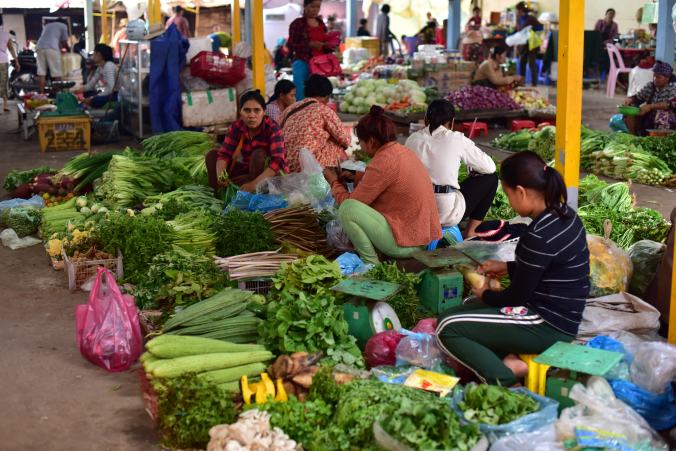
Most markets we’ve seen are conducted primarily on the ground.

NJB_2519.JPG

This is not the gluten-free section.

NJB_2493

Spices ready to blend into fiery curry pastes.

NJB_2306

NJB_2304

Markets in southeast Asia aren’t just for food; Cambodia and Vietnam produce a great deal of the world’s “fast fashion,” typically in abysmal working conditions.

NJB_2507.JPG

Everything you need to garnish pho.

Needless to say, I’m looking forward to cooking again when we get home!


Food for thought

NJB_9683

Octopus skewers, Nishiki Market, Kyoto.

Food – ingredients, preparation, presentation – is something I think about far more than the average person. As I’ve mentioned, at home we almost never eat out, both because I love to cook and because I’m often testing recipes or preparing for a class, so I tend to have an excess of food on hand at any given moment. Food obviously plays a huge role in travel, too, and for me that’s both positive and negative. I love tasting unfamiliar ingredients and trying to appreciate a place through its food culture, but the reality is that more often than not restaurant food is disappointing and overpriced – especially when you’re traveling in heavily touristed areas. I know how much I’m overpaying for it and I hate that feeling of being cheated – paying $75 or more for a “nice” meal, only to leave with a bitter taste. It’s tough, though, especially in a country like Japan where everyday communication is delicate at best and a mess of unforeseen land mines at worst, to know where the locals eat. My answer to that, invariably, is “at home.”

NJB_9689

Prepared food counter, Nishiki Market, Kyoto.

Other people travel and visit art museums and temples and things. I travel and visit minimarkets and grocery stores, because I think few places tell a country’s story better than where the locals shop for food. I was looking forward to Japan for many reasons, but the food was high on the list. We have a superficial impression of Japanese food in the U.S. – primarily sushi, of course, then perhaps tempura or soba or various tofu dishes. I’m interested not in what people eat when they go out to celebrate a special occasion (do we all eat at The Capital Grille every night? I think not), but what they grab from the store at 5:30 on a Tuesday night after a long day at work.

FullSizeRender (3)

Soba noodles with shrimp tempura, Arashiyama.

And I’ll admit – I’ve been really surprised by Japanese food culture, at least what little I’ve seen of it. First and foremost, sugary drinks take a lot of rightful blame as a major source of excess calories in the American diet; we’re now seeing “soda taxes” and other measures designed to curb consumption and hopefully reduce our obesity and diabetes rates. But Japan, which I think many people perceive as one of the healthiest countries in the world (see The Blue Zones) is absolutely covered with drink vending machines. They are everywhere. There are apparently more than 5.5 million machines in this tiny country, while the U.S. has just under 7 million for nearly three times the population and a lot more landmass. While the machines do contain bottled water, they also contain sugared coffee drinks (cold and hot – and that is a miracle in the middle of this damp, frigid winter), sports drinks (the awkwardly-named Pocari Sweat is my favorite), and plenty of other sugary beverages. Clearly, the machines are worth the real estate – so why aren’t the Japanese plunging into a sugar-related health crisis like we are?

NJB_9687

Fried snacks, Nishiki Market, Kyoto.

I’ve also been surprised at the amount of refined grains, but that may be because I’m so focused on teaching whole grains at home. Obviously plain white rice is a staple served with every meal; we’re currently on a farm stay and the rice steamer is kept filled with fresh, hot rice for eating at any time of day. But the buns, pastries and breads are all soft, white and sweet – the bread available for our morning toast here is like that super-cheap, super-thick “Texas Toast” we used for French toast as kids. I watched the nine-year-old son eat four pieces slathered with fake butter and jam for his breakfast this morning, and he’s thin as a whippet. So again, I’m observing very high consumption of refined grains – which the body essentially converts to sugar – and yet not observing the expected results.

NJB_9681

One of N’s recent lunches, and the only time yet I’ve seen raw vegetables such as lettuce and tomato.

Meals for us have primarily been inexpensive, filling and warming – plenty of ramen, of course, plus other noodle soup variations, but also curry rice and simple “lunch sets,” which usually include miso soup, various pickles and a main such as chicken and rice (photo above). These too have surprised me with the overall lack of vegetables. While there might be a few small dishes of pickled or fermented vegetables, we’ve only once had any served raw – a fresh carrot and daikon salad here at the farm, with a delicious creamy, tangy dressing. There are never any vegetables in the soups or with the meat and rice, certainly nothing like what we’d think of as traditional stir-fry. That said, the Japanese tend to cook more seasonally than we do, and I suspect we’d see a greater variety of raw vegetables during warmer months than in the middle of bleakest winter.

NJB_9707

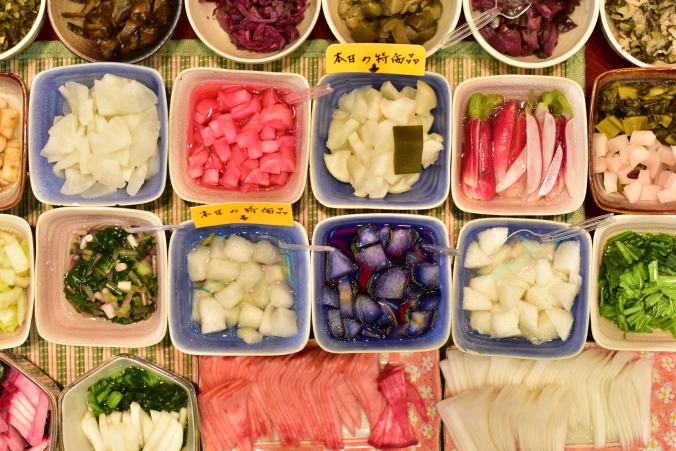
Pickled vegetable selection, Nishiki Market, Kyoto.

In stores, it’s package after package after package. From a thousand varieties of crunchy salty snacks to pre-made sandwiches to “Hot Pockets” to sushi and sashimi, I’ve noticed very little in the way of fresh ingredients designed for preparing meals at home. Fresh fruits and vegetables are almost nowhere to be seen and crazily expensive when found; I bought an apple in downtown Kyoto – one apple – for about $2.50. We’ve walked by a couple of small fruit and veg stands, but literally nothing that would rival your most basic American grocery store produce department with its stunning array of gloriously arranged, perfectly shiny, identically sized out-of-season fruits and vegetables. And yet the farm we’re currently staying on has acres of fruit trees and thousands of apples in cold storage right now, so where are they all going?

NJB_9565

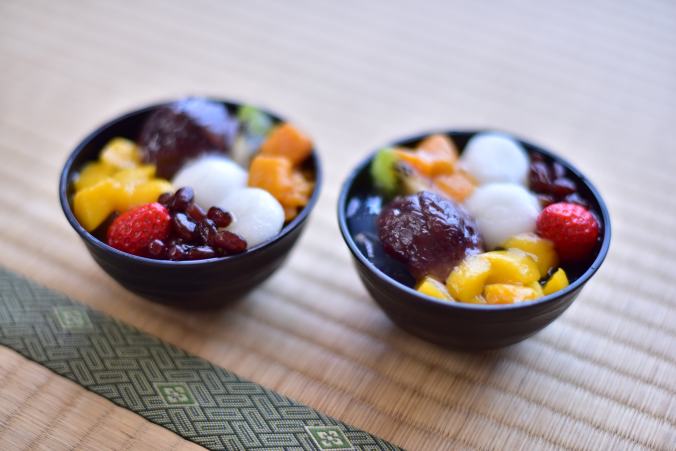
The oddest dessert I’ve ever eaten…jellied fruit and red beans with clear gelatinous cubes underneath. Algae? Gelatin? Space-age packing material? Also it came with what I thought was a sauce and may have actually been hand sanitizer. Not dead yet.

So after nearly two weeks of eating and travelling in Japan, I’m left with a mess of contradictions. The diet appears, at least on the surface, to be as unhealthy as ours in the U.S. And yet the people here, at least from my extremely limited research, don’t seem to be plagued by the same health crises. What can we learn from this?

(P.S. Please know that these observations are only based on a few days here in Japan and are in no way intended to represent some sort of serious large-scale sociological study. If anyone has spent time in Japan and has additional insight to share about the food culture, I’d love to hear it!)