How to start composting

Americans produce about five times as much trash per capita as does the rest of the world: a truly shameful statistic. Even while the news shows images of food bank lines stretching for miles, we still manage to waste far more food (about 40% of everything we buy) than the average human. Most of this food waste ends up in landfills, which are rapidly reaching capacity; by some estimates, over half the waste in municipal landfills could be composted and used to build soil fertility. It’s also frustrating to see thousands of plastic trash bags filled with grass clippings and raked leaves headed to the landfill where they won’t decompose effectively when rebuilding the soil is one of the very best weapons we have against climate change.
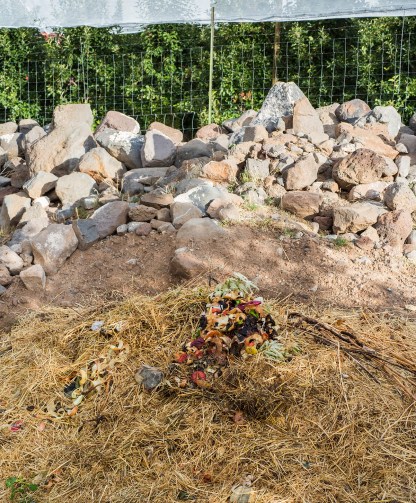
QF Compost 01 sml

Our original compost pile.

If you’re looking to reduce your own waste stream, starting a compost pile is one of the best and easiest solutions. And if you’re cooking at home more these days, as most of us are, you might find yourself producing a lot of food scraps that could be put to much better use than the landfill. Composting has long been presented as too challenging / too time-consuming / too complicated / too messy / too smelly / impossible on a small scale. If managed correctly it is none of these, and is one of the very best ways to make your own plants better, even if you’re simply growing fresh herbs on a sunny windowsill.

Continue reading

Farm update: June 22

‘Tis the season of both growth and destruction. We spend most of our time weeding and watering and looking for new growth on our crops and in our pasture; in response, all of our crafty farm pests have come out with hunger in their tummies and destruction on their minds. Time spent not watering or weeding is instead spent defending our territory. It’s a hard-fought war of attrition out here, and both sides are digging their heels in.

Raspberry Growth 01 sml

A raspberry cane with reassuring new growth.

We’re so pleased to see new growth on most of our raspberry canes. You might remember that we planted forty canes last year and every single one failed; this year we regrouped with drip irrigation and we believe that made all the difference. Bramble fruits like raspberries and blackberries typically do well in our climate; we’d love to grow our own fruit as well as our own vegetables. We’re always, always learning out here, and we’re trying hard not to make the same mistakes twice. We like to make lots of different mistakes instead.

Continue reading

Farm update: June 8

“Good morning. Concentration is hard to come by these days, amid the nation’s strife. We are living through a tough and chaotic and wrenching time, filled with fury and an abiding sadness. We’re unsettled. We’re tense. We’re divided. The emotions arrange themselves in combinations that make it hard to work, to read, to watch, to listen, much less to think.

Cooking can help. The act of preparing food is a deliberate and caring one, even if you’re just making yourself a bowl of oatmeal at the end of a long night of worry. The way you sprinkle raisins over the top is an intentional act of kindness to yourself. So what I’m doing now, amid my restless skimming of nonfiction and news, thrillers and literature, poems that don’t bring solace: I read recipes, think about who in my family they might please, and I cook.”

-Sam Sifton, The New York Times

Brownies 01 sml

So much effort, yet so worth it.

While I was flipping through the April issue of Bon Appétit, N saw this recipe and asked me to make these “camouflage brownies.” And so I did. They required approximately seventeen different bowls, forty-two utensils, nine measuring devices and three separate batter components. (When a professional chef tells you a recipe is complicated and elaborate, believe her.) But the end result? Amazing. We don’t eat a lot of sweets, so we devoured this pan a little quicker than good sense would indicate, and it was entirely worth it. And I had to buy the cream cheese in a two-pack, so we’ll probably see these again in our kitchen very soon.

Continue reading

Where the water goes

There has long existed a tired stereotype of a farmer as some sort of rural idiot, a barely-literate country bumpkin who can only just string two sentences together. If there is anything we’ve learned during our nearly two-year (!) farming adventure, it’s that a successful small farmer is anything but stupid. You have to be a veterinarian and a seedsman and an ATV mechanic and a soil scientist and an entomologist. You have to dig holes, repair fences, build structures, patch hoses and outwit pests. You have to be strong, creative, resourceful, thrifty and tireless. And you have to know how to manage the water on your property, no matter how it gets there.

Drip Irrigation 02 sml

The components of one of our drip irrigation kits.

One of our goals for this, our second full season of farming, is to get our irrigation dialed in. We don’t farm in a traditional American sense, i.e. hundreds of acres of the same crop (usually corn or soybeans) laid out in precise rows and neat blocks. Irrigating that sort of monocrop is relatively easy, because every plant is identical and therefore its water needs are identical, too. Once that irrigation system is established, it’s basically set-it-and-forget-it. Instead, we farm in a sort-of patchwork style all across our property: perennial herbs in this corner, a bed or two or nine here, trees over there. As a result, our irrigation is similarly patchwork, because there is no one-size-fits-all solution.

Continue reading

Farm update: May 11

It’s hot, dry and windy out here, and feels more like late July than early May. We seem to have skipped straight from a parched winter into an equally arid summer, missing the soft green lushness of spring entirely; the peas and radishes survived frost damage only to turn bitter and pithy from sun scald. Last year we had rain almost every single day in May, and this year it’s unlikely we’ll see any. Early reports indicate that the mountain snowpack is melting far too quickly, thanks to this premature summer, and our primary focus these days is on keeping all of our plants irrigated. Here are a few more things we’ve been up to recently.

Irrigation 02 sml

Our gated irrigation pipe at work. 

All of our irrigation water comes from snow on the Grand Mesa. When the snow thaws each spring, the snowmelt makes its way down the mountain through an intricate series of ditches, headgates, creeks and pipes. We’re focused this year on regenerating our pasture, so have started flood-irrigating our land to see what grows. Later this season we’ll remark our pasture (cut channels that direct the water) and hopefully seed it with perennial grasses, too. Eventually we’ll use the land for rotational grazing, likely a grass-fed steer or two. Flood irrigation requires a lot of work – the water has to be “moved” by opening and closing valves and gates along the pipes – but it’s the system we have, so we’re learning how to use it to the land’s advantage.

Continue reading

One potato, two potato

Last year we planted potatoes for the first time and achieved a reasonable level of success for a freshman effort, though our part of Colorado isn’t at all suited for potato growing. To our south and east, however, you’ll find the San Luis Valley: the second-largest fresh potato-growing region in the country and justifiably famous for the crop. Their loose, sandy soils are much better for potatoes than our heavy, rocky clay.

Potato Towers 01 sml

Last season’s potato towers.

But like any stubborn farmer, we love being told what we can’t grow, so that we can try it anyway. We quickly realized that we wouldn’t be planting potatoes in the ground and so opted for potato towers: layers of soil, compost, newspaper and straw in a wire cage, with seed potatoes nestled gently in between. We planted about one and a half pounds of seed potatoes in each of three potato towers, and yielded about twenty pounds of potatoes in total – not bad, considering the minimal growing space and effort required, but not the thirty-plus pounds we were hoping for. And some of the potatoes were really tiny, like the size of marbles. Not very practical.

Continue reading

Farm update: April 27

Hello there. How are things in your world? It’s an odd and unsettled time, to be sure. Here at Quiet Farm we’re keeping our heads down and our hands busy as we navigate the seasonal weather shifts that have us careening from wind to rain to sun to hail and back again, all in the space of a few minutes.

House Finch 01 sml

House finch (Haemorhous mexicanus).

Spring is underway, slowly but surely, and our diverse bird life reflects that. The bald eagle pair we’d been keeping an eye on has vanished, presumably for colder climes; now the gorgeous call of the Western meadowlark (Sturnella neglecta) marks our days. Watching the scrappy magpies fight off aggressive egg-stealing ravens is decent entertainment, too.

Continue reading

Chick lit

A couple of weeks ago The New York Times ran an article about how, in addition to guns, seeds, toilet paper and yeast, Americans have “stress-bought all the baby chickens.” For the record, N and I would like to point out that raising chicks was always in our 2020 plan, even before this pandemic wreaked havoc on the universe. And so it happens that ten chicks now reside in a makeshift fort in our sunroom, deftly constructed of cardboard, repurposed pallets, a vintage metal fireplace guard, free Harbor Freight tarps, and salvaged window screens. This chicken palace is a thing of architectural beauty, make no mistake.

Bielefelder Chick sml

Bielefelder

What distressed me most about that NYT article – and to be fair, this happens every Easter – is how many people buy chicks (and puppies, and kittens…) without thinking beyond their cuteness stage. Do you know anything about keeping chickens? Where do you plan to house them? How will you keep them safe from predators? What if you end up with a rooster, which are illegal in most municipalities? This flock will be our fourth, and before we had chickens at our old house we did a ton of research on how to keep them safe, healthy and happy.

Continue reading

Starting seeds

Welcome to March! Our spring is shaping up to be a bit too premature and a bit too warm and a bit too dry for our liking; we’d like to see quite a lot more moisture. This time last year, we still had at least four inches of snowpack on the ground; this year, zilch. Also last year, we were adorable, eager, optimistic, first-year farmers, and we started our seeds way too early. This year, we’re hardened, grizzled veterans, so we know better. And next year? Watch out.

Compost 08 sml

If you’re going to grow anything outside, the single most important piece of information you need is your average first and last frost date. This statistic is pretty much exactly what it sounds like; weather stations all over the country send data to the USDA, which in turn calculates average first and last frost dates. These dates are essential because most (but not all) annual food crops will not tolerate freezing temperatures.

Here at Quiet Farm, our average last frost is May 13, and our average first frost is October 4 for a 143-day growing season; this means we’re almost assured not to have frost between these dates. Keep in mind, however, that this is an average, not a guarantee – you’re safer assuming that frost is possible one to two weeks on either side of these dates. (The location of weather stations varies widely and can sometimes be inaccurate, so check where your closest weather station is located to ensure you’re getting the best information. Plus, the climate emergency is totally destroying the consistency and reliability of these dates. It’s all pretty much guesswork from here on out.)

Continue reading

The best books about food

Apparently this country is electing a president this year and probably electing some other people too, though over here at Quiet Farm we’re doing our damnedest to ignore the entire circus. One thing that still surprises (and infuriates!) me immensely in every single election cycle is that we never, ever discuss national food policy. Neither side even mentions it in passing, unless a hotdish fundraiser happens. We talk about defense, and education, and occasionally the climate crisis, and of course health care, and yet we never discuss the single issue that unites every one of us, regardless of party affiliation. We never talk about the fact that if we changed our food system, we’d naturally change our health care system for the better. And that changing our food system would be a huge step towards repairing our devastated planet. Changing our food system would also mean more military readiness, since we’re now too fat to fight. And our children would gain a better education if they had access to better nutrition for growing brains and bodies. We always ignore the food, when it’s the one issue we should talk about more than any other.

Continue reading