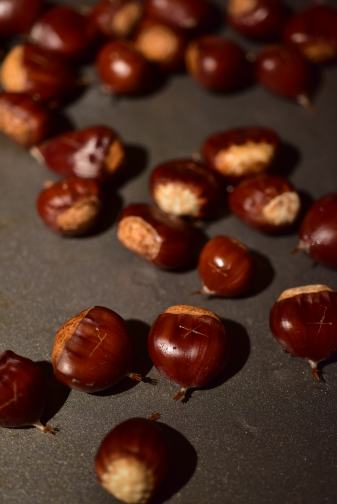
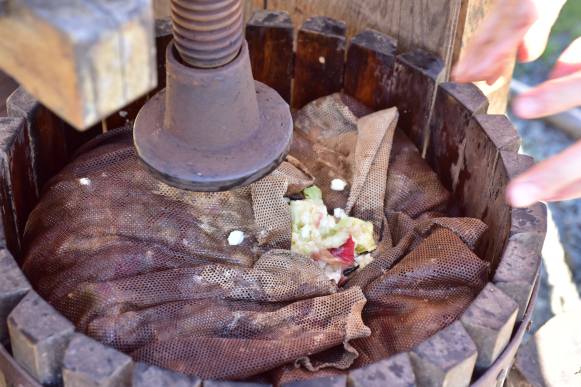
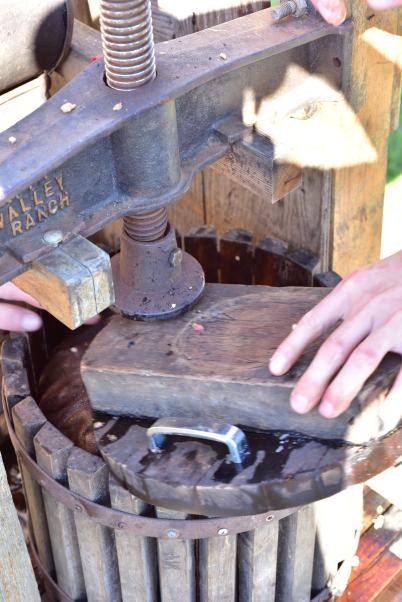
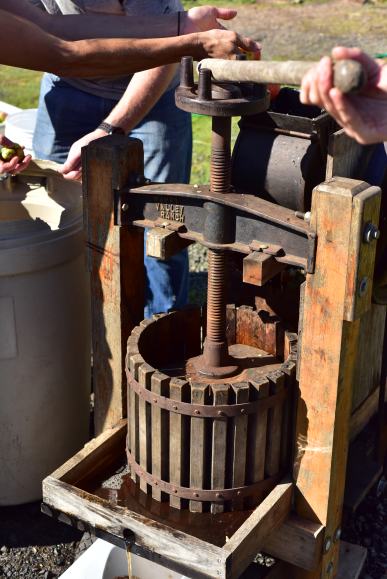
Cider days

Gather round, kiddos, and let your crazy old auntie tell you stories about what people did down on the farm when they didn’t have these newfangled modern conveniences like “wifi” and “television” and “an actual life.” We participated in fun old-timey group activities like apple pressing, yes we did. And we have the photos to prove it.

NJB_0997.JPG

First, start with apples.

Grassward Dairy had about a dozen mature apple trees on the property; I felt especially silly because we went grocery shopping prior to our stay there and I bought apples. Like spent actual money! And there were thousands of delicious apples, free for the taking.

NJB_1028

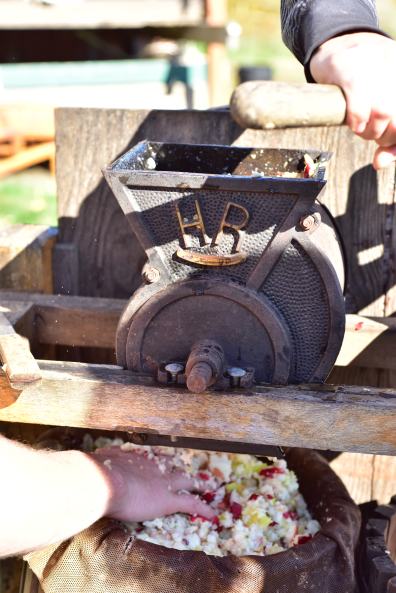
This press is pretty old-fashioned…except that it’s partially electric, so shredding the fruit is quicker and easier.

NJB_1040

One of many important foods pollinated entirely by bees.

For best results, use a mix of different apples so your cider is a balance of tart and sweet. And you don’t have to worry about bruised spots or any other damage, as the press takes no prisoners. Throw them all in.

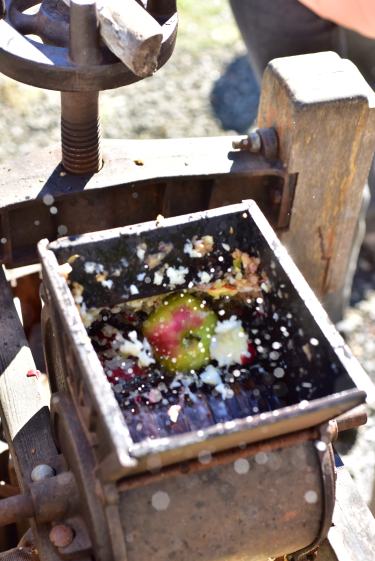
NJB_1010

An action shot of an apple hitting the toothed shredding wheel. 

NJB_1012

The shredded pulp before pressing.

NJB_1014

Gravity forces the pulp into a mesh bag for pressing and straining.

NJB_1018

Readying the pulp for pressing.

NJB_1020

Placing the weighted lid on the bag.

NJB_1003

The electricity only helps with the shredding wheel; the press is still cranked by hand.

njb_1022.jpg

Leftover pulp is fed to the pigs. It’s like pre-marinating.

NJB_1001

And the result of all this hard work? The most incredible apple cider you’ve ever tasted.

NJB_1025

We pressed hundreds of pounds of apples; most of the juice was left for drinking fresh, but a few gallons will be turned into hard cider. Sadly, it won’t be ready for weeks, so we won’t be able to taste the fruits of our labors. (P.S. You can do this at home using a juicer…but it’s much more authentic if you’re fighting off aggressive wasps outside on a farm.)


Let’s learn about the farm bill!

Since about – oh, let’s just say November 9, 2016, not to be too precise – many Americans have found themselves much more interested in politics than in times past. And while that’s a good thing, it’s an understatement to say American politics can be rather confusing. As in, we don’t really get what’s going on, but it doesn’t seem to have that much impact on our relatively comfortable day-to-day lives, so we just go along, merrily forwarding cat videos, virtual-signing critical online petitions that have absolutely no real-world impact and binge-watching the new season of Stranger Things.
NJB_0905.JPG

Finding Quiet Farm tries hard to both educate and entertain, so today we’re going to talk about the farm bill. Oh, I can hear you rolling your eyes right now all the way across the Interwebs, but bear with me. The farm bill, which as Michael Pollan says “should actually be called the food bill,” really does affect every single American, every single day. Multiple times a day, to be honest, because each bite of food you eat in this country is directly tied to the farm bill. And if you have kids, and if they eat any food at all in a school environment, then you’re affected even more. Without further ado, then, a brief, (hopefully) simple introduction to the farm bill, and why you should care about it.
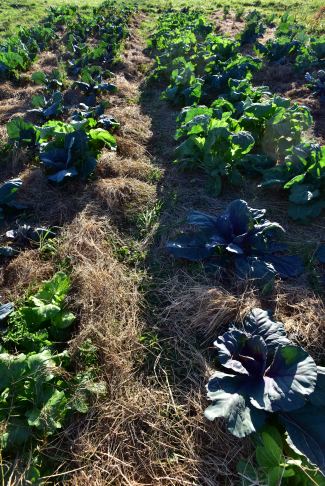
NJB_0763.JPG

Let’s start with the basics. What is the farm bill?

The farm bill is a “multibillion dollar tangle of agricultural subsidies, welfare programs and environmental patronage,” or, more simply, it’s legislation that connects the food on our plates, the farmers and ranchers who produce that food, and the natural resources – our soil, air and water – that making growing food possible. It costs just under $500 billion – that’s half a trillion U.S. taxpayer dollars!

It’s a multiyear omnibus (meaning it covers many different programs) law revamped about every five years and the current farm bill will expire in 2018. That means it’s time for our beloved politicians to start crafting a new farm bill.
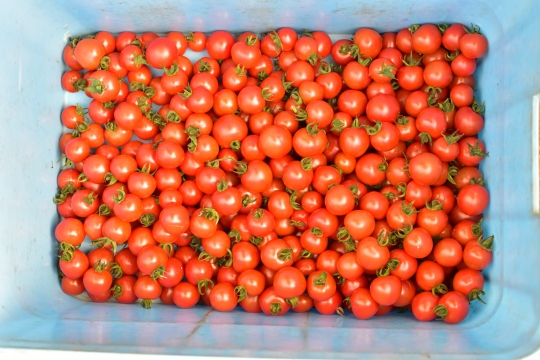
njb_0202.jpg

What does the farm bill do?

The National Sustainable Agriculture Coalition puts it best:

“In the simplest terms, the farm bill has a tremendous impact on farming livelihoods, how food is grown, and what kinds of foods are grown.  This in turn affects the environment, local economies, and public health.  These are some pretty good reasons to become involved in advocating for a farm bill that supports health and sustainability!

Through programs covering everything from crop insurance for farmers to healthy food access for low-income families, from beginning farmer training to support for sustainable farming practices, this powerful package of laws sets the course of our food and farming system – in good ways and bad. It’s our job to make sure the farm bill reflects what our country’s farmers and eaters need for a sustainable future.

Every five years, the farm bill expires and is updated: proposed, debated, and passed by Congress and then signed into law by the President. (The current farm bill, The Agricultural Act of 2014, was signed into law on February 7, 2014.)

The farm bill got its start in 1933 as part of President Franklin Delano Roosevelt’s New Deal legislation. Its three original goals –  to keep food prices fair for farmers and consumers, ensure an adequate food supply, and protect and sustain the country’s vital natural resources – responded to the economic and environmental crises of the Great Depression and the Dust Bowl. Although the farm bill has changed in the last 70 years, its primary purposes are the same.”

Basically, the farm bill does many things, but its most significant elements are the federal food stamp program (officially called the Supplemental Nutrition Assistance Program), crop insurance and crop subsidies. There are other, smaller aspects, but these are by far the most important (and costly).

Stone Barns 031.jpg

How does this affect me, or more literally, why should I care?

You should care if you either 1. eat food in the U.S. and/or 2. pay taxes, because you’re funding this monster. And if you’re concerned about our rapidly escalating health care costs, or that for the first time in modern industrial history the current generation has a lower life expectancy than their parents, or even if you only care about just your own household food budget, then the farm bill (and food policy in general) should matter to you.
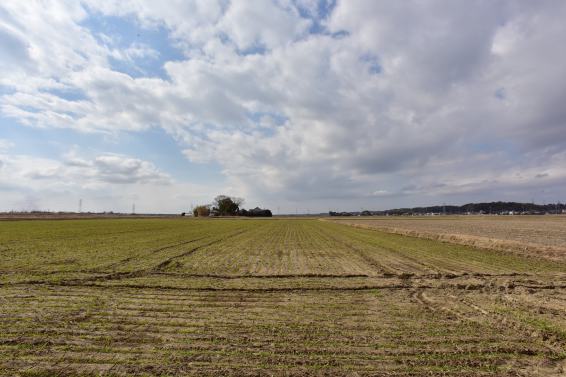
NJB_0269.JPG

What’s wrong with the farm bill?

Where to begin? It was implemented in the 1930s, and modern agriculture is vastly different now than it was during the Great Depression and the ensuing years. After World War II, we got really, really good at growing vast quantities of corn, wheat and soy with the help of leftover nitrogen, which was made into powerful fertilizer. And in the 1970s farmers were encouraged to “get big or get out,” so the small, diversified family farm started to disappear, and farmers were paid to constantly increase their production of cereal grains, again primarily corn and soy – now used as inexpensive animal feed and as the primary ingredients in processed foods and drinks.

Now, fewer than two million Americans live on farms, while crop yields – and pesticide, herbicide and insecticide usage – continues to increase. Huge monoculture farms cover most of the Midwest, reducing natural diversity and vastly increasing the chances of another devastating Dust Bowl. Large monocrop farmers are millionaires many times over, and small farms are going under. We produce far more cheap, high-calorie, nutritionally-devoid food than we need in this country, and the result of that overproduction includes massive dead zones in the Gulf of Mexico, sick animals raised in their own waste, and a population ridden with heart disease, obesity, diabetes and other lifestyle-related ailments. Plus, many low-income Americans cannot afford fresh fruit and vegetables and other whole foods.

Without question, the farm bill needs revision so it can better impact our current crises, including our food-insecure population and the serious health and environmental burdens our country is facing. But Big Ag has a lot of money and a lot of influence, and the 2018 version is unlikely to offer any significant improvements.

Stone Barns 098.jpg
What can I do to help implement changes in future farm bills?

Well, I’d love to end this on a super-positive, grassroots movement note and tell you to write your elected representative! Call your elected representative! Stand outside the office of your elected representative! But let’s be truthful here: all of our elected representatives are on someone’s payroll, and lobbying is a lucrative career. So the best you can do, to be perfectly honest, is vote with your dollars, because that’s the only vote that really matters. And you vote every single time you spend money.

If you value small farms, find your local farms, know your farmer, and buy directly from them. Skip the middleman. Search out local CSAs, and patronize them. If you believe more federal dollars should support organic farms, buy organic. Read labels, and ask questions. If you want to eat animals that have lived a good life and had a humane death, stop buying cheap commodity feedlot meat and battery eggs. Buy from companies who honor the same values you honor. Do some research. Don’t buy heavily processed foods and drinks made from soy and corn derivatives. Grow your own food, if possible. Anything helps, even a few windowboxes of herbs. And above all else, refuse to believe that something is in your best interest just because someone tells you so. Stand up for yourself, your family, your health and your values – because everyone is out to sell you something, and it’s your responsibility to figure out whether you really should buy it.
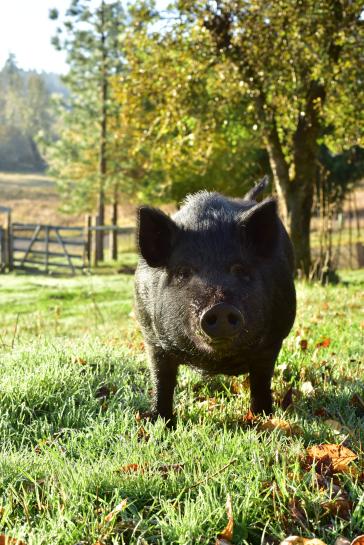

NJB_0992


The Farm Series: Grassward Dairy

Well, hello there. We’re at this moment in Oregon, volunteering on farms and trying to determine if Quiet Farm wants to be born in this place. We planned to spend a month on one particular small goat dairy, but as we know from previous adventures, travel plans don’t always work out exactly as envisioned. So we ended up living in a vintage trailer (oh, the memories) for ten days here at Grassward Dairy, a micro-creamery just outside of a college town we know and love (go Beavs!).

NJB_0979.JPG

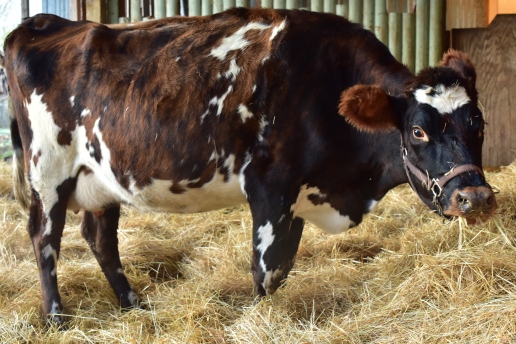
The farmers have to cross a road twice a day to move the cows for milking.

We’ve now worked and/or volunteered on more than half a dozen farms around the world, and every single one is different. Grassward Dairy sits on about one hundred rolling acres along Mary’s River in the southern stretch of the Willamette Valley; in addition to the three milking cows, there are ducks, laying hens, beef cattle, sheep, a donkey, a llama and a rambunctious cattle dog-in-training.

NJB_0713.JPG

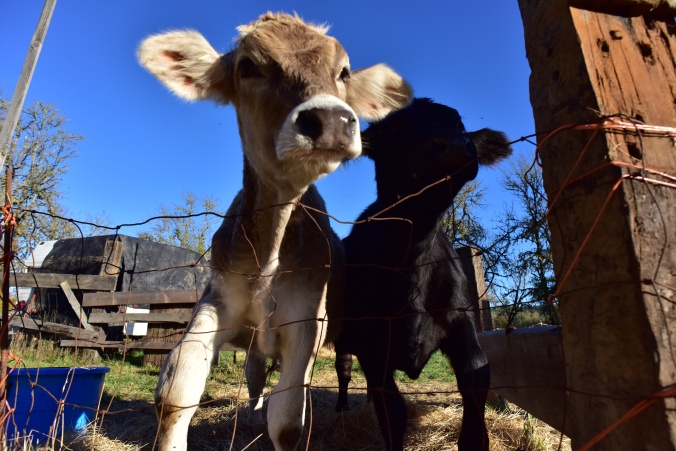
Harold, on the left, and Hazelita are being raised for meat. Hand-feeding them collards and chard was one of the highlights of our time here.

NJB_0810.JPG

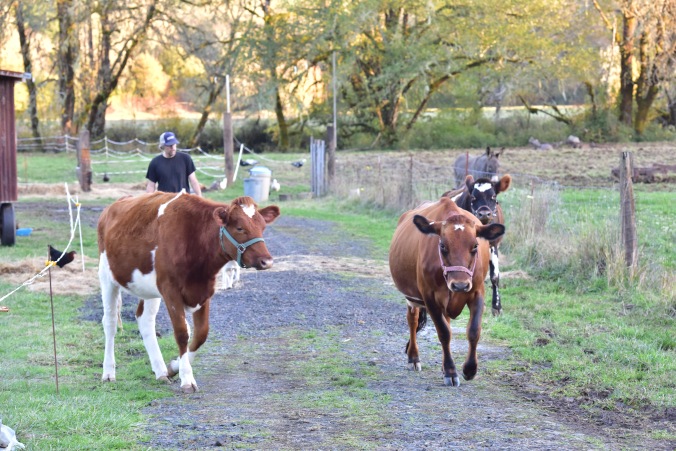
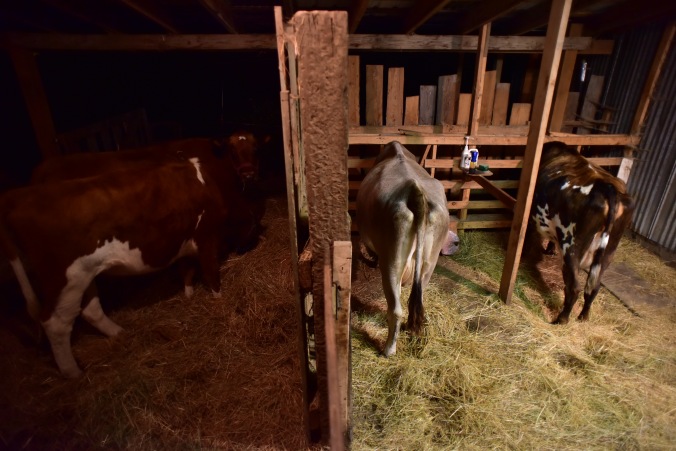
Cows on their way to the barn for the evening milking.

NJB_0970

It doesn’t always rain in Oregon.

NJB_0759.JPG

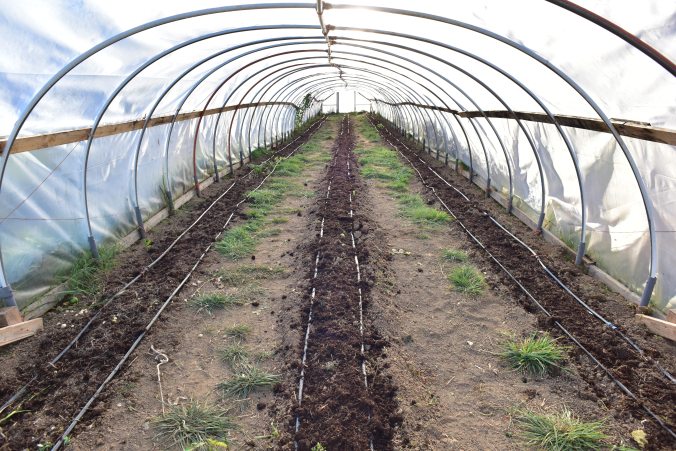
We cleaned out the tomato and pepper plants from this 100-foot hoop house, then prepped and reseeded the beds with winter greens.

NJB_0799.JPG

The guard llama and her flock.

Every farm is unique, and every farm’s business model is unique, too. Grassward Dairy offers a dairy CSA, which means that customers pay a fixed price each month in exchange for fresh raw milk, yogurt, cheese, butter and cream. In this agricultural part of Oregon, it’s easy to eat local just about all year.

NJB_0867.JPG

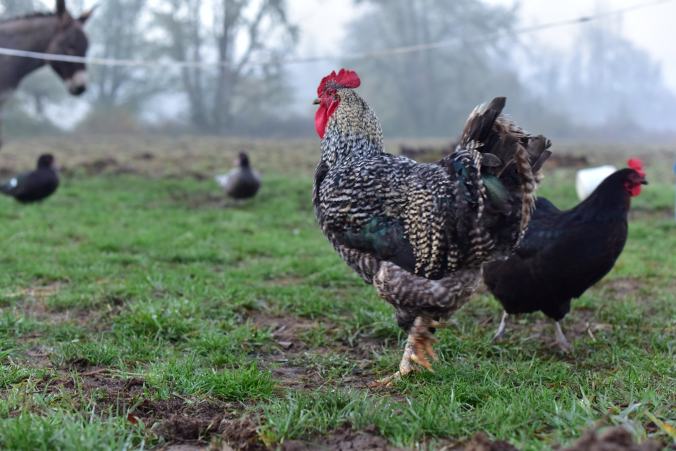
Terry the rooster, with one of his ladies. Muscovy ducks and Florencia the guard donkey can be seen in the background.

NJB_0766.JPG

Hattie, looking regal and proud.

NJB_0913

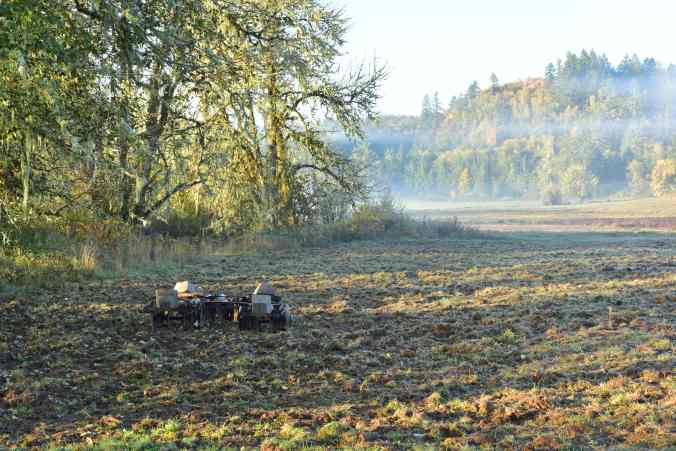
Disking one of the pastures in preparation for cover cropping. While we were there, heavy rains swelled the river and flooded this pasture, among others.

NJB_0824.JPG

The evening milking.

The more time we spend on farms, the more we know this is the right path for us. Many thanks to the team at Grassward Dairy for letting us be part of their farm family for a short time. And if you’re in the area, you can stay there too!


Eating healthy on the road

Oh, the quintessential American road trip. Our country’s iconic open highways have been immortalized in so many classic movies, like when we thought “the Rocky Mountains would be a whole lot rockier.” Or perhaps you need to bootleg a few Coors Banquets from Texas to Georgia? Maybe two legendary ladies in a ’66 T-Bird is more your style? Whatever your favorite road trip film might be, there is no arguing that eating healthy while driving American highways is no easy feat.

IMG_20171014_101120147

Hello Wyoming, and thanks for inventing cruise control. (Photo may have been taken in 1987 or 2017. With filters, who knows?)

I like to move food. It’s my thing. Whenever we leave our house, it’s a guarantee that there are a few canvas shopping bags and maybe a plastic tub or two stacked by the door. We go to my sister’s for dinner and I bring jars of homemade applesauce, fruit leather for my niece (also known as “repurposed jam”) or gorgeous cheese from these lovely folks. My book club ladies leave with end-of-the-garden produce, dinner leftovers and more cheese. And if we’re off on a trip, whether by car or by plane, I simply will not be held hostage by the American industrial food complex.

IMG_0764

Mmmm…McDonald’s or Cinnabon? Why not both?

The vast majority of food in this country is based on two key ingredients: corn and soy. We are very, very good at growing corn and soy, and even better at turning it into cheap meat, soda and processed food. And these “edible foodlike substances” are most of what’s on offer at your standard convenience store or truck stop. And to add insult to injury, it is absurdly priced! I will not play by those rules.

IMG_20171016_204714

Example A, above. Look! It’s a $2.79 “meal replacement bar!” You know, so we don’t have to eat an actual meal! Can you read the first ingredient? It’s soy protein isolate. The second ingredient is sugar, and the third is soluble corn fiber. If all of your standard meals are composed of soy, sugar and corn, then by all means, please choose this as a meal replacement. But this is just one of many examples of a giant, powerful marketing machine that has convinced the American public that we 1. don’t have time to cook and 2. can eat some junk like this with “PROTEIN” printed in large font and call it a meal. No, no and no.

IMG_0760.JPG

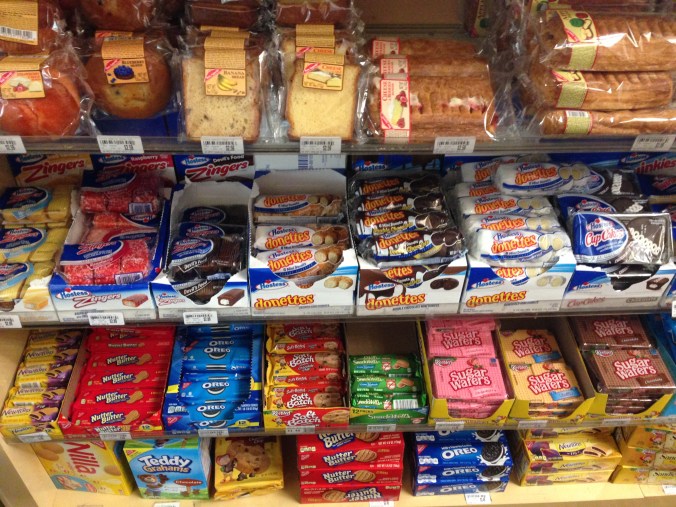
Absolutely no actual food was harmed in the making of these edible foodlike substances.

If you’re on a road trip, whenever possible get off the highway and into a town supermarket. Gas stations, convenience stores and truck stops are by their very nature stocked with cheap, non-perishable food, so that’s what you’ll buy. Their staff has neither the time or inclination to stock and then dispose of fresh fruit, vegetables and meat, so instead you’ll encounter a display like the one above. If you can make it away from the interstate and into a small grocery store, you’ll hopefully have access to a much better selection of food.

IMG_20171015_122515762

I genuinely pity the poor animals who died to make these “meat sticks.” (Also, “thungry?” Is this like “hangry?” Notice that it’s trademarked.)

NJB_0687.JPG

Part of our road trip survival kit.

So what’s a person to do in the face of this pretend food trash? Easy answer: plan in advance. Just like cooking healthy food at home, eating well on the road requires a bit of time and planning. But if you’re already doing other pre-road trip tasks like checking your tire pressure and refilling your windshield wiper fluid, why not get some healthy food in order? For me, it’s mostly shelf-stable items, plus a few perishables in a cooler. My basic road trip essentials, most of which are easily found in the bulk section of a good supermarket:

  • stellar cheese and good crackers are mandatory
  • dried fruit, including figs, apricots and homemade fruit leather
  • fresh fruit that can last, such as citrus and apples (no berries or bananas!)
  • homemade granola, to eat on its own or with purchased yogurt
  • jerky, either homemade or from well-raised animals
  • nuts, which for us are typically roasted salted almonds
  • rice cracker mix, pretzels or other reasonably healthy salty snacks
  • homemade granola or energy bars, or packaged bars with clean labels (be able to pronounce and understand every single ingredient, and the first three ingredients shouldn’t be soy, sugar and corn)
  • good-quality dark chocolate, preferably without soy lecithin

And for equipment:

  • without question, a good chef’s knife and paring knife, protected in sheaths, and a small polypropylene cutting board.
  • we bring our own coffeemaker, grinder, beans and mugs. We sleep cheap, and I’m not drinking Motel 6 coffee. Not negotiable.
  • cutlery rolls, which include an inexpensive metal fork, knife, spoon, reusable straw and corkscrew. We don’t use single-use items, with the exception of compostable paper napkins.
  • Mason jars with screw-top lids and a few plastic containers. These can be used for drinks, storing snacks or to eat meals.
  • a wooden spoon, rubber spatula and metal tongs
  • a small electric burner plus a frying pan and mini stockpot. This makes meal prep on the road easy – and more importantly – possible.

In all honesty, at various stops along this trip I did notice small containers of cut fresh fruit, hardboiled eggs and some seemingly fresh sandwiches and wraps, which indicates that demand is shifting. But there is no guarantee that every gas station will have these, and if you pack your own food you’ll have a much better selection and save a ton of money. I saw two packaged hardboiled eggs priced at $1.99; with a cooler and ice packs, a dozen well-sourced hardboiled eggs, flaky salt and hot sauce can easily be brought along for about $4 and a few minutes’ work in advance. There is simply no one thing you can do to improve both your physical and financial health more than planning, cooking and bringing your own food. Enough said.

Friends, please remember that your health is your responsibility, and what you choose to eat makes a huge difference in your health. Take some time prior to your next trip and bring food along, and stand in opposition to a system that insists you have to eat what it offers.


Cooking Class: Chiang Mai, Thailand

We’re excited to be headed out on the road again, and in that spirit we wanted to revisit some of our favorite moments from our adventures earlier this year. Some weeks back, we shared a cooking class we had taken in Udaipur, India. And as we’re in nostalgia mode, and I’ve got Thailand on my mind since I just spent time talking to a friend about his trip, let’s return to Chiang Mai and a fabulous cooking class we experienced there. Like our Indian class, this day out was one of the highlights of our trip to southeast Asia.

Thai dessert bowl

Looks like Thai green curry, but it’s actually dessert: sweet rice pudding with bananas and coconut milk.

Thai rice market

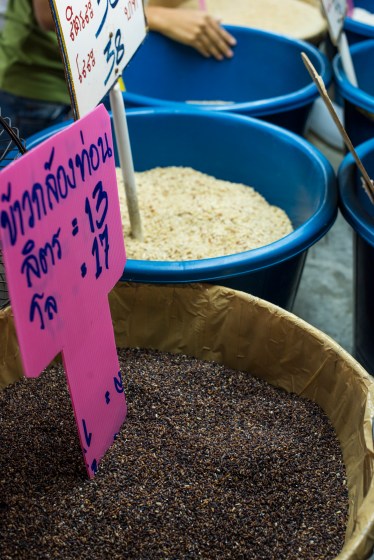
Dozens of varieties of rice are for sale at the market.

Thai ingredients market

Fish sauce, a key ingredient in southeast Asian cooking.

We started our cooking class at one of the many local markets, where we sampled various ingredients and drank cold, sweet Thai iced coffee. While the cooking school has an extensive garden and grows many of their own herbs and spices, they still need to shop for a few things. Many Thai homes don’t have refrigeration, so shopping each day for fresh ingredients is both a pleasure and a necessity.

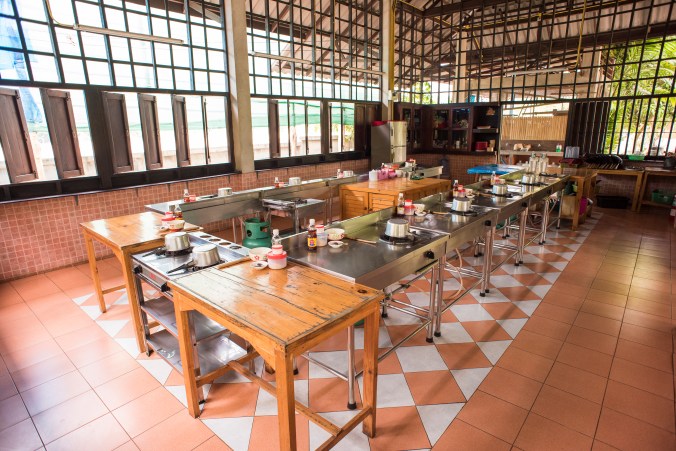
Thai cooking tables

We’ll grind our curry pastes and chop our ingredients here.

We left the market and traveled by minibus to the school, where we were offered iced jasmine tea and given a tour of the property. The cooking school is perfectly set up to accommodate guests, with spaces for prep, cooking and eating together.

Thai garden chilies

Tiny, fiery Thai bird chiles. Typically, the smaller the chile, the bigger the punch.

Thai ingredients basket

Fresh herbs and aromatics, just harvested.

The cooking school has acres of gardens, where they grow lemongrass, basil, coriander, mint, galangal, ginger, kaffir lime, chiles and many other ingredients for their classes.

Thai cooking kitchen

Our indoor-outdoor kitchen, with cooking stations set up for each student.

Thai ingredients board

Thai ingredients bowls 01

Thai ingredients bowls 02

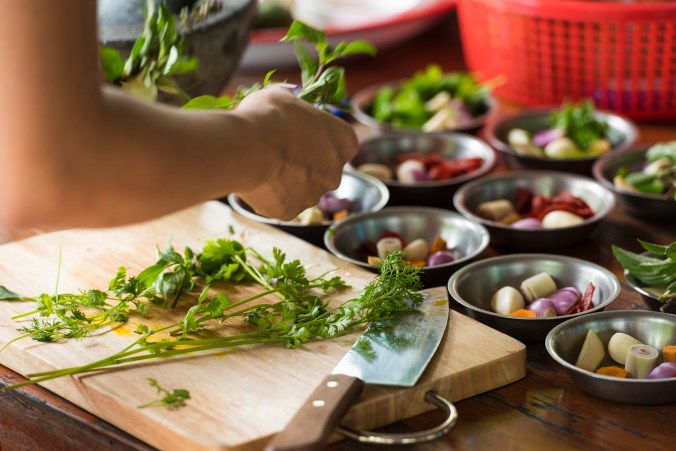
All of the components for the recipes we would make in class were neatly laid out for us. I emphasize this classical French technique a lot in my own cooking classes: it’s called mise-en-place, and it literally means “to put everything in its place.” When you’re cooking, assemble all of your ingredients like this in advance; it may seem tedious and time-consuming, but it actually makes preparing your dish much, much easier. Trust me.

Thai cutting board spoon

Fresh herbs and tamarind paste, like fish sauce, are key to classic Thai cooking.

Thai pestle mortar table

Although you can of course make curry paste in a blender, traditionally it’s prepared in a stone mortar and pestle.

Thai pestle mortar

Grinding aromatics for red curry paste.

Thai wok stir-fry veg

A wok allows for quick, high heat, so vegetables and proteins remain crisp and fresh.

Thai wok stir-fry tofu

Pad thai, a favorite Thai dish. In Thailand it’s not quite as sweet as it often is in America.

Thai red curry

Vegetarian red curry soup. Good Thai food is most often a delicate balance of hot, sour, salty and sweet.

Craving some Thai food after reading this? Me too. Try here, here or here. And if you have the chance, definitely book a cooking class on your next adventure. It’s well worth the time and money to cook and eat like a local, if only for a few hours.

On the road again + best travel tips

It’s early October, cool and crisp. N and I have been home from our round-the-world adventure for about four months, and it’s time to go again. We’re at the moment in a flurry of last-minute preparations to head to Oregon for a month, where we’ll volunteer on another goat dairy. This trip is quite a bit easier than the last one: no worrying about visas or passports, no cramming everything into just one bag, plus we’ll only be gone for one month, instead of five. But in the spirit of adventure, we thought we’d share some of our most useful travel tips, gleaned from nearly two decades (!) of short- and long-term travel.

Travel Books.jpg

There are vacations, and then there are trips. One could argue that a trip is a bit more serious than a vacation; it might last for more than a month and involve a committed disentanglement from the everyday world. And nowadays, with opportunities for remote work increasing, it’s more likely that you might be able to swing that four-months-or-more abroad plan you’ve been ruminating on for ever so long. Below, our most useful tips for those of you who might be thinking about making the leap from a standard holiday to a trip.

  • Identify – roughly, at least – what you expect to get out of your travel. If you’re just traveling to capture Insta followers or get paid for blogging, fair enough. Or if you’re running away from a difficult situation, be honest about that, too. But don’t go traveling without at least a reasonably clear idea of what you hope to accomplish. Any less, and you’re asking the travel itself to do all the work. You have to show up, too.

Travel Blur.jpg

  • Make a budget. Then increase it by 25%. The old adage goes like this: “Lay out everything you think you need. Then take half that and twice the money,” and it holds true. For our five months overseas, we budgeted generously for two adults and still went over that number by 20%. They may say that the best things in life are free, but the truth is that travel costs money, and there is no glory in arriving back in your own country completely, totally broke. Account for the unexpected; for us, that was the high cost of point-to-point travel in Japan and unexpected gratuities required literally everywhere in India.
  • Ensure your passport is valid for at least six months beyond your return date. This seems like a surprisingly obvious tip, but you’d be amazed at how many travelers are caught out by it. Different countries have different requirements, but having at least six months’ validity, plus at least three or four blank pages, in your passport will make border crossings much easier.

Travel Diary.jpg

  • Please, research your destinations – and their visa rules – before you go. Again, different countries have different requirements and all of this information can easily be found online, most likely through your home country’s government. “I didn’t know” is simply not a valid excuse at any international border crossing.
  • Also, do a bit of research on your destinations and their customs. In many countries, it’s not appropriate to show shoulders and/or knees. Women might be expected to cover their heads. Certain countries may only eat with the right hand. Knowing this in advance can save a lot of awkwardness once you arrive, and you should always, always be respectful of the customs of the country you’re visiting.

IMG_20171011_095945299.jpg

  • If possible, sign up for a debit card that reimburses ATM fees. In the U.S., Charles Schwab provides some terrific options that can save you a lot of money. Find out if any banks in your country offer similar programs because ATMs are simply the very best way to withdraw local currency and avoid usurious fees. Money changers – especially in airports and train stations – should be used as an absolute last resort. (Thanks, India, for only having broken ATMs in your airports so we were forced to use money changers.)
  • Get travel insurance, and know its limitations. There are a number of great plans out there, but they vary enormously based on your home country and where and how long you plan to travel for. Do your research and don’t skimp on the essentials, and make sure you understand what will be covered if you’re required to be repatriated to your home country for additional treatment. Oh, and know that you’re rarely, if ever, covered for high-risk activities like skydiving, bungee jumping and so on.

Travel backpack.jpg

Five months in just one backpack each.

  • Pack less than you think you need, and buy your travel clothes at your local Goodwill or op-shop. It sounds counterintuitive, but you actually need far less for travel of more than two weeks than you do for a standard holiday. Bring some concentrated biodegradable laundry soap, and get used to washing your smalls in a hostel sink. Pegs and a simple washing line come in handy, too. Don’t take any article of clothing that you absolutely treasure – my favorite jumper is lost forever somewhere on an Indian train, or hopefully keeping someone else warm. You can always buy things on the road and donate what no longer serves you.
  • Ziptop bags, duct tape, safety pins and a small sewing kit are absolute necessities. If there is one thing that long-term travel teaches you, it’s to be resourceful with what you have. Especially if you’re traveling extensively in underdeveloped countries, you’ll find that things we take for granted at home aren’t always available. Being able to successfully repair your own kit is good for the wallet and the psyche.

TajMahal 1.jpg

Oh, this? Just doing a few renovations at our summer cottage.

  • Identify your priorities, and leave the rest to chance. In any country, there will be a few must-sees. Choose your top two or three mandatory sights, and let the rest of your trip happen as it will. Serendipitous travel moments rarely occur when every single second is carefully plotted out.

Above all else, go. Don’t let this or any of the billions of other pre-travel posts out there scare you – just go. There are few experiences in life as enriching as long-term travel and it will change you in ways you never even knew were possible. Grab your passport and your backpack and get out there. The world needs you.


Backyard chickens

We have made no secret here at Finding Quiet Farm of our love for backyard poultry. Honestly, what is there not to love?

Black Star

A Black Star from our most recent flock.

They monitor the rodent population. They keep weeds under control. They are ridiculously entertaining. And most importantly, they turn food waste into incredible eggs.

Pullet Silver Wyandot 01

Our young Silver Wyandotte pullet at about six months.

Pullet Barred Rock 02

Lovely, but these chickens are NOT supposed to be in these raised beds.

Okay, sometimes they (repeatedly) escape the run you’ve so carefully built and they eat your tomatoes. But the eggs are worth it, we swear.

chickens4

A Barred Rock (upper left) and a Silver Wyandotte.

chickens2

A strong, proud Australorp, one of our favorite breeds.

We’ve had two flocks now at our suburban home, and we encourage the entire universe to keep backyard chickens. They’re less work than dogs or cats, with more reward. They need food, clean water and shelter, of course, plus the ability to run around and eat bugs and weeds and kitchen scraps and what-have-you, and they need protection from predators. Where we live, those are unfortunately rampant – hawks, owls, raccoons, foxes, dogs – but thanks to N’s superlative coop-building skills, we never had a single bird taken.

chickens1

The windfall apple clean-up crew.

If you’re thinking of adding chickens to your family homestead, check your local regulations first. We’re allowed five hens and no roosters where we live, but laws vary widely from city to city. Know what you’re buying, too; many a rooster has ended up abandoned at a shelter because it was sold as a hen. It’s not common knowledge, but you don’t need a rooster to get eggs – and they’re illegal in most communities.

Garden Snow 02

Winter is coming. Seriously. And the chickens need to stay warm.

If you live in a particularly cold area, make sure to buy cold-hardy breeds and that your coop protects your birds from winter drafts. It’s actually easier for birds to stay warm than cool (those trusty feathers) but icy winds can be very detrimental to their health. When planning your coop and run, keep in mind that chickens also need adequate shade in hot summer months. Keeping their space clean and dry doesn’t take much time or effort, and you’ll be amply rewarded.

chickens3

Chickens are not vegetarians, no matter what your egg carton says.

Oh, the “vegetarian-fed hens” you see advertised on your egg cartons? They’re only vegetarian because they’re crowded into miniscule cages and don’t have the opportunity to eat what they actually want to eat, which is mice. And bugs. And lettuce. And sandwich crusts. And overly ripe peaches. And leftover sausage bits. And the aforementioned tomatoes. Chickens are omnivores, not vegetarians. Please remember that the next time you buy eggs, and don’t be swayed by meaningless packaging terms – or by bucolic pictures of peaceful, verdant farms. In the U.S., at least, laying hens have by far the worst lives of any production animal.

Chicken eggs

Small pleasures: collecting still-warm eggs from nest boxes.

None of the other labels on your egg carton mean anything either, by the way. Whether “farm-fresh” or “natural” or “pasture-raised,” not one of these is regulated by any governing body. You can pretty much slap whatever you want on an egg carton and call it good, and people will pay more for pretty words that make them feel better. “USDA Organic” is actually regulated – if they can find enough inspectors to do some real inspecting – but it only indicates that the chickens consumed organic feed, not that they had any sort of decent life. Well over 95% of all commercially produced eggs in the U.S. were laid by hens who lived their entire lives in less space than a standard piece of paper. They never went outside, they never hunted or pecked, they never dust-bathed,  they never saw sunlight or grass, they never even flapped their wings because they didn’t have enough room. That’s why eggs are cheap, and also why salmonella outbreaks are rampant. Bottom line: buy your eggs from someone you know.

Eggs Thai pink

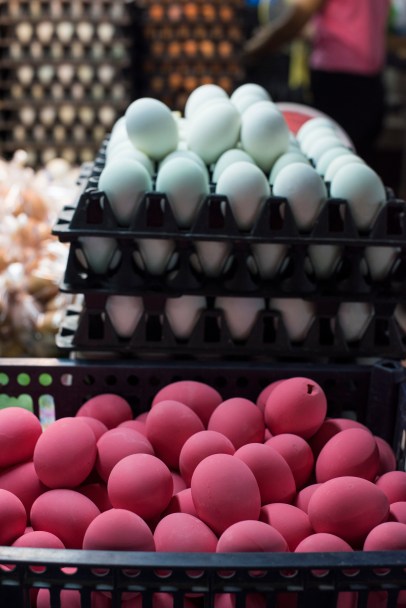
Eggs for sale at a Thai market.

Americans are often shocked when eggs in Europe and elsewhere in the world aren’t sold in the refrigerated section. Yet another example of our obsession with “safety” and “hygiene,” in this country we wash all eggs prior to shipping and sale at grocery stores, superstores and warehouses. This removes the protective coating that eggs are laid with, and reduces their shelf life, thereby requiring refrigeration. Eggs in the rest of the world aren’t washed until they’re used, and so can be stored at room temperature.

Eggs Basket

Although brown eggs will cost you more at the grocery store, there is no nutritional difference. The color of the shells is determined by the chicken’s breed, not by what it eats or where it lives. Most supermarket eggs are white because they were laid by Leghorns, the most common breed in the U.S., whereas brown supermarket eggs were probably produced by Rhode Island Reds. Blue and green eggs come from Araucanas and other unique breeds. You’re not getting any extra nutrition by paying for brown eggs.

Eggs Comparison

There really is a difference between eggs laid by battery hens and those laid by true free-range birds. Notice the backyard egg, on the right: the white is thicker, with more color and viscosity, and the yolk is definitely more yellow. This indicates a varied diet, including foraged protein.

Eggs Frying Pan

And when they’re cooked, the backyard egg (again on the right) stays true and tall, but the battery egg sort of melts. Supermarket egg yolks are weirdly chalky and sticky when cooked, while backyard eggs have a buttery creaminess. The taste difference, honestly, is night and day. Good eggs taste the way eggs ought to taste, instead of some insipid manufactured version thereof.

Eggs

According to legend, the one hundred pleats in a chef’s hat represent the number of ways they know how to cook eggs.

Whether or not you keep chickens at home, know that eggs from well-kept hens are one of the best inexpensive protein sources available. Ask at your local feed store or farmers’ market to find eggs raised near you and support backyard poultry, or start your own flock! Go here to learn more.


Food waste + helpful tips!

Thankfully, we’re finally, finally talking about food waste in the U.S. Chefs have long been painfully aware of the staggering quantities of perfectly edible food thrown out in restaurants and hotels on a daily basis, but only recently have we started discussing how much food is wasted in grocery stores and, more personally, at home.

Waste tomatoes

Trash tomatoes at a greenhouse operation in eastern Colorado.

I want people to cook at home, obviously, and I also want people to save money. I teach classes on how to reduce food waste, and I typically cite statistics like “40% of all edible food produced in the United States is thrown away uneaten” and “The average American family throws away over $2,000 worth of food every year.” I like to augment these cheery facts with even more cheery facts, like that the annual value of all edible food thrown away worldwide is over $3 trillion. That, however, isn’t even a comprehensible number, nor is the idea that food waste takes up more space in landfills than any other item – including the devil of them all, disposable diapers. Decomposing food contributes more methane to the environment than all livestock together; if food waste were a country, it would be the third-largest polluter in the world, after the U.S. and China.

Waste strawberries

All destined for the trash and no, they won’t be composted.

Let’s be realistic: I can drone on and on, citing all sorts of numbing statistics, but it makes for boring reading and quite frankly, no one really wants to read a blog where they’re lectured for their appallingly bad habits. Plus, eco-anxiety is an actual thing, and many of us, myself included, feel utterly powerless about our ability to do anything in the face of insurmountable problems like climate change. But minimizing your own food waste is something you can actually do to both save money and save the planet, rather than just wring your hands helplessly. So let’s keep it a bit more positive and I’ll just present a professional chef’s tips for minimizing food waste at home!

Zuccini

We grew these! Unfortunately, only one would be saleable at a standard grocery store. Our aesthetic expectations are utterly unrealistic.

But wait! Before we get into the helpful tips, let’s boost our positivity even further by highlighting organizations actually doing something about food waste!

Cucumbers

We grew these too! Same story as the zucchini above; only one is the correct size.

Americans throw away food for lots of different reasons – mostly because food here is cheaper than anywhere else in the world, and we’re really picky – but at home there are two key factors: meaningless expiration dates and poor planning. A bit of effort on your part will not only save you lots of money, but also keep food out of landfills. It’s a true win-win! (Fun fact: sell-by dates were introduced in Marks & Spencer storerooms in the 1950s; they first appeared on consumer-facing shelves in U.S. and Europe in the early 1970s.)

Waste Honey Jars

Honey doesn’t spoil. Ever. It’s been found in edible condition in Egyptian tombs. So why the expiration date?

At the Store:

  • Shop with a list and buy only what you need. Before going to the store, check out the coupons and promotions. Make a meal plan for the week and incorporate ingredients on sale, and review the contents of your pantry, refrigerator and freezer. How will you know what you need if you don’t know what you have?
  • Avoid “bulk club” buys unless you’ll actually use it. Warehouse-style shopping – i.e. ten pounds of spinach or quinoa – might seem like a bargain at the time, but if you let it spoil it just means money wasted. It seems counterintuitive, but there are times when spending more for a smaller amount is the better choice. Be honest with yourself about how much your household will actually eat.
  • Use the bulk department for spices, grains, beans and more. In addition to reducing packaging, you can buy exactly the amount you need and try lots of new ingredients too!
  • If you only need a tiny amount of an ingredient, consider the prepped food available in the store’s salad bar. This might avoid buying an entire package that you’ll then throw away, plus you’ll save on prep time.
  • If you only need half a cabbage or a tiny portion of cheese, just ask nicely. Most stores will be happy to provide exactly what you need instead of what they’ve already packaged.
  • If you’re going to buy a special, expensive ingredient for one recipe, figure out other recipes in which you can also use that ingredient rather than wasting it.
  • If you shop at your local farmers’ market and you’re planning on doing any canning or preserving, buy seconds. These are just as delicious as the first-run produce, but you get to pay less and your farmer doesn’t have to throw their hard work away.

Waste Salt

It’s a rock. I’m fairly certain we will expire long before it does.

At Home:

  • Most importantly, remember that all best-by dates are only a guideline. Please, use your common sense when deciding whether to throw something away simply because an unregulated date on the package says to. These dates are totally confusing, essentially meaningless and they contribute hugely to our food waste issue.
  • Shop from your own pantry and challenge yourself not to buy food for a week, two weeks or a month. Use up everything you have before buying more.
  • Learn to repurpose your food: when you make your weekly meal plan, also consider the meals you’ll make from the leftovers. Batches of whole grains or rice can be used for numerous meals.
  • Store your produce properly. Certain items should stay on the counter (tomatoes!) and others should go in the fridge (apples!). Know how best to keep everything fresh.
  • Use your freezer – if you’re not going to use something, freeze it. Bread freezes beautifully, as do most vegetables, meat and fruit. Use small containers and wrap items well; label and date everything.
  • Portion control is important. Start with a small amount on your plate, and get seconds if you want them rather than taking a huge serving and throwing most away. This goes for serving kids, too.
  • Devote one dinner per week to “favorites,” and eat leftovers rather than throwing them out.
  • Start a compost bin and be amazed by how much less trash your household produces; the compost you make will do wonders for your vegetable garden. Even better: get a flock of backyard chickens and enjoy fresh eggs while they enjoy your fruit and vegetable scraps.

Waste compost

Our compost pile looks a mess, but it turns into the most incredible soil.

What can you make with random odds and ends?

  • It mystifies me that people regularly throw away bread and buy croutons. If you’ve got stale bread, you’ve got croutons, crostini and bread crumbs. Tear or cut bread into chunks, toss it in a little olive oil, salt, pepper and garlic powder and toast in a 300 degree oven until golden and crispy. Slice slender baguettes into thin slices for crostini and toast as for croutons. Store in an airtight bag. Process in a food processor or blender to make bread crumbs; store crumbs in the freezer.
  • Just about any listless vegetable can become part of a delicious soup. Dice vegetables into small pieces, simmer in stock, and finish with a drizzle of good olive oil and a sprinkling of sharp cheese.
  • Tomato sauce can take a lot of extra vegetables without you even noticing! Add in not-so-perfect carrots, celery, greens, onions, squash…and puree the whole thing. The tomatoes will dominate, trust me.
  • And all those vegetable trimmings from your soups and sauces? Add onion tops, celery leaves, carrot peelings and other odds and ends to a zip-top bag and store in the freezer. When it’s full, simmer to make homemade vegetable stock. Add chicken or beef bones too, if you’ve got them.
  • Parmigiano rinds are every Italian grandmother’s secret to the most flavorful soups, stocks, broths and risottos. Store in the freezer and use as needed for extra umami punch.
  • Fruit no longer nice enough to eat fresh? Cut it into small pieces and freeze it on a cookie sheet. Once frozen, transfer the chunks to a zip-top bag and use for smoothies.
  • Speaking of smoothies, all your greens – kale, spinach, chard – can be thrown right in with your fruit and yogurt. You might notice the color, but you won’t notice the taste.

Above all else, consider the amount of time, effort and money that went into the food you’re eating – and respect that by treating it carefully and mindfully!

Hive inspection

Back in late July, we showed some photos of our beehive. A few weeks later, we opened the hive again for a summer inspection and wanted to share those pictures here too. As we’ve said before, we’re new to beekeeping, but we’re learning more every day.

Equipment.jpg

Necessary equipment: veil, smoker, pry bar and support frame.

Smoker Ignition.jpg

Lighting the smoker.

Smokers are commonly used by beekeepers when opening and inspecting hives. The smoke is thought to dampen the guard bees’ pheromone response, allowing the beekeeper to open the hive without a defensive reaction. This does not mean, however, that beekeepers don’t get stung – but the goal is to minimize the stings, because those are harmful not only to the beekeeper but obviously to the hive, too, as the bees die once they’ve stung. Good beekeepers want to reduce unnecessary bee death whenever possible.

Smoker Entrance

Smoking the hive in preparation for opening.

Hive Opening.jpg

Carefully opening the hive. (I am very helpfully holding an enormous sunflower stalk out of the way.)

Beekeepers traditionally wear white because large predators of hives – bears, raccoons, skunks – are overall dark in color. It is thought that the bees will be less stressed, and therefore less likely to attack, if the beekeepers are clothed in white. In South America, however, beekeepers most often wear red.

Honey Super.jpg

The inner workings of our Langstroth hive.

Frame Opening.jpg

Removing the frames one by one.

Frames 02.jpg

It is such a thrill to see so many healthy, thriving bees!

Frame Inspection 05.jpg

Frame Honeycomb.jpg

Honeycomb! We’ll leave some for the bees’ winter food supply, and hopefully there will be enough for us, too.

Frame Inspection 06.jpg

Can you spot the queen? I couldn’t.

Hive Open.jpg

Our hive without its top box and cover.

Hive Closing Up 02.jpg

Closing up the hive.

We’re hoping we’ll be able to harvest some of that gorgeous honey you saw above in a few weeks, before the weather turns. Stay tuned!

P.S. Jim, you’re the best. We couldn’t do this without you. Thanks!


Cookbook Club: Full Moon Suppers

It will come as precisely no surprise to any of you that I have what some might consider an excessive cookbook collection. I try to keep it pared down – honestly, I do – but then every October the local library has their annual book sale where you get to fill shopping bags for $6 each and I just lose any ability I might once have had to act like a rational adult. It’s true. And no one will ever, ever help us move.

Peach Cake Cook Book.jpg

Not long ago, this cookbook crossed my path, and it is pure and simple and lovely. As a professional chef, I know that most cookbooks are used by home cooks, and therefore I am infuriated (not too strong a word) by gorgeous, glossy, overproduced cookbooks with fabulous photos where the recipes don’t actually work. Home cooks, especially those just starting out, don’t need perfect photos of airbrushed superstars (or blog stars) happily munching on avocado toast. What they need are clear, easy to-understand recipes that have been tested many times, in many kitchens (preferably home kitchens), with variable equipment. And possibly not all of the correct ingredients.

Peaches Garden.jpg

The last of the season’s stone fruit. 

Annemarie Ahearn has been cooking and farming on her family’s property overlooking Penobscot Bay, Maine, since 2009. As she says,

“I had not moved to Maine on a whim. My plan was to open a cooking school for home cooks and teach people how to grow a kitchen garden. The mission of the school aligned with my personal ambition, which was to fundamentally change my daily routine. City life, while rich with professional opportunity, did not feed my soul in the way that I was hoping a more rural life would. And what better place to experience nature than on a farm, nestled between the mountains and the sea? So many skills that my grandmothers and generations prior to theirs possessed I did not know the first thing about. Chopping wood for warmth, putting up preserves for winter, catching a fish for dinner and raising laying hens for eggs were all efforts that I wanted to experience firsthand.”

The book is broken into twelve menus, appropriately themed to the twelve months of the year. Her recipes are simple, seasonal and easy to follow, and every single one pays homage to the land above all else. I can’t get the quality of Maine lobster that she has, nor fresh periwinkles, but there are plenty of recipes here that could easily be made across the country, depending on the season. We haven’t been to Salt Water Farm (yet), but we feel a definite kinship between the cooking and farming life Annemarie has forged for herself on Maine’s rocky, windswept coast and the cooking and farming life we want to build at Quiet Farm, wherever that may be.

Tomatoes Green.jpg

Please ripen before first frost hits…

I’ll be completely honest and say that I’m a little late on this post, but truly that’s only because I was (im)patiently waiting for our tomatoes to ripen so I could make a glorious summer salad. Salt Water Farm has a short growing season too; they treasure their warm-weather peaches, tomatoes and corn just as we do at nearly six thousand feet in the Rocky Mountains. You work with what you have.

Lovage G&T.jpg

Cocktail hour is my favorite hour!

Each of the twelve menus in Full Moon Suppers starts with a paired beverage. N and I really only partake of gin-and-tonics in summer; they seem to suit the weather so well. I’ve seen a couple of recipes this summer encouraging the use of lovage in a simple syrup to add to G&Ts or sparkling water; since I have an abundance of lovage that I leave for the bees every year, I thought I might as well use it. The syrup is truly simple: combine two cups water, two cups sugar and bring to a boil. Add eight cups roughly chopped lovage, remove from heat and allow to cool completely while lovage steeps. Strain into a clean quart jar and store in refrigerator. It’s herby, grassy and deeply refreshing, whether in a cocktail or sparkling water. I’m surprised by how much I like it.

Tomatoes Tray 02.jpg

Tomato Cucumber Salad.jpg

I know that I said previously that once you finally have ripe tomatoes, you should only anoint them with olive oil and salt. But really, you should also find some amazing local sweet corn (I froze all my excess from this event) and some fresh cucumbers and you should make this salad. It has a simple vinaigrette made with lemon and mustard and honey and red wine vinegar, and honestly, it tastes like summer in a bowl. This is not a salad you’d make any other time of the year – only when the ingredients are at their absolute very best. And that window of opportunity is very swiftly closing.

Peach Cake Recipe.jpg

Peaches Tray.jpg

And then there’s the peach cake, although in my world it’s a peach and nectarine cake, plus I added almonds to complement the almond flour and for extra crunch. Oh, and I just served it with mascarpone rather than sweetened whipped cream. (It’s exceedingly difficult for me to follow recipes exactly.) But this one is worth the time and effort, and even though it takes forever to bake, you’ll be rewarded. The butter creates a gorgeous, rich crust, but the interior is as soft as a dream. And this would work beautifully with home-canned peaches, too, should you be so inclined, so you can make it more than two months of the year.

Peach Cake Uncooked.jpg

Peach Cake Cooked.jpg

Peach Cake.jpg

Peach Almond Cake with Mascarpone

Chef’s Notes: As mentioned above, I included 1/2 cup slivered almonds in the batter; incorporate these with the dry ingredients in the first step. I used a combination of ripe peaches and nectarines, and I served the cake with just a dollop of this plus additional sliced fresh peaches and nectarines on the side. No additional alterations are needed to bake this cake in the Denver area, although above 7,000 feet you may wish to make adjustments. This cake counts as breakfast, in case you’re wondering.

For The Cake

  • 1 cup all-purpose flour
  • ½ cup almond flour
  • ½ tsp. sea salt
  • 2 tsp. baking powder
  • 9 tbsp. unsalted butter, softened to room temperature
  • 1 heaping cup sugar
  • 3 extra-large eggs, at room temperature
  • 1 tsp. vanilla extract
  • ¾ cup cream
  • 4 large, pitted peaches, thinly sliced
  • 2 tbsp. melted butter

For The Cream

  • 2 cups heavy cream
  • 1 tbsp. sugar
  • ½ tsp. vanilla extract
  • ½ cup mascarpone
  • confectioner’s sugar for dusting
  

Directions

Preheat the oven to 375°. Line the bottom of an 8-inch springform pan with a round of parchment paper. Butter and flour the sides of the pan.

In a medium bowl, combine the all-purpose flour, almond flour, salt and baking powder. With a stand mixer fitted with the paddle attachment, whip together the butter and sugar. Incorporate the eggs one at a time, whipping well. Whip in the vanilla extract. Mix in a third of the dry ingredients, then a third of the cream. Continue alternating the dry ingredients and cream in thirds, scraping the sides of the bowl in between additions.

Pour the batter into the prepared cake pan. Spread the peach slices on top and press them into the dough. Brush with melted butter. Bake for 1 hour, or until the cake has set and turned golden on top. The cake is done when you insert a toothpick into the center and it comes out clean. Allow to cool on a rack; serve slightly warm or at room temperature.

Using your stand mixer fitted with a whisk, whip the cream with the sugar and vanilla extract until soft peaks form. Fold in mascarpone.

Serve slices of cake on individual plates with a generous spoonful of cream and a dusting of confectioner’s sugar on top.

(All recipes reprinted with permission from Full Moon Suppers at Salt Water Farm by Annemarie Ahearn and published by Roost Books, but the photographs are N’s!)