Hi there, friends. How are you? I am in no way ignoring the state of the world, so this chitchat feels remarkably discordant. However…here are some books I’ve read recently.
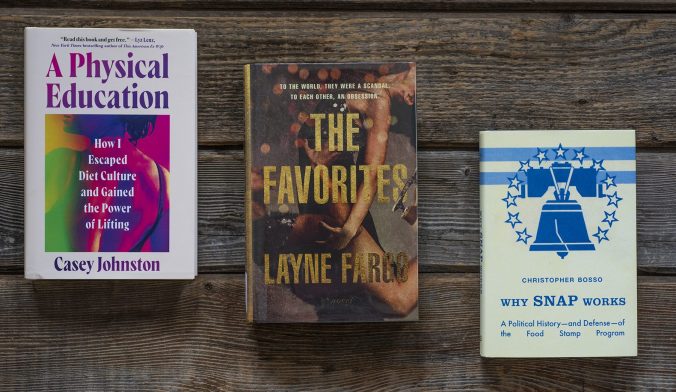
A Physical Education, Casey Johnston
Let’s sum up diet culture like this: so many of us women strive endlessly to make ourselves “healthy” (read: smaller) by actively making our bodies weaker. We are told again and again, every single day, in a million noticeable and hidden ways, that we only have value when we take up as little space as possible. And we buy into it, again and again, every single day. “I’ll just have a side salad!” / “Oh, I really shouldn’t eat that!” / “I’ll need to spend hours on the treadmill running that off!” / “I’m fine with just this protein bar!” We have been drowning in this profitable torture chamber forever, and SkinnygirlTM influencers promoting “summer beach bodies” still chase us everywhere – but if diets actually worked, where is the evidence? (Any writer actively researching diet culture will tell you that keeping women focused on their appearance and weight rather tidily prevents them from focusing on the entrenched capitalist patriarchy determined to lock them into second-tier status.) Johnston spent years (decades?) restricting herself, limiting calories, doing hours of cardio, depriving her body of nutrients, only to realize that she could find and reclaim her power with weights! Heavy ones! In a gym full of jacked dudes! Loved every page of this book, and love Johnston’s entirely refreshing fitness philosophy; her newsletter is also terrific. Strength training for everyone (but especially women)!
The Favorites, Layne Fargo
I will be neither the first nor the last person to phrase a review of The Favorites as “Daisy Jones & the Six set in the world of competitive ice dancing,” but the comparison holds. Read this if you’re a fan of Taylor Jenkins Reid and/or you love ice dancing and/or you enjoy a distinct anti-Russian sentiment threaded through your novels. A quick, propulsive read, but escapism of the highest order. Recommended.
Why SNAP Works, Christopher Bosso
This excellent explanation of the United States’ largest, most comprehensive and most effective anti-poverty program was only published in late 2023. It’s an incisive, deeply-researched, carefully-written book – and it’s also now painfully, terrifyingly obsolete, based on the likely impending cancellation of 30% or more of the current SNAP programming, which supports about 40 million Americans. Assuming this devastating bill passes, and it most likely will, millions of people will be forced to visit food pantries, which of course are already under severe strain. Why SNAP Works is a terrific introduction to large-scale food policy and access issues; I would have liked for the book to include more information from both SNAP users and from small farms who also benefit by accepting SNAP payments, especially through DoubleUp Bucks programs. The SNAP program wasn’t perfect (far too many benefits funneled to commodity megafarms), but it did a remarkable job given its scope and scale. In order to provide tax breaks for billionaires, however, we have voluntarily chosen to take food from impoverished children, disabled folks, and the elderly. SNAP will be yet another program that we won’t fully appreciate until it’s gone. Make America Cruel Again, indeed.

Margo’s Got Money Troubles, Rufi Thorpe
Professional wrestling, OnlyFans and unwanted pregnancy – what’s not to love? Truthfully, I’m unclear on my feelings about this book. Margo is a mostly adrift college student who stumbles into an ill-advised affair with her married professor, many years her senior. When her decision to keep the baby forces her into the world of mostly responsible bill-paying grown-ups, she starts an OnlyFans account and hilarity ensues. Sort of. Her broken-down addict father, a former pro wrestler, moves in, and she’s obligated to prove to her baby’s father that she is adult enough to maintain custody, while of course building a profitable career as a sex worker. Many reviews call it ‘feel-good,’ ‘heartwarming’ and ‘charming, and the characters and storyline are quirky and modern, but this ends up mostly as a happily-ever-after while glossing over doxxing, the realities of sex work, partner violence, addiction and quite a few more issues. A troublesome book, but the audio narration by Elle Fanning is truly spectacular.
Care and Feeding: A Memoir, Laurie Woolever
While Woolever has published a number of books, mostly in partnership with and/or about Anthony Bourdain, this is her first in her own voice. I approached this as a traditional memoir, but in truth this is squarely in the addiction memoir genre – Woolever spends approximately 90% of her time very drunk, very stoned or both. She was an assistant to both Mario Batali and Anthony Bourdain, and I spent much of the book frustrated with her incredible good fortune and her seeming inability to appreciate that same good fortune – despite her appalling behavior, total lack of sobriety and stunningly poor choices, she never seems to screw up, or at least not enough to derail a fantastic career. This woman is simply relentlessly self-destructive, and she takes out many other people on her path to personal immolation. There are some laugh-out-loud funny moments in the book, but there is also a lot of pain, a lot of escape, and a lot of incredibly self-absorbed, idiotically stupid and pointlessly careless behavior. A difficult read, entirely lacking in redemption and self-awareness. Care and Feeding left me feeling sad and queasy.
Cellar Rat, Hannah Selinger
Another restaurant/food memoir but an even tougher and less-enjoyable read. Selinger spent years in New York’s restaurant world and some twenty years on she’s still really angry about her treatment during that time. There is quite a lot of humble-bragging and name-dropping here; anyone who has spent a minute working in fine dining knows that it’s an incredibly toxic, deeply sexist, and seriously abusive (substances and otherwise) environment. This is not exactly revelatory. Selinger doesn’t actually seem to have any passion for food, wine or hospitality, but instead pushes herself to succeed in a world she doesn’t love and should clearly step away from. She also gets fired. A lot. And #MeToo changed absolutely nothing in the restaurant industry, as we all know. If you, like me, have done your time in fine dining you might well enjoy parts of this; otherwise, skip it.

A Paradise Built in Hell, Rebecca Solnit
Published in 2009, A Paradise Built in Hell argues that in the aftermath of natural disasters, humans become their best selves. Solnit follows five natural disasters (including September 11 and Hurricane Katrina) and presents compelling evidence that disasters actually bring out the best in us, rather than the expected chaos and panic. This book feels particularly relevant now, in light of increasing climate instability and the resulting environmental impacts, and with the impending extermination of FEMA, Americans are going to need to pull together more than ever in the face of extreme crisis. Plus, we’d do well to remember that what we see in legacy media is rarely the authentic picture of an emergency (see also: recent immigration protests in L.A.) I’d argue that Solnit is one of the best writers working today; her ‘Meditations in an Emergency’ Substack or any of her other works are well worth your time.
Shark Heart: A Love Story, Emily Habeck
One of the oddest, most compelling novels I’ve read recently; this one entirely defies characterization or explanation. A man will ultimately turn into a great white shark while retaining much of his human consciousness. Another character will become a Komodo dragon. Stories link, unwind and overlap. Beautifully written, heart-wrenchingly sad, and so carefully constructed that I entirely succumbed to the unusual premise and the all encompassing magical realism. A brilliant, surprising, devastating, transporting read.
Go As A River, Shelley Read
I adored this simple, spare novel, set here in western Colorado. The story follows a young girl on her family’s peach farm and the true events of the construction of the Blue Mesa Reservoir in the 1960s, a cataclysmic happening that submerged towns and entirely transformed the Western Slope’s landscape. This is a must-read for historical fiction lovers, and even more so if you live in western Colorado – you will recognize many places and names! I loved how familiar I found the setting – how much this treasured place feels like home to me – and I particularly loved the book’s ending. Also! If you live in the area, Shelley Read will be a featured author at our first annual writers’ symposium in August! So exciting! Maybe I will bring her some fresh peaches?

An Honest Woman, Charlotte Shane
My expectations for this memoir were perhaps too high; those expectations remain unmet. While it is easy to convince yourself that you want to write a memoir – especially if you are a highly-paid sex worker – the act of committing those most intimate thoughts and experiences to paper might turn out to be a bridge too far. Shane’s story promises to be racy and salacious, and it is, to a point. It is also deeply uneven, more a series of self-indulgent stream-of-consciousness long-form essays than a memoir. An Honest Woman traffics in broad generalizations and doesn’t demonstrate any respect for marriage as an institution or her clients’ “frigid, money-grubbing wives.” Shane claims to want to share her experiences, and she does, somewhat- but she almost entirely avoids any real self-reflection and leaves a great deal unsaid – and then introduces her husband (!), whom she met on a dating app, in the final few pages. As with the rest of the book, this last-minute reveal leaves a number of unanswered questions! In an attempt to normalize and justify sex work, An Honest Woman holds up, but as a memoir it falls flat. Not recommended.
Meditations for Mortals, Oliver Burkeman
Honestly, Oliver Burkeman is quite possibly my favorite person writing today. I loved Four Thousand Weeks, and I loved Meditations for Mortals. Burkeman’s clear-eyed, calm, instructive essays always hit perfectly for me – he is never condescending, never pedantic, never dismissive – but just about everything he writes feels like it’s exactly what I need to read at that moment. Highly, highly recommended.
Radical Homemakers, Shannon Hayes
This book is adamantly not for everyone, but I am very much its target audience! This was originally published back in 2010, but its message feels even more applicable now as we zombie-shuffle our way towards obsolescence by unleashing AI demons that the billionaires refuse to rein in. If AI really is as world-changing as the tech bros promise (and I have pretty serious doubts about that), we will need to dramatically redesign much of our current existence to account for these seismic shifts; choosing to opt out of modern consumerist culture and “reclaim domesticity” will be a first and likely mandatory step. The book is definitely not perfect – there is a decent amount of generational wealth, a distinct white New Englander bent, and an avowed refusal to acknowledge privilege. That said, so much of Radical Homemakers reflects the lifestyle that we’ve chosen out here on Quiet Farm, and I’ll state honestly that I’d like to see many more folks choosing to minimize their impact before world events make the choice for us. As ever, we can learn these lessons the easy way or the hard way, and all signs point to us choosing the hard way. We always claim that “it is what it is,” but more accurately “it is what we accept.”
Finally, I want to again recommend Priya Parker’s The Art of Gathering. I reviewed it here, but recently reread it and enjoyed it even more. As we work to build and strengthen community and gather folks for cooking classes and other events in our studio space, creating a warm, welcoming, comfortable environment has become even more of a priority. Have you read The Art of Gathering? I’d love to hear your thoughts, if so.
As always, we want to know what you’re reading, too. Please share below!
 Finding Quiet Farm