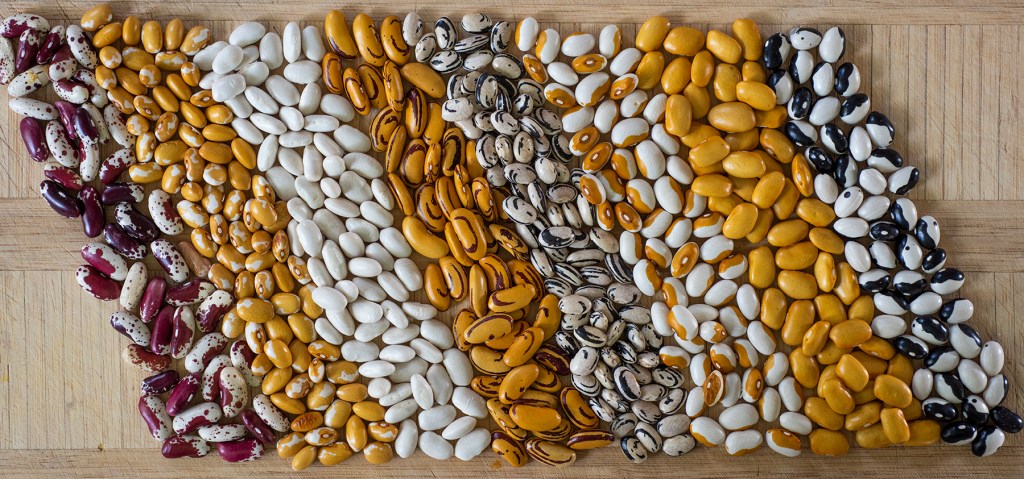
Well, hello there. It’s nice to be here again. We’ve taken a break from posting, but we certainly haven’t taken a break from farming. On the contrary, we have expanded our growing area and our crops. This year, we grew hundreds of pounds of organic vegetables, but we’re most proud of our dry bean harvest – twenty varieties! Read on to learn more about what we grew.
Clockwise from top left: Hopi Yellow, Vaquero, Bolita, Dragon’s Tongue.
Hopi Yellow: A classic yellow bean, larger than Buckeye. Perfectly at home in any soup or stew, this is a bean that will enhance any recipe yet never steal the spotlight. Excellent productivity.
Vaquero: Also called Orca or Yin-Yang (for obvious reasons), these small, dense beans cook up beautifully and produce a rich, inky pot liquor. A stunning bean and surprisingly productive for an heirloom.
Bolita: A lovely, delicate little bean in the pinto family, but smaller and sweeter in flavor. Bolitas are native to southwestern Colorado and New Mexico and figure prominently in the Indigenous cuisine of the region.
Dragon’s Tongue: These pale lavender wax beans grow inside pretty dark purple-striped pods and are most commonly eaten as a fresh green bean, though the attractive pod stripes unfortunately disappear when they’re cooked.
Clockwise from top left: Aztec White, Rio Zape, Jacob’s Cattle, Tiger’s Eye.
Aztec White: One of our very favorite varieties, Aztec White is our top producer and a bean we will likely always grow. These beans are perfect for a white chili or a lush, garlicky dip for crudités.
Rio Zape: We’re proud to grow this spectacular purple and black bean that inspired the creation of the legendary Rancho Gordo. An impressive member of the pinto family, this bean offers deep, dark flavor with coffee and chocolate notes.
Jacob’s Cattle: Like most beans in the kidney family, Jacob’s Cattle’s is dense, meaty and full-flavored. It holds its shape and stands up to strong seasoning, so it makes an excellent chili bean.
Tiger’s Eye: These stunning beans are honestly almost too beautiful to eat. Almost! Tiger’s Eye ripen early due to their thin pods; their correspondingly thin skin nearly disappears in cooking, but they’ll hold their own in any chili or soup.
Clockwise from top left: Hutterite, Cranberry, Palomino, Midnight Black.
Hutterite: Possibly brought to the northern Midwest by Ukrainians in the 1850s, or maybe selected from China Yellow by settlers – like many beans its origin story is a bit murky. This bean is creamy, productive and mild, perfect for any gentle, warming soup or stew.
Cranberry: This comes from a huge bean family; it is likely native to Colombia but is now bred around the world. It’s also called Borlotti, Wren’s Egg and more. Cranberry beans are soft and thin-skinned and they produce a luxurious pot liquor, perfect for pasta e fagioli.
Palomino: This bean is a golden variation of Anasazi, but we choose not to use that disputed name and so have branded it Palomino. Like other yellow beans, it is creamy, mild and versatile.
Midnight Black: A true black turtle bean with traditional flavor and an inky broth, this bean originates from Rancho Gordo’s seedstock. Fresh black beans, cooked from dry, will completely change hearts and minds on using canned black beans.
Clockwise from top left: Forelle, Mayocoba, Peregion, Yellow Eye.
Forelle: Officially known as Forelle fliederfarben, which translates to ‘lilac trout’ in German, these round, purple beans with black stripes are absolutely gorgeous. This variety produced abundantly, always a surprise for heirloom beans.
Mayocoba: Native to either Peru or Mexico, these are creamy, pale yellow, thin-skinned beans with a soft, buttery texture. They make excellent refried beans.
Peregion: These come out of the Pacific Northwest and have a gorgeous zebra coloration. One of the few beans where the striping is still (faintly) visible after cooking, Peregion are productive and delicious.
Yellow Eye: These beans are both rich and mild, more a supporting character than an outright star. They are an old New England variety and the bean of choice for classic Boston baked beans.
Clockwise from top left: Garbanzo, Buckeye, Marcella, Red Cranberry.
Garbanzo: Also called chickpea or ceci bean, this legume is most commonly used in hummus and other Middle Eastern dishes. Garbanzos are not native to North America like most other beans here and are low-yielding and tricky to grow – but the unusual, fronded plants are fun to see in the field.
Buckeye: Rancho Gordo says, “A small, dense yet velvety bean that holds its shape and provides a rich bean broth. Easily one of the staff’s favorite beans. Buckeye is incredibly creamy, almost more like a classic black turtle bean than anything else. It’s dense without being intense, if that makes sense.” Can’t top that description.
Marcella: A long white cannellini-style bean, named by Rancho Gordo in honor of the great Marcella Hazan. Thin-skinned and creamy; ideal for brothy Italian-style soups and rich, flavorsome dips and spreads.
Red Cranberry: An old variety, likely grown by Indigenous tribes in the northeast U.S. Gorgeous rich red color and much rounder than the more common striped/speckled cranberry bean above. Listed in Slow Food’s Ark of Taste.
We could go on and on about dry beans (and have, previously), but let’s sum it up like this: they’re native to our region and therefore exceptionally drought-tolerant. They’re an incredibly nutritious source of plant-based protein and beneficial fiber. They require almost no care, and they are not plagued by pests, viruses or disease so require no inputs, at least in our microclimate. They keep well. And they actually give more than they take, replenishing the soil with each season’s growth. Beans are an absolute powerhouse in every category, and they’re a great addition to Quiet Farm. We’re deeply proud of our 2023 harvest, and are already evaluating what varieties we’ll grow next year.
More than ever, we know that small, regenerative farms are the only sure way out of this increasingly catastrophic environmental mess we find ourselves in. We encourage you to support small farms in whatever way makes the most sense for you and your household.
As always, thanks for being here. We’ll be back again soon!



 Finding Quiet Farm