Interlude: Cows love Skittles

Friends, we interrupt our regularly scheduled light and fluffy travel programming to bring you a brief interlude on cows. Cows and Skittles, to be precise. If you are here just for fun travel adventures, please feel free to tune out now – this one is about food politics.

Perhaps some of you noticed a little story that a couple of papers ran recently about a Skittles spill on a Wisconsin highway (although I’m painfully aware that there are one or two more significant American news stories to focus on right now). To summarize, a truckload of red Skittles missing their signature “S” spilled onto the road thanks to a rain-saturated cardboard box. When the local sheriff’s department came out to investigate, they discovered that the candy was on its way to be used as cattle feed. Maybe it’s fake news? Now that so much of what we read contains “alternative facts,” it’s hard to know what to believe. (You can read versions of the article here, here and here, and I’m sure there are plenty more.) Feeding food waste to cattle is apparently common practice in the U.S.
Stone Barns-06

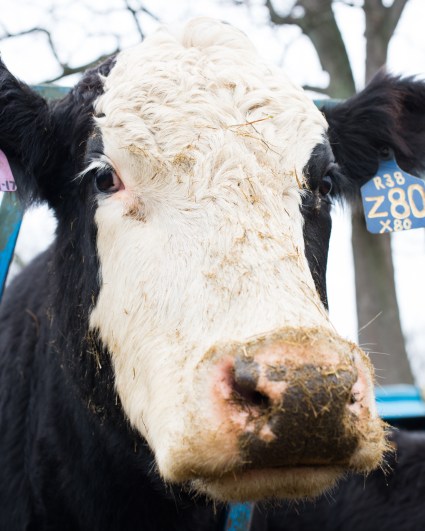
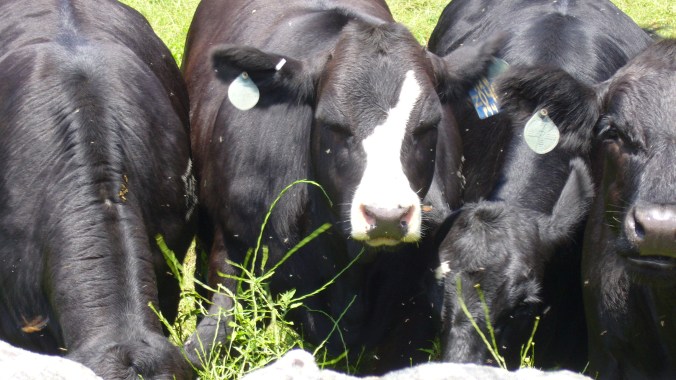
Bessie here actually prefers M&Ms to Skittles, if you want to know the truth.

Back in 2012, the severe drought that swept across the country caused corn prices to skyrocket, and that’s reportedly when the trend of feeding excess food to cattle really accelerated. In some cases, cows were even fed candy that was still wrapped, although a professor of animal nutrition seemed mostly convinced that the wrappers would pass through the cow without issue. I’m in no way a vet or other animal expert, but I imagine that plastic really can’t be good for an animal’s insides – even one as large and tough as a cow.

But wait, you might say. Skittles are mostly just corn syrup, which is just corn, right? And that’s what the cow would be eating if corn prices hadn’t risen so much, so really, what’s the big deal? It’s actually not the Skittles that bother me – it’s all the other stuff we don’t know about. Consider that the only reason we now know that these Skittles were intended for cattle feed is because they spilled. Had they not spilled, we’d still be shoveling our CAFO hamburgers in, none the wiser. This story indicates that a lot of other mysterious food waste goes to our cows, including but not limited to stale baked goods, peanut and almond shells, and orange rinds. Probably harmless, yes, but do these ingredients affect the integrity (what little there is) of the meat? Could a severely peanut-allergic person have a reaction to beef from a cow fed on peanut meal? I have no idea. And I also have no idea what is in our food.
Stone Barns 074

My point is not that the Skittles themselves that are inherently bad (although they are). It’s that you didn’t know they were there. How can anyone make an informed decision about what they eat when they don’t have all the information? How can I implore my cooking students to read the label of every food item they buy when I know full well that label is inherently misleading? I also resent the implication that feeding Skittles to cows saves them from the landfill and is therefore virtuous. In a country that wastes over 40% of all edible food produced, I’m fairly certain that the quantity of Skittles we’re talking about here is negligible enough that the landfill excuse doesn’t hold up – greenwashing at its finest.

Some time ago, a friend who shops very consciously received a recall notice at the bottom of her grocery store receipt indicating that the big-brand chicken she’d purchased weeks earlier had been recalled. Since she deliberately never purchased big-brand chicken, she knew this had to be a mistake – yet when she contacted store management, she received a boilerplate customer service response that didn’t address the issue. Follow-up calls and emails went ignored, leaving her to assume that of course she had purchased that chicken – labeled as organic and packaged under a “clean” name – even while trying so hard not to. Plus, organic and conventional chicken were both part of the same recall, so how can one trust that the organic product really is? And that leaves us here, stumbling around the grocery store in a panic, reading labels frantically and generally feeling like a failure all the time because we no longer have any faith in a system designed to protect us from fraud and mislabeling.

These stories are compelling on many levels, but my takeaway is this: unless we’ve grown, raised and processed food ourselves from start to finish, we no longer can have any faith that we’re buying what we think we’re buying. I know plenty of people who wouldn’t feed their kid Skittles (concerns over Red 40 high on the list) but would certainly offer a lean beef stir-fry with plenty of supposedly organic vegetables and arsenic-free brown rice. Yet these same people, who are working so hard to get it right, are getting it wrong. Again and again, because they cannot trust that they’re buying and consuming what they think they are.
Stone Barns 070

I’d love to end on a positive note, so I’ll leave you with this – if you want to trust your food, grow your own. Start a small garden. (If you’re in the Denver area, support a locally-owned business and go here for everything you need to get growing.) Raise backyard chickens. Get a beehive. Join a CSA. Know what you’re eating and where it came from, and be willing to ask questions. Also: eat less meat, and spend more money on it, and know who raised and processed it. And please, let us know your thoughts on this story. We’d specifically like to hear if you feel confident about label honesty and accuracy (including organic vs. conventional) and what exactly is in the food you buy.

chickens2

Food for thought

NJB_9683

Octopus skewers, Nishiki Market, Kyoto.

Food – ingredients, preparation, presentation – is something I think about far more than the average person. As I’ve mentioned, at home we almost never eat out, both because I love to cook and because I’m often testing recipes or preparing for a class, so I tend to have an excess of food on hand at any given moment. Food obviously plays a huge role in travel, too, and for me that’s both positive and negative. I love tasting unfamiliar ingredients and trying to appreciate a place through its food culture, but the reality is that more often than not restaurant food is disappointing and overpriced – especially when you’re traveling in heavily touristed areas. I know how much I’m overpaying for it and I hate that feeling of being cheated – paying $75 or more for a “nice” meal, only to leave with a bitter taste. It’s tough, though, especially in a country like Japan where everyday communication is delicate at best and a mess of unforeseen land mines at worst, to know where the locals eat. My answer to that, invariably, is “at home.”

NJB_9689

Prepared food counter, Nishiki Market, Kyoto.

Other people travel and visit art museums and temples and things. I travel and visit minimarkets and grocery stores, because I think few places tell a country’s story better than where the locals shop for food. I was looking forward to Japan for many reasons, but the food was high on the list. We have a superficial impression of Japanese food in the U.S. – primarily sushi, of course, then perhaps tempura or soba or various tofu dishes. I’m interested not in what people eat when they go out to celebrate a special occasion (do we all eat at The Capital Grille every night? I think not), but what they grab from the store at 5:30 on a Tuesday night after a long day at work.

FullSizeRender (3)

Soba noodles with shrimp tempura, Arashiyama.

And I’ll admit – I’ve been really surprised by Japanese food culture, at least what little I’ve seen of it. First and foremost, sugary drinks take a lot of rightful blame as a major source of excess calories in the American diet; we’re now seeing “soda taxes” and other measures designed to curb consumption and hopefully reduce our obesity and diabetes rates. But Japan, which I think many people perceive as one of the healthiest countries in the world (see The Blue Zones) is absolutely covered with drink vending machines. They are everywhere. There are apparently more than 5.5 million machines in this tiny country, while the U.S. has just under 7 million for nearly three times the population and a lot more landmass. While the machines do contain bottled water, they also contain sugared coffee drinks (cold and hot – and that is a miracle in the middle of this damp, frigid winter), sports drinks (the awkwardly-named Pocari Sweat is my favorite), and plenty of other sugary beverages. Clearly, the machines are worth the real estate – so why aren’t the Japanese plunging into a sugar-related health crisis like we are?

NJB_9687

Fried snacks, Nishiki Market, Kyoto.

I’ve also been surprised at the amount of refined grains, but that may be because I’m so focused on teaching whole grains at home. Obviously plain white rice is a staple served with every meal; we’re currently on a farm stay and the rice steamer is kept filled with fresh, hot rice for eating at any time of day. But the buns, pastries and breads are all soft, white and sweet – the bread available for our morning toast here is like that super-cheap, super-thick “Texas Toast” we used for French toast as kids. I watched the nine-year-old son eat four pieces slathered with fake butter and jam for his breakfast this morning, and he’s thin as a whippet. So again, I’m observing very high consumption of refined grains – which the body essentially converts to sugar – and yet not observing the expected results.

NJB_9681

One of N’s recent lunches, and the only time yet I’ve seen raw vegetables such as lettuce and tomato.

Meals for us have primarily been inexpensive, filling and warming – plenty of ramen, of course, plus other noodle soup variations, but also curry rice and simple “lunch sets,” which usually include miso soup, various pickles and a main such as chicken and rice (photo above). These too have surprised me with the overall lack of vegetables. While there might be a few small dishes of pickled or fermented vegetables, we’ve only once had any served raw – a fresh carrot and daikon salad here at the farm, with a delicious creamy, tangy dressing. There are never any vegetables in the soups or with the meat and rice, certainly nothing like what we’d think of as traditional stir-fry. That said, the Japanese tend to cook more seasonally than we do, and I suspect we’d see a greater variety of raw vegetables during warmer months than in the middle of bleakest winter.

NJB_9707

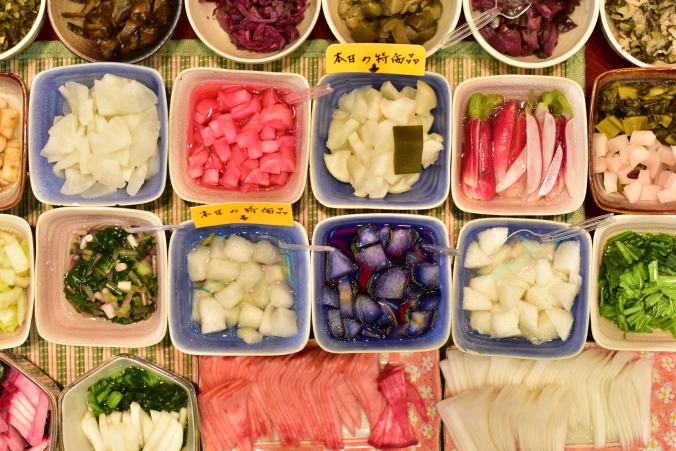
Pickled vegetable selection, Nishiki Market, Kyoto.

In stores, it’s package after package after package. From a thousand varieties of crunchy salty snacks to pre-made sandwiches to “Hot Pockets” to sushi and sashimi, I’ve noticed very little in the way of fresh ingredients designed for preparing meals at home. Fresh fruits and vegetables are almost nowhere to be seen and crazily expensive when found; I bought an apple in downtown Kyoto – one apple – for about $2.50. We’ve walked by a couple of small fruit and veg stands, but literally nothing that would rival your most basic American grocery store produce department with its stunning array of gloriously arranged, perfectly shiny, identically sized out-of-season fruits and vegetables. And yet the farm we’re currently staying on has acres of fruit trees and thousands of apples in cold storage right now, so where are they all going?

NJB_9565

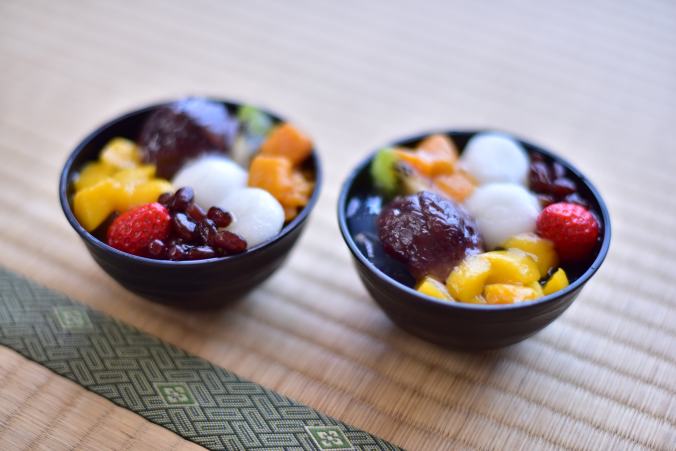
The oddest dessert I’ve ever eaten…jellied fruit and red beans with clear gelatinous cubes underneath. Algae? Gelatin? Space-age packing material? Also it came with what I thought was a sauce and may have actually been hand sanitizer. Not dead yet.

So after nearly two weeks of eating and travelling in Japan, I’m left with a mess of contradictions. The diet appears, at least on the surface, to be as unhealthy as ours in the U.S. And yet the people here, at least from my extremely limited research, don’t seem to be plagued by the same health crises. What can we learn from this?

(P.S. Please know that these observations are only based on a few days here in Japan and are in no way intended to represent some sort of serious large-scale sociological study. If anyone has spent time in Japan and has additional insight to share about the food culture, I’d love to hear it!)