Farm update: June 8

“Good morning. Concentration is hard to come by these days, amid the nation’s strife. We are living through a tough and chaotic and wrenching time, filled with fury and an abiding sadness. We’re unsettled. We’re tense. We’re divided. The emotions arrange themselves in combinations that make it hard to work, to read, to watch, to listen, much less to think.

Cooking can help. The act of preparing food is a deliberate and caring one, even if you’re just making yourself a bowl of oatmeal at the end of a long night of worry. The way you sprinkle raisins over the top is an intentional act of kindness to yourself. So what I’m doing now, amid my restless skimming of nonfiction and news, thrillers and literature, poems that don’t bring solace: I read recipes, think about who in my family they might please, and I cook.”

-Sam Sifton, The New York Times

Brownies 01 sml

So much effort, yet so worth it.

While I was flipping through the April issue of Bon Appétit, N saw this recipe and asked me to make these “camouflage brownies.” And so I did. They required approximately seventeen different bowls, forty-two utensils, nine measuring devices and three separate batter components. (When a professional chef tells you a recipe is complicated and elaborate, believe her.) But the end result? Amazing. We don’t eat a lot of sweets, so we devoured this pan a little quicker than good sense would indicate, and it was entirely worth it. And I had to buy the cream cheese in a two-pack, so we’ll probably see these again in our kitchen very soon.

Continue reading

Where the water goes

There has long existed a tired stereotype of a farmer as some sort of rural idiot, a barely-literate country bumpkin who can only just string two sentences together. If there is anything we’ve learned during our nearly two-year (!) farming adventure, it’s that a successful small farmer is anything but stupid. You have to be a veterinarian and a seedsman and an ATV mechanic and a soil scientist and an entomologist. You have to dig holes, repair fences, build structures, patch hoses and outwit pests. You have to be strong, creative, resourceful, thrifty and tireless. And you have to know how to manage the water on your property, no matter how it gets there.

Drip Irrigation 02 sml

The components of one of our drip irrigation kits.

One of our goals for this, our second full season of farming, is to get our irrigation dialed in. We don’t farm in a traditional American sense, i.e. hundreds of acres of the same crop (usually corn or soybeans) laid out in precise rows and neat blocks. Irrigating that sort of monocrop is relatively easy, because every plant is identical and therefore its water needs are identical, too. Once that irrigation system is established, it’s basically set-it-and-forget-it. Instead, we farm in a sort-of patchwork style all across our property: perennial herbs in this corner, a bed or two or nine here, trees over there. As a result, our irrigation is similarly patchwork, because there is no one-size-fits-all solution.

Continue reading

Farm update: May 11

It’s hot, dry and windy out here, and feels more like late July than early May. We seem to have skipped straight from a parched winter into an equally arid summer, missing the soft green lushness of spring entirely; the peas and radishes survived frost damage only to turn bitter and pithy from sun scald. Last year we had rain almost every single day in May, and this year it’s unlikely we’ll see any. Early reports indicate that the mountain snowpack is melting far too quickly, thanks to this premature summer, and our primary focus these days is on keeping all of our plants irrigated. Here are a few more things we’ve been up to recently.

Irrigation 02 sml

Our gated irrigation pipe at work. 

All of our irrigation water comes from snow on the Grand Mesa. When the snow thaws each spring, the snowmelt makes its way down the mountain through an intricate series of ditches, headgates, creeks and pipes. We’re focused this year on regenerating our pasture, so have started flood-irrigating our land to see what grows. Later this season we’ll remark our pasture (cut channels that direct the water) and hopefully seed it with perennial grasses, too. Eventually we’ll use the land for rotational grazing, likely a grass-fed steer or two. Flood irrigation requires a lot of work – the water has to be “moved” by opening and closing valves and gates along the pipes – but it’s the system we have, so we’re learning how to use it to the land’s advantage.

Continue reading

One potato, two potato

Last year we planted potatoes for the first time and achieved a reasonable level of success for a freshman effort, though our part of Colorado isn’t at all suited for potato growing. To our south and east, however, you’ll find the San Luis Valley: the second-largest fresh potato-growing region in the country and justifiably famous for the crop. Their loose, sandy soils are much better for potatoes than our heavy, rocky clay.

Potato Towers 01 sml

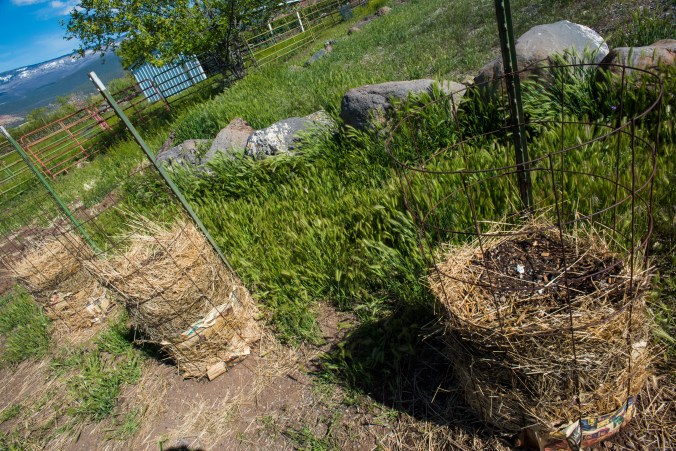
Last season’s potato towers.

But like any stubborn farmer, we love being told what we can’t grow, so that we can try it anyway. We quickly realized that we wouldn’t be planting potatoes in the ground and so opted for potato towers: layers of soil, compost, newspaper and straw in a wire cage, with seed potatoes nestled gently in between. We planted about one and a half pounds of seed potatoes in each of three potato towers, and yielded about twenty pounds of potatoes in total – not bad, considering the minimal growing space and effort required, but not the thirty-plus pounds we were hoping for. And some of the potatoes were really tiny, like the size of marbles. Not very practical.

Continue reading

Farm update: April 27

Hello there. How are things in your world? It’s an odd and unsettled time, to be sure. Here at Quiet Farm we’re keeping our heads down and our hands busy as we navigate the seasonal weather shifts that have us careening from wind to rain to sun to hail and back again, all in the space of a few minutes.

House Finch 01 sml

House finch (Haemorhous mexicanus).

Spring is underway, slowly but surely, and our diverse bird life reflects that. The bald eagle pair we’d been keeping an eye on has vanished, presumably for colder climes; now the gorgeous call of the Western meadowlark (Sturnella neglecta) marks our days. Watching the scrappy magpies fight off aggressive egg-stealing ravens is decent entertainment, too.

Continue reading

Starting seeds

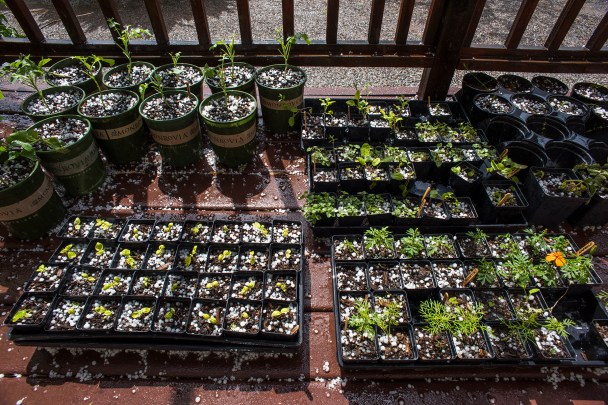
Welcome to March! Our spring is shaping up to be a bit too premature and a bit too warm and a bit too dry for our liking; we’d like to see quite a lot more moisture. This time last year, we still had at least four inches of snowpack on the ground; this year, zilch. Also last year, we were adorable, eager, optimistic, first-year farmers, and we started our seeds way too early. This year, we’re hardened, grizzled veterans, so we know better. And next year? Watch out.

Compost 08 sml

If you’re going to grow anything outside, the single most important piece of information you need is your average first and last frost date. This statistic is pretty much exactly what it sounds like; weather stations all over the country send data to the USDA, which in turn calculates average first and last frost dates. These dates are essential because most (but not all) annual food crops will not tolerate freezing temperatures.

Here at Quiet Farm, our average last frost is May 13, and our average first frost is October 4 for a 143-day growing season; this means we’re almost assured not to have frost between these dates. Keep in mind, however, that this is an average, not a guarantee – you’re safer assuming that frost is possible one to two weeks on either side of these dates. (The location of weather stations varies widely and can sometimes be inaccurate, so check where your closest weather station is located to ensure you’re getting the best information. Plus, the climate emergency is totally destroying the consistency and reliability of these dates. It’s all pretty much guesswork from here on out.)

Continue reading

The FAQ Series: Tomatoes

People think of tomatoes as a summer crop – as in June and July summer. And perhaps you live in a Magical Land of Elves and Unicorns (hello, Florida and southern California!) where field-grown tomatoes are available virtually year-round. Here in western Colorado, however, field-grown tomatoes don’t come on strong until August and September – but of course all the food blogs and magazines are telling us that it’s now time for apple cider and winter squash and pumpkin spice everything. It’s a confusing period, this shoulder season.

heirloom-tomatoes-05-sml.jpg

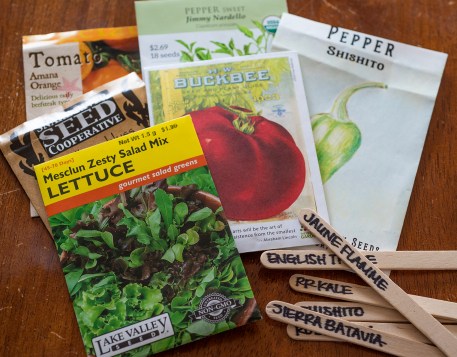
Seed packets offer plenty of information – and if it’s an heirloom, they’ll be sure to mention it.

There is no debate that tomatoes are the star of the garden. They’re by far the most popular crop for home gardeners as well as the biggest seller at farmers’ markets, and more tomatoes are grown each year than any other fruit in the world – including apples and bananas. There are more than twenty thousand known varieties of tomatoes, and new cultivars are developed every year.

Like the word organic, the word heirloom gets thrown around a lot in reference to tomatoes. But what is an heirloom tomato, exactly? And why do they cost five dollars a pound?

Continue reading

Lessons learned

Hello again, and please forgive us our recent absence. We’ve taken a small summer hiatus – not because we’ve actually been on vacation, but because for a period of time there we didn’t have many nice things to say about farming, and we didn’t want our space here to sound whiny and negative. We’re genuinely thrilled to be farming, even when we aren’t.

Hail 01 sml

One of early summer’s low points.

It’s been just under one year since we found Quiet Farm, and what a year it’s been. There have been highs and lows and successes and failures. And now that we’re one year wiser and can officially call ourselves farmers, we’re working hard on learning from our experiences. We always say that we’re allowed to make as many mistakes as we want, but we have to make different mistakes. If we make the same mistakes over and over, then we obviously haven’t learned anything.

Continue reading

Deer diary, vol. 2

Game Fence 08 sml

Tools at the ready for constructing an H-brace.

Early this year, Colorado Parks and Wildlife delivered our game fencing materials. They also included a thin pamphlet with a few helpful suggestions on how to construct said fence – not really what we’d call “instructions.” As we’d never built even a simple fence before, this meant a lot of time on the University of YouTube. Our game fence is nine feet tall and composed of wood posts, metal T-posts, two strands of grid wire fencing and three strands of barbed wire. That’s a lot just to keep deer out – and each component has to be installed separately.

Game Fence 14 sml

Once we’d set our wood posts in concrete, we went around building H-braces at corners. H-braces (seen above on the left and right sides of the gate) are required when the fence turns a corner to keep it supported. The H-braces seem relatively simple – you just notch the vertical posts, insert a horizontal post, then use massive nails (3/8 inch by 12 inches!) to secure the horizontal to the vertical. As with all aspects of this fence, though, this is simpler on paper than in reality. Notching the fenceposts required climbing on a rickety stepladder on very rocky and uneven ground and holding a reciprocating saw at an awkward angle while trying not to fall off the ladder. Not at all OSHA-approved.

Game Fence 13 sml

Four completed H-braces on either side of our corral gate.

With the posts successfully notched, we set about connecting the horizontal to the vertical. Driving the heavy, thick nails in proved to be yet another challenge. After hours of frustration, we finally bought an extra-long drill bit so we could pre-drill the holes for the nails. This was an important lesson learned: don’t try to do something the hard way if a power tool can make the task easier.

Game Fence 12 sml

Looking southwest at our pasture gate.

H-braces then have to be wrapped with nine-gauge wire in order to stabilize the posts. As with the nails, this was much easier in theory than in practice. The wire was delivered to us in huge coils which were absolutely unmanageable – no matter where you wanted the wire to go, it was set on uncoiling the wrong way somewhere else, usually slapping you in the face along the way. We each bear our fair share of fence scars.

Game Fence 15 sml

Using a come-along and a wood clamp to stretch the grid fencing.

Now that the H-braces are up and wrapped, the two strands of grid fencing have to be installed. We could have opted for one-strand fencing, but the fencing comes in 330-feet rolls and the two of us could barely lift one of the smaller rolls. So we chose to wrap two strands, which most small farms do. It takes longer, but it’s much easier for two people to handle.

We unrolled the coils along the fence line, then used a come-along and N’s very crafty wood plank clamp to stretch the fencing. It’s imperative that the fencing be as tight as possible, but because our posts aren’t exactly straight, we had to adapt a bit. We’ll call it “accounting for the curvature of the earth.” Once in place, the fencing was secured to the wood posts using thick staples, and to the T-posts using clips.

Game Fence 16 sml

Using the wood clamp and the ATV hook and cable to install the top row.

Installing the top row offered additional challenges, since we had to hold up hundreds of feet of fencing while stretching and then securing it. Our ATV’s hook and cable set-up helped a great deal here, as did some sturdy chains attached to our wood plank clamp.

Game Fence 20 sml

We were pleased (and surprised!) to find that all of our fencing materials were made in the USA.

Game Fence 18 sml

Waiting for barbed wire along the top and bottom.

Game Fence 17 sml

Nearly finished!

The complexity of the fence might seem like a bit much just for some deer…but we have watched these animals easily leap a six-foot fence from a standstill. The power in their strong legs and their lean bodies is remarkable, and the fence has to be nine feet tall to have any hope of keeping them out, especially when they’re moving at a full, panicked run.

Game Fence 19 sml

Dear deer: the Quiet Farm salad bar is officially closed. Go torment someone else.

Building our game fence is the most extensive, complex and difficult project we’ve tackled yet here on Quiet Farm, and we are so proud of the results. The fence isn’t perfect, but we did it ourselves for about one-tenth what it would have cost to hire a fencing company, and we learned so much along the way. This sense of accomplishment and self-sufficiency is why we’re out here.

Thanks for reading!


Farm update: June 3

Hello there! Has summer finally started where you live? We’re excited for warm weather and sunshine and to get all of our tomatoes, peppers, eggplant and other summer crops into the ground finally.

Rasberry Beds 04 sml

The raspberry plants are tiny, like our fruit trees, and are protected with plastic cages.

A few weeks ago we planted forty raspberry plants, ten each of four different cultivars. We planted both summer-bearing and fall-bearing varieties, in the hopes of having fresh raspberries for months on end. We don’t expect to see any fruit this year, but raspberries typically do well in this area so we’re looking forward to bountiful future harvests. In order to plant these canes, we used the excavator to dig long, wide beds, then we filled those beds with about eight cubic yards of soil from Mount Doom. This meant around thirty-six wheelbarrow loads moved by hand – we farm like it’s the 1850s over here, friends. One day, we’ll have a tractor. One day.

Kale Salad 01 sml

Greens this fresh make those plastic supermarket packets taste like nothing.

We were excited to harvest our first salad greens and radishes; shown here is a mixture of Buttercrunch lettuce, pak choi, red Russian kale and lacinato kale. Our greens are pretty late this year; next year we hope to have our high tunnel built so that we have fresh greens throughout the winter and early spring. Few things taste better after months of heavy, rich, starchy foods than a bright, crisp salad.

Bullock's Oriole 02 sml

A male Bullock’s oriole waiting for the buffet to open.

Although we love seeing the hummingbirds at our feeders, we’ve found that the local population of Bullock’s orioles (Icterus bullockii) appreciates the easy sugar hit, too. The orioles are much bigger than the tiny hummingbirds, and when they’re on the feeders they scare the hummingbirds away. Because they’re so big, they also cause the feeders to swing wildly and spill sugar syrup everywhere, which makes a sticky mess. We haven’t yet figured out how to keep the hummingbirds coming while discouraging the orioles, even though their flashy yellow plumage is gorgeous.

Compost 03 sml

So much tidier now!

We built a new bin structure for our compost using salvaged shipping pallets; you can see the original small compost pile here. (We think pallets are one of the most useful free things you can find!) Now the compost can be kept neater, and it’s simple to throw fresh organic material into the left bin while waiting for the right side to finish “cooking.” When we get that tractor it will be a lot easier to move the finished compost onto the vegetable beds.

Chickens 01 sml

Welcome home, chickens!

And then there’s this news: Quiet Farm has twelve new residents. They are a motley, ragtag bunch, who came to us because a friend was moving house. We have at least two roosters (maybe three; one is sensibly staying quiet for the moment) and an assortment of breeds. They’re still laying pretty well for older birds – certainly enough for our needs – and thus far they’ve had an exciting time exploring their new home. More on the chicken house renovation coming soon!

Have a great week!