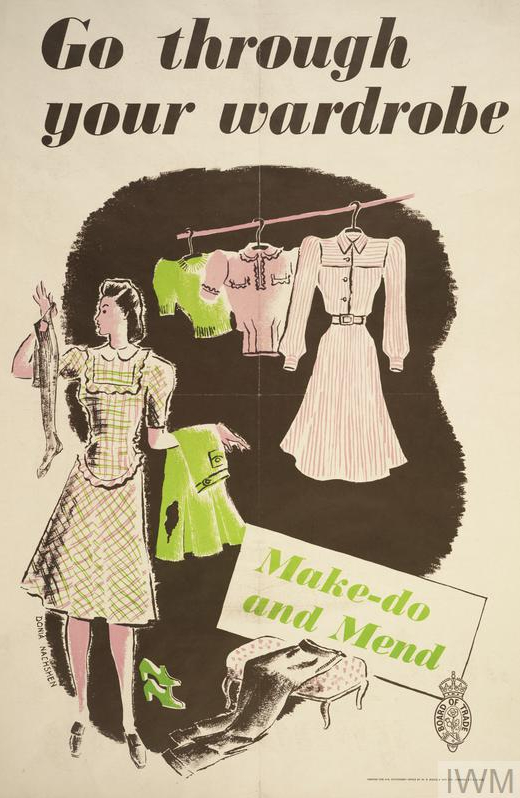
This Saturday, I’m teaching Visible Mending and Practical Textile Repairs at our local arts center. Keeping your clothes in good repair and keeping textiles out of the landfill is one tangible way you can actively fight the climate crisis, plus your clothes will be one-of-a-kind. Come sew with me! I’d love to see you there.
A visible mend on a favorite pair of thrifted vintage jeans.
Do you choose a significant word or guiding principle for each year? My word for 2025 is “mend.” I love both the literal and metaphorical meanings of this word, and how it ties in beautifully with my current sewing practice as well as my overarching goal to build and strengthen my community ties. As Austin Kleon wrote recently, “The idea of ‘being local’ is becoming more and more important to me. In times like these I crave the company of humans living near me who care about the same things I do.”
Hello friends. Mid-November and we’ve only just finished harvesting the last of our dry beans. We grew over thirty cultivars this year, some roaring successes and some total crop failures (Ayocote Blanco). As ever, we learn from each year’s experience and know better what to grow and what not to grow in coming seasons.
Below we’ve listed all the new cultivars we grew this season, and we also grew almost every cultivar from 2023. We won’t describe those again in this post, but you can read about that harvest here. (Note that the bean we referred to as ‘Palomino’ in 2023 is also called ‘Southwest Gold’ and ‘Zuni Gold,’ depending on the company.)
The cold plunge is everywhere these days – most especially in early January – and I am not even on social media. I am so innately resistant to doing something just because everyone else is doing it that it feels exceptionally silly and performative to share this here, as though I’m shouting into the void, “Hey! I’m doing this too!” What sort of glittery prize do I want for this? Even so, I keep discovering beautiful, crystalline thoughts on cold plunges and they seem like just the thing to share when I have a hard time putting my own experience into words.
From Ani Lee: “Saying that this practice feels good is not exactly accurate, that would negate the fact that it is actually kind of painful. But it feels helpful, really helpful…The experience of cold dipping feels good, I think, because it requires all of your attention. You can’t think about anything when your body is trying to stop you from freezing. I am most a body when I am dipping. But cold dipping is, somehow, its own kind of cozy…There’s something about taking my body to a place of deep discomfort and saying ‘I will not abandon you here’.”
If it’s snowed, the gutters drip from above while I’m in the tank.
And from the brilliant Catherine Newman, writing on Cup of Jo: “But you learn to detach your mind from fear, and this is no small thing. Your whole life, your brain has been a generator generating preemptive anxiety and catastrophic possibility and now you stand at the water’s edge and you pull the plug on it. You hit mute on the shrieking voices of sanity and natural selection — “The water is too cold! You will die!” — so that you can wade in and, paradoxically, be well.”
Of course we live in America in the rapidly-dimming golden twilight of late-stage capitalism, and so of course you can spend many thousands of dollars on some sort of overly complicated backyard cold-plunge absurdity. Or you can run a hose from your ag tap and fill a galvanized stock tank that serves the exact same purpose and probably costs no more than two hundred bucks. Plus, the alpacas can still drink from it in the summer.
I’m not here to claim that cold plunges will cure all the world’s troubles. I do think, however, that we’d be far better off if we weren’t quite so comfortable all the time, and if we didn’t always look first to the pharmaceutical industry to solve all of our First World problems.
What are your thoughts, friends? Anyone else out there cold plunging this winter?
Many of my recent nonfiction selections, including Being Mortal and The Blue Zones, focus on the oft-fraught topics of aging and dying. I loved Becca Levy’s Breaking the Age Code; in simple, accessible prose, she posits that how we age can be in large part determined by our attitude towards aging. In America in particular, as well as many other Western cultures (but certainly not all!), aging is seen as somehow shameful and useless; we do not revere our elders here but instead shove them into terrible facilities and care homes, destined to die of inactivity, depression, boredom and loneliness. Our hackneyed clichés about aging, as well as our near-total erasure of older people from films, books, fashion and TV, are overdue for a revamp, too. We also need to rethink our standard retirement age of 65; that arbitrary number was in large part determined by a life expectancy of about 67; very few people were expected to survive another third of their lives after retiring, and that’s posing a major challenge. There are far better ways to embrace aging, of course, and as the U.S. faces the millions of people living well beyond standard life expectancy, it is essential that we address these issues. Breaking the Age Code argues that our actions and beliefs have a lot more influence over our aging than we might think, a theory I wholeheartedly support.
Two Nights in Lisbon by Chris Pavone
Two Nights in Lisbon, as with all of Chris Pavone’s books, fits squarely in my ‘junk thriller’ category – also known as airplane books. This particular example is compelling if long-winded, although I did enjoy the the plot points that tied into recent events. Pavone’s books are pure Snickers bars – quickly consumed, no nutritional value and forgotten shortly thereafter. Nonetheless, I am a firm believer in the idea that ‘there is no worthless reading,’ so if you’re looking for a smart, well-crafted thriller, his books definitely fit the bill.
Worn: A People’s History of Clothing by Sofi Thanhauser
Textiles are ubiquitous, from birth to death and every single day in between; it seems almost silly to give any thought to their existence nowadays. And while textiles used to have such value – if you only owned one or two pairs of trousers, you’d take good care of them and patch them again and again, until they were finally repurposed into a warm quilt – we now each throw away an average of eighty pounds (!) of textiles every year, and every single second, a trailer-truck filled with textiles is buried or incinerated. The world is simply awash in cheap cloth, and that carries significant implications for our ability to deal with climate change and its attendant issues. Worn: A People’s History of Clothing, by Sofi Thanhauser, is an exhaustively researched book about a material good that was once so valuable that every single scrap was carefully saved for reuse; now, those textiles are inexpensive and meaningless. Of course, any history of textiles will notably be raw, tragic and depressing, especially in addressing modern-day slavery production; this book is terribly downbeat, but it’s also fascinating. Facing down our individual contributions to climate change, namely fast fashion and our unwillingness to care for, mend and repair our things instead of simply throwing them out, is an important step forward.
The House in the Cerulean Sea by TJ Klune
I wrote previously that once a book “appears” three times in my world, I immediately request it from the library. The House in the Cerulean Sea was one such book, showing up on every single must-read list for a time, and I read numerous reviews where people claimed “it changed their lives.” I should have listened to my initial misgivings and ignored this derivative mess of a book which reads as though a publisher made a checklist of what the book needed to include, then commissioned it from a mediocre author. “Total ripoff Harry Potter-style magic? Check. Misunderstood kids? Check. Queer characters? Check.” All of that mishmash was jammed into a Vitamix to produce this book, which might actually be somewhat acceptable if the author hadn’t made some deeply troubling comments in reference to the book’s origin story. This smug, off-putting book and its author are seriously problematic for numerous reasons and I recommend avoiding this clichéd and awkward waste of paper at all costs. (P.S. If you read this book and loved it, I would genuinely love to hear your thoughts on it.)
Adrift: America in 100 Charts by Scott Galloway
There isn’t much that Americans agree on at the moment, except that our once-great country is most definitely headed in the wrong direction. It’s also all too easy to find various media that support any conceivable point of view, without any valid data or research to back up a particular viewpoint. Adrift clearly and concisely makes its salient argument – that we are quickly headed over a cliff – by distilling granular data and figures into easy-to-understand charts and graphs; this book proves that it’s far easier to grasp deeply complex topics when presented with a stark image, rather than thousands of words of text. Galloway is himself a polarizing figure and his aggressive approach can often be coarse and unrefined; Adrift, however, is a difficult read because of its sharp-edged honesty and therefore difficult to argue with. Adrift is a remarkable and compelling book – you’ll learn a great deal, but you definitely won’t like what you learn. Highly recommended.
The Arc by Tory Henwood Hoen
The Arc is best described as contemporary romance with a sharp, sarcastic edge – chick-lit for the world-weary. The story follows two wealthy, high-achieving Manhattanites who opt to “fully optimize” their dating experience by paying The ARC, a secretive matchmaking operation, to find their guaranteed partner for life. The author smartly set the book pre-pandemic, so that all the trappings of today’s all-connected life (dating websites, The Wing) are recognizable, but there was no need to tackle lockdown and the ensuing worldwide health crisis. This book didn’t earn particularly high reviews, but I loved it; it was a quick read with a wry sense of humor and I found myself entirely captivated by Ursula and Rafael’s orchestrated (or is it?) modern romance.
Grit by Angela Duckworth
On the one hand, Grit tells us that talent is mostly overrated, that fixed mindsets result in stagnation and/or complacency and that ‘grit’ is something that can essentially be acquired by anyone, at any time. On the other hand, this book does little to address socioeconomic factors possibly limiting to grit, and, as other reviewers have rightfully pointed out, it only addresses grit in the American sense, which is obviously unique. Does the concept of grit work in China? Iran? Ukraine? I wholeheartedly respect the idea that focusing on a particular goal and sticking with it is more likely to result in success, except that ‘success’ might be defined differently by every single person – plus, success doesn’t guarantee happiness. (Plenty of doctors and lawyers will freely share that they only continued with their career because they’d already invested so much time and effort in their education that it seemed foolhardy to quit.) While I also respect the author’s section on parenting, specifically as it refers to extracurricular activities, the book fails to address the very obvious fact that many American kids do not have the resources available to compete in club sports, play a musical instrument and learn another language outside of school. Passion and perseverance are to be lauded, certainly, but Duckworth’s scholarly work is far more focused on intellectual policy and other challenging topics. I suspect that Duckworth’s editors told her she needed to appeal more to the masses; as such, this book definitely reads as dumbed-down self-help/pop psychology. This isn’t necessarily bad, except that as with most broad-brush self-help, readers seem to often just seek a simple quick fix, rather than the long-term work actually required. Worth reading, but keep your expectations reasonable.
The Confidence Game by Maria Konnikova
We’ve likely all been conned at least once in our lives, whether or not we’re willing to admit it. Maria Konnikova explores the psychology of the con man, and why otherwise smart people fall for schemes that to others seem painfully obvious (see also: fortune tellers). The Confidence Game isn’t Konnikova’s best work; her books on poker and on Sherlock Holmes are far better, but she does present some painfully relatable anecdotes. Unfortunately, the book drags quite a bit; after a few, the stories all sound remarkably similar, and the reader can easily see where the tale ends. As our collective interest in both science and traditional organized religion wanes, beliefs in ‘alternative theories’ such as astrology, tarot and divination are on the rise, which means that many more people are putting themselves at risk of being swindled. (See also: cryptocurrency.) Ultimately, Konnikova leaves us with the disconcerting thought that our innate desire to believe in a well-crafted narrative may mean that we, too, are vulnerable, even when we’re on our guard.
The Psychology of Moneyby Morgan Housel
The Psychology of Money is a short, easily digestible book that clearly originates from a blog post – and likely didn’t need to be made into a full book. That said, there is a lot in here worth taking to heart, particularly the overarching theme that math (and therefore finance) is typically taught as a cold, hard science, when in fact money, and its outsized influence on our lives, is very much a hot emotional topic, threaded through with childhood, culture, socioeconomic status and many other factors. Therefore, people’s experiences with money are different and most personal financial decisions aren’t made with the clearheaded, rational emotionless thinking they require. The book’s most important points, and ones we personally hold dear in our committed FIRE lifestyle, are to acknowledge that money’s greatest use is to buy freedom, not things, and to always, always build a margin of error into any financial decision you make. Also, to roughly paraphrase Einstein, compound interest is the most powerful force in the universe – whether it’s working for you or against you. A good quick read, worth your time.
As always, we’d love to hear your thoughts on any of these books, or other notable books you’ve read of late. Wishing you a safe, comfortable winter full of lots of compelling reading!
Friends! Hello! My final pot of tomato puree is bubbling away on the stove, anxiously awaiting the canning jars and then a dark cupboard. I’m so pleased to be finished with preservation for this season; we did manage to salvage a decent harvest – nearly eight hundred pounds of organic vegetables – despite our challenges with viruses and insects. Naturally, winter in our agricultural world allows much more time for reading and sewing, and plenty of time has been gladly given over to both recently! With that, may I present a brief round-up of recent (and not-so recent) reads that have lately crossed my path.
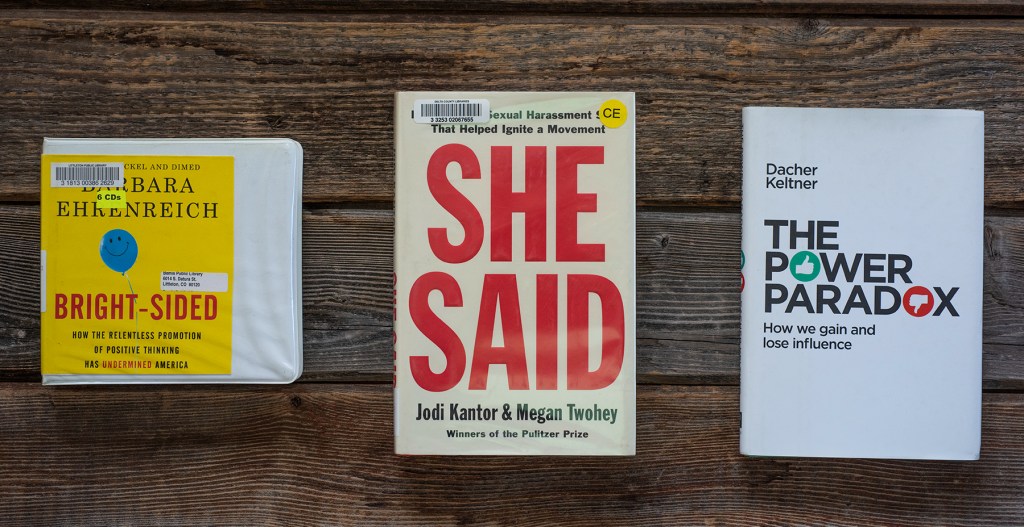
Bright-Sided: How the Relentless Promotion of Positive Thinking Has Undermined America by Barbara Ehrenreich
Barbara Ehrenreich was one of the nation’s foremost writers on sociology before her recent death; she’s best known for Nickel and Dimed, a highly controversial and deeply problematic first-person account of trying to survive on low-wage work. Bright-Sided was mostly overlooked, but I think it’s far more relevant since it focuses on our obsession with positive thinking, and how that actually undermines and harms us.
An NPR review sums this up rather neatly:
“Militarily, yes, we are the mightiest nation on earth. But on many other fronts, the American score is dismal, and was dismal even before the economic downturn that began in 2007. Our children routinely turn out to be more ignorant of basic subjects like math and geography than their counterparts in other industrialized nations. They are also more likely to die in infancy or grow up in poverty. Almost everyone acknowledges that our health care system is “broken” and our physical infrastructure crumbling. We have lost so much of our edge in science and technology that American companies have even begun to outsource their research and development efforts. Worse, some of the measures by which we do lead the world should inspire embarrassment rather than pride: We have the highest percentage of our population incarcerated, and the greatest level of inequality in wealth and income. We are plagued by gun violence and racked by personal debt. And Americans account for two-thirds of the global market for antidepressants, which happen also to be the most commonly prescribed drugs in the United States.”
Clearly, all that positivity isn’t doing us much good. Ehrenreich’s book sharply skewers all this positive thinking rubbish, and makes a solid case that it isn’t helping us thrive. And since the book was written prior to 2016 and all that followed after, one only wonders what Ehrenreich might have thought of the morass we find ourselves currently trapped in; thankfully, we’re starting to collectively address the concept of “toxic positivity.” A strong book from a stellar observer of our deeply flawed society.
She Said by Jodi Kantor and Megan Twohey
She Said is far and away one of the absolute best investigative journalism books I’ve ever read; it follows New York Times journalists Jodi Kantor and Megan Twohey as they break the Harvey Weinstein story. Ronan Farrow’s Catch and Kill, which covers much of the same sordid mess, was released prior to this and I thought that book was also excellent, but I do wish I’d read She Said first because it’s simply better. There isn’t much more to write about this work that hasn’t been written, but among other accomplishments, She Said shows why good journalism is more important than ever in this fractured age of disinformation and misinformation. Freedom of the press matters in a stable democracy, and books like She Said succinctly show why. A must-read.
The Power Paradox by Dacher Kelter
“The power paradox is this: We gain power and the capacity for influence through social practices that advance the interests of others, such as empathy, collaboration, open mindedness, fairness, and generosity. And yet, once we gain power, success, or wealth, those very practices vanish, leaving us vulnerable to impulsive, self-serving actions and empathy deficits that set in motion our fall.” This is another social psychology book that reads differently now than when it was first published in early 2016; it is rather an understatement to say that the world is a very changed place. Ultimately, though, the book makes the salient point that we humans gain power through what is best about human nature and then lose it through what is worst. One only has to look at recent headlines – Trump, Musk, Bankman-Fried – to know just how accurate this research is. The Power Paradox is not a particularly stellar book in and of itself, but it will force the reader to examine the way that power structure within any human interaction, from the barista to a partner to a colleague – shifts and evolves. This a definitely a book that changes one’s perspective.
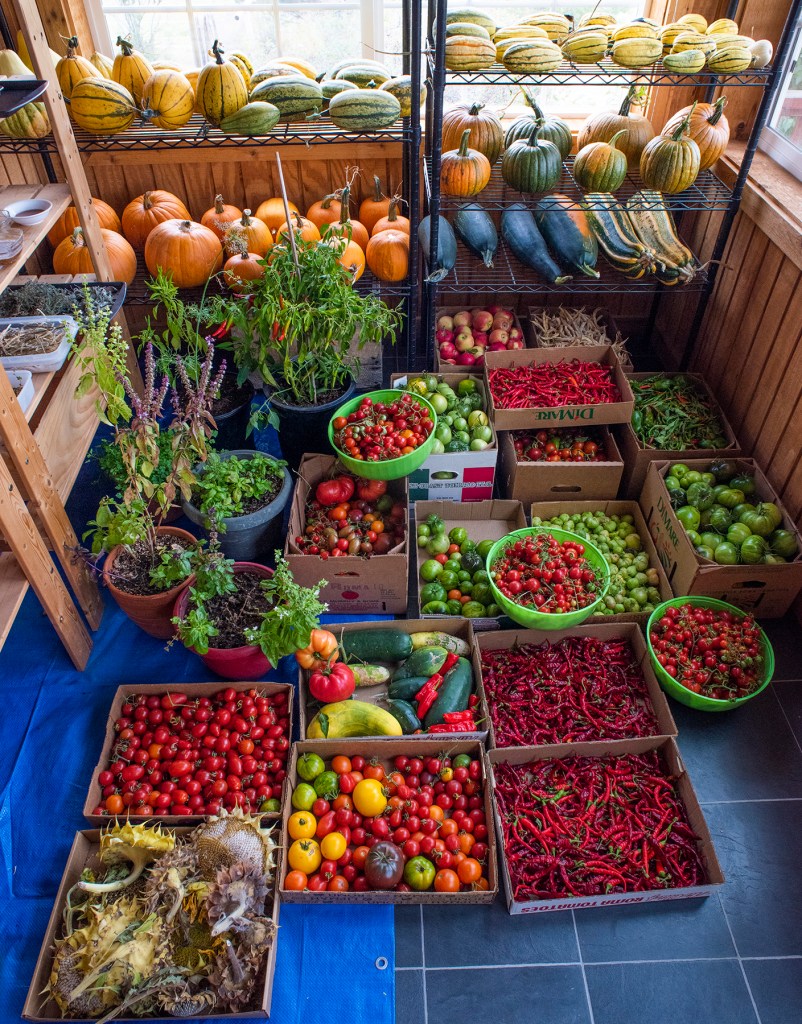
It’s surprisingly cold now, in late November, although dry and clear. As always, we’d love for some of the snow blanketing other parts of the country (hello, six feet in Buffalo!) to bestow its generosity upon us here, but nothing shows in the forecast as yet. Days are crisp and blue, and nights definitely require extra quilts. The sunroom is still full of cardboard trays of slowly ripening tomatoes and peppers; this unheated room works perfectly for cold storage and allows these vegetables to ripen slowly with sunlight but without so much warmth that they’d rot. Certainly something is sacrificed in terms of flavor when crops aren’t allowed to ripen outside, but we have a reasonably short growing season here so we have to work with what we have – and it’s a lovely treat to enjoy our own fresh tomato salads well into winter.
Those cardboard trays are slowly transforming into rustic, delicate ristras and canning jars of salsa and sauce; seeds are mostly dried and packed away. The winter squash bounty hasn’t been tapped into yet; that will carry us through the coldest months and into fragile spring with warming soups and curries. New planting rows for next year have been plowed and filled with compost. The plants we pulled out have been mowed into bits to break down into compost over winter; the beds have been mulched with spent straw and next year’s garlic has been planted. In all ways, our season is gradually winding down and we’re more than ready to tuck ourselves in for a couple of months of much-needed rest.
We’re still reviewing our season, cataloguing our successes and noting what changes and improvements we plan to make for next year. This year certainly had its challenges, but it definitely offered wins, too! Read on for more about the 2022 growing season.
Hello and what’s new in your world? Here at Quiet Farm we very much wish that winter would appear already. We haven’t had even a dusting of snow since that frost back in October, and it’s barely cold enough to freeze the animals’ water or kill off all the aphids on the kale. Far too warm for late November – but don’t you worry, our trusty politicians are taking care of that pesky climate collapse issue even as we speak.
Our fall harvest has all been successfully preserved; the last of the ripe tomatoes went into the sauce pot yesterday. Chiles are drying in the sunroom, ready to be pulverized into chile powder; pumpkins and squash are neatly stacked on shelves; apples and onions remain in cold storage in our insulated woodworking shed. We are stocked and ready, and we invite Serious Winter to show up immediately if not sooner.
Here are a few more things we’ve been up to recently, if you’d like to see:
Bright, tart pomegranate seeds make these amazing waffles even better.
Obviously we’ve discussedthe waffles previously, but yet here we are again. I made a fresh batch last weekend and since holiday brunches and family gatherings and all sorts of festivities are lurking just around the corner, I must evangelize the waffles once more. Please, dear friends, if you do not make one other thing from scratch this holiday season, please make these waffles. I know this level of devotion to a seemingly innocuous breakfast food seems a bit over the top, but trust me – these are the best waffles ever, and you can stop Googling ‘best waffle recipe.’ Plus they’re very easy to make, and they freeze beautifully – you can just have fabulous homemade toaster waffles any time you like, and you can also stop buying expensive processed frozen waffles with mysterious ingredients! The recipe hails from Fannie Farmer by way of Marion Cunningham’s brilliant The Breakfast Book, which I highly recommend. (But seriously, go make these waffles. Do it now.)
Hot sauce doesn’t have to be just painfully ‘hot.’
Making hot sauce is always part of our farm preservation work each year. Although I’ve experimented with lots of different types of hot sauces, for the moment I’m keeping it simple – one fiery-sweet red version, very loosely based on Sriracha and this Melissa Clark recipe, and one fermented serrano version, a rough knock-off of green Tabasco. The red hot sauce is definitely milder, with a gentle undertone of sweetness from the red bell peppers, while the green is a tangier, sharper vinegar-based sauce, used more sparingly. As a personal rule, I don’t love aggressive, punch-in-the-face hot sauces; I want a bit of heat but would still like to taste whatever I’m eating. Hot sauce is simple and inexpensive to make at home, keeps indefinitely and is a thoughtful consumable gift for anyone on your list who likes things spicy. (P.S. If you buy classic Sriracha, save, wash and reuse the iconic squeeze bottles for your own homemade hot sauce.)
Small part. Big impact.
I don’t in any way fancy myself an influencer, but if I can influence you to NEVER, EVER buy GE appliances, please allow me to do so. We have a full suite of GE appliances in our kitchen – all of which came with the house – and every single one has failed at least once. Most recently we found ourselves without a functioning oven, which is quite challenging for someone who bakes on a more or less daily basis. Some investigation and a few helpful YouTube tutorials later, we ordered a new igniter. (Of course, I foolishly ordered the first igniter from GE and it arrived pre-broken, thanks to their careless packing. The second igniter, from an entirely different company, arrived in perfect condition, but obviously it was now two weeks later. Thanks again, GE. You’re tops.) We successfully installed the new igniter – a five-minute job, though gaining access to the compartment and putting everything back together neatly made it more like an afternoon – and lo and behold, we thankfully once again have a working oven. As always, successfully learning to repair things ourselves goes a long way towards our goal of self-sufficiency.
Crispy, salty, savory and delicious hot or at room temperature – galettes are winners.
And of course with a working oven, we can once again make delicious meals like galettes! Like the waffles above, we’ve extolled the virtues of galettes previously – they can be sweet or savory, hot or cold, made in advance or pulled fresh from the oven – and they lend themselves well to using up whatever odd bits and ends you might have on hand. They’re also beginner-friendly, if you’re intimidated by all the perfect pies you’re seeing right now; galettes are designed to be “artisanal” and “rustic” which – fun fact! – are both Latin for “messy” and “imperfect.” This time of year our galettes are most likely to have fall flavors, like delicata squash, caramelized onion, peppery goat cheese, sage and rosemary – but honestly, you can put pretty much anything you want in one. If you’ve got a couple rounds of pastry dough in the freezer you’re halfway there; galettes are easy to prep for holiday gatherings and perfect as a vegetarian main dish or as a simple, impressive dessert.
Available now as an NFT: “Untitled: Llama and Alpacas at Rest, 2021”
And finally, it’s always nice to observe our camelid herd lounging peacefully in the pasture; if they’re at rest, it means they’re getting plenty to eat. We’re regularly challenged by this rebellious bunch of feral miscreants, but they add a certain flair to Quiet Farm, and we’re glad to have them here.
Wishing you all the best during a tough time of year, dear friends.
And in the space of a few days, our season went from lush abundance to a frozen wasteland. Such is the nature of growing food at over six thousand feet in a high-plains desert.
Our first hard frost arrived this past week, and with it a few light dustings of early snow. Up on the mesa we were thrilled to see a solid fifteen inches show up on the Sno-Tel! All of our irrigation water, of course, comes directly from the mesa, so we are always in favor of as much winter moisture as possible to boost next year’s irrigation allotment.
Our sunroom looks like an unusual farmers’ market!
Temperatures dropped into the high 20s overnight, which is far too cold for summer crops like tomatoes, cucumbers and peppers. (Don’t worry, the kale is fine. The kale is always fine.) Prior to the freeze we harvested everything we could – nearly four hundred pounds on Monday alone; now comes the task of preserving all of that food to enjoy through winter and spring. The cruel irony, of course, is that once the storm passed we quickly returned to bright bluebird skies and comfortable daytime temperatures in the mid-60s, which likely means we would have gotten at least another two or three weeks in the growing season. But when a hard freeze announces that you’re done, then you’re done – and there’s not much arguing.
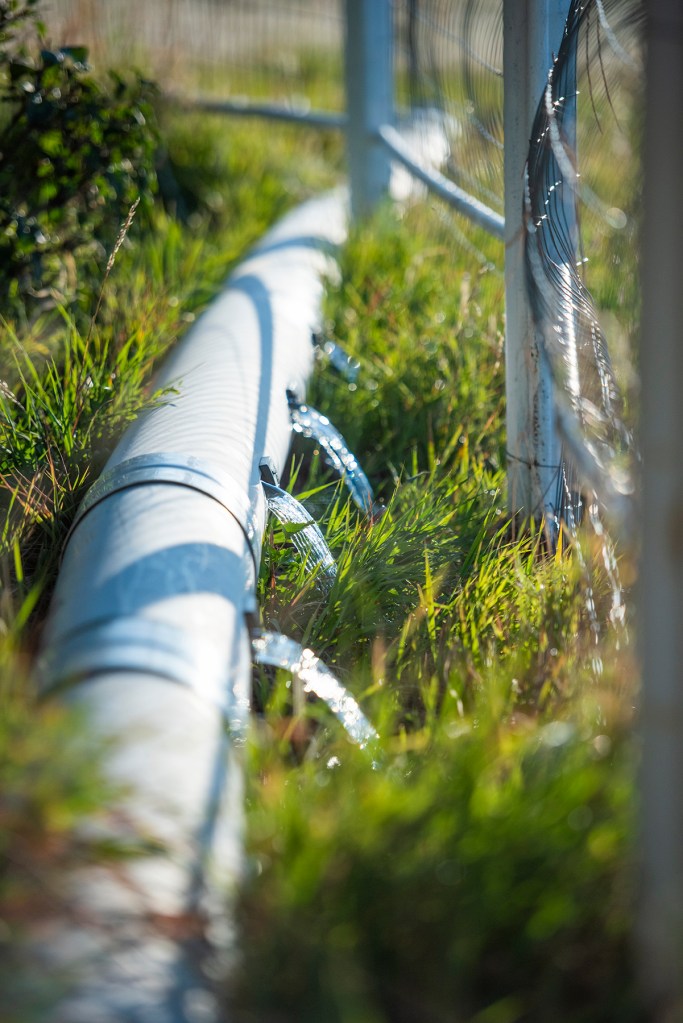
One of our gated pipes with the season’s final run.
Our irrigation season runs through the end of October, but we balanced our account this year to fortuitously end just before the cold snap arrived. Running irrigation later in the season is already a chilly task; combine that with a hard freeze and it can be downright miserable. We were very pleased with how we managed our irrigation in a drought year and though of course we hope for higher water shares next year, we know that with smart planning we can make even a low allotment work for our land. It’s incredible how much we’ve learned in only three short years here.
A friend’s trial orchard, where new apple varieties are tested.
Prior to the hard freeze we’d picked nearly two hundred pounds of local apples for winter storage. One box has already been transformed into applesauce; the remainder will stay reasonably fresh in one of our insulated but unheated sheds. This delicious fruit will provide snacks all throughout the winter; I’ll also bake with the apples as well as dehydrate a few pounds for adding to granola. As always, the bounty of incredible local fruit is one of the greatest benefits of living where we do.
Adelaide, Paris, Paihia and Fiji contemplating the change in seasons.
Although the damp, freezing weather makes the corral a bit of a sloppy mess, the animals are entirely unfazed by the cooler weather. They’ve put on quite a bit of fleece since their shearing, so they’re ready for winter, too.
And with that, we’re off to sort produce for canning. Wishing you a calm and peaceful week, friends.
Hello there, and welcome to March. (March?!? Really? We are completely not prepared for all of our spring tasks yet.)Also, welcome to the nearly one-year anniversary of the pandemic lockdowns. A year of this madness. How is everyone doing out there? The “pandemic wall” is a real thing, make no mistake, and I think a lot of us have hit it. Hard.
The images in this post might convince you that we’re buried in snow over here at Quiet Farm; sadly, that is not at all true. We have gotten a bit of snow both here and up on the mesa, and of course we’re grateful for every last flake, but it’s still looking as though it’s going to be a painfully dry year. As always, the only thing within our control is how we use the water we do have, so we’ll be focusing our efforts on making sure that not a drop goes to waste.
Paris secured in our makeshift crush before the vet’s arrival.
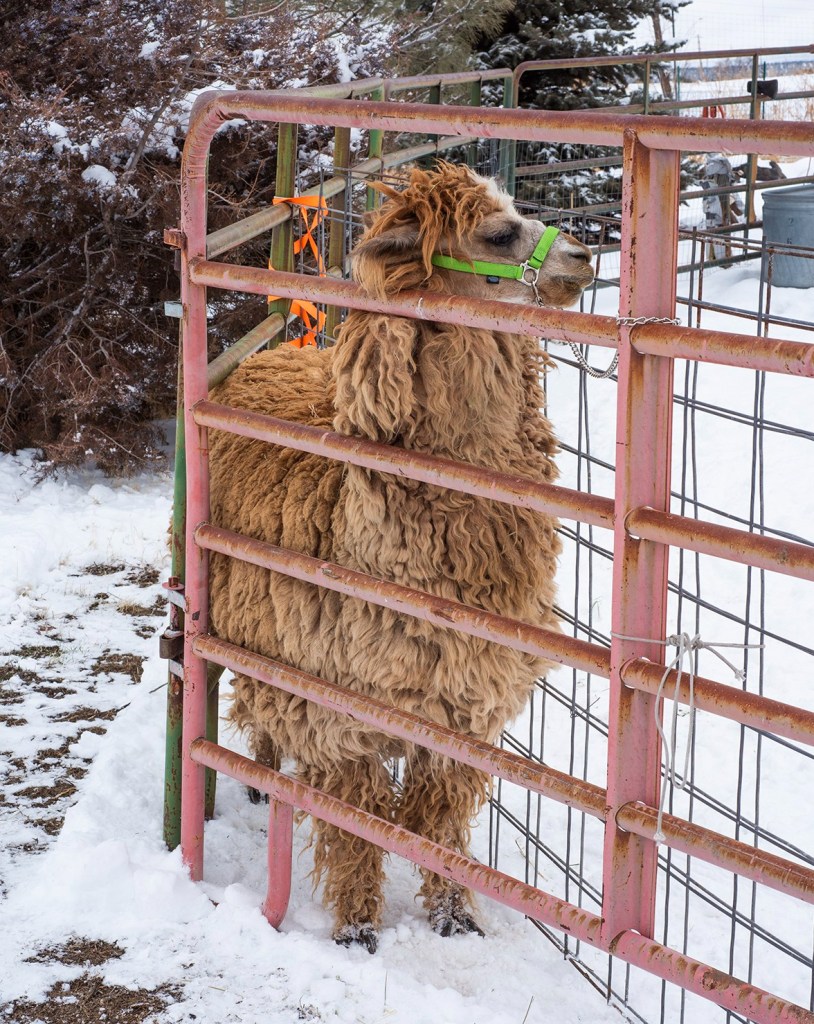
One great accomplishment that we’ve had recently is to successfully geld one of our male alpacas, Paris. His behavior had become increasingly aggressive and since we are not running a breeding program, there is no reason to keep an intact male on the farm. We were able to safely secure him in a “crush,” and our terrific local vet took care of the rest. It takes about sixty days for all the testosterone to leave his system, but his aggressive behavior has definitely lessened since the fateful day. We’re also pleased to announce that we’re on the mobile shearing schedule for the spring, so the alpacas will be getting a tidy cut in late May or early June, which will make them much more comfortable this summer. We are working on halter-training all the animals so that we can handle them in a safe and calm manner – this is much easier said than done, and frequently both humans and alpacas stomp off in frustration and tears. (Okay, maybe not the alpacas. Definitely the humans.)
Our game fence is good for more than just keeping out deer!
I’m also proud to announce that I’ve finished a patchwork quilt I started late last year. I won’t lie: I made approximately ten million mistakes on this quilt and learned so much about what not to do in quilting. I also unknowingly caused a lot of my own problems by designing a somewhat complicated pattern that required an excessive amount of piecework and stop/start stitching. (It’s only my fourth full-size quilt, however, so perhaps I should cut myself a bit of slack. I am very much a novice.) I read an article recently about different crafting hobbies people had taken up during the pandemic; one woman tackled a complicated shawl using fairly advanced knitting techniques. She wrote, “I almost quit a lot of times. But I kept at it, and I was both miserable and joyful at times – it was a good emotional process for me. The challenge was a great distraction from the chaos and stress of the unknown.” That accurately sums up my feelings about making this quilt – and I’m already excited about starting my next one.
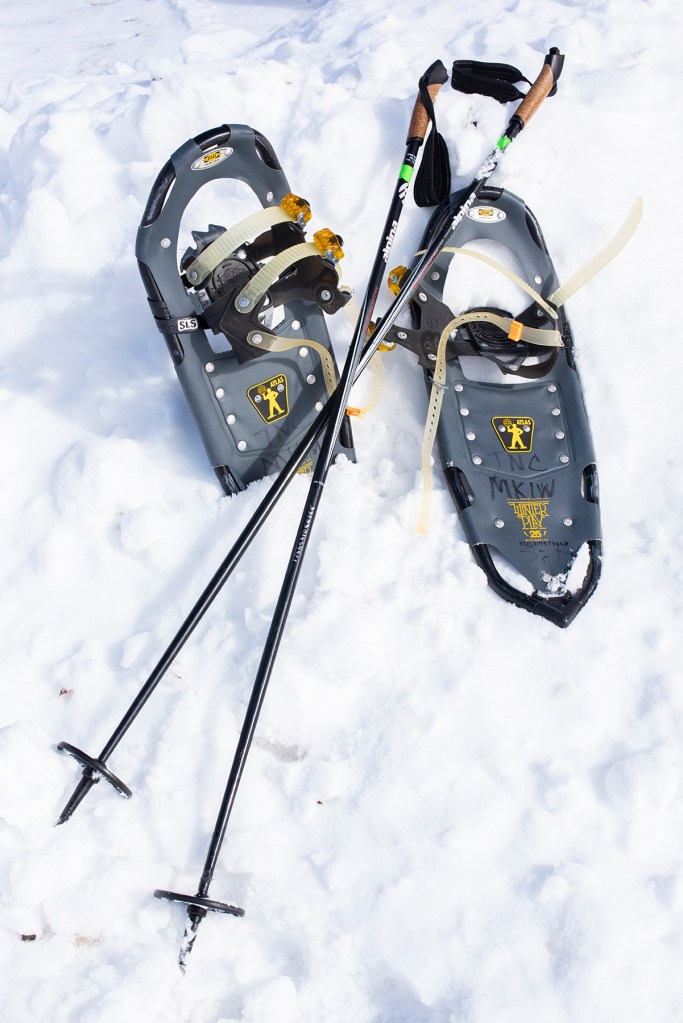
Snowshoeing is a surprisingly challenging workout!
We’ve mentioned on more than one occasion how much we adore our local library system; to make us love them even more, they’ve started loaning snowshoeing equipment! We’re about twenty minutes’ away from some of the best snowshoe/cross-country trails in the West, and borrowing equipment and just running up the mountain for a couple of hours has been a terrific break. (Even better: many of the trails ban loud, obnoxious snowmobiles.) We’re hopeful that we’ll be able to go a few more times before the demands of spring on the farm limit our time away.
This is an ideal afternoon snackwith a strong cup of PG Tips.
There’s been more comfort baking than usual ’round these parts lately. One favorite is a long-ago classic that I’ve resurrected because for once I have a massive bag of spelt flour andplenty of fresh rosemary on hand: this rosemary-chocolate olive oil cake, originally from Kim Boyce’s Good to the Grain. This may not be to everyone’s liking – rosemary isn’t frequently used in desserts – but I love it and don’t find the piney herb flavor overwhelming at all. The cake is tender, delicate and not too sweet, and is a perfect afternoon pick-me-up. I highly recommend a good-quality 70% dark chocolate bar here, cut into rough chunks, plus a generous sprinkling of turbinado sugar on top for extra crunch and texture. (For high-altitude bakers: I reduced the baking powder to 1 tsp. but didn’t make any other changes.) As with most things I bake, more than half of this cake promptly went straight into the freezer as a gift to my future self.
Stay calm and stay sane out there, dear friends. The best thing we can do is just to keep going.









 Finding Quiet Farm